AI-Moderated Interviews: How They Work & Where They Fail
AI-moderated interviews trade depth for speed. Compare when AI works for screening and volume, when humans matter, and why the best teams blend both.

Key Takeaways:
- AI moderation excels at scale, not depth: It's fast and consistent for screening, volume testing, and standardized surveys, but it can't sense hesitation, contradictions, or when to follow an unexpected thread.
- AI amplifies bias instead of catching it: Respondents anchor, agree, and self-censor more with AI systems, and data risks homogenizing as more people answer through their own AI tools.
- Humans catch what AI misses: Sarcasm, context, saturation, and the moment a conversation reveals something you didn't know to ask about all require human judgment.
- The best approach combines both: Use AI for screening, volume, and transcription; reserve human moderators for exploratory research, sensitive topics, and interpreting what the data actually means.
AI-moderated interviews sound like the future. Faster results. Lower costs. No scheduling headaches. Just you, the respondent, and an intelligent system asking the right follow-up questions in real time.
The reality is messier. AI moderation can unlock genuine speed and reach, but it also introduces blind spots that human moderators catch naturally. Respondents game the system. AI misses nuance. Data becomes homogenized. And the interviews that seem efficient often hide deeper problems.
If you're considering AI moderation for your research, you need to understand where it genuinely shines, and where it will let you down.
What AI-moderated interviews actually do
An AI-moderated interview is a research conversation guided by an artificial intelligence system rather than a human. The AI asks your core questions, listens for patterns, generates follow-ups, and records responses. Some systems probe deeper when answers seem incomplete. Others adapt the conversation flow based on earlier replies.
The appeal is clear: AI adoption in market research has climbed quickly over the past two years, with many teams now using it for at least part of their workflow. Tools exist for everything from simple screening interviews to complex user research sessions. The promise is speed without sacrifice.
But what AI actually does in these moments is more constrained than the marketing suggests. It follows patterns and responds to keywords. But it can't truly understand context the way a person interviewing their 50th respondent can, because a person learns from their first 49 interviews. Each respondent teaches the moderator something that informs how they listen to the next person. AI systems don't accumulate wisdom this way; they execute the same algorithm whether it's interview one or interview 500.

Where AI moderation works well
AI moderation shines in specific, bounded scenarios where efficiency matters more than depth.
Screening and qualifying respondents is one of them. If you need to rapidly identify whether someone fits your research criteria—age, purchase history, product familiarity—AI can ask standardized screening questions and route respondents into the right bucket. It's fast, consistent, and doesn't require a human to repeat the same questions 200 times. The AI executes these questions with perfect uniformity, ensuring no respondent gets an advantage or disadvantage based on moderator mood or fatigue.
Volume testing is another. When you're running a broad poll or collecting initial reactions to many variations of something (headlines, messaging, product concepts), AI can expand the conversation across hundreds of respondents without the cost of hiring moderators. You get breadth over depth. This is particularly valuable when your primary goal is statistical comparison rather than understanding the reasoning behind preferences.
Scheduling and logistics benefit from AI, too. Automated systems don't forget to send reminders, reschedule cancellations, or ask respondents to verify they're ready to start. This alone saves hours of coordination work. AI systems manage calendars, handle time zone conversions, and send follow-up messages without the human error that creeps in when someone manages dozens of scheduling threads simultaneously.
Real-time sentiment sampling works in AI's favor as well. If you want to know how an audience is reacting to something right now—a live event, a news story, a product launch—an AI system can ask rapid-fire questions and aggregate mood data before human moderators could even finish their coffee. The speed of deployment means you can capture authentic reactions before people have time to overthink their responses.
Standardized questionnaires and surveys also fit squarely within AI moderation's wheelhouse. When every respondent needs to answer identical questions in identical order (often a requirement for statistical validity), an AI system ensures zero deviation. This consistency is actually a strength when you're building quantitative datasets that demand uniformity.
These are the moments when AI moderation delivers what it promises: speed, reach, and consistency.
The human moderator advantage
But the moment your research needs depth, context, or the ability to follow intuition, a human moderator becomes irreplaceable.
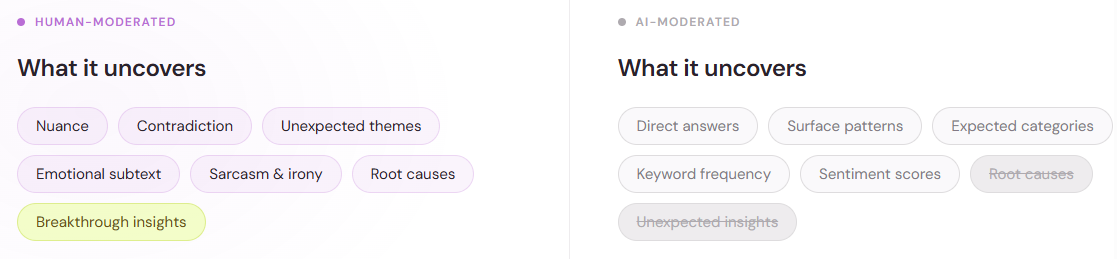
A human moderator can hear hesitation in a respondent's voice and slow down. They can sense when an answer is surface-level and probe authentically. They pick up on contradictions ("You said you love the feature, but you also said you'd never pay for it") and dig into them without sounding robotic. They know when to ask an entirely different question because the research is pointing somewhere unexpected. This adaptive capability emerges not from programming but from experience, from having conducted dozens or hundreds of interviews and recognizing the patterns that matter.
An experienced moderator also builds rapport. Respondents relax. They say more honest things. They reveal underlying motivations that wouldn't surface in a scripted exchange. This psychological shift is real: people share differently with humans than with systems. They interpret silence differently. They respond to empathy. A moderator who says, "I hear you," and pauses creates space for deeper reflection that an AI's predetermined timing structure simply cannot replicate.
AI doesn't do any of this naturally. It follows decision trees. It responds to triggers. It lacks the judgment to say, "Wait, let me ask that differently." It cannot make the intuitive leaps that humans make: the sudden realization that a respondent's frustration about Feature A is actually rooted in a Problem B they haven't named yet.
Where AI moderation fails
The failures fall into several categories, and understanding them is essential before you commit to an AI-moderated approach.
Data homogenization is the first major risk. When 34% of survey respondents are already using LLMs to help answer open-ended questions, the data you collect becomes less authentic. Respondents—intentionally or not—are filtering their answers through another AI. You're not capturing what people actually think; you're capturing what they think an AI would approve of. Your data starts to sound the same because it's been laundered through the same models. The richness and diversity of human expression gets smoothed into patterns that multiple language models recognize as "acceptable" responses. Unique insights disappear. Outlier opinions vanish. What remains is data that reflects the biases of multiple AI systems, not the genuine thinking of your respondents.
Anchoring effects distort responses in ways AI moderators can't catch. Tversky and Kahneman's foundational research (1974) demonstrated that the order in which information is presented dramatically shifts how people interpret it. When asked to estimate the product of a multiplication equation, the median responses were more than four times higher when presented in descending order (8x7x6x5x4x3x2x1) than in ascending order (the reverse). A human moderator notices when a respondent seems anchored and can reframe. An AI system doesn't recognize the bias; it just records the answer. This means your findings may reflect the order of your questions more than respondent preferences.
Acquiescence bias (the tendency to agree with statements regardless of content) and social desirability bias (overreporting good behavior, underreporting bad behavior) run rampant in any interview setting, but AI moderation amplifies them. Respondents tend to be more agreeable with systems they perceive as formal or institutional. They're more likely to give "correct" answers to an AI than to a human who might understand their real motivations. This dynamic is especially strong in B2B research, where respondents worry about how their answers might be interpreted by unknown systems.
Missing the thread of saturation. Qualitative research reaches near saturation (90% of codes) at 15–23 interviews, with full saturation requiring 30–67 interviews, depending on complexity. But saturation is more than a number; it's a lived understanding that comes from analyzing interviews as you go. A human moderator doing this work feels when they've stopped learning new things. An AI system running 200 automated interviews has no sense of whether it's reached saturation or is just collecting redundant data. You might run twice as many interviews as necessary, inflating costs and diluting insights without realizing it.
Failing to follow unexpected paths. Research often reveals things you didn't expect to ask about. A respondent mentions a competitor you'd never heard of. A pain point emerges that changes the shape of your research. A human moderator pivots and explores. An AI system has no mechanism to recognize importance and adjust. It continues on its predetermined path, and you miss the insight. These unexpected discoveries often become the most valuable findings from qualitative research.
Misinterpreting context. AI reads words but not context. A respondent might say, "Yeah, that's great," but mean the opposite sarcastically. A human moderator catches the tone and adjusts. An AI logs the positive sentiment and moves on. Sarcasm, irony, cultural nuance, and generational speech patterns all trip up AI systems that lack the contextual knowledge to interpret human communication accurately.
The middle ground: Human-led, AI-augmented research
The most sophisticated research teams aren't choosing between AI and humans. They're using AI to handle what it does well and reserving human judgment for what matters.
This might look like:
AI screening with human depth interviews. Use AI to rapidly filter a large pool of potential respondents down to qualified candidates. Then hand those candidates off to human moderators for the substantive, exploratory conversation. This hybrid approach gives you both efficiency and depth.
AI for volume, humans for insight. Run AI moderation for broad, initial reactions and sentiment. Use those findings to inform which topics deserve deeper human-moderated exploration. Let AI reveal patterns in high volume, then have humans investigate why those patterns exist.
AI transcription and tagging, human analysis. Let AI handle the mechanical work: recording, transcribing, initial coding of themes. Then have a human researcher interpret what those codes actually mean in the context of your research goals. This frees human expertise for analytical work rather than data management.
Hybrid sessions. Some research tools now support both moderated and unmoderated approaches. You might use AI for the opening screening, then transition to a human moderator for the detailed conversation, or use AI to surface insights from session recordings after a human-led session.
The key is being honest about what each method can do. AI excels at reach, speed, and consistency. Humans excel at understanding, judgment, and adaptation. The best research uses both.

Questions to ask before choosing AI moderation
If you're evaluating whether to use AI-moderated interviews for your next project, start with these questions:
Do you already know what you're looking for? If your research is confirmatory (validating an existing hypothesis), AI moderation can work. If it's exploratory (discovering new patterns), you need a human moderator who can follow unexpected threads.
Does your topic invite bias? Sensitive subjects—health, finances, personal behavior—trigger social desirability bias worse in AI-moderated settings. Stick with human moderation.
What's your volume requirement? If you need insights from 10 to 20 respondents, the cost of hiring a moderator is negligible compared to the quality loss of AI. If you need 500, AI moderation starts to make financial sense.
How nuanced is the feedback you need? Simple preference testing or screening? AI can handle it. Understanding why people feel the way they do? Bring in a human.
Are you training on your own data? If you're planning to use AI moderation across many studies, audit your training data for quality and bias. Garbage training data produces garbage interviews.
The honest take
AI-moderated interviews aren't bad, but they’re not universally good either. They're a tool for specific jobs: scaling screening, running volume tests, cutting coordination costs. But they're a poor substitute for human understanding, judgment, and the ability to follow where research actually leads.
The researchers getting the best results aren't replacing humans with AI. They're using AI to handle drudgery so humans can do what humans do best: listen, interpret, and discover.

Liked that? Check these out:
Opinions and Expertise
What’s actually slowing research teams down (Hint: it’s not the research)
From recruiting participants and scheduling interviews to building the actual surveys, the operational drag is taking researchers away from what they do best. See what's actually slowing them down and how Research Flow fixes it.
Read more