Brand research: Methods, examples, and where to start
Learn how to run brand research with practical methods, examples, and a simple plan to understand your audience and make better brand decisions.
Your team thinks your brand feels approachable. Your customers describe it as “professional, but a little confusing.”
The gap is where brand research comes in.
Key takeaways
- Brand research replaces assumptions with evidence: Learn whether people recognize your brand, what they associate with it, and why they might choose you.
- Match the method to your question: Surveys reveal patterns, interviews explain experiences, and message testing checks whether your ideas communicate what you intend.
- Look beyond your biggest fans: Include prospective customers, former customers, and people who chose another option to understand different perspectives.
- Keep every question purposeful: Focus on the decision you need to make, use neutral wording, and remove questions that won’t help you act.
- Turn findings into specific changes: Use what you learn to refine your messaging, test a new direction, or improve the customer experience.
You can spend weeks debating a tagline or refreshing your visual identity. But until you ask people what they recognize, believe, and expect from your brand, you’re working with assumptions.
Brand research replaces those assumptions with evidence. You learn what’s landing, what’s getting lost, and what might convince someone to choose you.
And you don’t need a huge research budget to get started. You need a clear question, the right people, and a plan for using what you learn.
What is brand research?
Brand research is the process of gathering and analyzing information about how people experience your brand. It explores whether they know you, what they associate with you, how much they trust you, and why they might choose you over another option.
It answers questions like:
- Do people remember our brand when they need something we offer?
- Does our message mean what we think it means?
- What makes us different in customers’ eyes?
- Where does our brand promise fall short of the actual experience?
Brand research sits within the broader world of market research, which explores customers, competitors, and demand. Brand research focuses specifically on your brand’s place in that picture.
It’s useful before a launch or rebrand, but it also helps with everyday decisions: what your homepage should say, which customer stories to share, or why an audience isn’t responding.
What should brand research measure?
Start with the part of your brand you need to understand. Each of these measures answers a different question.
Brand awareness: Do people know you exist? Unaided recall asks people to name brands without suggestions. Aided awareness asks whether they recognize a name from a list.
Brand perception: What do people associate with you? You might want to be seen as simple, reliable, or creative. Research checks whether those associations actually show up.
Brand positioning: Where do you sit compared with alternatives? People might see you as the easiest option, the premium choice, or the brand for beginners.
Brand trust: Do people believe your promises? Ask what builds confidence and what creates hesitation.
Trust deserves extra attention. In Edelman’s 2025 Trust Barometer Special Report on brand trust, 80% of people across 15 markets said they trust the brands they use (based on online interviews conducted in April and May 2025). That finding covers brands people already buy. Your own research can show what earns that trust in your category, and what stops it from forming.

Five brand research methods and when to use them
Different methods show you different parts of the picture. Choose based on your question.
1. Brand surveys: Find the patterns
Surveys let you ask a consistent set of questions across an audience. They’re useful for comparing awareness, associations, consideration, and perceptions between groups.
For example, an online learning business might compare what first-time visitors and existing students think its courses offer. Visitors might expect career credentials, while students value practical skills.
That difference can shape the homepage message.
Mix questions you can count with questions that let people explain themselves. “Which words describe this brand?” gives you a pattern. “What made you choose those words?” adds context.
Explore our brand awareness survey examples for more question ideas.
2. Customer interviews: Understand the reasons
Interviews give people room to tell you what happened in their own words. Instead of asking, “Do you like our brand?” try:
- “Tell me about the first time you came across us.”
- “What did you expect before buying?”
- “What nearly stopped you?”
- “How would you describe us to a friend?”
Listen for specific moments, surprising comparisons, and language your team wouldn’t naturally use.
Interview people with different experiences. Loyal customers can explain what works. Former customers and lost prospects can reveal expectations your brand hasn’t met.

3. Message and concept testing: Check understanding before launch
Testing lets you see how people interpret a tagline, homepage message, packaging concept, or campaign idea. Ask what they think the offer is, who it’s for, and what feels believable or unclear.
If you’re comparing options, keep the testing conditions consistent. Showing one message in a polished design and another as plain text makes the results harder to interpret.
Don’t stop at “Which do you like?” An attractive concept can still communicate the wrong thing.
4. Reviews and conversation analysis: Hear the unprompted feedback
Reviews, support conversations, community discussions, and sales notes all reveal how people talk about your brand when no one asks them a formal research question. Look for repeated expectations, frustrations, and comparisons.
Typeform’s Voice of the Customer guide offers a practical example of bringing feedback from multiple sources together.
Remember that visible comments only represent the people who chose to speak up. Use them to find themes worth investigating, then check those themes with a broader audience.
5. Desk research and competitor audits: Add context
Review category reports, public research, competitor messaging, and customer reviews of alternatives.
The Australian government’s guide to market research suggests starting with existing research before you gather your own. Desk research tells you where to aim it.
A competitor audit often shows that every brand in your category promises “simplicity.” Your audience research can then explore what simplicity means to buyers, and whether anyone actually delivers it.
How to start brand research
You don’t need to research everything at once. These 5 steps will help you gather answers you can act on.
Step 1: Pick a decision you need to make
“We want to understand our brand” is a huge assignment.
“We need to know whether our homepage explains who we help” gives you something concrete to investigate.
Write down the decision, the uncertainty behind it, and how different findings would change your next move. This keeps interesting but unnecessary questions from taking over.
Step 2: Choose the people who can answer
Your customer list is useful, but it won’t answer every question.
To study awareness, include relevant category buyers who may never have heard of you. To understand loyalty, speak with customers who’ve had time to experience your offer.
Separate audiences where it matters: customers and non-customers, for example, or new buyers and repeat buyers. An overall average can hide very different experiences.
Be clear about recruitment, too. A survey shared with newsletter subscribers describes those respondents. It doesn’t automatically represent your entire market.
Step 3: Keep the survey focused
Every question should help you make the decision you identified. Typeform data from 882 million form starts (September 2025 to August 2026) shows how completion rates change with the number of questions per form:
- 1 to 3 questions: 75.7%
- 4 to 6 questions: 67.7%
- 7 to 10 questions: 58.9%
- 11 or more questions: 54.0%
As you can see, the largest drop is between the 4-to-6 and 7-to-10 bands: 8.8 percentage points.
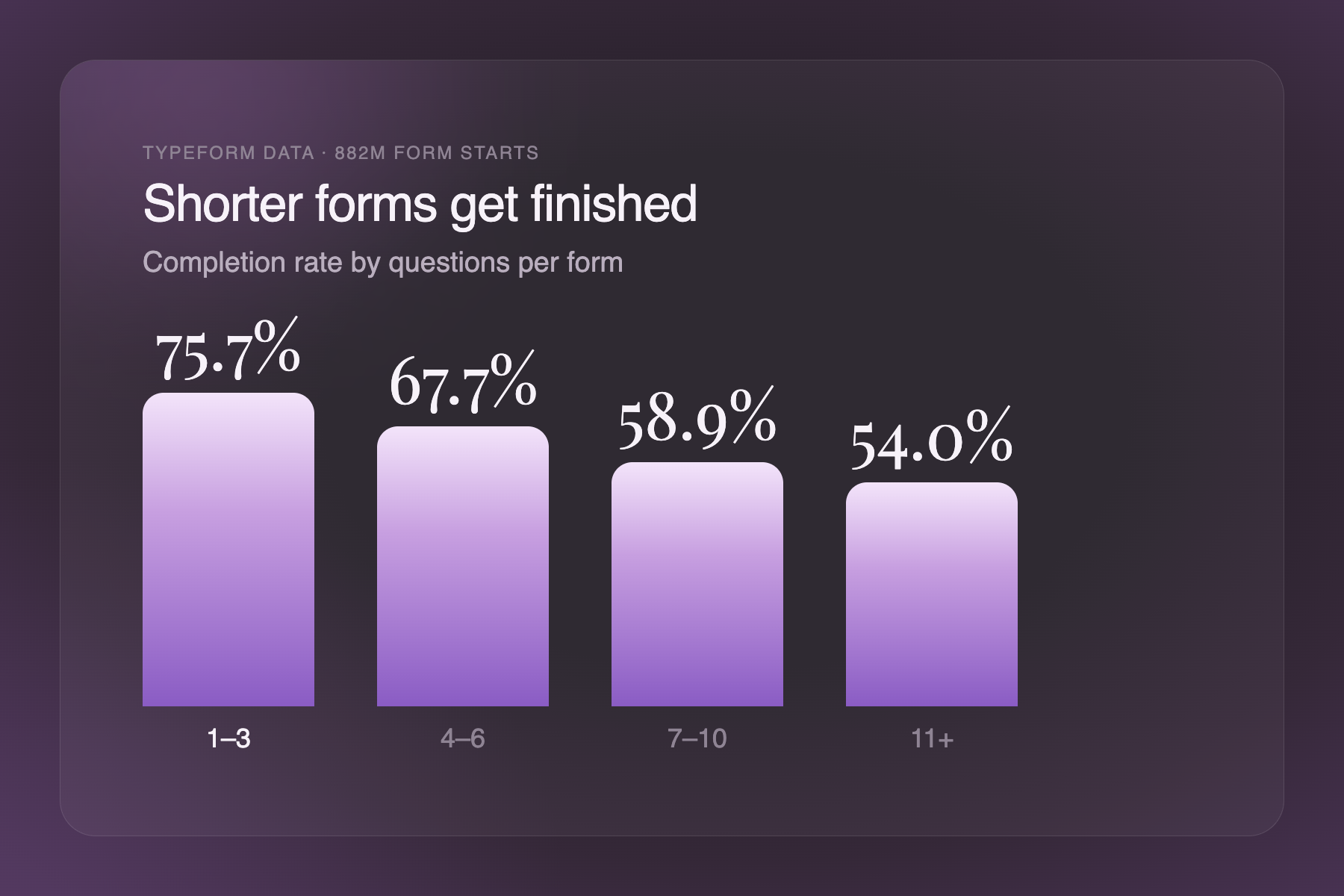
These rates cover all types of forms, not brand research surveys specifically. They don’t prove that removing questions will produce the same improvement in your survey. But they give you a good reason to challenge every “while we’re asking…” addition.
Completion here means submissions divided by form starts.
Start with essential questions, then use follow-up interviews when you need more depth. Our guide to creating a market research survey can help you plan the questionnaire.
Step 4: Ask without steering
“Why do you love our easy-to-use platform?” assumes someone loves it and finds it easy.
“What has your experience with the platform been like?” leaves room for an honest answer.
Pew Research Center’s guide to writing survey questions explains how wording and question order influence responses. For brand research, ask unaided recall questions before you show any brand names. Otherwise, you’ve already supplied the answer you’re trying to measure.
Include a “not familiar enough to say” option where it fits. Guesswork won’t help your brand strategy.
Step 5: Pilot, analyze, and act
Test the survey with a small group before you send it more widely. Ask what was confusing, which options were missing, and whether anything felt repetitive.
When responses arrive, compare the audience groups that matter and read the open answers alongside the numbers. Report how many people answered each question, especially when you compare small segments.
Then connect each finding to an action: revise a message, investigate a service issue, test a concept, or gather more evidence.
Brand research examples: Turning insights into action
These examples can show how brand research helps teams make practical decisions.
Example 1: A skincare brand tests positioning
A small skincare brand is preparing to refresh its website. The team thinks customers choose its products for their luxurious feel. But interviews suggest customers value something else: clear ingredient information and routines that are easy to follow.
The team uses a survey to see whether that theme holds across a wider customer group. Then it tests two headlines, one focused on luxury and another on straightforward skincare.
If the second message communicates the offer more clearly and feels relevant to customers, the team has a direction to test on its website.
Example 2: A software company measures brand awareness
A project management software company has spent a year sponsoring podcasts. Now the team wants to understand whether category buyers remember its name.
Before its next campaign, it surveys potential buyers, starting with “Which project management tools come to mind?” Then it shows a list of brands and asks which ones they recognize.
If people recognize the company’s name but rarely mention it unprompted, the brand is familiar without being top of mind. Repeating the survey with a comparable audience after the campaign can reveal changes, though it won’t prove the campaign alone caused them.
Example 3: A cleaning service compares taglines
A home cleaning company is choosing between “Spotless, every time” and “Your weekend back.”
The team randomly assigns prospects to see one tagline, keeping the design and supporting information consistent. It asks what they think the company offers, who the service is for, and what the message promises.
“Your weekend back” might sound more appealing while leaving some people unsure what’s being sold. “Spotless, every time” might communicate cleaning more clearly but raise questions about the guarantee.
Those responses help the team refine the wording before launch. The goal is a message people understand, find relevant, and believe.
Make brand research a habit
Your first project doesn’t have to answer everything.
Choose one decision, invite the people whose perspectives matter, and ask questions that leave room for surprise. Keep a record of what you learned and what changed because of it.
As your brand grows, repeat a consistent set of core measures with comparable audiences. That gives you a way to track progress while leaving space to explore new questions. Our brand awareness survey templates, which combine aided and unaided questions, are a great place to start.
Start with the assumption your team repeats most often. Find out whether your audience sees it the same way.