Customer journey mapping: step-by-step with template
Customer journey mapping turns assumptions into insights. Visualize touchpoints across all channels, identify pain points, and eliminate silos across teams.
Key Takeaways
- Map the journey to end the silo problem: Marketing, sales, and support each own a piece of the customer journey, but a shared map shows where handoffs fail and customers fall through the cracks.
- Research real customers, not assumptions: Combine interviews (the why) with behavioral data (the what) to find where confusion or friction actually happens.
- Build two to four personas, not more: More personas dilute focus and make the customer journey map harder to act on.
- Prioritize by impact, not by what's easiest to fix: A pain point affecting 80% of customers deserves urgent attention over one affecting just a handful.
Every customer takes a different path to becoming a loyal advocate, or else they abandon you entirely. The difference often comes down to whether you actually understand what that path looks like.
Customer journey mapping is the practice of visualizing every touchpoint where someone interacts with your brand, from the moment they first notice you to long after they've made a purchase. It turns vague assumptions about your customers into concrete, testable insights. When you map the journey, you stop guessing and start designing experiences that actually work.
This guide walks you through the entire process: why it matters, how to build a map from scratch, and how to use it to drive real business results.
What is customer journey mapping?
A customer journey map is a visual representation of every interaction a customer has with your brand across all channels and touchpoints. It typically shows the stages they move through, the emotions they experience, the pain points that frustrate them, and the moments where they're most engaged or most likely to quit.
Think of it as a detailed narrative. Instead of treating your customer base as a single group, a journey map acknowledges that different people experience your brand in different ways, and that the same person might experience it differently depending on their context. By recognizing these variations, you create a foundation for more personalized, responsive customer experiences.
A typical map includes:
- Stages – the major phases of interaction (awareness, consideration, purchase, onboarding, retention, advocacy)
- Touchpoints – every channel or moment where a customer contacts you (website visit, email, in-app notification, customer support call, social media, etc.)
- Emotions – how the customer feels at each stage, often represented visually
- Pain points – friction, confusion, delays, or unmet needs
- Opportunities – moments where a small improvement could drive disproportionate value
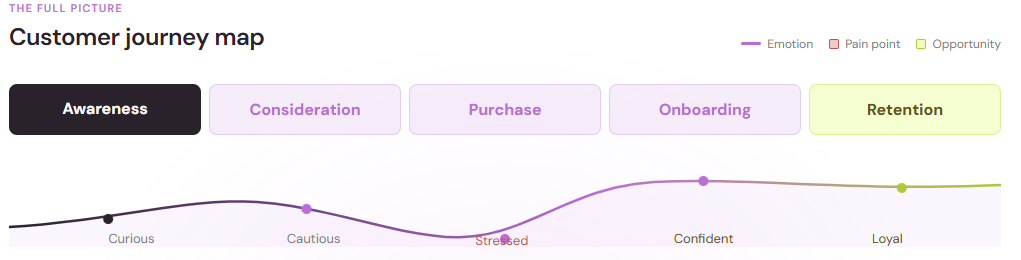
The visualization itself matters considerably. A well-designed customer journey map becomes a shared reference point that teams across your organization can use to align on strategy and execution. Rather than each department interpreting customer needs differently, everyone works from the same visual language and shared understanding of the customer experience. When marketing, sales, product, and support teams all reference the same map, decision-making becomes faster and more coherent. Instead of debating what the customer actually wants, you're looking at documented evidence from real customer interviews and behavioral data. This alignment extends beyond strategy discussions. It influences how you allocate budget, prioritize product development, and structure team responsibilities.
Why customer journey mapping matters
Without a map, your organization operates in silos. Marketing owns acquisition, sales owns conversion, and customer success owns retention, but nobody owns the customer's actual experience. Gaps form. Handoffs fail. Customers slip through cracks.
A shared map forces alignment. When your entire team can see the journey, suddenly it's obvious where communication breaks down, where expectations aren't met, or where you're asking customers to repeat information they already gave you. This alignment extends across departments: product teams understand what marketing promised, support teams know what the sales team committed to, and onboarding teams see exactly where customers struggle most. When a customer calls support frustrated because they don't understand how to use a feature, you can trace that frustration back to an onboarding gap or a confusing in-app experience. The journey map serves as a diagnostic tool for connecting cause and effect across departments.
Beyond internal alignment, mapping reveals something crucial: where your current approach is failing. You might discover that a large share of your customers drop off right after purchase because onboarding is confusing. Or that your most loyal customers skip your email channel entirely because they prefer in-app notifications. These insights don't live in your data. They emerge only when you connect the dots across the full journey. The customer journey mapping process itself becomes a discovery tool, uncovering patterns that spreadsheets and dashboards alone cannot surface. Your analytics might show that 30% of customers never complete the setup process, but only by talking to those customers and watching them attempt setup can you understand whether they're confused by jargon, frustrated by technical requirements, overwhelmed by too many options, or simply distracted by other work priorities.
Organizations that invest in customer journey mapping often report measurable improvements in retention and satisfaction. By identifying and addressing friction points systematically, companies reduce churn, increase product adoption, and create moments of delight that turn customers into advocates. These aren't theoretical benefits; they're direct outcomes of understanding the customer experience deeply enough to improve it deliberately. Companies that regularly conduct customer journey mapping exercises have seen 15-30% improvements in customer satisfaction scores within six months of implementing map-based improvements. They also experience reduced support ticket volume because they've eliminated confusion points, and stronger retention rates because they've designed the experience to feel supportive rather than frustrating at critical moments.

How to build a customer journey map: five steps
Step 1: Define your scope and objectives
Start by naming who you're mapping and why. Are you mapping the journey for new customers or long-term users? B2B buyers or direct consumers? Are you optimizing for conversion rate, customer satisfaction, or retention?
Scope matters because the same customer might have wildly different journeys depending on which segment you're analyzing. A designer discovering your product for the first time has a completely different journey than a design agency manager who's evaluating you as a team tool. The first might prioritize ease of use and quick wins, while the second cares about integration capabilities and team collaboration features. Mapping both simultaneously creates confusion and leads to recommendations that serve neither segment well. Mapping them separately yields actionable insights specific to each group's needs and concerns.
Write down your primary objective in one sentence: "We're mapping the first 90 days of a new customer's journey to identify why a quarter churns before their first paid renewal." That clarity keeps you from bloating the map with irrelevant details and ensures everyone involved has the same mission. A well-defined scope also helps you decide which research methods to prioritize and which touchpoints to emphasize in your final map. When you're clear about your goal, you can say no to tangential questions and stay focused on gathering the specific insights that will drive decision-making.
Step 2: Research your actual customers
Rather than mapping decisions based on assumptions and hope, talk to your customers.
Conduct interviews with a mix of people: those who've had great experiences, those who've had poor ones, and those somewhere in the middle. Ask them to walk you through their journey in their own words. What was their first interaction with your brand? What made them decide to try you? What almost made them leave? What moment made them feel confident they'd made the right choice? The best customer journey mapping conversations feel less like interviews and more like stories. You're asking customers to narrate their experience, and you're listening for the emotional turning points, the moments of confusion, and the unexpected delight.
Complement interviews with behavioral data. Where do users spend the most time in your product? Which emails do they open? Which pages do they revisit? Where do they hit obstacles and stop progressing? Analytics tools can show you the what; interviews show you the why. Together, they paint a complete picture. You might see that 60% of trial users never activate a critical feature, but without talking to them, you won't know whether they don't see the feature, don't understand how to use it, don't realize they need it, or consciously chose not to use it.
Surveys can help too, especially if you need feedback from a broader group. Open-ended questions work better than multiple-choice ones here because you're trying to understand narrative, not just tally votes. A question like "What was the most frustrating part of getting started?" yields much richer insights than "Did you find onboarding difficult? Yes/No." With surveys, you can reach dozens or hundreds of customers quickly, identifying patterns that might not emerge from a handful of interviews.
The output of this research should be a collection of real stories, quotes, and behavioral patterns. Those stories become the substance of your map. Instead of theoretical pain points, you have specific quotes from actual customers: "I spent 30 minutes trying to figure out which plan I needed." Instead of vague assumptions about emotions, you have documented moments where customers felt confused, excited, relieved, or frustrated. This grounding in real experience transforms customer journey mapping from speculation into evidence-based analysis.
Step 3: Build customer personas
A persona is a semi-fictional representation of a key customer segment. It's based on research but fills in details so you can think of real people instead of abstract demographics. Personas humanize your data and make your customer journey mapping more intuitive and actionable.
A useful persona includes:
- Name and a brief background
- Goals and motivations
- Pain points and frustrations
- Preferred channels and devices
- Objections or concerns they typically have
- Typical use cases or workflows
You don't need many personas. Two to four is usually enough. More than that, and you dilute your focus and make customer journey mapping harder to complete and apply. Each additional persona means another map, another set of research interviews, and more cognitive load for your team. If you're a B2B company, you might have one persona for the decision-maker (the CFO who cares about ROI), one for the primary user (the operations manager who lives in your product daily), and perhaps one for the implementer (the IT person who manages integration and security). If you're B2C, you might distinguish between your convenience-seeking customer and your power-user customer.
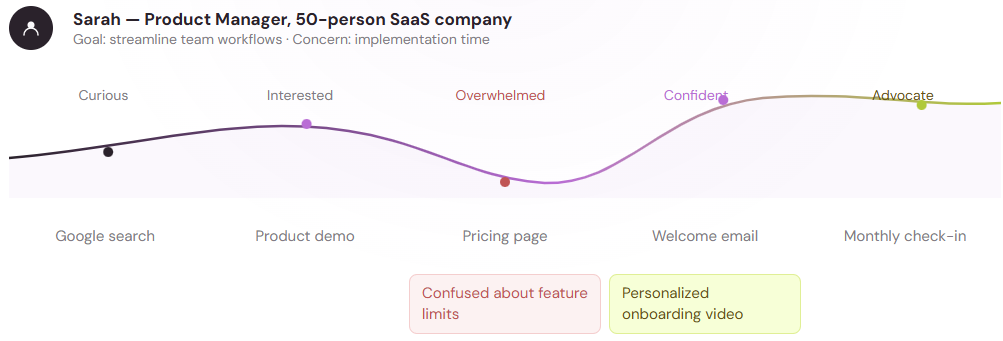
Personas matter for mapping because they anchor your thinking. Instead of mapping "customers," you're mapping Sarah, the overworked project manager with a team of five who needs to streamline workflows, or James, the skeptical CFO who's been burned by software overspend in the past and demands clear ROI. That specificity makes it easier to anticipate emotions and needs at each stage. You can ask better questions: "What would Sarah worry about here?" or "Would James have access to this information?" Personas turn customer journey mapping from an abstract exercise into a grounded, empathetic practice. They also make it easier to spot gaps in your approach. You might realize you've optimized for Sarah's workflow but completely overlooked James's concerns, which could explain why adoption is stalling with finance teams.
Step 4: Identify all touchpoints
List every place your customer interacts with your brand or sees your brand mentioned. This includes owned channels (your website, app, email, social media), earned channels (reviews, word-of-mouth, press mentions), and paid channels (ads, sponsored content).
Don't limit yourself to digital. If you sell physical products or offer phone support, those interactions count. If a customer calls your sales team, that's a touchpoint. If they attend your webinar, that's a touchpoint. If they read a case study someone shared with them on Slack, that's a touchpoint. If they see your product mentioned in an industry newsletter or receive a recommendation from a colleague, those are touchpoints too. The more comprehensive your touchpoint list, the more complete your understanding of the actual customer journey becomes.
The point is to be exhaustive. You'll probably identify 15 to 40 touchpoints per journey, depending on complexity. Once you have the full list, you can evaluate which ones matter most and which ones need improvement. Some touchpoints will emerge as critical moments where your customer makes major decisions. Others will be supporting moments that reinforce confidence or reduce friction. Still others might be broken or missing entirely, illuminating gaps where customers need help but aren't getting it.
Consider both the intended journey and the unintended one. Your ideal customer might follow a specific path through your website, pricing page, and demo, then sign up. But real customers meander. They read forum threads about your product. They ask friends for recommendations. They check your pricing page five times before deciding. They watch competitor comparisons on video platforms. They search Google for reviews or cost analyses. They might even find your product through a completely unexpected channel, like a podcast mention or an academic paper.
All of these are real touchpoints in the real journey. When you map what customers actually do rather than what you want them to do, you start spotting opportunities to guide them more effectively or meet them where they already are.
Step 5: Map emotions, pain points, and opportunities
Now you have the structure. Fill in the human layer.
For each stage of the journey, ask: How does the customer feel? Are they excited? Frustrated? Confused? Cautious? Eager? Skeptical? Emotions aren't fluffy; they drive behavior. A customer who feels lost during onboarding is more likely to churn. A customer who feels welcomed and supported is more likely to upgrade and refer friends. Your customer journey mapping process should capture these emotional states explicitly so you can design interventions that shift them.
Some teams represent emotions visually with a curve that rises and falls across stages: excitement is high during awareness, dipping during consideration as they compare options, rising again when they make a decision, potentially dropping during onboarding if the experience is confusing, then climbing again as they succeed with the product. This emotional arc helps teams understand not just what customers do, but how they feel doing it.
Identify pain points: moments where friction or confusion occurs. These are the obstacles between your customer and their desired outcome. Common pain points include:
- Not understanding your pricing clearly
- Waiting too long to hear back from your team
- Being asked to provide information more than once
- Not knowing what comes next
- Discovering hidden fees or surprise requirements
- Struggling to find the feature they need
- Receiving generic, irrelevant communications
- Having to switch between tools or repeat steps
For each pain point, ask: How many customers hit this? How badly does it impact them? Does it cause them to abandon, or just slow them down? Does it affect retention or just reduce satisfaction? Quantifying pain points helps you prioritize. A pain point that affects 80% of customers deserves urgent attention. One that affects five percent might be lower priority unless it's creating significant harm for those customers.
Finally, identify opportunities. These are moments where a small intervention could shift the experience dramatically. Maybe a proactive email explaining next steps prevents confusion. Maybe a single-click onboarding flow reduces setup time from 20 minutes to two. Maybe connecting new customers with a peer community during the first month measurably boosts retention. Maybe showing usage tips inside the product increases feature adoption. Maybe a brief video tutorial clarifies a confusing interface. Opportunities are where your customer journey mapping directly translates into business impact. The best opportunities are high-impact (they affect many customers or strongly influence retention) and low-effort (they're relatively quick and inexpensive to implement).
Using your journey map to drive results
A finished map is only valuable if your team actually uses it. Here's how to make it real:
Share it widely. Post it in your workspace, whether on a physical wall or whiteboard, or in a shared digital space. Make it the reference document for any conversation about customer experience. When someone proposes a change, ask: "How does this affect the journey map?" When a new team member joins, walk them through it. When your product evolves, update it. The best customer journey maps become living documents that guide decisions across the entire organization. Teams that physically post their maps report higher engagement and retention of the insights, since people naturally reference what they see regularly.
Prioritize by impact. Not every pain point deserves equal attention. Look for moments that affect the most customers or have the highest business impact. A problem that causes five percent of customers to churn deserves more urgency than one that causes 0.5% to churn. Similarly, a friction point that hits new customers in their first week carries more weight than one that affects power users six months in. Create a simple matrix: plot each pain point by how many customers it affects, versus how severe the impact is. Focus first on the high-impact, high-severity issues.
Test your improvements. Once you've identified an opportunity, design a change and measure whether it actually works. Did that new onboarding email reduce support tickets? Did the community feature increase retention? Did personalized product recommendations boost feature adoption? Let data confirm your hypothesis. This turns customer journey mapping from an analytical exercise into an experimental framework where every improvement gets validated before scaling. You might discover that an opportunity you thought would be high-impact actually had minimal effect, or that a small tweak had outsized results. Let experiments guide your efforts.
Revisit regularly. Your journey map isn't a one-time artifact. Customers need change. Your product evolves. New channels emerge. Competitors launch offerings that shift customer expectations. Set a cadence—quarterly or biannually—to revisit your map and update it based on new research and results. You might discover that customer journey mapping reveals different pain points than it did six months ago. That's a signal that your business environment is shifting and your strategies need to adapt. Seasonal variations matter too. The journey for a B2B customer signing up in January might be different than one signing up in June, with different priorities and concerns.
Connect it to your workflow. The best journey maps inform the tools and processes you use. If your map reveals that customers are confused about which plan fits their needs, maybe your quoting process needs to change. If it shows that onboarding is fragmented across email, video, and calls, maybe you need a more cohesive system. Your journey map should influence how you design your customer-facing processes, how your teams coordinate, and where you invest resources. Some teams use their journey map to rebuild their entire customer onboarding sequence. Others use it to redesign their support documentation or restructure their sales process.
Starting small
You don't need a perfect map to begin. Start with one persona and one stage of the journey. Interview five customers. Sketch out what you learn. Share it with your team and refine it based on feedback.
The goal is to move from implicit assumptions to explicit, shared understanding. Even a rough map—built quickly and updated often—beats a polished but static one that nobody references. Your first customer journey mapping effort might take just a week and involve a single page of notes. That's perfectly valid. What matters is that you're doing it, learning from it, and letting it guide your decisions.
Over time, you'll deepen your customer journey mapping practice. You'll interview more customers. You'll capture richer data. You'll identify subtler pain points and more impactful opportunities. You'll see patterns that weren't visible before. This iterative approach builds institutional knowledge and creates a culture where customer-centric thinking becomes how your team operates. Teams that practice regular customer journey mapping develop stronger intuition about what customers need and why. They spot emerging issues faster. They anticipate problems before customers encounter them.
Customer journey mapping works because it forces you to think like your customer instead of like your company. It reveals the gaps between how you think customers experience you and how they actually experience you. That gap is where the opportunity lives. By systematically mapping the journey, researching real customer experiences, and using those insights to guide improvements, you turn customer experience from a nice-to-have into a competitive advantage that drives retention, revenue, and growth.