How to Analyze Interview Data: Manual vs AI-Assisted
Discover how to analyze interview data with manual and AI-assisted methods. Compare pros and cons, uncover themes faster, and choose the right workflow.

Key takeaways
- Manual coding trades speed for depth: Hand-coding takes 30-45 minutes per transcript but gives you direct control, deep familiarity, and preserved nuance, best for small, exploratory, or sensitive studies.
- AI handles scale, humans handle judgment: AI tools code transcripts in minutes and apply consistent logic, but they miss sarcasm, jargon, and context, so their output is a draft that needs human review.
- Saturation has real numbers: High-level themes plateau around 10-12 interviews, and near saturation typically takes 15-23. Let the size of your dataset and your timeline drive your method.
- Hybrid is the safest default for most teams: Let AI run the first pass, then focus your human attention on outliers, contradictions, and the themes central to your research question.
Interview data holds some of the richest insights you can collect: personal stories, unexpected motivations, genuine reactions. But turning hours of recorded conversations into clear, actionable findings is one of the toughest parts of research work. The question isn't just what people said; it's how to organize, interpret, and act on what you heard without losing nuance or spending weeks in manual review.
This guide walks you through both approaches: the traditional method of hand-coding your data, and the newer path of letting AI assist with the heavy lifting. We'll look at where each shines, where each stumbles, and how many interviews you actually need before patterns start to emerge.
Understanding interview data
Interview data is qualitative by nature. It's language and meaning, not numbers. Unlike survey responses where you can drop answers into a spreadsheet and count them, interview analysis requires you to read, interpret, and find patterns across responses. That complexity is also why interview data is valuable. People explain their thinking in ways that reveal not just what they want, but why they want it.
Before you dive into analysis, there are a few foundational concepts to understand.
Coding is the act of tagging pieces of text with labels that represent themes, ideas, or concepts. One interview might be coded with labels like "frustrated by onboarding," "values simplicity," and "budget-conscious." Coding reduces raw text into manageable categories.
Saturation is the point at which new interviews no longer surface new themes. Research shows that high-level themes plateau at 10-12 interviews, near saturation (90% of codes) is reached at 15-23 interviews, and true saturation (100%) requires 30-67 interviews. The number depends on your research question, audience consistency, and coding detail.
Thematic analysis is the process of identifying and describing patterns across your data. It's more flexible than formal coding systems and works well for exploratory research where you're still figuring out what matters most.
The manual approach: hand-coding interview data
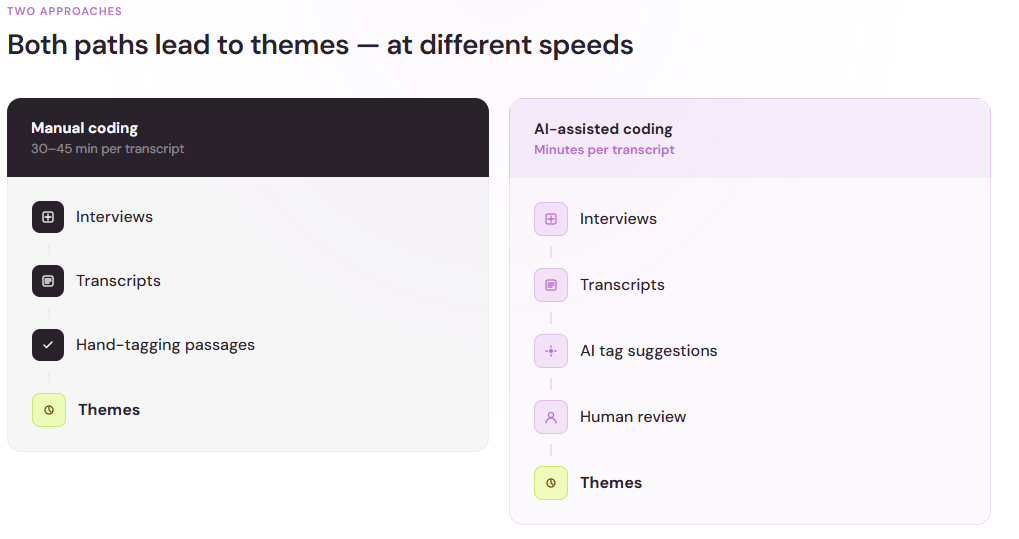
Hand-coding is the traditional method. You read through transcripts, highlight relevant passages, and assign labels to group similar ideas together. It's time-intensive, but it gives you direct control and deep familiarity with your data.
When to use manual coding
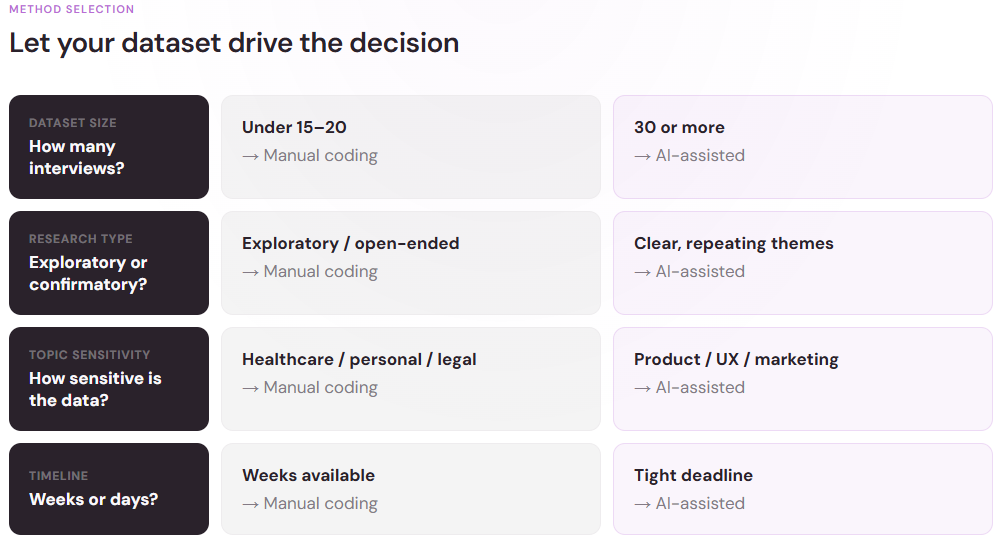
Manual coding makes sense when your dataset is small (under 15-20 interviews), when you need to preserve nuance and context, or when your interview questions are highly open-ended and exploratory. It's also appropriate for sensitive topics—healthcare decisions, family planning, mental health—where careful, human review feels more ethical.
How to hand-code effectively
Start by reading all your transcripts once without coding anything. Get a feel for the landscape, notice patterns, and jot down provisional themes. This first pass prevents you from over-labeling early interviews only to discover new, more important themes halfway through.
On the second pass, start coding. Use a spreadsheet, a dedicated qualitative analysis tool, or even a simple document with color highlighting. Assign codes as you go, and create a codebook (a master list of codes and their definitions) so that "user frustration" stays consistent across every transcript.
Pay attention to direct quotes. Pull out three to five representative quotes for each major theme. These quotes serve as evidence for your findings and help readers understand your conclusions, not just your summary.
As you go, watch for codes that rarely appear. Sometimes you'll tag something "competitor comparison" only three times across 20 interviews. Track frequency and decide what threshold you'll use to highlight a finding.
Challenges with manual coding
Manual coding is vulnerable to human bias. You might unconsciously code responses that match your hypothesis more readily than those that challenge it. It's also slow, around 30-45 minutes per interview transcript. Scale that across 20-30 interviews and you're looking at weeks of work.
Another trap is coder fatigue. By interview 15, your attention drifts, and your coding becomes less rigorous. If you have a research team, running the same set of interviews past two independent coders and comparing results (called inter-rater reliability) catches this, but it also doubles your time investment.
AI-assisted analysis: speeding up the process
AI-powered tools can auto-code transcripts, suggest themes, and flag patterns in minutes instead of weeks. These tools scan text using language models trained on large datasets and identify semantic patterns based on what they've learned.
Around 47% of researchers worldwide use AI regularly in their market research activities, signaling that AI-assisted analysis is moving into the mainstream of qualitative research.
When to use AI assistance
AI helps most when your dataset is large (30+ interviews), when your codes are relatively clear and standard (e.g., "pain point," "feature request," "competitor mention"), or when you need to turn results around fast. It also works well for a first-pass analysis. Let the AI suggest codes and themes, then you review, refine, and validate. This hybrid approach can dramatically reduce your analysis time while keeping human judgment in the loop.
How AI-assisted coding works
Most AI tools work in a three-step cycle:
- Upload and transcribe – Feed interview recordings or transcripts into the platform. If you have audio, the tool transcribes it automatically.
- Auto-code – The AI scans the text and assigns codes based on patterns it recognizes. You typically get a list of suggested themes and the passages associated with each.
- Review and refine – You read through the AI's work, adjust codes, merge duplicates, delete irrelevant tags, and add context. This step is crucial. AI suggestions are a draft, not final.
Some platforms also offer sentiment analysis, topic clustering, and visualization tools that show which themes appear most often.
Strengths of AI assistance
Speed is the obvious win. What takes weeks manually can take hours with AI. Consistency is another. AI doesn't get tired or biased toward earlier or later interviews. It applies the same logic and rigor to every transcript.
AI is also good at spotting patterns you might miss. It can be hard to hold all the context from past interviews in our heads and notice subtle similarities, especially when working across multiple days.
Limitations and risks of AI-assisted analysis
AI models are trained on general language patterns, not your specific research domain. If you're analyzing interviews with technical specialists using industry jargon, the AI might misinterpret specialized language or miss domain-specific concepts.
AI also struggles with sarcasm, cultural context, and irony. A respondent who says "Oh great, another update" might mean frustration, but an AI might tag it as positive sentiment if it misses the tone.
Finally, AI-generated codes can feel generic. The AI might suggest "user experience" when what you really need is "confusion during account setup." You'll spend time translating AI output into codes that fit your research question, or breaking their generic categories into more telling sub-categories.
Building a hybrid workflow
The most effective teams combine the two tactics.
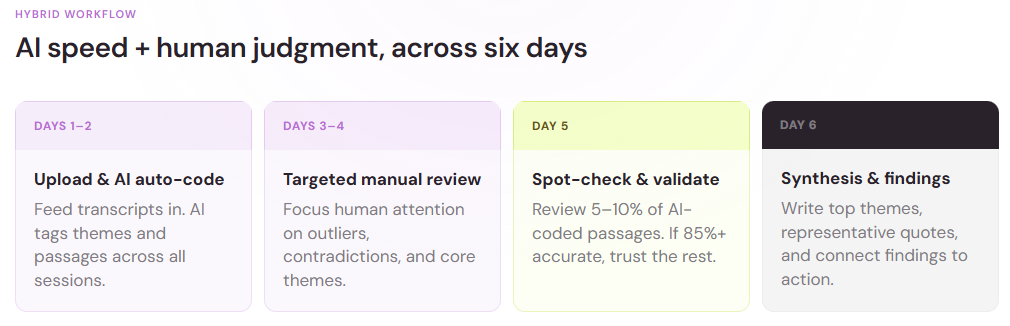
Start with AI to handle the initial pass. Upload your transcripts, let the tool suggest codes and themes, and use that output as your starting point. Then do targeted manual review. Focus your human attention on passages where the AI seems uncertain, on responses that are outliers or contradictions, or on themes central to your research question.
If you have a team, parallel workflows save calendar time. When you're done, randomly pick 5-10% of the AI-coded passages and verify they match the assigned code. If your accuracy is above 85%, you can trust the rest.
Getting quality data in the first place
No analysis method—manual or AI—can fix poor data. Carefully planning and structuring your research can make downstream analysis much easier.
Use clear, open-ended questions. Instead of "Do you like our product?" ask "Walk me through the last time you used our product. What was easy? What was frustrating?" You'll get richer, more analyzable responses. The same care that goes into a well-designed survey applies to interview guides: clarity beats cleverness.
Keep interviews focused. A 45-minute interview with clear scope is better than a two-hour conversation that touches on everything.
Prepare a loose interview guide. List the topics you want to cover and a few open questions to prompt discussion, but don't read from a script. The guide keeps you on track while still letting the conversation breathe.
Record and transcribe accurately. Manual data entry remains a major source of error for approximately 60% of data professionals. Use an automated transcription service, then spend 15-20 minutes per interview spot-checking the transcript against the audio. Fix names, technical terms, and any garbled sections.
Making sense of your findings
Once your data is coded—whether by hand or AI—you need to synthesize it into findings.
Start by counting. How many interviews mentioned "difficult onboarding"? Frequency doesn't equal importance, but it tells you what's widespread versus rare.
Then look for patterns. Did everyone with a certain job title mention the same pain point? Do newer users struggle with something that power users don't?
Create a findings document with your top three to five themes, the frequency of each, representative quotes, and any unexpected tensions. For example: "Most people want more features, but experienced users said feature bloat was their main complaint." Those contradictions are insights.
Finally, connect your findings to action. "Our onboarding is confusing" is a finding. "Three of eight users got stuck on the payment page, and two others skipped it entirely" is actionable. The specificity tells your team where to focus and closes the loop between user feedback and product decisions.
Choosing your method
Manual coding demands time but gives you precision and direct understanding. It's best for small, exploratory studies where nuance matters.
AI-assisted analysis is faster and scales better. It's ideal when you have dozens of interviews, tight timelines, or repeating, clear-cut themes. But it needs human validation. You should never ship AI-coded findings without review.
The strongest choice for most teams is a hybrid: use AI for the heavy lifting, then invest your human expertise where it matters most—spotting nuance, validating results, and translating findings into action. You get speed and depth together.
Sometimes, volume and turnaround time push you toward a certain decision. If you have under 15 interviews and weeks to work, you can go manual. If you have 30+ interviews and need findings in days, go AI-first with manual validation. For most mid-sized projects, hybrid is your safest bet.

Liked that? Check these out:

Opinions and Expertise
What’s actually slowing research teams down (Hint: it’s not the research)
From recruiting participants and scheduling interviews to building the actual surveys, the operational drag is taking researchers away from what they do best. See what's actually slowing them down and how Research Flow fixes it.
Read more