Employee engagement survey questions: how to build yours
From question design to follow-up, learn how to run surveys for employee engagement that build trust and drive real workplace improvements.
Share
Latest posts on
Free online trivia maker: custom trivia quizzes in minutes
|
September 4, 2026
Read more
AI survey builder: create smart surveys in minutes
|
September 4, 2026
Read more
How to make a test online: tips and tricks
Typeform
|
September 4, 2026
Read more
How to build a landing page that converts
Typeform
|
September 4, 2026
Read more
Share
How to build an employee engagement survey
Your best employees aren't going to tell you they're unhappy. They'll just leave. By the time you notice the pattern—declining output, missed meetings, a two-week notice—the damage is done.
Whether you're an HR leader trying to reduce turnover, a manager looking for early warning signs, or a founder building culture from scratch, an employee engagement survey catches what conversations miss. It gives every person on your team a safe, structured way to share how they really feel about their work, their manager, and the company.
Done well, it's an early warning system and a roadmap for building a workplace people don't want to leave.
What employee engagement actually measures
Engagement isn't the same as satisfaction. An employee can be satisfied—comfortable pay, decent benefits, no major complaints—and still be disengaged. Engagement is about connection. It measures whether someone feels invested in their work, aligned with the company's mission, and motivated to contribute beyond the minimum.
The distinction matters because satisfied employees stay. Engaged employees perform. And the gap between the two can be enormous—a team of satisfied but disengaged employees will hit targets but never exceed them.
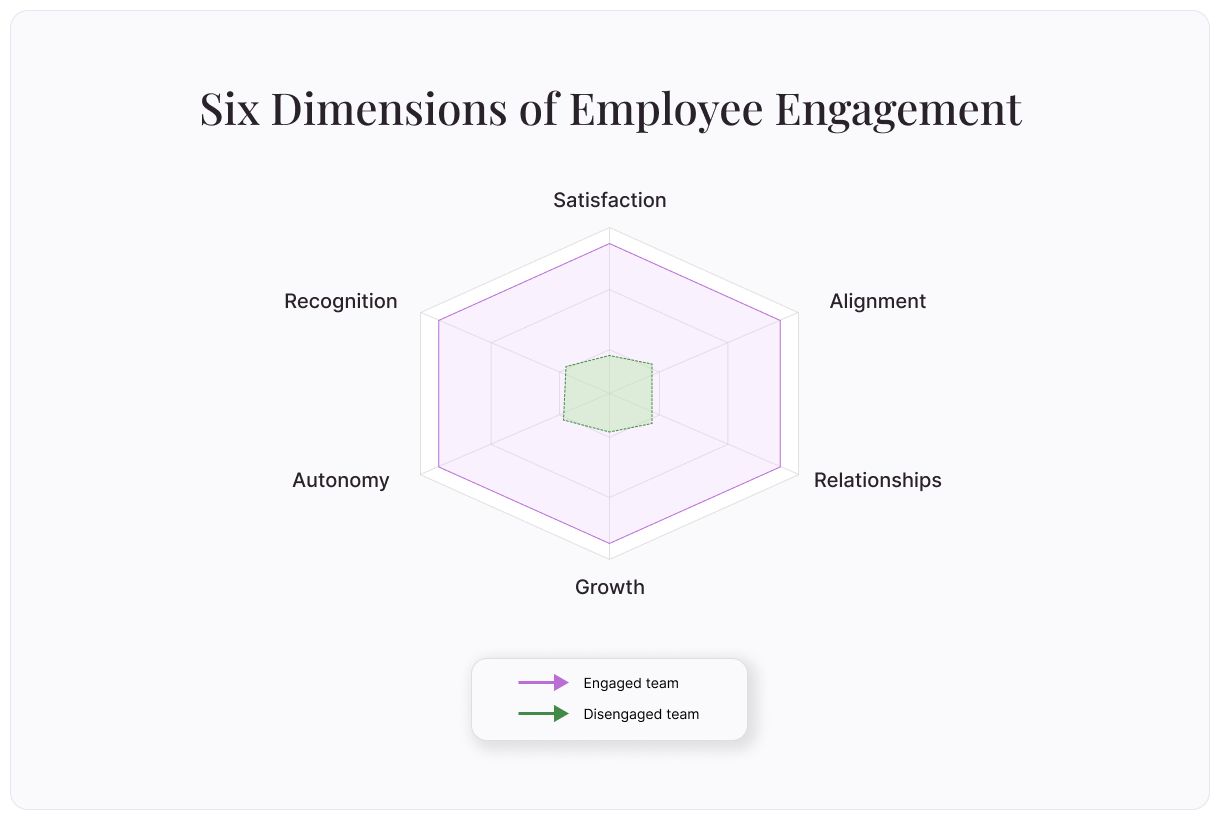
Most engagement surveys measure a combination of these dimensions:
Satisfaction – How happy are employees with their role, compensation, and work environment?
Alignment – Do employees understand and believe in the company's direction?
Relationships – Do employees feel supported by their manager and connected to their team?
Growth – Do employees see a path forward? Are they learning and developing?
Autonomy – Do employees feel trusted to make decisions and manage their own work?
Recognition – Do employees feel their contributions are noticed and valued?
When you measure across all of these dimensions, you get a picture that's far more nuanced—and far more actionable—than a single "How happy are you at work?" question.
Designing your survey
Understanding how to design an effective survey involves knowing what questions to ask and when to ask them.
Decide on frequency
How often should you survey? There's no single right answer, but here are the most common approaches.
Annual surveys – Comprehensive, 40-60 questions, covering every engagement dimension in depth. Good for benchmarking year over year. The downside: A lot can change in 12 months, and you won't catch problems until the next cycle.
Pulse surveys – Short (5-10 questions), sent monthly or quarterly. These surveys catch shifts in morale quickly and don't demand much from respondents. The downside: They don't go as deep, and over-surveying can cause fatigue.
Event-triggered surveys – Sent after specific moments: onboarding, a reorganization, a company-wide announcement, a leadership change. They capture reactions to change in real time, when feelings are strongest and most honest.
Most companies benefit from a combination: an annual comprehensive survey supplemented by quarterly pulse checks. The annual survey gives you depth; the pulses give you speed.
Whatever cadence you choose, the key to success is consistency—stick with it long enough to build a baseline that makes trends visible.
Write questions that surface real feelings
The difference between a useful survey and a useless one often comes down to how the questions are written. Here are a few principles to follow:
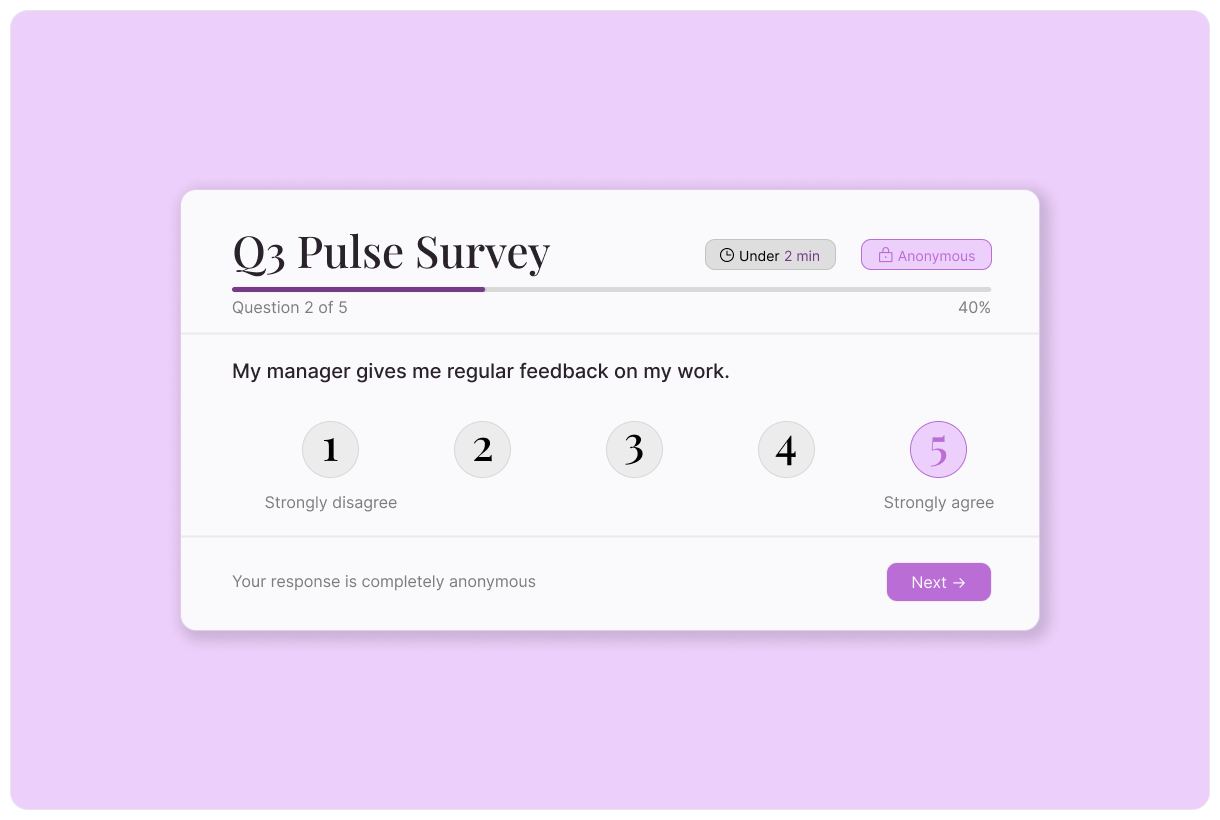
Ask about specific behaviors, not abstract feelings. "My manager gives me regular feedback on my work" is more actionable than "I feel supported." The first tells you exactly what to fix; the second tells you something is off without pointing to a cause.
Use a consistent rating scale. A five-point Likert scale (strongly disagree to strongly agree) is standard and well-understood. Don't mix scales within the same survey—it confuses respondents and makes analysis harder. Stick with one scale throughout.
Include open-ended questions sparingly. Two or three free-text questions give employees space to share context that ratings can't capture. But too many open-ended questions make the survey feel burdensome and harder to analyze. Place all open-ended questions at the end so they don't slow people down early.
Avoid leading questions. "Don't you agree that our company culture is strong?" will get you skewed data. "How would you describe our company culture?" won't. Neutral phrasing is the foundation of honest responses.
Keep it anonymous
If employees think their responses can be traced back to them, they'll self-censor. And a self-censored survey is worse than no survey at all—it gives you false confidence in problems that are still growing quietly.
Make anonymity the default, and mean it. Communicate it clearly before, during, and after the survey. For small teams where anonymity is harder to guarantee (fewer than five respondents per group), aggregate results at a higher level to protect individual identities. It's better to have less granular data that's honest than detailed data that's sanitized.
Sample questions by dimension
These questions work across most organizations. Adapt the language to match your company's culture and context.
Satisfaction
I would recommend this company as a great place to work
I feel fairly compensated for the work I do
My workload is manageable
I have the tools and resources I need to do my job well
Alignment
I understand how my work contributes to the company's goals
I believe in the direction leadership is taking
Leadership communicates openly about changes that affect my work
Relationships
My manager cares about my well-being
I feel like I belong on my team
I trust the people I work with
Growth
I have opportunities to learn and develop in my role
I can see a clear path for advancement here
My manager supports my professional development
Autonomy
I have the freedom to decide how I do my work
My opinions are considered when decisions are made that affect me
Recognition
I receive meaningful recognition when I do good work
My contributions are valued by my team
What to do with the results
Collecting data is the easy part. Acting on it is where most companies fall short—and where trust is either built or broken.
Here’s how you can ensure you’re building trust:
Share results transparently
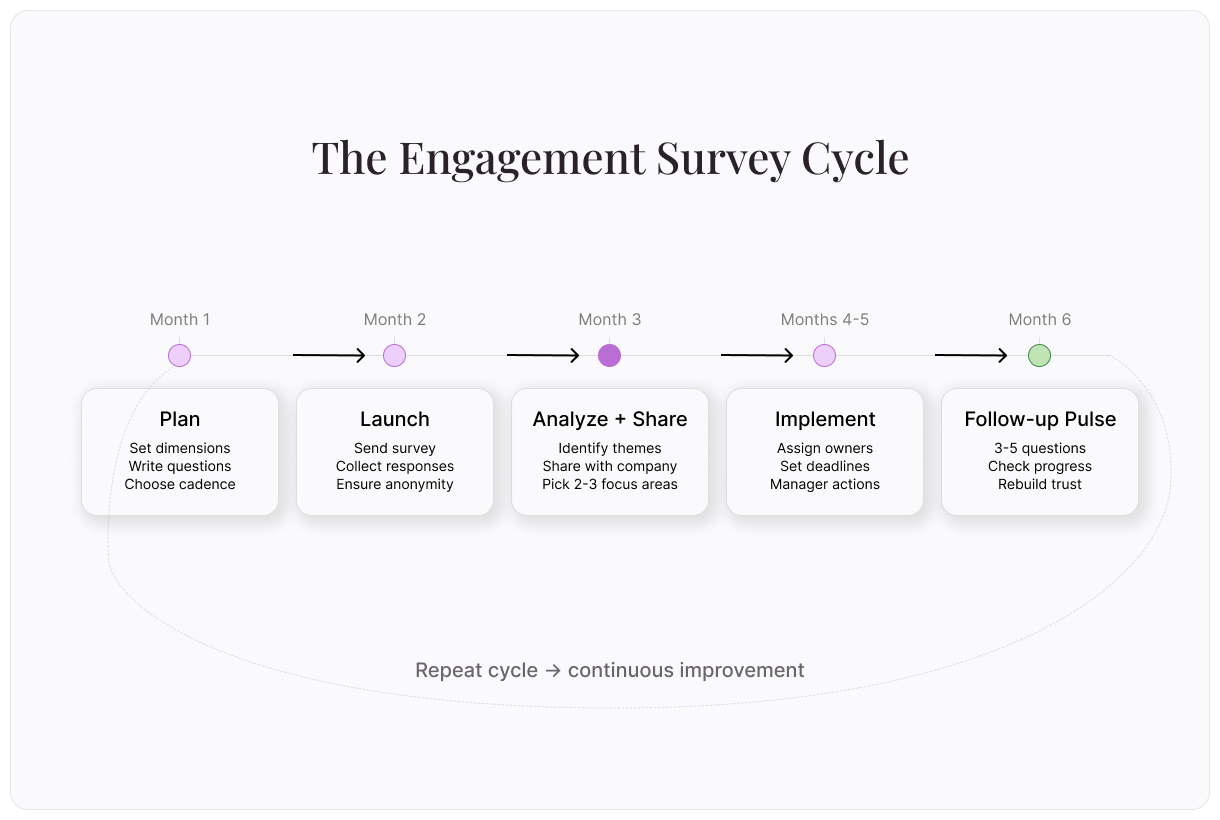
Employees took time to share honest feedback. If they never hear what came of it, they won't bother next time. Share high-level results with the entire company. Be open about what's going well and what needs work. Transparency doesn't mean sharing every data point—it means being honest about the themes that emerged.
Identify two or three focus areas
You can't fix everything at once, and trying to will only overwhelm your teams and dilute your efforts. Pick the two or three areas with the biggest gaps between current scores and where you want to be. Then, create specific, time-bound action plans for each—not vague commitments, but concrete steps with owners and deadlines.
Involve managers directly
Company-wide initiatives matter, but most engagement happens at the team level. Give managers access to their team's results (aggregated for anonymity) and coach them on how to act on the feedback. A manager who says, "You told us recognition is low on this team—here's what we're changing," builds credibility faster than any company-wide memo.
Follow up
Six to eight weeks after sharing results and action plans, check back in. A short follow-up pulse survey—focused specifically on the areas you committed to improving—shows employees that the process is real, not performative. It also gives you early data on whether your changes are landing.
The follow-up doesn't need to be long. Three to five questions targeting the specific issues you addressed are enough. What matters is that employees see the connection between what they said and what changed. That loop—feedback, action, follow-up—is what turns a survey from a corporate exercise into a trust-building tool.
Common pitfalls to avoid
Even well-intentioned survey programs can go sideways. Here are the mistakes that derail the most engagement efforts:
Surveying without acting. Nothing erodes trust faster than asking for feedback and ignoring it. If you're not prepared to act on results, wait until you are. A survey that goes nowhere is worse than no survey at all.
Asking too many questions. Survey fatigue is real. If your annual survey takes 45 minutes to complete, response rates will suffer and so will data quality. Aim for 20-30 minutes for a comprehensive survey; under five minutes for a pulse check.
Confusing engagement with perks. Free snacks and ping-pong tables are nice, but they don't move engagement scores. Meaningful work, strong management, and growth opportunities do. Focus on the fundamentals.
Benchmarking against the wrong data. Comparing your scores to industry averages can be useful, but it can also be misleading. A 72% engagement score means different things in a startup versus a 10,000-person enterprise. Focus on your own trajectory first—are scores improving quarter over quarter? That trend matters more than any absolute number.
Engagement is a conversation, not a campaign
The most engaged companies don't treat surveys as an annual checkbox. They treat feedback as a continuous conversation—one that's built into how the company operates, not bolted on as an afterthought.
Ask clear questions. Share what you learn. Act on what you find. Then do it again. Over time, you'll build something that no perk or policy can replicate: a workplace where people feel genuinely heard, and where hearing them is how you get better.
About the author
We're Typeform - a team on a mission to transform data collection by bringing you refreshingly different forms.
Employee engagement survey questions: how to build yours
Free online trivia maker: custom trivia quizzes in minutes
Trivia is engaging. People love testing their knowledge, competing with friends, and proving they know random facts nobody asked them to memorize. That’s why trivia works as a learning tool, a marketing hook, an event activity, and just plain fun.
AI survey builder: create smart surveys in minutes
Creating effective survey questions is easier said than done. You need to ask the right things, in the right order, to the right people—and do it in a way that actually makes people want to answer. Most survey builders make this harder, not easier. You’re staring at a blank form, second-guessing every word, wondering if your logic flows or if you’ll get useful data back