Market research platforms: What to look for in 2026
The best market research platforms in 2026 combine AI analytics, multi-channel collection, and panel access, with a guide on what features actually matter.

The global market research industry is booming. In 2024, the sector generated approximately $140 billion in revenue (Backlinko, 2026), with the US leading at $48 billion (Backlinko, 2026). That scale signals something important: businesses everywhere recognize that understanding your audience isn’t a luxury—it’s essential.
But here’s the challenge: the landscape of market research platforms has exploded. New tools emerge constantly, each promising to unlock insights faster, cheaper, or more accurately than the last. For teams trying to pick the right platform, the options can feel overwhelming.
This guide walks you through what modern market research platforms actually do, which features matter most in 2026, and how to evaluate them for your needs. Whether you’re a startup running your first study or an enterprise managing dozens of concurrent projects, you’ll find clarity here.
What market research platforms do
Market research platforms help you collect, analyze, and act on feedback from people in your target audience. They let you design surveys, conduct user testing, gather customer opinions, and extract meaning from the responses you get back.
The best platforms go beyond simple data collection. They help you recruit participants, set up logic-based workflows, run statistical analyses, and share findings with stakeholders—all in one place. Some even automate the interpretation of results using AI. These comprehensive market research platforms have become essential infrastructure for modern teams, eliminating the need to juggle multiple disconnected tools and reducing the friction between research and action.
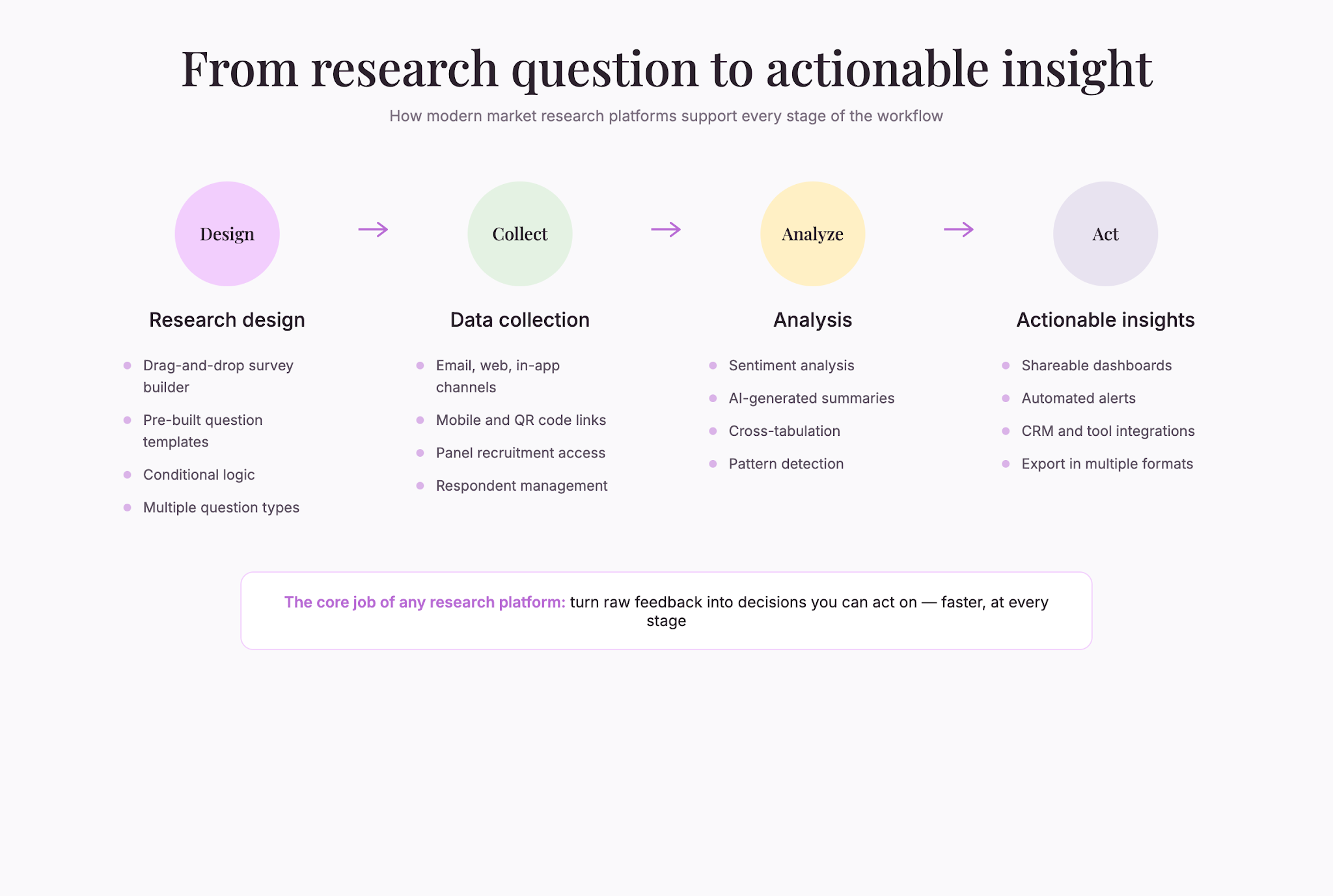
The core job of any research platform is the same: turn raw feedback into decisions you can act on. A well-designed platform removes barriers at every stage—making it faster to design research, easier to reach respondents, simpler to analyze results, and more straightforward to share findings with decision-makers.
Why market research matters now more than ever
Three shifts in 2025 and early 2026 have made the right platform choice more critical than before.
First-party data is the new currency. Nearly 90% of marketers report shifting their personalization tactics and budget toward first-party and zero-party data (IAB, 2024). Only 15% of global marketers felt fully ready for a cookieless world (Deloitte, March 2025). If you’re not actively collecting direct feedback from your audience, you’re falling behind. A solid market research platform is your primary tool for gathering that first-party insight. The platforms that make it easiest to collect, organize, and act on direct customer feedback will become increasingly valuable as third-party data sources disappear.
UX is a competitive advantage. User surveys remain one of the three most popular UX research methods alongside interviews and usability testing (TrueList, 2025). Every $1 invested in UX research returns $100 in value (TrueList, 2025)—a 9,900% ROI. Yet only 55% of companies even conduct UX testing (TrueList, 2025), which means most of your competitors are leaving money on the table. A platform that makes UX research fast and scalable gives you an edge. Teams that systematically gather and act on UX insights see measurable improvements in conversion rates, user retention, and customer satisfaction—all of which are directly tied to revenue.
AI is reshaping analysis. Around 47% of researchers worldwide now use AI regularly in their market research activities (Backlinko, 2026). Platforms that offer AI-powered insights—pattern detection, sentiment analysis, automated summary generation—let smaller teams accomplish what used to require dedicated researchers. That efficiency matters, especially if your budget is tight. AI-powered analytics also reduce human bias in interpretation, flag insights humans might miss in large datasets, and dramatically accelerate the path from raw data to actionable recommendations.
Key features to prioritize
Not all platforms are built the same. Here’s what to evaluate:
Survey and questionnaire design
Can you build and customize surveys without coding? Look for platforms that offer:
- Drag-and-drop question builders
- A library of pre-built, validated question templates
- Conditional logic (so questions adapt based on previous answers)
- Multiple question types (multiple choice, open-ended, rating scales, matrix, ranking)
The easier the design process, the faster you’ll launch research and iterate on findings. A platform with strong survey design capabilities will let your team experiment rapidly, test different question phrasings, and refine approaches based on early response patterns—all without waiting for a developer or research specialist.
Multi-channel data collection
Modern market research isn’t confined to email surveys. Today’s platforms should let you collect feedback via:
- Email invitations
- Web links and QR codes
- In-app prompts
- Mobile apps
- Social media
- Embedded forms on your website
Reach people where they naturally spend time, not just where your platform is easiest to deploy. Multi-channel collection also increases response rates because respondents can participate using their preferred method. Research shows that offering flexibility in how people respond leads to higher engagement and more representative samples.
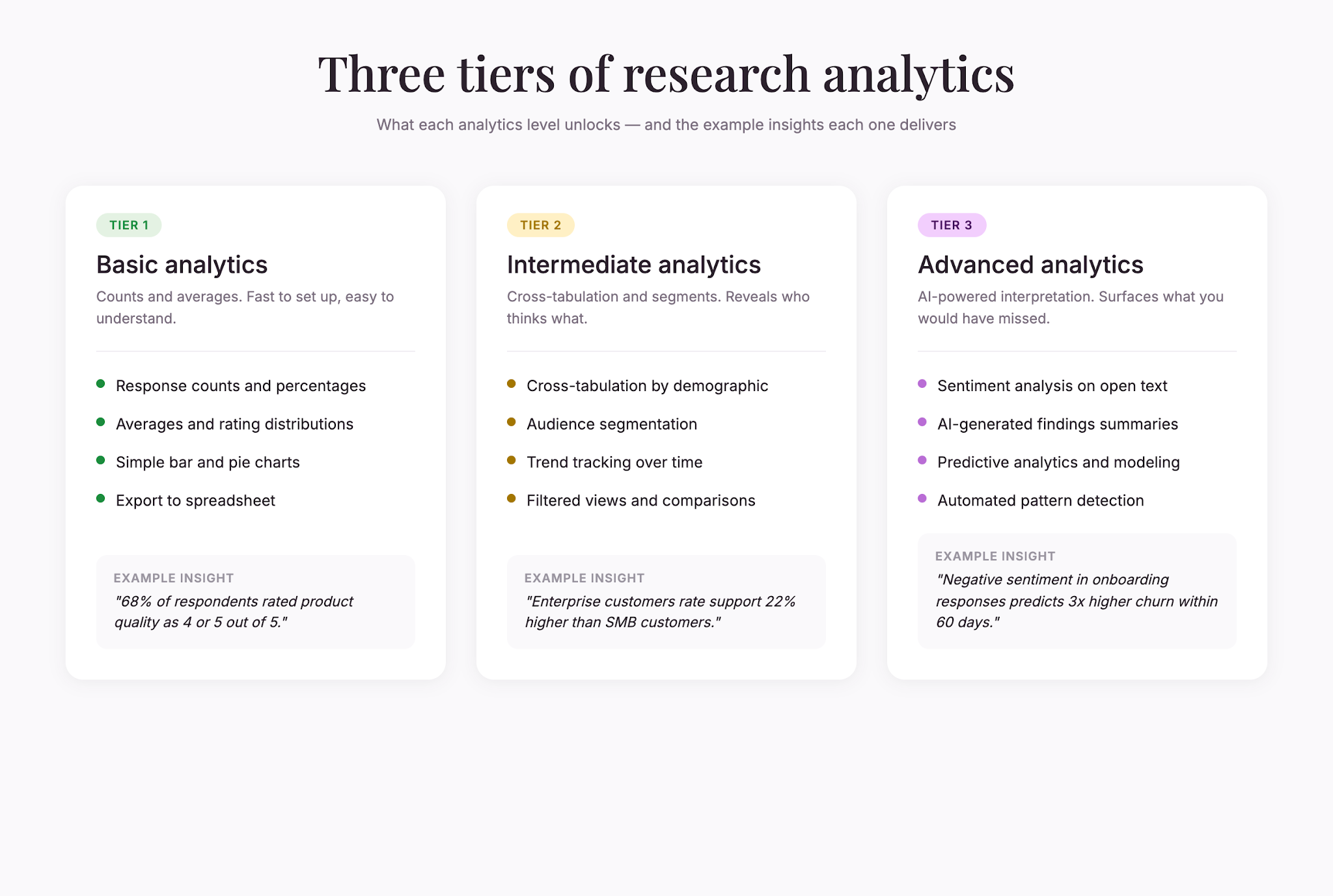
AI and analytics
This is where platforms are diverging most sharply in 2026. Look for:
- Automated sentiment analysis that flags emotional tone in open-ended responses
- Pattern detection that surfaces trends you might miss manually
- AI-generated summaries of findings
- Predictive analytics that tell you what respondents are likely to do next
AI doesn’t replace human judgment, but it accelerates the work of turning raw responses into clarity. Platforms with advanced analytics capabilities can process thousands of responses in minutes, identify statistically significant segments, and surface unexpected correlations that drive strategy.
Participant recruitment and panel access
Some platforms include built-in access to respondent panels—pools of pre-screened people willing to answer surveys. This matters if you need:
- Specific demographic targeting
- Large sample sizes fast
- Respondents outside your existing customer base
Not every project needs this, but it’s valuable to have the option without switching platforms. When recruiting is built into your research platform, you eliminate delays and quality issues that come from managing vendors separately.
Integration with your existing stack
Your research platform shouldn’t be an island. Check whether it connects seamlessly with:
- Your CRM (Salesforce, HubSpot)
- Analytics tools (Google Analytics, Mixpanel)
- Collaboration platforms (Slack, Microsoft Teams)
- Spreadsheet and automation tools (Google Sheets, Zapier)
- Other research and feedback tools
Seamless integration saves time and reduces manual data entry—and mistakes that come with it. When your market research platforms integrate with your CRM, for example, you can automatically tag respondents, trigger follow-up actions, and correlate survey answers with customer behavior.
Ease of sharing and collaboration
Research is only useful if your team acts on it. Platforms should make it simple to:
- Generate shareable reports and dashboards
- Annotate and comment on findings
- Export data in multiple formats
- Set up automated alerts for key insights
If creating and sharing reports takes days, insights get stale. Choose a platform that lets you move fast. The best platforms make it possible for non-researchers—product managers, executives, support teams—to access and understand findings without needing a researcher to translate them.
The state of market research platforms in 2026
The market research and usability testing tools sector is growing rapidly. The global usability testing tools market was valued at $1.51 billion in 2024 and is projected to reach $10.41 billion by 2034, growing at a 21.3% CAGR from 2025 to 2034 (Market.us, 2024).
That growth reflects real demand: businesses are running more research studies than ever, and they want platforms that are faster, smarter, and easier to use.
Modern customer feedback platforms in 2026 integrate AI-powered analytics, multi-channel collection (surveys, reviews, support tickets, chats, in-app), and case management automation. Key platforms in this space now include options ranging from specialized usability testing tools to full-featured feedback suites designed to handle multiple research methodologies across teams (Mopinion, 2026).
One notable trend: platforms that started narrow are expanding. For example, Maze, originally a startup-focused usability testing platform, now serves more than 3,000 companies as of 2025 (Maze, 2025)—a sign that the best research platforms are moving toward “all-in-one” ecosystems rather than point solutions.
Building a research workflow that works
Picking the right platform is one thing. Using it effectively is another.
Strong market research teams do three things:
1. Maintain a research calendar. Plan which questions you’ll ask, when, and to whom. This prevents you from survey fatigue (asking your audience the same things repeatedly) and helps you spot gaps in your knowledge. A calendar also ensures you’re spreading research across seasons and user segments, avoiding skewed data from timing-specific events.
2. Combine methods. Don’t rely on surveys alone. Pair quantitative surveys with qualitative interviews. Run usability tests alongside customer feedback collection. Different methods reveal different truths. Surveys tell you what people think happened and what they claim they’ll do. Usability tests show what people actually do. Interviews explain why they make certain choices. Together, these methods create a complete picture.
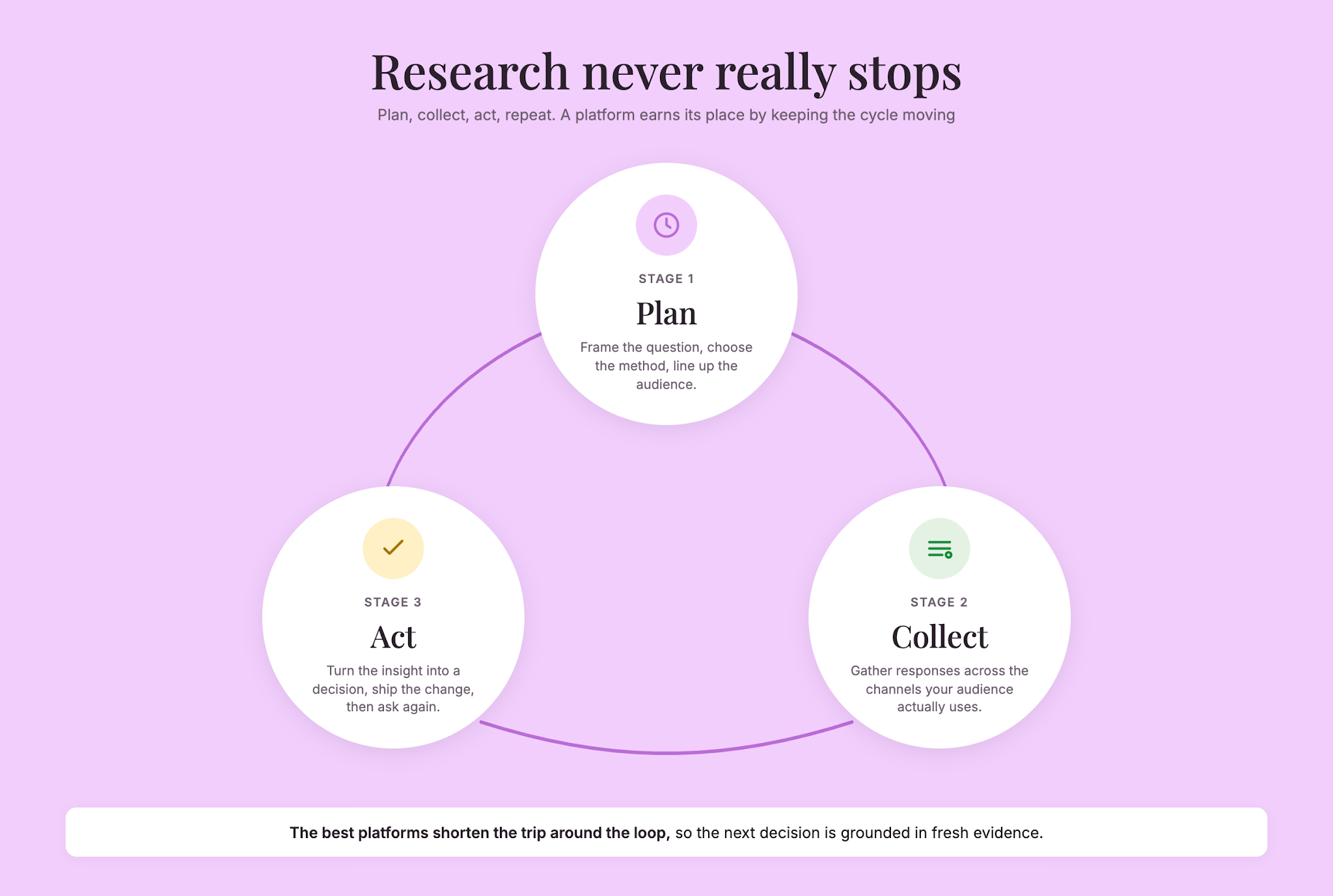
3. Close the loop. After you research, report back to your audience about what you learned and what you’ll change. When people see that their feedback created action, they’re more likely to respond to future requests—and more likely to trust your brand. This cycle of listening and responding builds loyalty and increases participation in future research.
An impressive 80% of people trust brands they use, more than trust in business, media, government, or NGOs (Edelman Trust Barometer, 2025). Research is one of the most powerful ways to earn that trust, because it demonstrates that you’re listening.
Evaluating platforms: questions to ask
When you’re comparing options, run each platform through this checklist:
- Can your team actually use it without extensive training? The best platform is the one your team will actually use consistently.
- Does it scale with you? If you’re growing from 100 respondents to 10,000, will the platform handle it—and will the pricing scale reasonably?
- Does it offer the research methods YOU need most? A platform doesn’t need to do everything. It needs to do the things that matter for your research.
- How fast can you get results? If analysis takes weeks, your findings are stale by the time you act on them.
- What’s the learning curve for new users? Team composition changes. Can someone new pick up the platform in a reasonable timeframe?
- Is the data export straightforward? You may outgrow a platform or want to combine data from multiple sources. Make sure you can get your data out cleanly.
For teams managing complex, multi-phase research projects, look for platforms that offer workflow automation and integrated project management. ResearchFlow, for example, lets you design research templates, automate participant logic and follow-ups, and track projects end-to-end—so your team spends less time on administration and more time on insights.
The future of market research
As AI becomes more powerful, platforms will increasingly handle the heavy lifting of analysis and interpretation. That doesn’t mean researchers become obsolete—it means their job shifts. Instead of spending time coding responses or calculating statistics, researchers will focus on asking better questions and applying judgment to what the data reveals.
Platforms that combine ease of use with intelligent automation will win. So will platforms that treat research as a continuous cycle rather than a one-off project—collecting feedback, analyzing it, acting on it, and learning what happened next.
When you evaluate platforms, remember this: the best tool is the one that fits your workflow, scales with your ambitions, and actually gets used. Generic feature lists don’t tell you that. Only a real trial—creating a test survey, collecting some responses, running through your analysis workflow—will show you whether a platform truly matches your team’s needs.

Liked that? Check these out:

Opinions and Expertise
What’s actually slowing research teams down (Hint: it’s not the research)
From recruiting participants and scheduling interviews to building the actual surveys, the operational drag is taking researchers away from what they do best. See what's actually slowing them down and how Research Flow fixes it.
Read more