Market validation: how to test demand before you build
Learn how to validate market demand before you build: test with surveys, interviews, MVP observation, and paid ads that measure real commitment.
Key takeaways
- Market validation tests demand before you invest: It confirms that a real, sizable group of people has a genuine problem and would pay to solve it, proven through real, observable behavior.
- Use three testing approaches: Direct surveys and interviews, prototype or MVP observation, and small paid A/B tests that measure real commitment like sign-ups and payments.
- Recruit the right participants: 10-50 conversations with people who match your target customer profile reveal patterns. Friends and random internet samples produce noise.
- Act on the results: Strong validation means build an MVP, mixed signals mean dig deeper into segments, and weak validation means pivot before you're too invested to turn around.
Some startups fail because smart people build the wrong thing. An entrepreneur can spend months crafting the perfect product, only to launch it and discover nobody wants it. Market validation—testing whether real people actually need your solution—is the cheapest insurance against that outcome.
The cost difference is staggering. The general belief is that correcting a problem once a system is in development costs 10 times as much as fixing it in design, and 100 times as much once the product has been released. That's about momentum as much as it is about money. Every week spent building something the market doesn't want is a week you're not building something it does.
This guide walks you through what market validation is, why it matters, and how to run tests that give you real answers before you invest heavily in development.
What market validation actually means
Market validation is the process of confirming that a real, sizable group of people has a genuine problem that they'd be willing to pay to solve.
Many founders conflate validation with cheerleading. A friend saying "that's a great idea" is not validation. A stranger paying money or spending time on your prototype is.
Market validation sits at the intersection of three questions:
- Does the problem exist? Are real people actually struggling with this, or are you assuming or projecting?
- Is the problem big enough? Do enough people care about it to sustain a business?
- Will people choose your solution? Even if the problem is real, why would they pick yours over alternatives (or doing nothing)?
Answering these questions early saves you from building a product with perfect execution and zero demand. The stakes are real: products that lack proper market validation often miss critical market signals that could have informed better positioning, feature prioritization, or go-to-market strategy.

Why most founders skip validation (and why that's expensive)
Validation feels like it slows you down. You want to build, launch, see your vision come alive. Waiting to test it feels like lost momentum.
But here's the math: acquiring new customers costs five times more than retaining existing ones, and 65% of revenue comes from existing customers over the lifetime of your business. This means getting product-market fit right from the start is practically a requirement for sustainable growth. Companies that rush to build without proper validation often find themselves spending heavily on customer acquisition to compensate for a product that doesn't resonate with its intended market.
When you skip validation, you're betting that your intuition about what people want is correct. Sometimes it is. Often, it isn't. The cost of being wrong is not a small delay. It's months of development, launch, marketing spend, and then a slow realization that the market doesn't care.
Validation is the early warning system that lets you pivot before you're too invested to turn around. It's also a form of due diligence for yourself, a way to build confidence that you're solving a problem people actually experience and care enough about to address.
How to validate your market: three testing approaches
1. Ask people directly (surveys and interviews)
The simplest form of validation is asking for it. You identify a group of people who match your target customer profile, describe your problem or solution, and listen to what they say.
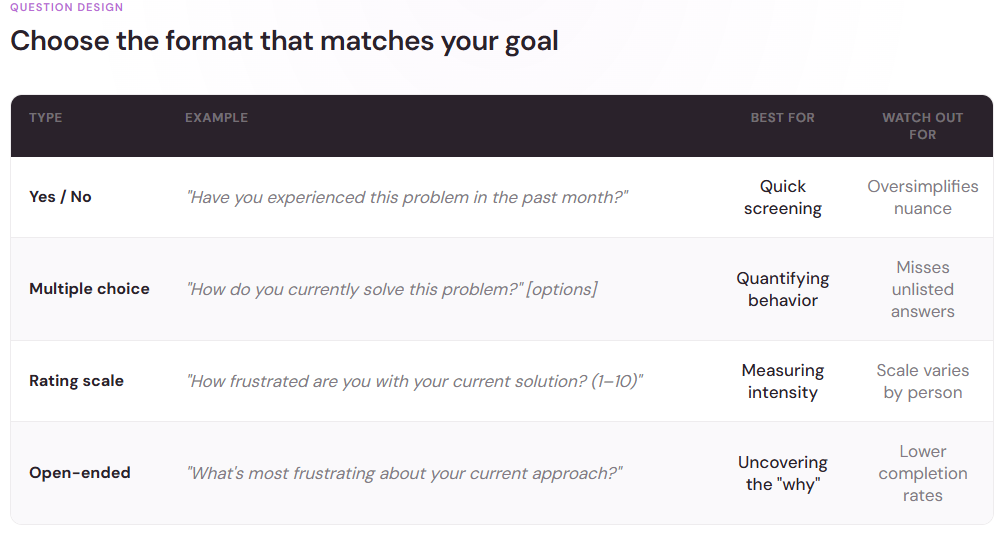
Surveys work when you want to quantify how many people experience a problem or would consider a solution. You can reach a large audience quickly and gather numerical data. The challenge: survey respondents are thinking in the abstract. They're not actually using your product, so "yes, I'd use that" is much easier to say than to do.
Interviews (usually one-on-one conversations) go deeper. You ask follow-up questions, probe for contradictions, and watch how people react to your idea. The downside is that interviews are slow and you reach fewer people. But the depth of understanding is much higher. You'll often uncover unarticulated needs and emotional drivers that surveys can't capture.
For either approach, clarity matters. When you survey your target audience, avoid leading questions like "Don't you think this would be useful?" Ask about their current behavior and pain points instead: "How are you solving this problem today?" and "What's frustrating about your current approach?"
Open-ended questions do drive richer answers, but they also require more effort from respondents, so they tend to get skipped more often than closed questions and can raise the chance someone abandons the survey.
2. Show them a prototype or MVP and observe behavior
Asking what people want is useful. Watching what they actually do is better.
An MVP (minimum viable product) is a stripped-down version of your solution, built out just enough to test whether (and how) people will engage with it. This doesn't mean building the full product. It means building the smallest possible version that lets you measure real behavior: clicks, time spent, abandonment, sign-ups, or purchases.
When you show people a prototype—whether it's a landing page, a mockup, or a bare-bones working version—you shift from hypothetical to real. They're not imagining what they'd do. They're actually doing it. This observable behavior provides stronger signals than any survey response, which is why product teams often treat prototype testing as the most reliable form of market validation.
Learn the three stages of validation—market validation, idea validation, and MVP validation—to understand how to structure this process and move from concept to a testable product.
3. Run an A/B test or small paid campaign
If you have an existing audience or can reach people affordably, a small paid test can validate demand with real money at stake.
Run two versions of a landing page or ad—one describing your problem and one describing your solution—and measure conversion rates. Do people click? Do they sign up? Do they follow through?
A/B testing won't give you a perfect signal. According to one platform’s data, about 60% of A/B tests put the winning option up by 20% or less, with 84% of test winners up by 50% or less. But even a small, honest conversion rate tells you something meaningful: people saw your message and chose to act. The behavioral commitment of clicking, filling out a form, or entering a credit card represents stronger validation than any stated preference.
The key is designing tests that measure real commitment. An email click is weaker validation than a completed signup. A completed signup is weaker than a payment. Start with small budgets and look for people who take actual steps. Set your success threshold before the test goes live. Deciding in advance what counts as a green light keeps you from rationalizing weak results after the fact.
Who to test with (and how to recruit them)
Validation only works if you're testing with the right people. Testing with your friends, your coworkers, or a random sample of the internet will give you noise, not insight.
Define your target customer profile first:
- Who has the problem? What's their job, industry, or situation?
- How do they currently solve it? What are they doing today?
- What would make them switch? What would need to be true for them to try something new?
Once you're clear on who you're looking for, recruit deliberately. Join communities where your target customers hang out (Slack groups, Reddit forums, industry associations, LinkedIn). Post in relevant groups and ask for 15-minute conversations or survey responses. Offer a small incentive if it helps, like a gift card or early access to your product.
Screen before you schedule, too. A short qualifying form—three or four questions about role, current tools, and how often the problem shows up—filters out poor matches before you spend an hour in conversation with them.
If you need a larger, more representative sample, usability testing platforms can help you reach pre-screened participants, though these platforms typically skew toward large enterprises—which accounted for 69.15% of the global usability testing tools market in 2024—and cloud-based deployments, which held 61.35% of the market that year.
The goal is not a massive, statistically perfect sample. Early validation works with 10-50 conversations or responses. Look for patterns in what people say. Do three separate people mention the same pain point unprompted? That's a signal. Does everyone you talk to already have a solution they like? That's a signal too, and it might not be the one you want to hear. Patterns emerge quickly when you're listening for genuine problems rather than validation of your assumptions.
What to do with validation results
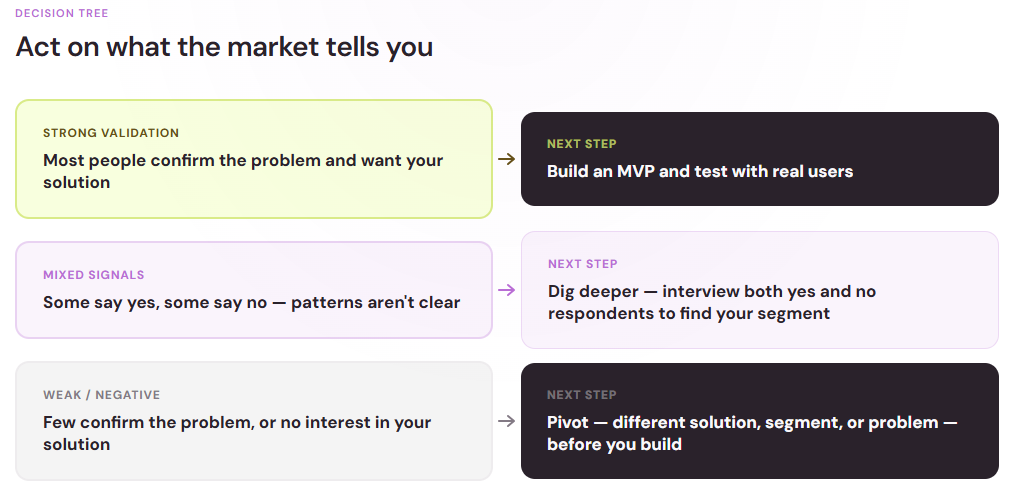
Validation results fall into three buckets:
Strong validation – Most people confirm the problem exists and express genuine interest in your solution. Next step: build an MVP and test it with users.
Mixed signals – Some people see the problem, others don't. Some like your approach, others prefer alternatives. Next step: dig deeper. Run interviews with people who said yes and people who said no. What's different about them? Is your solution better for a specific segment? Should you narrow your target?
Weak or negative validation – Few people confirm the problem, or they do but have no interest in your solution. This is uncomfortable, but it's also valuable. You've learned something important early, before you build. The next step is to pivot, either to a different solution, a different customer segment, or a different problem altogether.
The hardest part of validation is acting on results you don't want to hear. If you've tested thoroughly and the market is saying no, ignoring that feedback is expensive. The companies that succeed are the ones that listen, adjust, and test again.
Document what you hear along the way, too. A running log of quotes, objections, and repeated requests becomes the backbone of your positioning, your onboarding copy, and your first sales conversations.
Whichever outcome you land on, market validation isn't a box you check once. It's a habit you come back to. Keep asking, keep listening, and let real demand shape what you build next.