Quota sampling: definition and examples
Learn what quota sampling is, how it works, and when to use it with practical examples, advantages, disadvantages, and comparisons.
Key takeaways
- Quota sampling is a nonprobability sampling method that collects a predetermined number or proportion of respondents from specific population groups.
- Researchers can set quotas based on characteristics such as age, gender, location, or education to control sample composition.
- Quota sampling can be faster and less expensive than probability sampling because researchers do not need to randomly select respondents within each group.
- Meeting demographic quotas does not guarantee that a sample represents the broader population because respondent selection can still introduce bias.
- Quota sampling works well when researchers need specific groups represented but cannot conduct random sampling.
Quota sampling helps researchers make sure specific groups are included in a survey without requiring random selection. Researchers set quotas for characteristics such as age, gender, or location, then recruit respondents until each target is met.
This approach can make data collection faster and more practical, but it also introduces limitations that affect how researchers can interpret the results.
What Is quota sampling?
Quota sampling is a nonprobability sampling method in which researchers recruit a predetermined number or proportion of people from specific subgroups. Researchers control which characteristics are represented in the sample, but they do not randomly select the individual participants.
For example, a researcher surveying 500 customers could set quotas so the sample reflects specific age groups. Recruitment would continue within each age group until its assigned quota is filled.
Researchers can create quotas using characteristics relevant to the study, such as age, gender, location, education level, or purchasing behavior. However, because participants are not randomly selected, quota sampling can still introduce selection bias and does not guarantee that the sample represents the broader population.
How does quota sampling work?
Quota sampling works by dividing a target population into relevant subgroups, setting a recruitment target for each group, and collecting responses until every quota is filled.
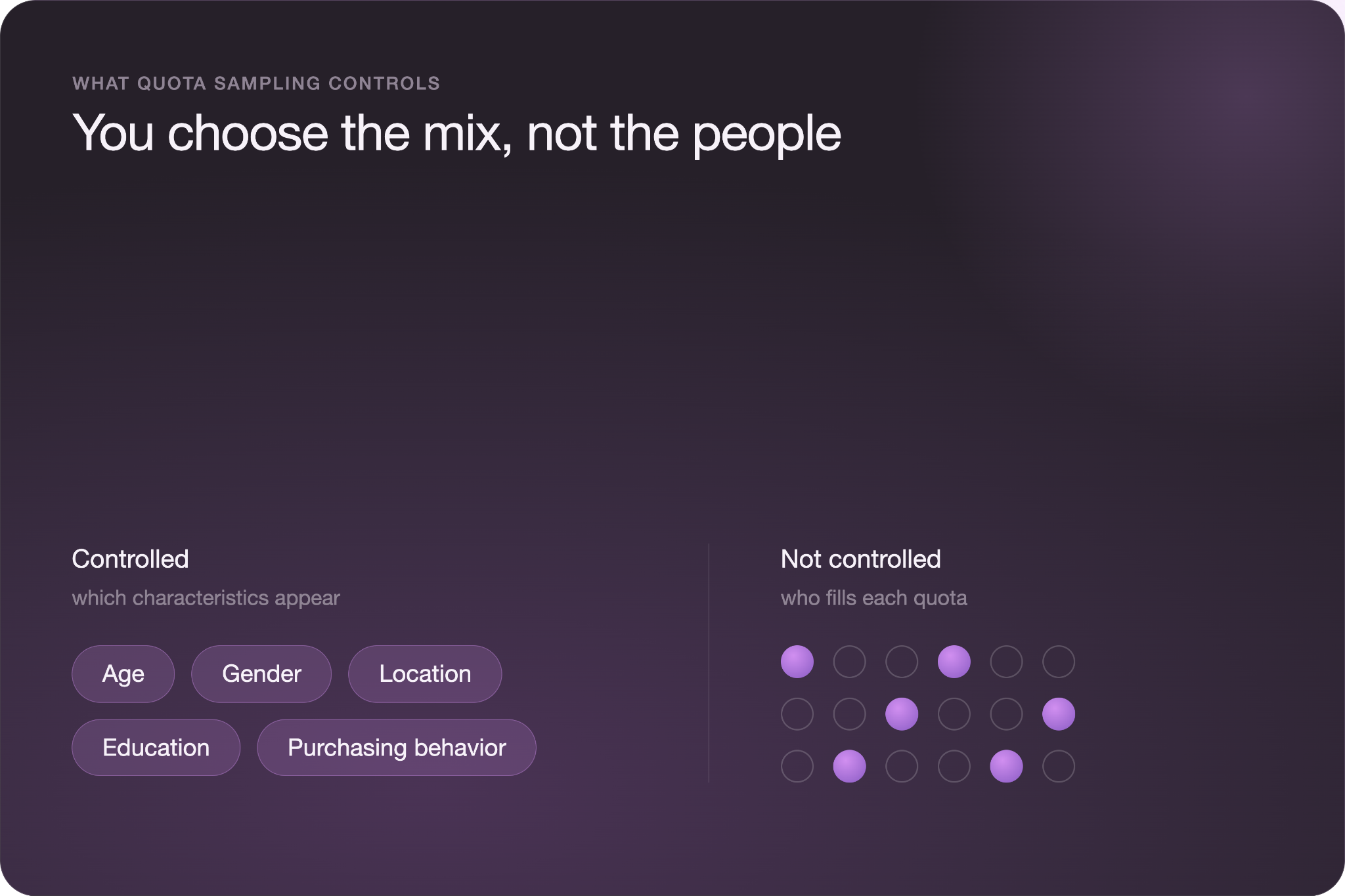
First, identify the characteristics that matter to your target audience, such as age, location, or education level. Then, determine how many respondents you need from each subgroup. These quotas may reflect the proportions found in the broader population or prioritize groups that are especially important to the research.
The next step is recruiting participants who meet the criteria for each subgroup. Unlike probability sampling, quota sampling does not require researchers to randomly select people within those groups.
Recruitment continues until each target is reached. For example, if a survey needs 100 respondents between ages 18 and 29, researchers stop accepting participants from that age group once the quota reaches 100 while continuing to fill the remaining quotas.
Quota sampling examples
Market research: A company surveying 500 consumers could set age quotas based on the demographics of its target market. If 30% of that market is between ages 18 and 29, the survey would recruit 150 respondents from that age group.
Customer feedback: A business comparing customer experiences could survey 100 new customers and 100 long-term customers. Equal quotas make it easier to compare the experiences of the two groups, even if they represent different proportions of the overall customer base.
Employee research: A company could set quotas for different departments to prevent a large team from dominating an employee survey. Researchers might recruit 50 employees each from sales, marketing, operations, and customer service.
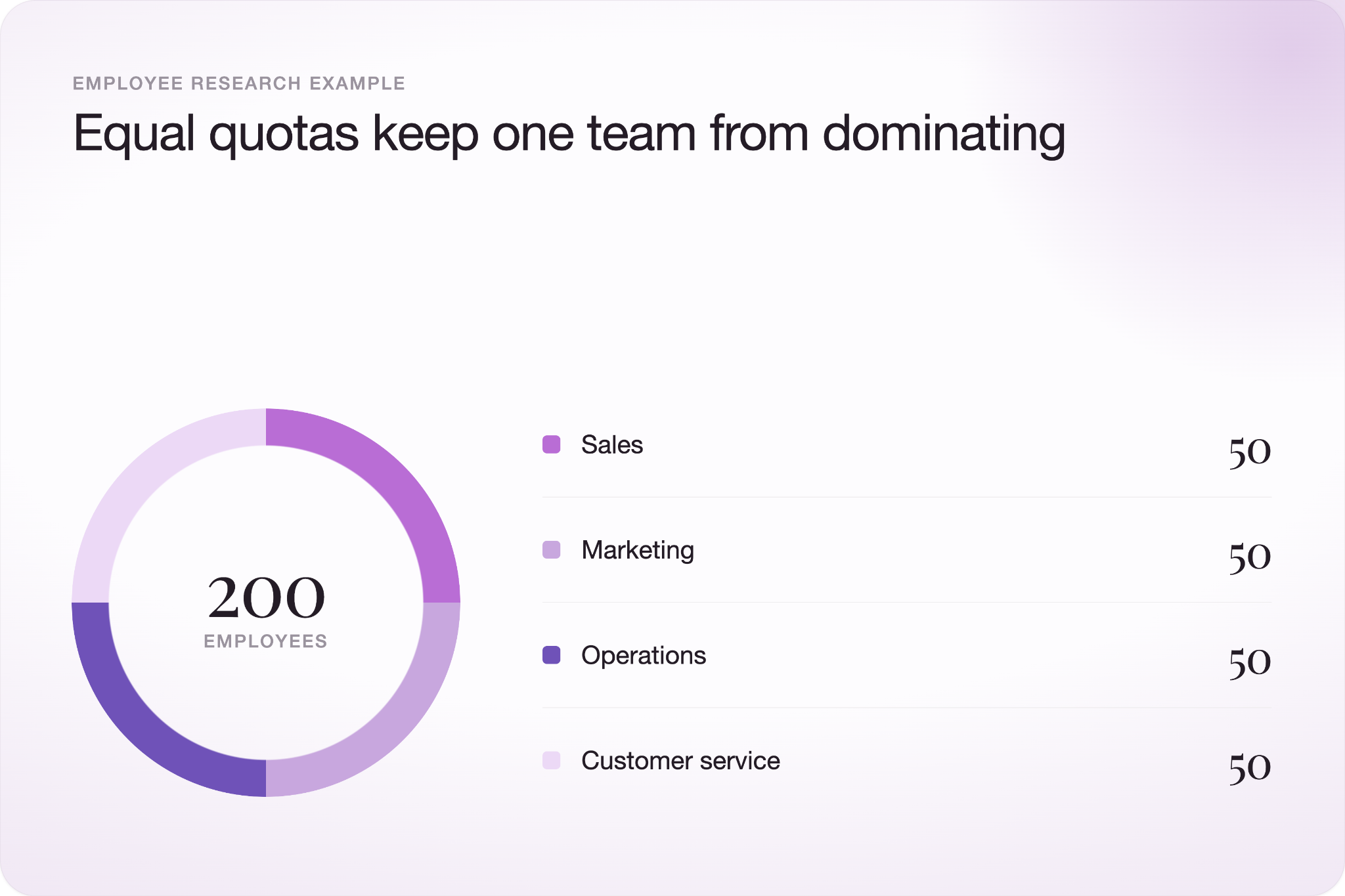
In each example, recruitment continues until the predetermined quota for each group is filled.
Advantages and disadvantages of quota sampling
Advantages of quota sampling
Quota sampling can be faster and less expensive than probability sampling because researchers do not need to randomly select participants from a complete population list. Setting quotas also helps prevent important groups from being left out of the sample.
Researchers can also adjust quotas based on the goal of the study. Proportional quotas can reflect known population characteristics, while equal or custom quotas can provide enough responses to compare specific groups.
Disadvantages of quota sampling
Quota sampling can introduce selection bias because participants within each subgroup are not randomly selected. Meeting a set of demographic quotas does not guarantee that the respondents represent the broader population in other important ways.
This limitation also makes it harder to generalize findings from a quota sample to the entire population with the same statistical confidence as probability sampling.
Quota sampling vs. stratified sampling
Quota sampling and stratified sampling both divide a population into subgroups, but the methods select participants differently. Quota sampling uses nonrandom selection, while stratified sampling randomly selects participants from each subgroup.
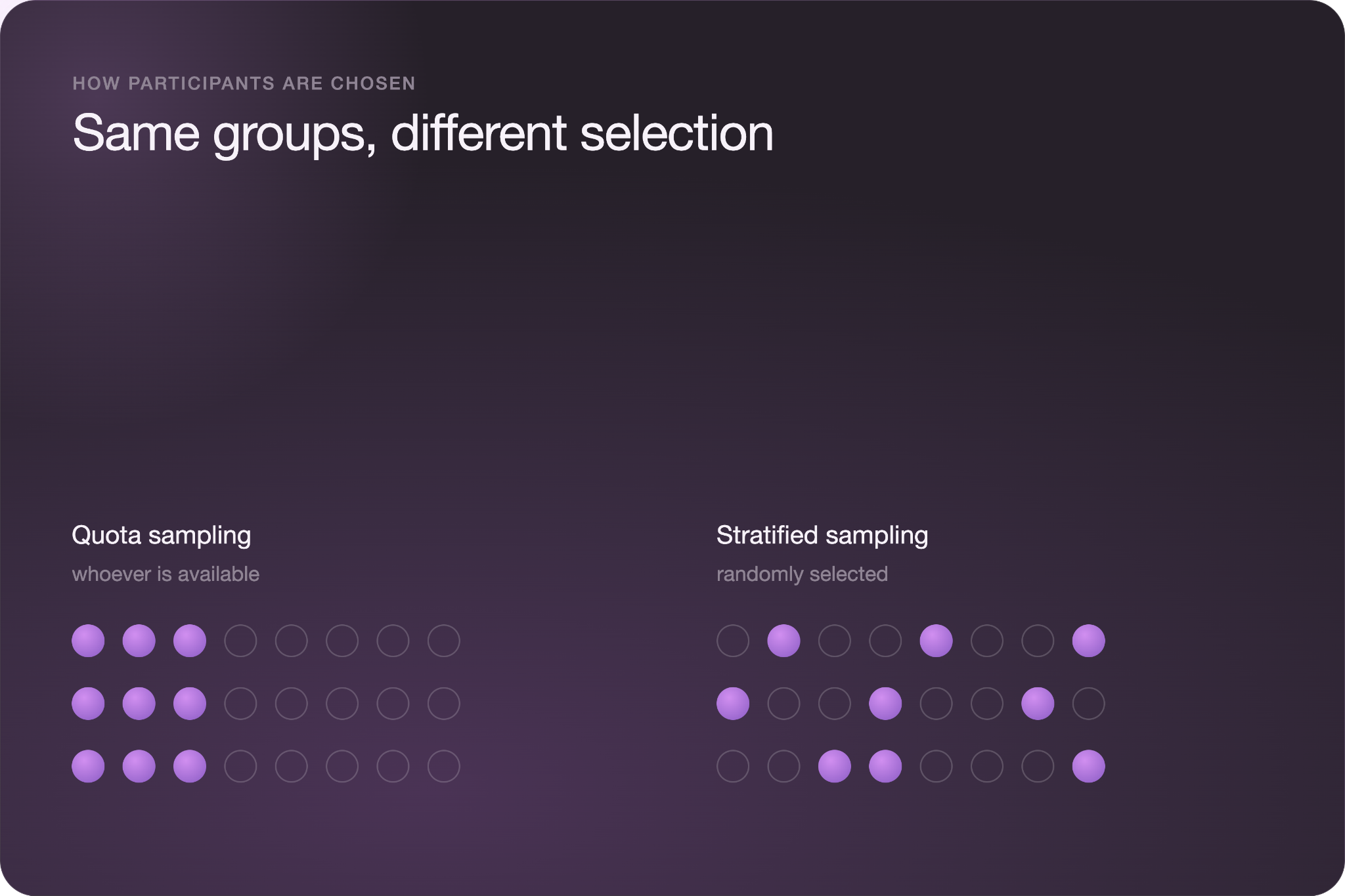
For example, both methods could divide customers into age groups before collecting responses. With quota sampling, researchers survey available participants until each age target is filled. With stratified sampling, researchers randomly select participants from each age group.
This distinction makes stratified sampling a probability sampling method and quota sampling a nonprobability sampling method. Stratified sampling also requires a sampling frame, while quota sampling does not.
When should you use quota sampling?
Use quota sampling when specific groups need to be represented in your research but random sampling is impractical. It can work well for market research, customer feedback, exploratory studies, and other projects where time, budget, or access to participants makes probability sampling difficult.
Quota sampling is also useful when no complete sampling frame exists or when researchers need enough respondents from particular groups to make meaningful comparisons.
Avoid quota sampling when the research requires precise estimates about a broader population. Participants are not randomly selected, so the results cannot provide the same level of statistical inference as a probability sample.
Once researchers establish their quotas, they can use a survey platform like Typeform to collect responses from the selected groups.
Frequently asked questions
Is quota sampling a probability or nonprobability sampling method?
Quota sampling is a nonprobability sampling method. Researchers set targets for specific subgroups but do not randomly select the individuals who fill those quotas. As a result, researchers generally cannot determine each member of the population’s probability of being selected.
What is the difference between quota sampling and convenience sampling?
Both quota and convenience sampling are nonprobability methods, but quota sampling controls the number or proportion of respondents from specified groups. Convenience sampling focuses on recruiting participants who are readily available without requiring the sample to meet predetermined subgroup targets.
Is quota sampling representative?
Quota sampling can match a population on selected characteristics, but that does not guarantee a representative sample. Respondents may differ from the broader population in characteristics that the quotas do not control, and nonrandom participant selection can introduce selection bias.