Population vs sample: the difference explained
Learn the difference between population vs sample, how sampling works, and why choosing the right sample is important for your research.
You may not need to ask everyone a question to get a useful answer.
Key takeaways
- Population is the entire group; sample is the smaller group: Your population includes everyone you want to understand, while your sample is the group of people you actually research.
- You typically don’t need to ask everyone: A well-chosen sample gives you useful insights into a much larger population without the time and cost of a census.
- A bigger sample is not automatically better: How you choose your sample matters just as much as how many people you include. A biased sample leads to misleading results.
- Start with your research question: Knowing exactly who you want to understand makes it easier to define your population and choose the right sampling method.
- Good survey design still matters: A representative sample could still provide weak insights if you have confusing, leading, or irrelevant questions.
Let’s think about it. If you want to know how people in your city are feeling about the newest restaurant opening, you don’t need to knock on every single door and ask for an opinion. You could simply ask a small group of people, look at their answers, and use those responses to better understand the bigger picture.
This is where population vs sample comes in.
These two terms will show up just about everywhere during your research, in surveys, statistics, and market research. While they do sound a little academic, the idea behind them is actually simple.
A population is the whole group that you want to understand. A sample is the smaller group you actually study.
Let’s break it down and explain what that means, why the difference matters, and how to choose a sample that gives you useful results.
What is a population?
In research, a population is the entire group of things, people, or observations that you’re interested in learning about. That group can be large or surprisingly small.
For example, your population could be:
- Every customer who purchased your product last year
- All employees at your company
- College students in the United States
- People who subscribe to your newsletter
- Every household in a particular city
The important thing to know: the population represents the entire group that you want your research to say something about.
So, say you run an online clothing boutique and want to know how satisfied your customers are with their recent purchases.
Your population could be every customer who made a purchase during the past 12 months.
In a perfect world, you would be able to ask every one of them for feedback. But depending on the size of your customer base, that could take a lot of time.
And that brings us to the sample.
What is a sample?
A sample is a smaller group that’s selected from the population for your research.
Instead of asking every customer, you can randomly select 500 customers and send them a satisfaction survey. Those 500 people are your sample.
The goal is for the sample to provide you with a useful picture of the larger population without having to collect responses from everyone.
This is why sampling is extremely useful for surveys and research. You can collect meaningful data without spending the time and money required to reach an entire population. We break this down further in our guide to sampling methods: surveying an entire population is rarely practical or necessary, so researchers choose a subset that can represent the whole.
For a simpler way of remembering it:
- Population = everyone you want to understand.
- Sample = the people you actually study.
Population vs sample: what’s the difference?
The easiest way to understand population vs sample is to think of the population as the whole pizza and the sample as a few slices. You don’t have to eat the entire pizza to know what it tastes like. (Although, admittedly, you might want to.)
In research, you use the sample to make observations about the larger population.
For example, imagine a company has 20,000 customers. The population is all 20,000 customers. The company may want to survey 1,000 of those customers. Those 1,000 people are the sample.
If the sample is selected carefully and reflects the larger customer base, the company can use the results to make reasonable conclusions about all 20,000 customers.
Why not survey the entire population?
This is a fair question.
Sometimes you can study the entire population. This is called a census, and the U.S. Census is one of the most familiar examples of this. But for most research projects, surveying everyone is just not realistic.
A sample gives you a much more manageable group.
Another benefit: a smaller study can be easier to manage well. You have fewer responses to collect, organize, clean, and analyze. You also need to consider people’s time.
Most people don’t want to spend 30 minutes answering a survey. Asking a carefully selected group to participate can make research more practical for both the researcher and the people answering the questions.
What makes a good sample?
Now, we’re digging into the most interesting aspect of sampling. Not every sample is automatically useful.
If you want your sample to tell you something about your population, then it should resemble that population in ways that matter specifically to your research.
For example, imagine your customer base is:
- 60% women
- 40% men
- A mix of ages
- Customers from several different regions
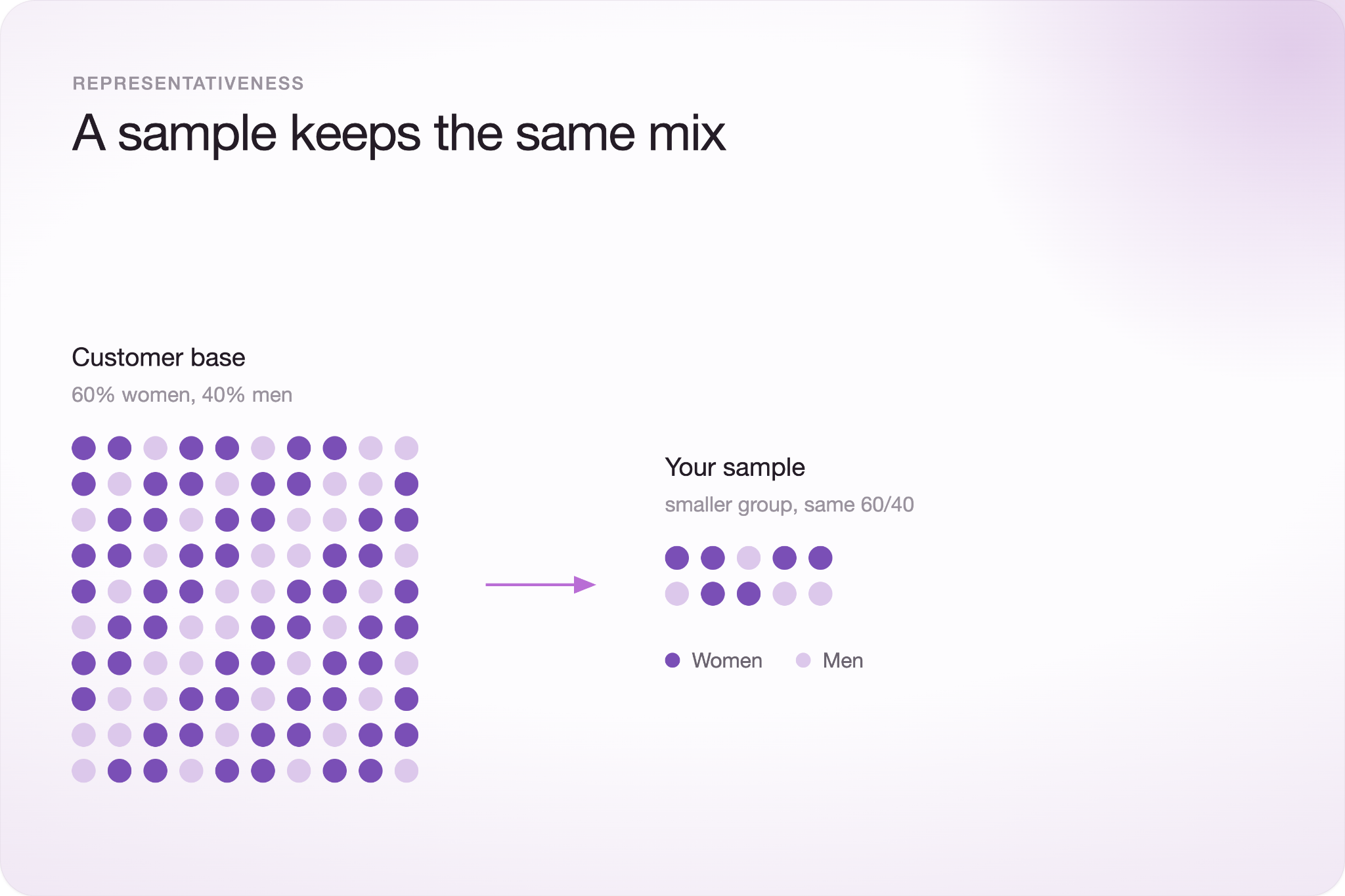
If your survey responses come almost entirely from one demographic, your results might not represent your customers that well.
This is why researchers pay close attention to representativeness. This type of sample will reflect important characteristics of the population you’re studying. However, it doesn’t need to perfectly mirror the population in every possible way. Instead, you want to make sure that the sample makes sense for the question you are asking.
You also want to think about who is likely to respond.
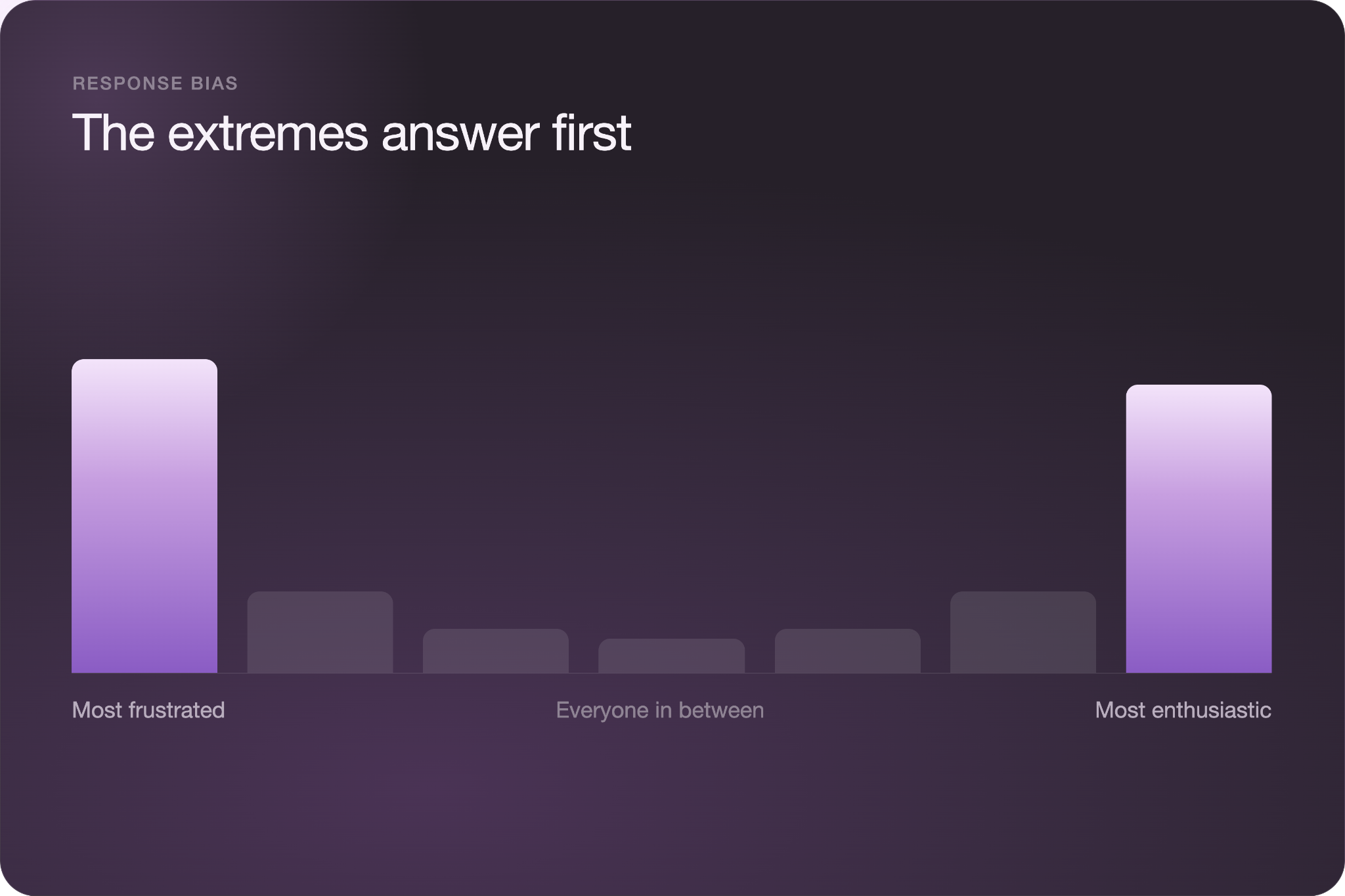
If you email a survey to 5,000 customers but only your happiest and most frustrated customers respond, the people who answered may not reflect your typical customer. This is known as response bias, and it’s one reason researchers must think carefully about how they recruit participants.
How do you choose a sample?
There are a several ways you can select people for a sample.
- One of the most straightforward methods is simple random sampling. This is where everyone in the population has a chance of being randomly selected.
- There is also stratified sampling, where you divide the population into relevant groups and choose your participants from each group. This helps ensure important subgroups are represented.
- Another option is systematic sampling, where you select people at a regular interval from a list. For example, you would choose every 20th person after selecting your random starting point.
- And then there is cluster sampling, where you divide the population into groups, randomly select some of those groups, and survey people within them.
- There is also a non-probability method called convenience sampling, where participants are chosen because they are easy to reach.
There are pros and cons for each option. The right one depends on your research goals, the population you are studying, and the resources you have available. For a smaller customer feedback survey, for example, you can have different priorities than someone conducting academic research with a strict methodology.
The key is choosing a sampling method intentionally rather than simply asking whoever happens to be available.
Population vs sample size: how many people do you need?
This is one of the biggest questions that many researchers face. How big does your sample size actually need to be?
The answer: it depends.
A large population doesn’t automatically mean that a massive sample is required. You may be researching a population of 100,000 people, but that doesn’t mean you need to collect 10,000 survey responses.
What does matter, however, is the level of confidence and precision needed, along with factors like your research design, expected variability, and how representative your sample is. Let’s not forget your time and budget.
Remember, bigger isn’t always better if the sample itself is poorly selected. You can collect 10,000 responses, but if they all come from the same narrow group, you could still have a problem.
Basically, quality matters just as much as quantity.
What happens when your sample doesn’t represent the population?
This is where sampling bias can cause some trouble.
Let’s say a company needs to find out how satisfied its customers are. It will send out a survey, but decide to only send out the survey to the most loyal customers. This often happens because they may be more enthusiastic about the company than the average customer.
While the results can look great, they wouldn’t necessarily represent the entire customer population. That’s why it’s essential to think about who is included in your sample and who might be missing.
So, before sending out your survey, ask yourself: does this group actually represent the people I’m trying to understand?
If your answer is no, then your results may not tell the entire story.
Population vs sample: a quick example
Let’s put everything together.
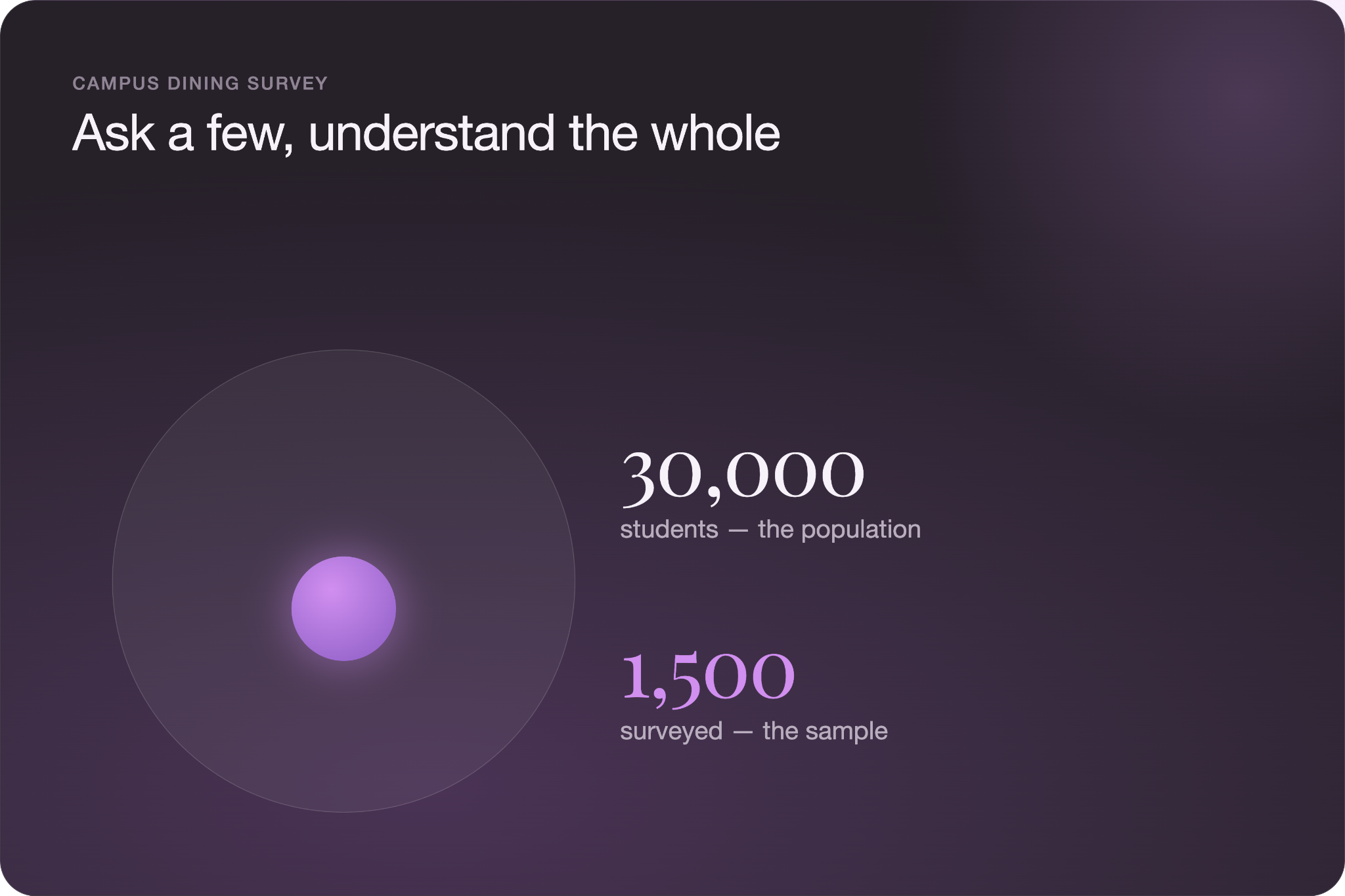
Imagine a university has 30,000 students. They want to find out how students feel about its campus dining options.
Population
All 30,000 students are the population.
Sample
The university randomly selects 1,500 students to complete the survey. Those 1,500 students are the sample.
Research goal
The university analyzes the survey responses to better understand how the broader student population currently feels about campus dining. If the sample is well selected, the university can use the results to make decisions about its dining services without needing to ask all 30,000 students.
That’s the basic idea behind sampling.
Population vs sample in surveys
If you are interested in building a survey, understanding the difference between population and sample is especially important. So, before writing your questions, figure out who you are actually trying to learn about.
Are you researching all of your customers? New customers? People who abandoned their shopping carts? Employees who have been at the company for more than a year?
That group is your population.
Then you will want to decide who you can realistically reach and how you will select participants from that group. Your survey itself is only one piece of the puzzle. The people who answer it matter just as much.
Remember, a beautifully crafted survey will not fix a poorly chosen sample.
And the reverse is also true. Even a well-selected sample can produce weak insights if your questions are confusing, leading, or irrelevant. A great survey design will help you collect better data and make it easier for people to actually complete the survey.
So, which one should you choose?
When comparing population vs sample, the difference between the two is pretty simple once you see it.
Your population is who you want to understand, while your sample provides a practical way to learn about that group.
The key is knowing the difference.
Start by clearly defining your population. Then think about how you can select a sample that represents the population as fairly as possible. From there, you can build your survey, collect responses, and analyze the results with a better understanding of what they actually mean.
Because at the end of the day, research isn’t about asking as many people as possible. It’s about asking the right people the right questions and using their answers to make better decisions.