Message Testing: A Playbook for Marketers
Learn how message testing helps marketers create clearer, more effective campaigns backed by customer insights.

Key Takeaways
- Message testing validates copy before launch: It shows teams what resonates, what confuses audiences, and what actually drives action.
- Combining quantitative and qualitative feedback reveals more than either alone: It shows not just which message performs best, but why.
- A structured process leads to better decisions: Defining clear objectives upfront and following through to analysis keeps marketers from guessing at what worked.
- AI-powered tools can speed up the analysis: Platforms like Research Flow support adaptive conversations and quickly surface themes, sentiment, and customer insights from the responses collected.
This is what many marketers are currently facing. They know the product’s value inside and out, but the audience is not able to see it through the same lens. This helps bring out their own priorities, experiences, and assumptions to every message they encounter.
We’re here to help bridge that gap with message testing.
Instead of relying mostly on internal opinions, assumptions, or the loudest voice in the room, message testing allows marketers a structured way to learn and understand what is resonating with their target audience, what is creating confusion, and what is motivating people to take action.
No matter if you’re launching a campaign, updating website copy, or preparing a new product release, message testing will answer one critical question: Does this message mean what we think it means to the people we’re trying to reach?
Our guide explains what it is and why it matters and ways marketers can build a repeatable process for running effective message tests.
What is message testing?
It’s the process of evaluating how an audience responds to specific marketing messages before they are used at scale.
The message test can examine the following:
- Product positioning
- Value propositions
- Headlines
- Taglines
- Website copy
- Campaign concepts
- Brand narratives
- Email messaging
- Advertising creative
The goal isn’t just to find the message people will like the most. Having an effective message is about uncovering deeper insights:
- What does the audience understand?
- What feels relevant to them?
- What creates interest or urgency?
- What questions or objections come up?
Why message testing matters for marketers
There are several reasons why it matters. Let’s take a look at a few.
Replaces the guesswork
Marketers can replace the guesswork with customer proof. Marketing teams often develop the message based on what they think customers care most about.
The problem?
Internal teams are experts on their products. Customers are experts on their own problems. Because of this, these perspectives don’t always align. A company can emphasize a feature because it took months to build, while customers only care about the outcome that it enables. Message testing reveals whether the audience connects with the story marketers are telling.
Let’s look at an example.
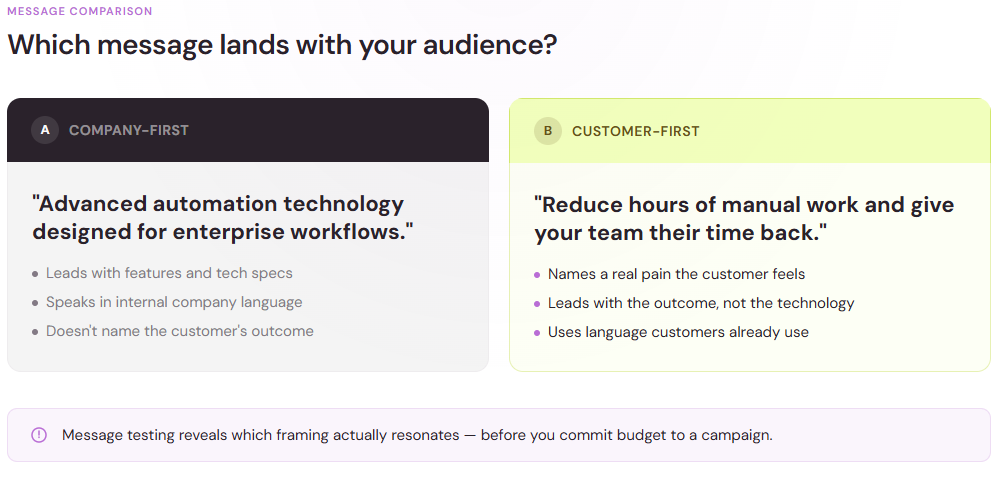
A software company wants to test these two messages:
- Message A: Advanced automation technology designed for enterprise workflows.
- Message B: Reduce hours of manual work and give them their time back.
Both are describing the same product, but they will create two completely different reactions. Through message testing, you can determine which message will better communicate its value.
Improves conversion across the customer’s journey
As we all know, messaging influences almost every stage of the buyer’s journey. Having a strong message can:
- Capture attention in an advertisement
- Encourage someone to click an email
- Help a prospect understand a product page
- Address objections during consideration
- Reinforce confidence before a purchase
Weak messages will create friction. Even if the product itself is strong. This is why testing messaging early is crucial, as it allows marketers to identify any confusion before investing a significant amount of time and budget into their campaigns.
Helps teams understand the “why” behind customer decisions
A survey is helpful in telling you that customers prefer one headline over another. But the most important question is the “why.”
Did the winning message feel clearer? Was it more emotional? More trustworthy?
These details matter because marketers need more than just a winning option. They must understand the underlying motivation so they can take those insights and apply them across channels, campaigns, and customer experiences.
This is where qualitative research comes especially valuable.
The message testing process: a step-by-step guide
Step 1: Define what you want to learn
Before creating any questions, define the decision you need research to support. It’s best to avoid starting with “Which headline is better,” and start with “What do we need to understand about our audience’s perception?”
Having this clear research objective will ultimately create better questions and more actionable results.
Step 2: Identify your audience
The quality of your message testing depends on who provides feedback. Your audience should reflect the people you are looking to reach.
Depending on your goals, participants might include:
- Current customers
- Prospective customers
- Lost customers
- Industry professionals
- Specific demographic or behavioral groups
Testing the wrong audience can create misleading results. A message that performs well with existing customers may not work with people who haven’t heard of your brand.
Step 3: Create multiple message variations
Don’t just test one message. Without alternatives, you are measuring whether people understand a message and not whether it is the strongest option.
Things to test can include a few options:
Value proposition: “Manage projects more efficiently.” vs. “Bring your entire team’s work into one place and eliminate unnecessary back-and-forth.”
Emotional appeal: “Improve productivity.” vs. “Spend less time managing tasks and more time doing meaningful work.”
Customer-focused language: “We provide AI-powered analytics.” vs. “Get answers faster without spending hours analyzing data.”
Majority of the time, the best message is often the one that reflects the audience’s priorities and not the company’s internal terminology.
Step 4: Ask the right questions
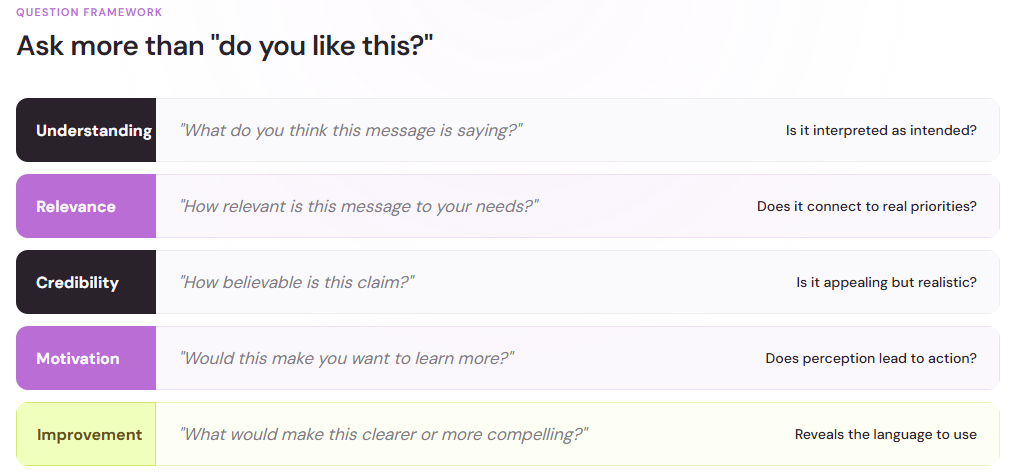
Having effective message testing goes beyond asking, “Do you like this?” This is because preference alone doesn’t always predict action.
So, what are better questions to include:
Understanding
“What do you think this message is saying?” This reveals whether your audience interprets the message as intended.
Relevance
“How relevant is this message to your needs?” This shows whether the message connects with customer priorities.
Credibility
“How believable is this claim?” This message is appealing but not always realistic.
Motivation
“Would this message make you want to learn more?” This connects perception to potential behavior.
Improvement
“What would make this message clearer or more compelling?” Having an open-ended question often reveals the language marketers should use in future campaigns.
How AI-powered research changes message testing
Traditional message testing can be valuable, but it will require significant time and resources. Often times, teams will need to:
- Recruit participants
- Schedule interviews
- Conduct conversations
- Review recordings
- Identify themes
- Organize findings
AI-powered research tools are changing how teams approach this process by helping automate parts of research while still capturing deeper customer feedback.
As an example, Typeform’s Research Flow is designed around an AI-moderated research workflow. It will help teams design studies, recruit participants (or use their own audience) to conduct AI-moderated conversations through video, voice, or text, and then analyze responses by surfacing themes, quotes, sentiment, and clips.
For marketers message testing, using that approach is useful because message feedback is rarely limited to a simple preference. A participant can say they prefer one message, but their explanation reveals that:
- A phrase feels too technical
- A benefit is unclear
- A claim feels unrealistic
- A different customer problem matters more
Using these AI-moderated conversations can help uncover those deeper reactions by asking adaptive follow-up questions based on participant responses.
Using message testing with research flow
As an example, a marketing team is preparing a campaign for a new customer analytics platform. The team creates three possible messages:
Message A: Advanced analytics that help businesses make smarter decisions.
Message B: Turn customer data into insights your team can act on immediately.
Message C: Stop guessing what customers want. Use data to understand their next move.
The team wants to understand:
- Which message feels the most relevant?
- Which message creates the strongest interest?
- What language do customers use when describing the problem?
Using research workflow like ours, the team can do the following:
- Design the study: Define the goal, audience, and discussion questions.
- Recruit participants: Gather feedback from current customers, prospects, or a relevant audience group.
- Run conversations: Participants respond through text, voice, or while AI moderation asks follow-up questions to explore their reactions.
- Analyze findings: The team reviews themes, quotes, sentiments, and patterns to understand which message performed best and why.
The outcome isn’t just about a winning headline. It’s a deeper understanding of customer language that helps influence website copy, sales materials, ads, emails, and future campaigns.

Common message testing mistakes to avoid
Let’s take a look at some common mistakes you can avoid when message testing.
Testing with internal stakeholders instead of customers
Your team knows too much about products. Customers do not. Internal feedback is helpful, but it shouldn’t replace audience research.
Asking leading questions
It’s important to avoid questions that push participants toward a preferred answer.
Instead of asking, “Don’t you think this message clearly explains our value?” You can ask, “What does this message mean to you?”
Testing too late
Many teams will often wait until campaigns are almost completed before gathering their feedback. Message testing works best early, when insights can still influence strategy.
Focusing only on the winner
The most valuable insight is often hidden in its explanation. If customers reject a message, that feedback can reveal:
- Missing information
- Confusing language
- Unmet needs
- New positioning opportunities
Turning message testing into an ongoing marketing practice
This shouldn’t be a one-time project. Customer language changes. Markets shift. Competitors evolve. The strongest marketing teams will continue learning from their audience.
A repeatable message testing process can help teams:
- Validate new campaign ideas
- Improve conversion-focused copy
- Strengthen product positioning
- Understand customer motivations
- Create messaging based on real customer language
A marketer’s goal isn’t to eliminate creativity from marketing. It’s to give creativity a stronger foundation. Having a great message isn’t created in isolation. It’s created by understanding what matters to the people you’re trying to reach.
Putting message testing into practice
Message testing gives marketers a way to move from “we think this will work" to “we know why this resonates.”
By combining structured research, customer conversations, and actionable analysis, teams can create messages that are clearer, more relevant, and more likely to drive action from customers. Whether conducted through traditional research methods or newer AI-powered approaches like Research Flow, the principle remains the same: the best marketing messages are not the ones companies want to say. They’re the ones customers understand, believe, and remember.