Probing questions: Definitions, comparisons, and examples
Probing questions turn vague answers into real insight. See 5 types, how they compare to open and closed questions, and common mistakes to avoid.
Probing questions are follow-ups designed to dig deeper into an answer someone already gave. They're the difference between surface-level feedback and real insight.
When you ask someone "How did the product feel to use?" and they say "Fine," a probing question might be "What could we change to make it feel better?" That second question uncovers what they really think. It turns a throwaway response into actionable information.
In research, surveys, and customer conversations, probing questions are essential. They help you move past "yes" and "no" to understand the "why" and "how." This guide covers what probing questions are, how they differ from other question types, and when to use them to get better data.
What is a probing question?
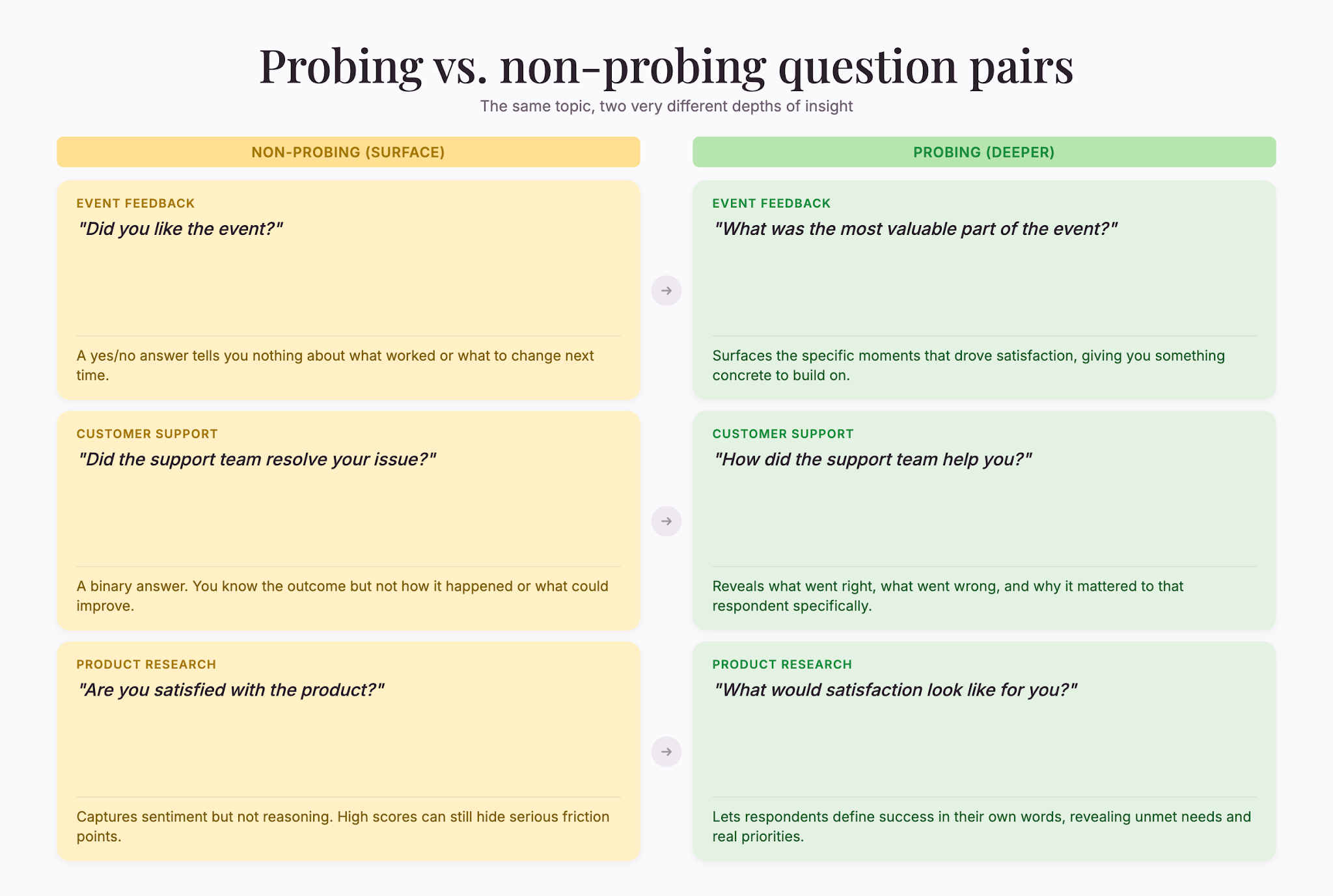
A probing question asks a respondent to elaborate, clarify, or explain something they've already said. It goes deeper than a surface-level inquiry. Instead of asking "Are you satisfied?" you might follow up with "What would satisfaction look like for you?"
Probing questions work in two ways:
- During interviews – You ask them in real time, naturally continuing the conversation based on what someone tells you.
- In surveys – You build them in as follow-up questions (often conditional, so they only appear based on earlier answers).
The goal is always the same: get richer, more honest, more useful information than a one-word or simple answer would give you.
Probing questions vs. closed-ended questions
Closed-ended questions ask respondents to pick from predefined options. The most common type is the dichotomous question—a yes/no pair.
Dichotomous questions have exactly two answer options. Common pairs include yes/no, agree/disagree, true/false, and satisfied/unsatisfied (SurveySparrow Dichotomous Questions, 2024). These are fast to answer and produce categorical data that's easy to quantify and graph without complex statistical software (piHappiness Dichotomous Questions Best Practices, 2024). They're also well suited to screening and quick assessments.
But they have limits. Binary questions can oversimplify and miss variance on a continuum. Respondents may rush through them, which can hurt reliability (Zonka Feedback Why to Avoid Dichotomous Questions, 2024). For this reason, researchers often pair dichotomous questions with open-ended or Likert-scale questions to capture richer detail alongside fast quantitative data.
Probing questions go the other direction. Instead of forcing a choice from a list, they invite respondents to explain in their own words. They reveal context, emotion, and nuance that closed-ended options can't capture.
Comparison:
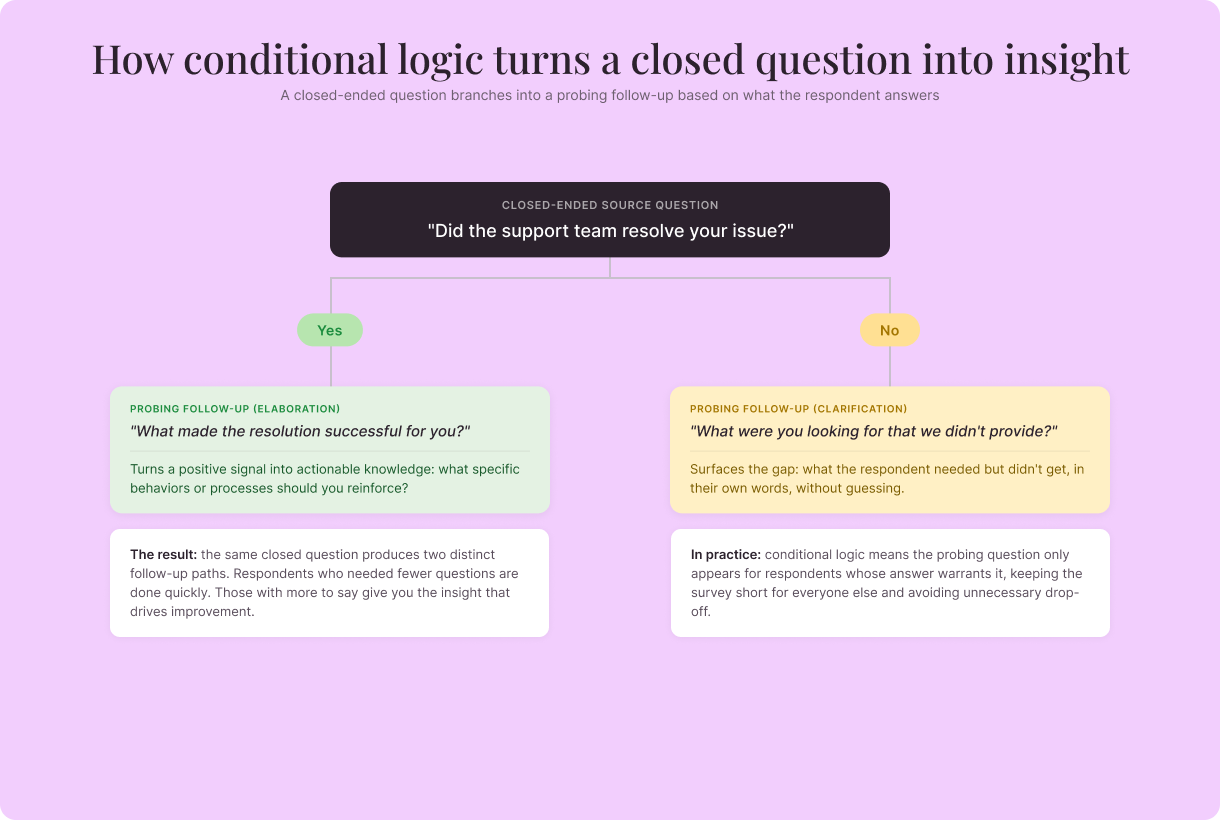
- Closed-ended (dichotomous): "Did the support team resolve your issue?" → Answer: Yes.
- Probing: "How did the support team help you?" → Answer: "They were quick, but they didn't understand my technical setup at first. Once I explained it, they were great."
The probing version tells you what went right, what went wrong, and why it mattered.
Probing questions vs. open-ended questions
Open-ended questions ask respondents to answer in their own words without preset options. They're different from probing questions because they don't assume a prior answer to build on.
Open-ended example: "What features would you most like to see in this product?"
Probing example: (After they mention a feature) "Why is that feature important to you?"
Open-ended questions cast a wide net. Probing questions zoom in on a specific piece of information someone already shared.
In practice, many researchers use both. An open-ended question gives respondents freedom to say what matters most to them. A probing question then clarifies or deepens that answer. Together, they often uncover insights that neither could alone.
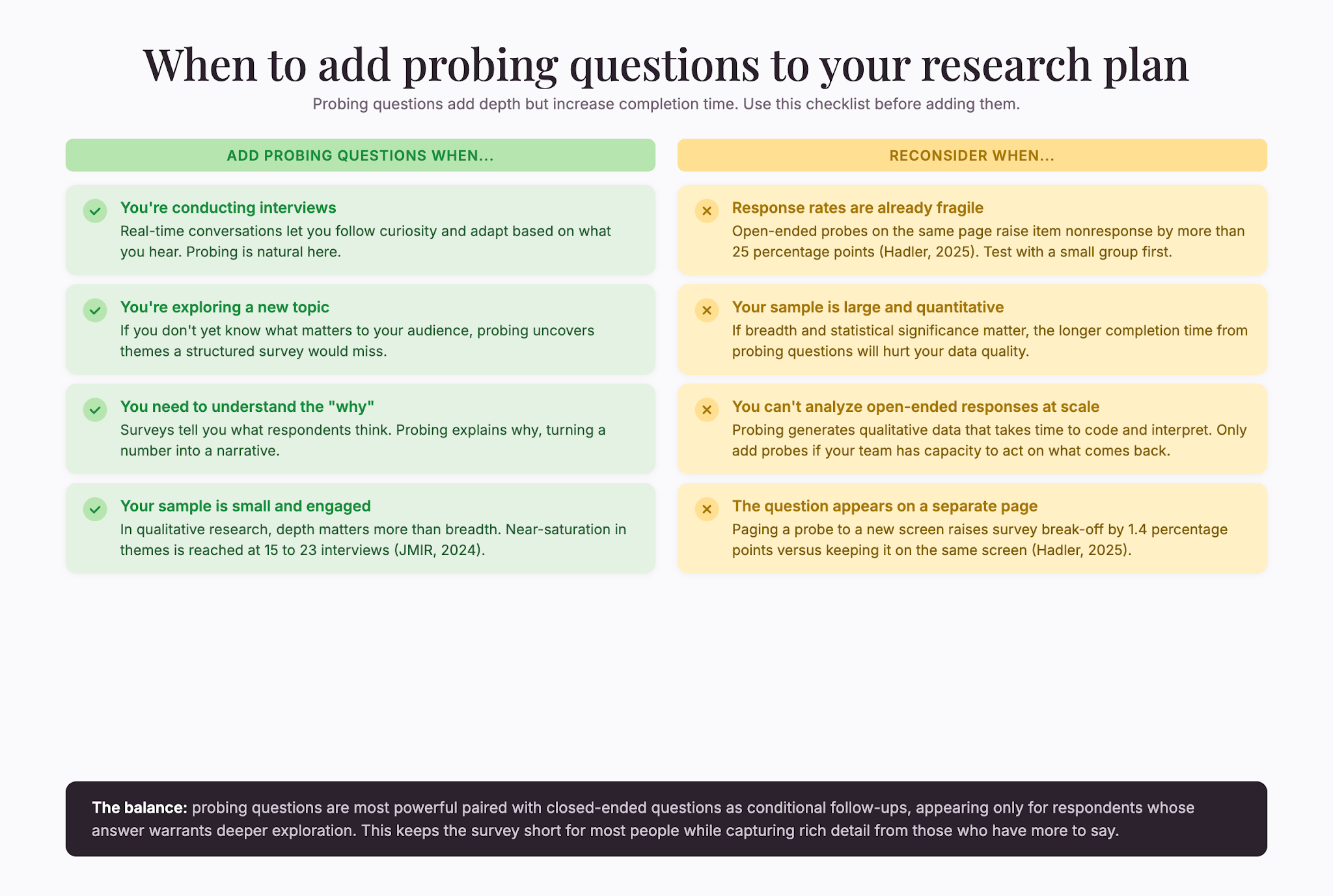
The tradeoff is time. Open-ended and probing questions take longer to answer and analyze than closed-ended ones. Adding probing questions to a survey can increase respondent dropout. Research shows that open-ended probes on the same page as the source question raise survey break-off by 0.6 points and item nonresponse by more than 25 percentage points (Hadler, Sociological Methods & Research, 2025). Paging probing questions to a separate screen increases break-off further, by 1.4 percentage points. If you're collecting data across teams, consider pacing and page design carefully.
Types of probing questions
Probing questions take several forms, depending on what you're trying to learn.
Clarification probes. These ask the respondent to explain what they meant or to rephrase a vague answer.
- "When you say 'complicated,' what do you mean?"
- "Can you give me an example?"
- "Who was involved in that decision?"
Elaboration probes. These ask for more detail or more examples.
- "Tell me more about that."
- "What happened next?"
- "How did that affect your work?"
Exploratory probes. These push the respondent to think beyond their initial answer.
- "Have you experienced anything similar before?"
- "What would an ideal solution look like?"
- "How does this compare to other tools you've tried?"
Confirmation probes. These check that you understood correctly.
- "So you're saying that X led to Y, right?"
- "Does this mean you'd recommend it to a colleague?"
Contradictory probes. These gently challenge an answer to see if the respondent reconsiders or stands firm.
- "Earlier you said X was important, but then you described it as secondary. How do those fit together?"
(Use these carefully—they're useful in interviews where you can build trust, but they can feel aggressive in written surveys.)
When to use probing questions
Probing questions are most useful when:
- You're interviewing – Real-time conversations let you follow curiosity and adapt based on what you hear. Probing is natural here.
- You're exploring a new topic – If you don't yet know what matters to your audience, probing questions help you uncover themes and patterns you might have missed in a structured survey.
- You need to understand the "why" – Surveys can tell you what respondents think; probing questions explain why.
- Response rates are high enough to absorb longer completion times – Remember the tradeoff: probing questions increase dropout. Use them if your sample size and respondent motivation allow.
- You're studying a small, engaged group – In qualitative research, probing is standard. Sample sizes are smaller, and depth matters more than breadth. Research on data saturation shows that near saturation (90% of codes) in qualitative research is reached at 15–23 interviews, while true saturation requires 30–67 interviews (Journal of Medical Internet Research, 2024).
Common mistakes when using probing questions
Leading the witness A leading probing question suggests the answer you want. "Wasn't the checkout process easy?" isn't really a probe—it's a prompt to agree with you.
Better: "What was the checkout process like for you?"
Being too vague "Tell me more" doesn't give respondents enough direction. They won't know what you actually want to know.
Better: "What part of the onboarding felt most confusing?"
Assuming knowledge Not all respondents have the context to answer a follow-up. If someone says "I didn't use the advanced settings," don't assume they know what those settings do.
Better: "Can you tell me what made you decide not to explore those options?"
Anchoring bias The order and framing of questions influence how respondents answer—a phenomenon called anchoring. When Tversky and Kahneman asked participants to estimate the product of 1–8, those given ascending sequences produced a median estimate of 512, while those given descending sequences estimated 2,250—a 4x difference from the same numbers in different order (Tversky & Kahneman, Science, 1974). In probing, this means the way you frame your first question shapes the second.
Better: Vary the order and wording of probes to reduce this effect.
Triggering social desirability bias When people sense a "right answer," they give it instead of the truth. If you ask "How committed are you to our brand?" and then probe "Why do you feel that way?"—the first question signals which answer is acceptable, and the probe won't get honest elaboration.
Better: Ask the probing question first, or frame it neutrally: "What role does this product play in your work, if any?"
Social desirability bias and acquiescence bias (the tendency to agree with statements regardless of content) are common in surveys (Qualtrics, 2025). Probing questions can help uncover what respondents really think, but only if they're asked in a way that feels safe.
How to write effective probing questions
Start neutral. Avoid words that imply judgment ("only," "just," "surprisingly"). Let respondents answer without feeling judged.
Be specific. "Tell me about your experience" is too broad. "What part of the experience surprised you most?" focuses the probe.
Listen first. In interviews, don't plan every probing question ahead of time. Listen to what the respondent says, and let that guide your follow-ups. Authenticity builds trust and gets better answers.
Use "what" and "how" more than "why." "Why" can feel accusatory ("Why didn't you like it?"). "What" and "how" feel more exploratory ("What didn't you like about it?" or "How could we improve it?").
Leave silence. After someone answers, pause. The instinct to fill silence is strong, but many respondents will elaborate on their own if you give them space.
Keep it short. Long, complex probing questions lose respondents. One clear question per probe is best.
Collecting probing data across the organization
In surveys, probing questions typically work as conditional follow-ups: they only appear if someone gives a specific answer to the source question. This keeps the survey short for most respondents while capturing detail from those who need it.
For example, If someone answers "No" to "Did you find what you needed on our website?" the next question might be "What were you looking for?" This probe only appears for people who said no, so it doesn't add length to the survey for satisfied respondents.
Designing these workflows—deciding which questions trigger which probes, and how to organize the logic—can get complex quickly, especially when you're running multiple parallel surveys or tracking responses over time. Tools that support conditional logic and automated workflows can save time and reduce errors. ResearchFlow is one example of a feature that helps researchers set up these conditional surveys and manage the data collection process, so you can focus on analysis rather than administration.
The key is balance: you want enough probing data to understand respondents deeply, but not so much that you overwhelm them or yourself. Pilot test your probing questions with a small group first. Watch for drop-off, and adjust pacing and complexity based on what you see.
Real-world examples
Customer feedback survey. After "Would you recommend us to a colleague?" (yes/no), probe with "What would make you more likely to recommend us?" This captures both a simple metric and the insight behind it.
Product research interview. After "How do you currently solve this problem?" follow with "What's the biggest limitation of that approach?" and then "How long have you been working around that limitation?" Each probe digs deeper into the friction point.
HR pulse survey. After "Do you feel supported by your manager?" (Likert scale), probe with "Can you give me an example of a time when you felt supported (or not)?" This turns sentiment into narrative.
Academic research. After an open-ended question about study habits, probe with "When did you first develop that habit?" and "Have you tried other approaches?" These help you understand the evolution of the respondent's behavior.
Key takeaway
Probing questions reshape surface-level answers into real insight. They're especially valuable in qualitative research, interviews, and surveys where understanding the "why" matters more than speed.
Use them when you have room in your research plan. They take longer to complete and analyze, but they're worth it for the depth they provide. Pair them with closed-ended and open-ended questions to balance breadth and depth. And always test your probing questions with a small group before rolling out to your full audience.
The better your probes, the better your data. And better data leads to decisions you can actually stand behind.

.png)