Product Testing: How to Test Before You Launch
Product testing catches expensive mistakes early. Compare testing methods, learn when each matters, and understand why early testing saves millions.

Key Takeaways
- Testing early is dramatically cheaper than fixing after launch: Catching a usability issue before launch costs a fraction of rebuilding interface sections and managing support tickets, once thousands of customers hit the same flaw.
- Match the test type to what you need to learn: A/B testing validates messaging, concept testing checks whether an idea solves a real problem, and usability testing shows where people actually get stuck.
- Watch behavior, don't just ask opinions: People may claim that something is intuitive even when they visibly struggle to use it, so observing without interrupting reveals what surveys can't.
- Look for patterns, then commit to fixing them: One person's confusion is a data point, but several people stuck on the same step is a signal worth acting on.
Product testing is a requirement, not a luxury. Before you put anything in front of customers, you need to know how people will actually use it, where they'll struggle, and whether it solves the problem you think it does.
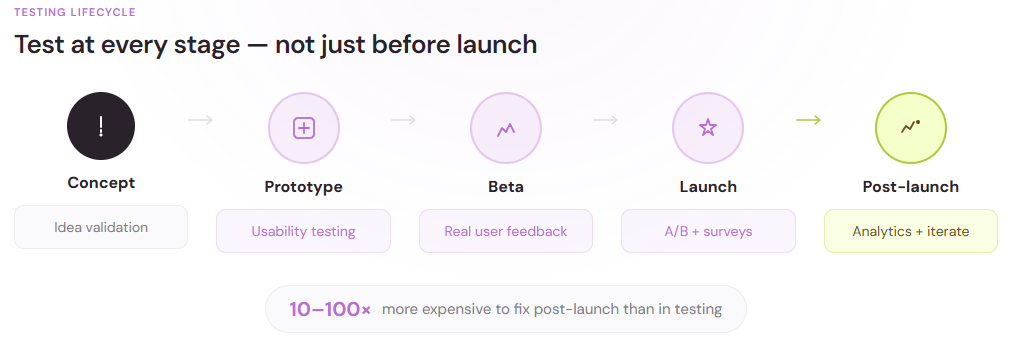
The cost of skipping this step is steep. Fixing a critical user experience issue after launch costs 10 to 100 times more than catching and fixing it during early usability testing. That investment upfront—in talking to users, running prototypes past them, and iterating based on real feedback—pays for itself many times over. A company that discovers a major navigation flaw six months after launch must rebuild interface sections, communicate changes to thousands of users, and manage support requests from confused customers. The same flaw, caught during testing with eight users before launch, takes hours to fix and costs almost nothing.
Consider the real-world implications: a post-launch redesign requires coordination across engineering, design, and product teams. It demands communication to users about what changed and why. It often results in support tickets, social media complaints, and damaged trust. Early testing prevents this cascade of expensive problems before it starts.
Product testing comes in many forms: testing a landing page with real visitors, validating a business idea with potential customers, gathering feedback on a prototype, or running formal usability studies. They all share a simple goal: learn from actual people before decisions become expensive. Testing can happen at any stage—from concept to post-launch refinement—and each stage benefits from insights that come from watching real people interact with your work.
Why product testing matters
People don't always do what you expect. Your assumptions about how someone will navigate your interface, what they'll find confusing, or which feature matters most often turn out to be wrong. Testing reveals those gaps early, when you can still change things. Even experienced designers and product managers are surprised by how real users behave. What seems obvious to the person who built it remains invisible or confusing to someone encountering it fresh.
The financial case is compelling. On one system used by over 100,000 people, a usability investment of $68,000 generated $6.8 million in benefit within the first year of implementation. That's a return of roughly 100 to 1. A retailer that invested in testing their checkout flow reduced cart abandonment by 12%, translating to millions in recovered sales. These numbers repeat across industries; companies that systematize product testing consistently see outsized returns.
Teams that invest in product testing see faster time-to-market, fewer post-launch bugs, and higher customer satisfaction. Why? Because they've already worked through hard problems while they had the freedom to change direction. They're not rushing to fix a broken launch; they're confidently scaling a product people already want to use. This compounds over time: a product that works well from day one accumulates positive reviews, word-of-mouth recommendations, and customer loyalty that drives growth for years.
Testing also protects your reputation. A product that people struggle to use spreads that word quickly. One bad review on an app store can tank download numbers. Testing also builds team confidence. When developers, designers, and product managers see real evidence that their work solves user problems, decision-making becomes faster and more decisive. Teams move with conviction rather than debate, because they're grounding decisions in data rather than intuition.
The market reflects this shift. Large enterprises accounted for 69.15% of the global usability testing tools market in 2024, and cloud-based deployments held 61.35% of the market that same year. What was once the domain of large tech companies is now available to startups and small businesses at a reasonable cost. This democratization means that testing is no longer a competitive advantage reserved for well-resourced teams. It's becoming table stakes for anyone serious about shipping products customers love.
Types of product testing
Different stages of product development call for different approaches. Understanding which type fits your situation helps you allocate resources effectively.
Landing page and conversion testing
If you're launching a website or marketing page, you need to know whether people understand your message and whether they'll take the action you want. Landing page tests typically focus on headlines, calls-to-action, images, and copy. You run these tests on real traffic—either all at once or split between variations (A/B testing) to see which version wins.
A/B testing lets you change one element at a time, measure the impact, and move forward with confidence. If you change both the headline and the button color and conversions go up, you won't know which change mattered. But if you change only the headline, measure the result, then change only the button color, you'll accumulate knowledge about what customers respond to. Over time, small improvements compound into dramatically better conversion rates. A headline that increases click-through rate by eight percent might seem minor, but across thousands of visitors, that compounds into significant revenue differences. The discipline of testing one variable at a time also trains teams to think in terms of evidence rather than opinion about what works.

Idea and concept validation
Before you build a full product, test whether your core idea solves a real problem. Show potential customers wireframes or prototypes, and listen to whether they'd actually use what you're proposing. Many founders discover they've been solving the wrong problem after spending months building something they thought customers desperately wanted. These conversations are uncomfortable—nobody enjoys hearing that their vision doesn't solve a real need—but they're far less painful than realizing it after launch.
Early validation conversations are revealing because prospects haven't invested time or money, so their feedback tends to be honest. You're looking for signals, not consensus. Do people understand what you're proposing? Do they see how it solves a problem they actually have? Are they excited enough to ask follow-up questions? A founder who talks to 20 potential customers before writing a single line of code is vastly more likely to build something people want than one who codes in isolation. These early conversations also begin building relationships with potential customers who may become your first paying users.
Usability testing
Once you have a prototype or live product, usability testing watches real people try to accomplish specific tasks. You might ask someone to "find our pricing page" or "sign up for an account" and observe where they get stuck. The power of usability testing lies in the gap between what people say they'll do and what they actually do. People often say they find something intuitive even when they visibly struggled to find it. Watching behavior without judgment reveals the truth.
Usability testing can be formal (recruiting five to eight participants) or informal (asking a colleague to click through your prototype). Both approaches reveal problems you'll miss by just looking at your own work. After spending weeks building something, your brain fills in gaps and assumes clarity that doesn't exist to a fresh user. You've internalized the logic so completely that you can't see what's actually confusing about it.
Customer feedback surveys
Surveys ask customers direct questions about their experience: what they like, what frustrated them, whether they'd recommend the product. Surveys work well once you have real users and want to understand patterns across a large group. They're scalable in ways that one-on-one interviews aren't. A survey reaching 500 customers provides quantitative data you can compare across segments, track over time, and use to identify where satisfaction is eroding.
Surveys capture what people say rather than what they do. Combining survey data with usage analytics and usability observations gives you a fuller picture of what's really happening with your product. A survey might show high satisfaction, but if usage data shows people are logging in less frequently, something's wrong. Either the survey captured the honeymoon period before problems emerged, or satisfaction doesn't translate into sustained usage.
How to run product testing
Define what you're testing
Before you recruit participants or send out a survey, get clear on what you actually want to learn. "Does this product work?" is too broad. "Do users understand how to add a team member in the first 30 seconds?" is testable. Specificity focuses your research and prevents collecting data you can't act on.
Write your core questions down. Good testing questions are narrow enough to answer in a single session but broad enough to inform real product decisions. Instead of "Do people like this feature?" ask "Can new users figure out how to share a document without reading instructions?" The second question gives you a measurable target. If eight out of ten participants succeed without instructions, you have one answer. If two out of ten succeed, you have a different one, and you know what to fix.
Choose your testing method
Your question, budget, and timeline shape which method you pick. Unmoderated remote testing is faster and cheaper than lab-based testing. Surveys reach more people than interviews. A quick landing page test takes days; a full usability study takes weeks. Early in development, speed matters more than statistical rigor, so a quick test with five people might teach you more than waiting months for a formal study. The goal is learning, not perfection. Getting 80% of the insights in 20% of the time often makes more business sense.
Recruit the right participants
The most rigorous test falls apart if you're testing with the wrong people. If your product is for small business owners, testing with friends and family won't be representative. Define who you want to talk to. For some tests, a small group of the right people teaches you more than a large group of the wrong ones. Recruit people who match your target customer's profile: same industry, similar company size, comparable technical sophistication.
Create tasks that don't lead the witness
Write tasks in plain language without hinting at the "right" answer. "Try to contact our support team" works better than "Click the chat button to contact support." The first asks people to solve a problem; the second tells them the solution.
Observe and listen without interrupting
When watching someone use your product, silence is your friend. Let them struggle. That moment, where they're unsure what to do, is where you learn something real. Jumping in to help prevents you from understanding what your product actually communicates.
If someone gets stuck, ask "What are you thinking right now?" rather than stepping in to solve the problem for them. Their answer tells you exactly what's confusing and why. You're building a map of where people's mental models don't match your product's actual behavior.
Analyze patterns, not individual comments
One person's complaint doesn't mean you need to redesign. But if three out of five people get stuck in the same place, that's a signal to fix something. Look for patterns: Do multiple people struggle with the same task? Patterns point to real problems. A single person confused by a button is interesting but not necessarily actionable. Five people confused by the same button is actionable.
Iterate and test again
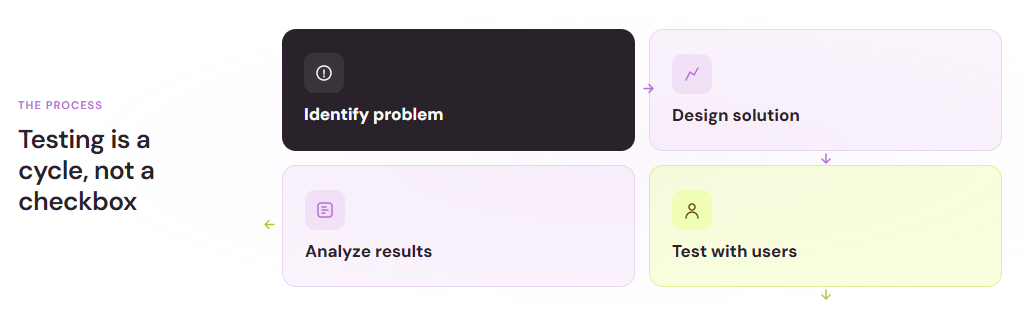
Testing isn't one-time. You test, fix something, and test again. Early on, this might mean testing a rough prototype with five people, learning something, updating it, and testing again with a new group. You're spiraling toward better with each cycle. Each round of testing costs less and teaches you more because you're focusing on narrower questions.
Common product testing mistakes
Testing only with people like you. Your target customer might have different expectations than you do. Testing with actual users reveals problems internal testing misses. Your team's expertise blinds you to what seems obvious to newcomers.
Asking leading questions. "Do you like the new dashboard?" gets a yes. "Walk me through how you'd check your sales numbers" reveals whether it actually works. Frame questions as open-ended tasks, not yes-or-no surveys.
Testing too late. If you wait until the product is fully built to test, fixing problems is expensive. Test early, when you can still change direction without losing months of work. A prototype test before development starts saves more time than a usability test after launch.
Ignoring outliers without understanding them. If someone uses your product unexpectedly, that's worth understanding. They might be seeing something everyone else misses. That outlier could represent an entire segment you haven't considered or a creative use case that opens new markets.
Collecting data but not acting on it. Testing reveals problems; your job is to decide which ones matter and fix them. If testing shows that 70% of users can't find a feature, and you decide not to fix it, what was the point? Use testing to inform decisions, then commit to change.
The ROI of testing
The global usability testing tools market was valued at $1.51 billion in 2024 and is projected to reach $10.41 billion by 2034, growing at a 21.3% CAGR from 2025 to 2034. That growth reflects what teams across industries already know: testing saves money and reduces risk. Companies are willing to pay because testing delivers measurable returns.
Every dollar you spend on testing before launch prevents you from spending tens of dollars fixing problems after customers are using it. Testing shortens the time between launch and a product people actually love. This is something teams build into their timeline from the start, not something they do if they have budget left over. The most successful teams treat testing as foundational to product development, not an optional add-on.
Get started with product testing
You don't need perfect conditions or a large budget to test. You don't need a lab or specialized software. You need people, questions, and a willingness to listen to answers that surprise you.
Start with one clear question: What do I need to learn about this product before launch? Then pick the simplest way to answer it. Talk to five customers. Set up a landing page. Ask people to click through a prototype and narrate what they're thinking. The testing you do—even informal, quick testing—teaches you more than the testing you don't do. Start now, start small, and start learning from your actual customers rather than your assumptions about them.
The testing you do early, while you still have the power to change things, is the cheapest, highest-impact work you'll do.

Liked that? Check these out:
Opinions and Expertise
What’s actually slowing research teams down (Hint: it’s not the research)
From recruiting participants and scheduling interviews to building the actual surveys, the operational drag is taking researchers away from what they do best. See what's actually slowing them down and how Research Flow fixes it.
Read more