Sample size for qualitative research: How many is enough
Qualitative research sample size has no universal answer, but data saturation does. See the benchmarks, key factors, and common pitfalls that define "enough."
When you’re planning a qualitative study—whether it’s interviews, focus groups, or in-depth observations—one question tends to come up early: “How many people do we need to talk to?”
The honest answer is that it depends. Unlike quantitative research, which relies on statistical formulas to determine sample size, qualitative research doesn’t have a one-size-fits-all number.
But that doesn’t mean you’re flying blind. Understanding the factors that influence sample size—and knowing when you’ve gathered enough data—helps you design a study that’s both rigorous and practical.
What makes qualitative sample size different
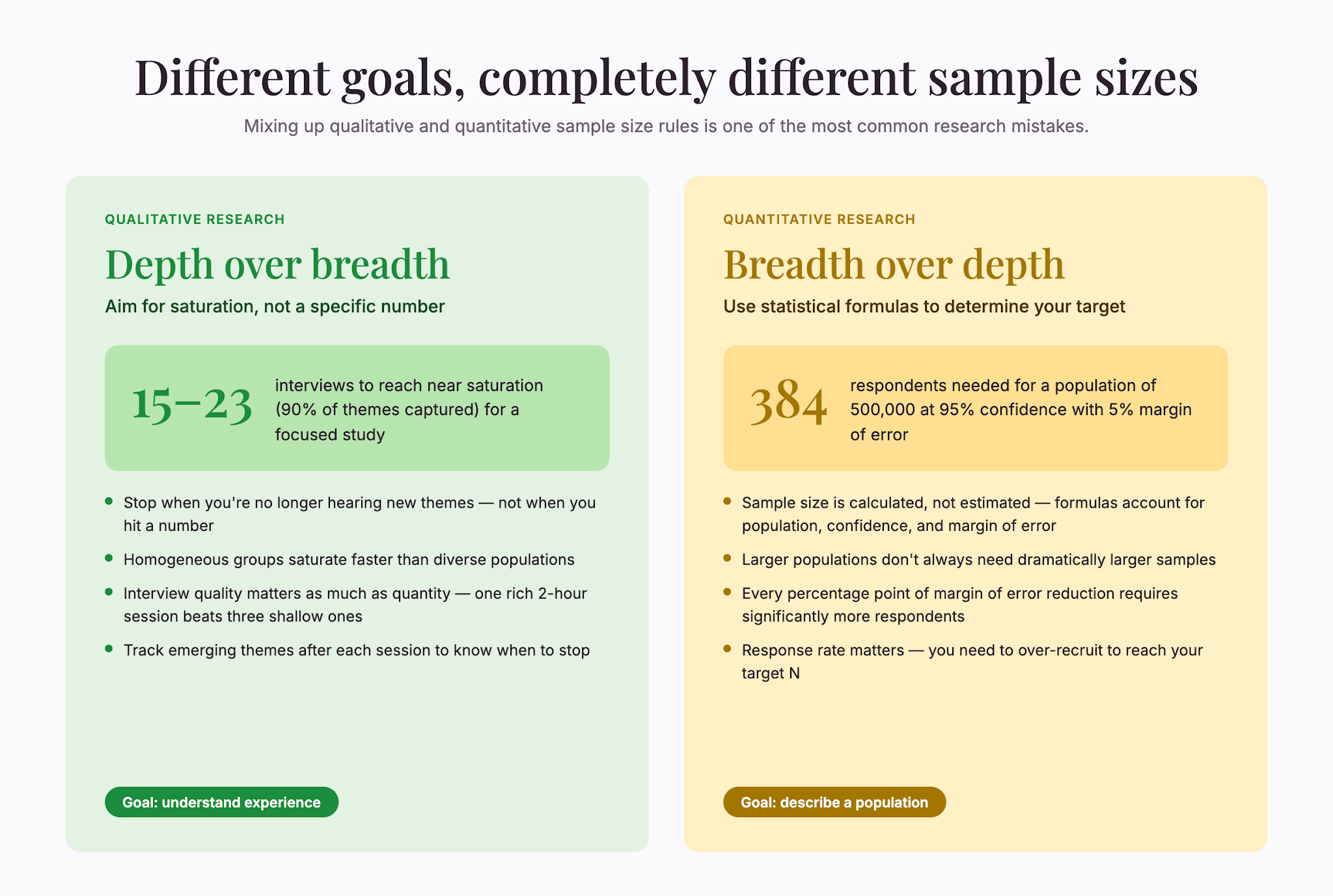
Quantitative research is built on the idea that you need a certain number of respondents to represent a larger population with a known margin of error. Qualitative research works differently. Instead of aiming for statistical representation, you’re looking for depth, nuance, and patterns in how people experience something.
The goal in qualitative research isn’t to prove a hypothesis with numbers. It’s to understand the lived experience of your participants and uncover the underlying reasons why they think, feel, or act a certain way.
This shift in purpose changes everything about how you think about sample size. A qualitative study with 10 thoughtfully selected participants might reveal more insight than a quantitative survey with 1,000 respondents—if those 10 people are the right people, and your questions are designed to draw out their genuine perspectives. The difference lies in what you’re measuring: breadth versus depth. Quantitative research prioritizes breadth, casting a wide net to capture statistical patterns across a population. Qualitative research prioritizes depth, diving deep into a smaller number of cases to understand the complexity and richness of human experience.
When researchers talk about qualitative research sample size, they’re discussing an entirely different philosophy. You’re not trying to achieve a representative sample in the statistical sense. You’re trying to select participants who can best illuminate the phenomenon you’re studying. This might mean purposefully choosing participants with specific characteristics, or it might mean being strategic about diversity to capture different perspectives within your target group.
The concept of saturation
The most practical guide for qualitative research sample size is something called data saturation. This is the point at which you’re no longer hearing new information or seeing new patterns in your data—you’re just hearing the same themes repeated.
Think of it like reading customer feedback. At first, every review teaches you something. Someone mentions slow checkout, someone else talks about confusing navigation, a third person wishes the search function worked better. But after you’ve read 50 reviews, you’re no longer discovering new problems. You’re seeing the same issues over and over. That’s saturation.
Saturation is particularly valuable because it gives you an objective stopping point. You’re not making an arbitrary decision about how many participants to include. Instead, you’re following a methodological principle that tells you when you’ve gathered sufficient data. This approach is widely respected in qualitative research because it balances rigor with practicality.
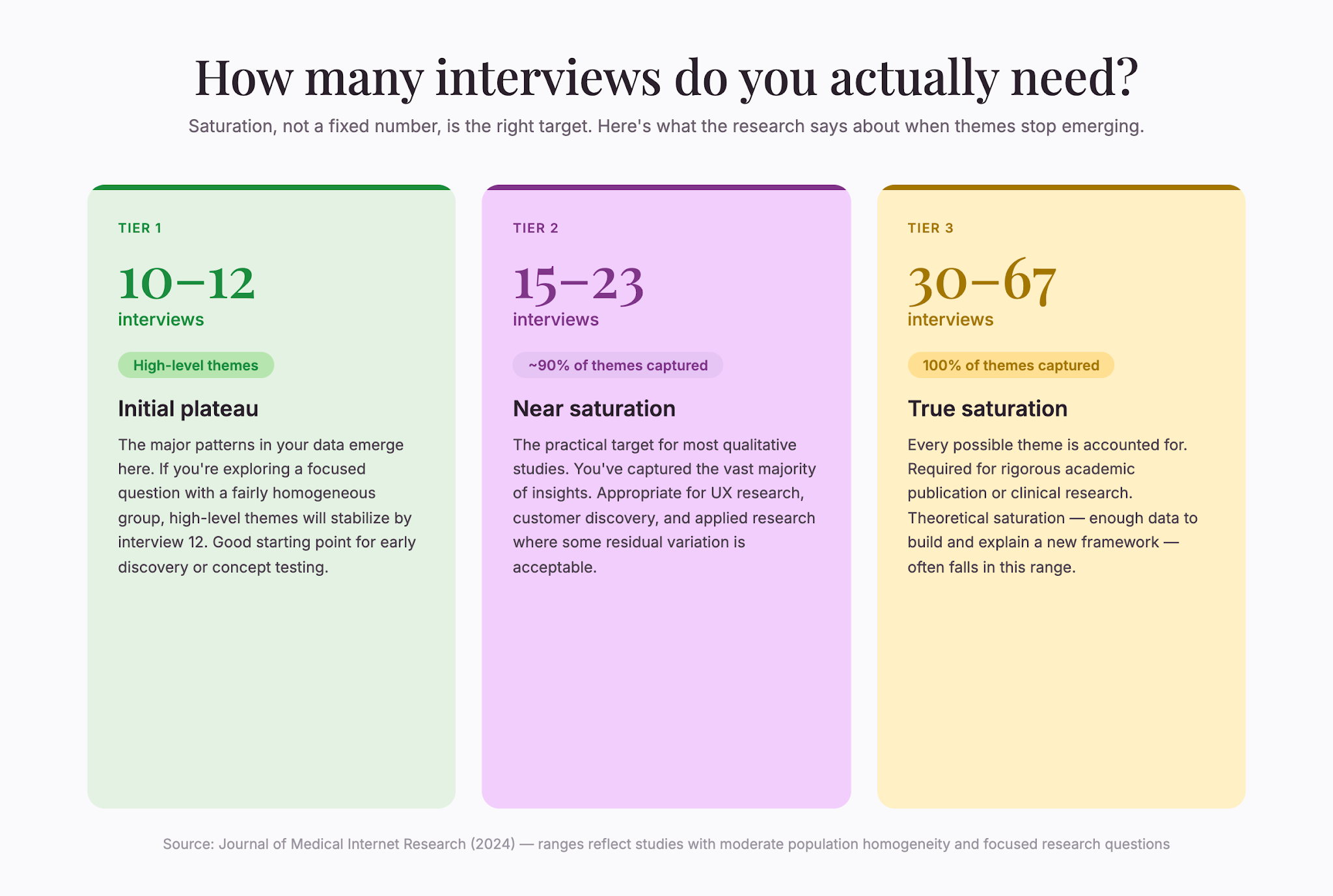
Research shows that saturation happens at different points depending on your study. Guest et al. found that high-level themes tend to plateau around 10 to 12 interviews (Journal of Medical Internet Research, 2024). In other words, if you’re just looking for the main themes, you may not need many participants. But if you’re aiming for near saturation—where you’ve captured about 90% of all possible codes or insights—you’ll need between 15 and 23 interviews. True saturation, where you’ve captured every possible insight, requires 30 to 67 interviews (Journal of Medical Internet Research, 2024).
The range exists because saturation depends heavily on your specific study. A homogeneous group—people who share similar backgrounds, experiences, or perspectives—will reach saturation faster than a diverse group. If your research question is narrow and focused, saturation comes sooner. If it’s broad, you may need more participants. Understanding this variation helps you avoid both undershooting (stopping too early) and overshooting (collecting more data than necessary).
Factors that influence how many participants you need
Several variables affect the point at which you’ll reach saturation, and understanding them helps you make a realistic plan for your study.
Study design and research question
A tightly focused research question—“Why do parents abandon online grocery checkout?”—will likely saturate with fewer interviews than a broad one like “How do people experience grocery shopping?” The more specific your question, the faster patterns emerge. When your research question has clear boundaries, participants’ answers tend to cluster around similar themes more quickly. Conversely, broad questions invite diverse responses that take longer to fully explore.
Population homogeneity
If your participants are similar to each other (same age, income, profession, or background), you’ll reach saturation faster because they tend to share similar perspectives. A study of software engineers at one company might saturate at 8 interviews. A study of engineers across different industries and career stages might need 20 or more. This doesn’t mean homogeneous studies are better or worse—it just means they reach saturation faster. Sometimes you want homogeneity to deeply understand a specific group. Other times, you need diversity to understand how experiences vary across different contexts.
Theoretical saturation vs. data saturation
There’s another layer to consider: theoretical saturation. This is when you’ve not only collected enough data to see patterns, but enough to build a coherent theory or framework that explains those patterns. Theoretical saturation often requires roughly twice as many interviews as data saturation (Journal of Teaching in International Business, 2025). If your study aims to develop a new theory, plan for a larger sample than if you’re simply describing what you observe. The difference is significant: data saturation tells you when patterns stop emerging, while theoretical saturation tells you when you understand why those patterns exist and can explain them in a broader context.
Interview quality and depth
A single, rich two-hour interview can yield more insight than three 20-minute interviews. The depth of your questioning, how well you listen, and how much participants open up affect how quickly you’ll gather meaningful data. A skilled interviewer who asks thoughtful follow-up questions and creates psychological safety for participants will extract richer information from fewer interviews. This is why interview technique matters as much as sample size. You’re not just counting participants—you’re measuring the quality of the data you collect from them.
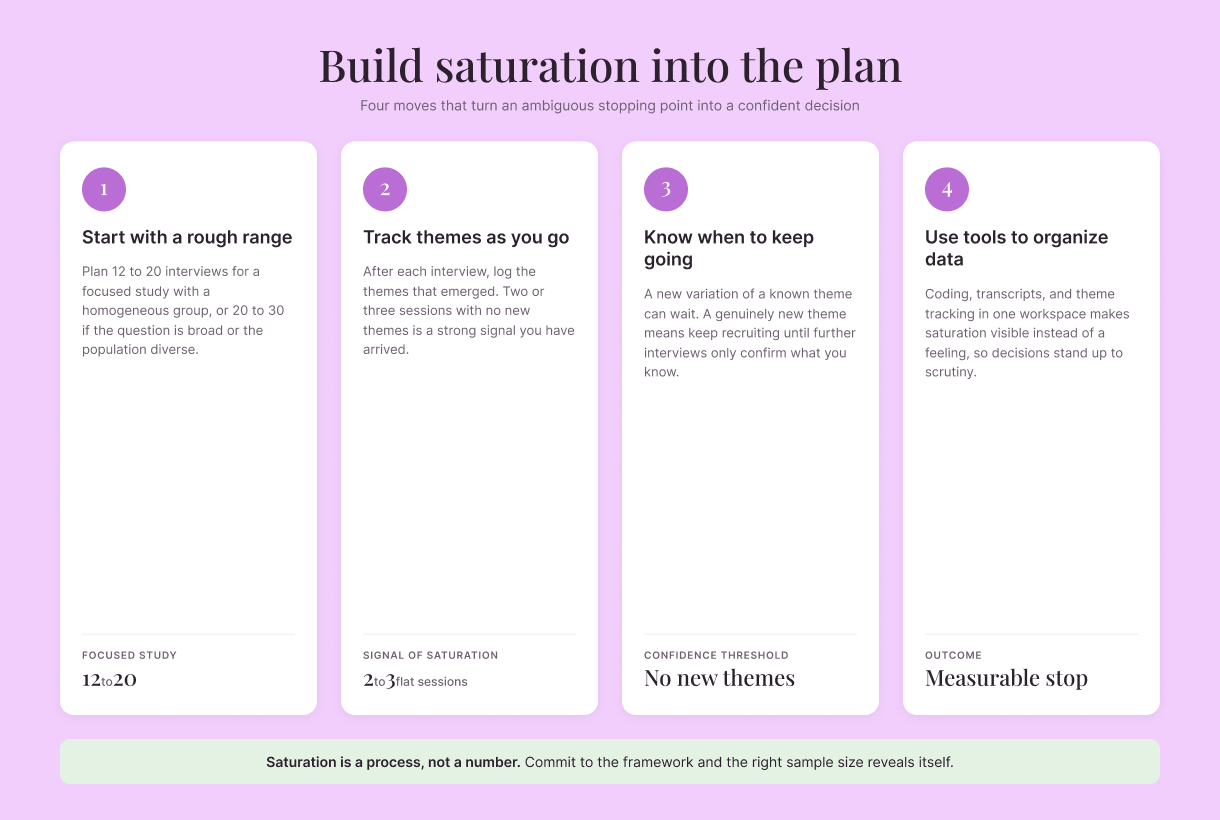
Building saturation into your research plan
Since saturation is the real target—not a fixed number—here’s how to build it into your study:
Start with a rough range
Plan for 12 to 20 initial interviews if your study has a moderately focused question and you’re working with a fairly homogeneous group. If your population is diverse or your question is broad, plan for 20 to 30. This gives you a starting point without locking you into a number that might be too low or too high. The value of starting with a range is that it sets realistic expectations for time and resources while leaving room for flexibility. You’re committing to a process, not just a number.
Track themes as you go
After each interview or focus group, jot down the main themes that emerged. Keep a running list. When you complete an interview and realize it didn’t add any new themes to your list, you’re getting close to saturation. When you’ve done 2 or 3 interviews in a row without new themes, you’ve likely reached it. This active tracking is crucial because it forces you to pay attention to whether you’re still learning new things. Many researchers skip this step and simply collect interviews until their timeline runs out, which often means they miss the actual point of saturation.
Know when to keep going
Saturation isn’t always obvious. If you’re seeing new perspectives emerge—even if they’re not entirely new themes—it’s worth continuing. Aim for a point where you feel confident that further interviews would only confirm what you already know, not contradict or complicate it. There’s a difference between seeing a new variation of an existing theme and discovering an entirely new theme. The former may suggest you’re near saturation. The latter means you need to keep going.
Use tools to organize your data
Managing interview transcripts and coding themes manually is possible, but tools that help you track, organize, and visualize your data make it much easier to spot when saturation has been reached. Platforms like ResearchFlow can help you collect responses, organize participant data, and track emerging patterns—making it clearer when you’ve gathered enough. The right tools reshape saturation from something ambiguous into something measurable and transparent.
Qualitative vs. quantitative: Different rules
It’s worth noting that the sample size rules are completely different for quantitative research, and mixing up the two is a common mistake.
In quantitative research—surveys with closed-ended questions sent to hundreds or thousands of people—you need a specific sample size to achieve a certain level of statistical confidence. An acceptable margin of error is typically 3 to 6% at the 95% confidence level (Qualtrics, 2025). This means if you survey a population of 500,000 people at a 95% confidence level with a 5% margin of error, you’d need roughly 384 respondents to get a statistically reliable result (Qualtrics, 2025).
That’s because quantitative research aims to describe a population. Qualitative research aims to understand experience. The math is different, and so is the approach to sample size. When deciding whether to use quantitative or qualitative methods—or both—it’s important to recognize these fundamental differences. A qualitative research sample size of 15 to 20 participants is not a limitation. It’s an appropriate number for gathering rich, detailed data. Similarly, a quantitative sample size of 384 is not excessive—it’s what’s needed to make statistically valid claims about a larger population.
Common pitfalls to avoid
Stopping too early
The urge to wrap up a study and move on is real. But if you stop before saturation, you risk missing important insights. Your final interviews might reveal a perspective you hadn’t heard yet, or complicate a theme you thought was straightforward. Push past the temptation to call it done too soon. This is particularly challenging under budget and time constraints, but research quality depends on reaching saturation, not on finishing on schedule.
Confusing saturation with convenience
It’s easy to convince yourself you’ve reached saturation when really you’ve just run out of time or budget. Be honest: Did you stop because you weren’t hearing new themes, or because recruiting the next participant felt difficult? True saturation means you’ve genuinely exhausted the variation in your data, not that you’ve stopped trying. This is why tracking themes throughout the process is essential—it keeps you accountable to the actual data rather than external pressures.
Not accounting for diversity
If your population is diverse and you recruit only from the easiest-to-reach segment, you won’t reach true saturation—you’ll have saturation within that subgroup only. Plan your recruitment to capture different perspectives, backgrounds, and experiences. This takes longer, but it’s worth it. Saturation achieved through a homogeneous sample is not the same as saturation achieved across a diverse sample. The latter is more robust and more likely to capture the full range of possible experiences.
The practical takeaway
There’s no magic number for qualitative research sample size. But there is a practical framework: aim for saturation, track themes as you collect data, and be honest about when you’re no longer hearing anything new.
Start with a target range (12 to 20 for a focused study, 20 to 30 for a broad one), adjust based on the homogeneity of your participants, and commit to continuing until you’ve reached saturation. Build in time and budget for recruitment that reflects the diversity of your population, and use organized methods to track your data so saturation becomes clear rather than ambiguous.
The payoff is worth the effort. A qualitative study that reaches genuine saturation gives you the kind of depth and understanding that no amount of quantitative data alone can provide. When you’ve truly reached saturation in your qualitative research sample size decisions, you can confidently stand behind your findings and feel assured that you’ve captured the full complexity of what you set out to understand.

Liked that? Check these out:

Opinions and Expertise
What’s actually slowing research teams down (Hint: it’s not the research)
From recruiting participants and scheduling interviews to building the actual surveys, the operational drag is taking researchers away from what they do best. See what's actually slowing them down and how Research Flow fixes it.
Read more