How to scale market research for your startup
Money may be tight at startups, but that doesn’t mean market research isn’t within reach. Here’s how to scale market research and make it attainable.

Contents
As a startup, you probably know your customers intimately. You’ve talked to them one-on-one, understood their pain points, and built your product on direct feedback.
But as you grow, that closeness becomes harder to maintain. You can’t talk to every customer. There are more of them, they’re more diverse, and you’re busier. The temptation is to stop doing market research altogether.
That’s exactly when it becomes most critical. Without direct insight, you make assumptions. Assumptions lead to building the wrong things. Building the wrong things wastes money you don’t have.
Scaling research means doing it more efficiently, not abandoning it. Here’s how to keep listening as you grow.
Start with what you already know
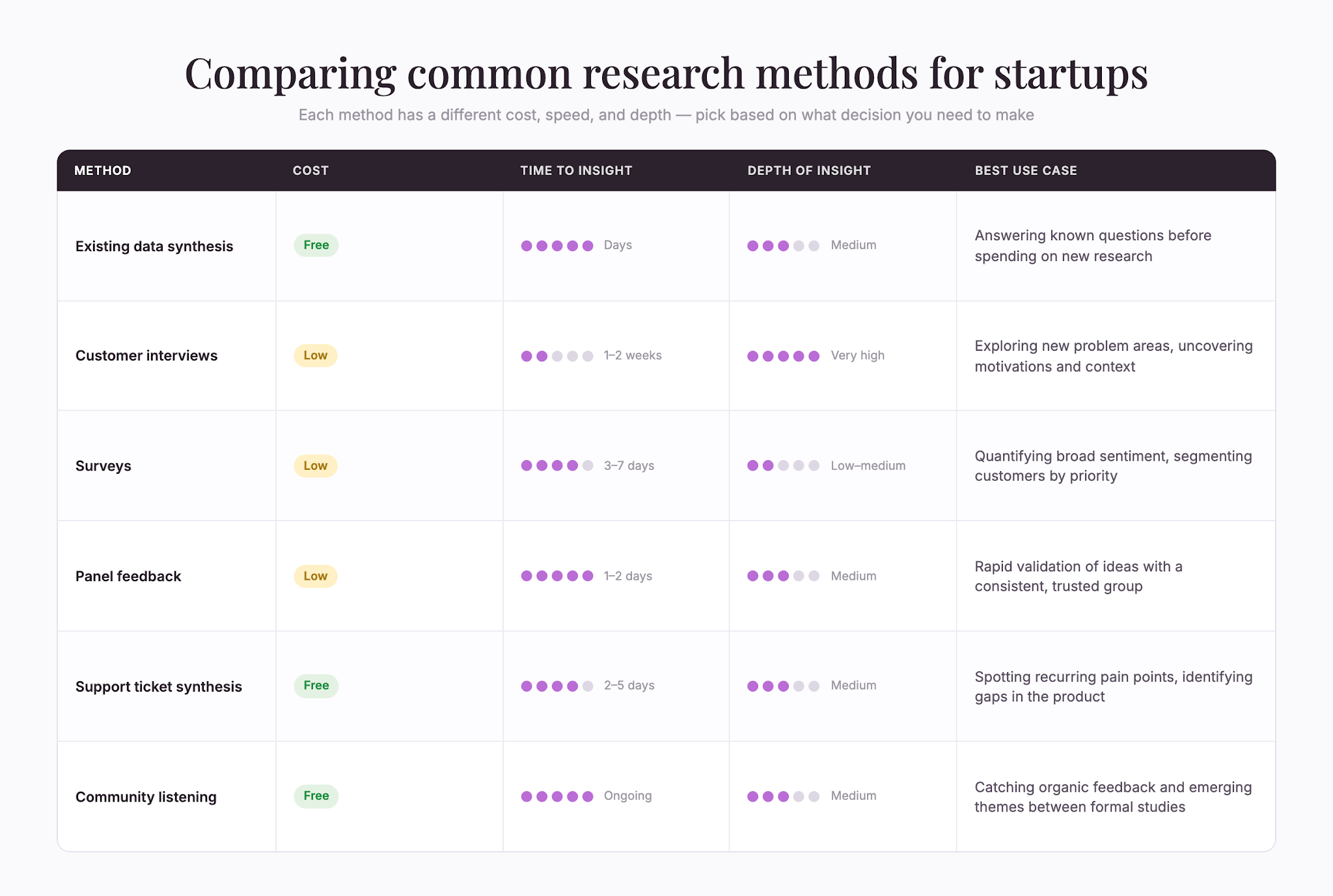
Before you launch a new project, audit what you already have. Most startups have data scattered across multiple places: customer interviews, support tickets, sales call notes, net promoter scores (NPS), usage analytics.
Bring it all together. Look for patterns. What problems come up repeatedly in support tickets? What objections do prospects raise on sales calls? Which features do power users rely on?
This existing data is gold. It’s free, and it’s based on real interactions. You can answer most of your immediate questions by synthesizing what you already have. Document what you learn and share it with the team. This becomes your research baseline.
Build a small research panel
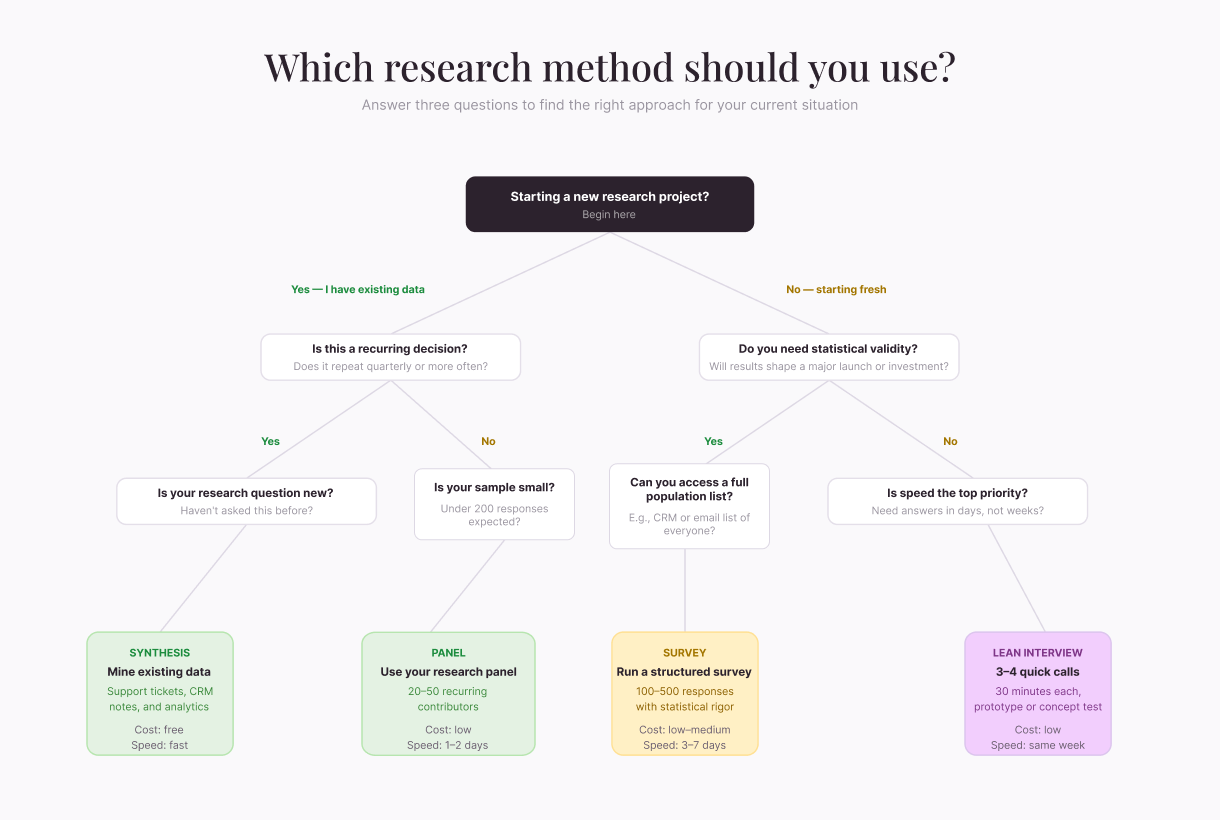
Instead of interviewing random customers ad hoc, recruit a panel of 20–50 customers who agree to give regular feedback. Aim for a mix: a few power users, a few who are still ramping up, and a couple who churned and came back. The diversity protects you from echo chamber thinking.
Offer something in return: early access to features, a discount on their plan, or the satisfaction of shaping the product. Make it clear you want candid feedback, not just positive testimonials. The most useful panel members are the ones who’ll tell you when something is broken.
A panel gives you a consistent group to validate ideas with. You can run a quick survey in a day. You can get prototype feedback in a week. You’re not starting from scratch each time, and you’re not spending weeks recruiting before you can ask a single question. Panel members often become your advocates—they feel invested because you’ve explicitly asked for their input.
Use surveys to understand broad patterns
One-on-one interviews are rich and detailed, but they don’t scale. Surveys do.
Send a brief quarterly survey to a segment of your customer base. Ask about top pain points, feature priorities, and whether they’d recommend you. Keep it under 10 questions so completion rates stay high.
You don’t need to survey everyone. A thoughtful sample of 100–200 responses gives reliable direction about what your broader base thinks.
Use the results to identify segments. Enterprise customers may have very different priorities than small-business ones. Healthcare may differ from retail. Let those differences inform product decisions.
Embrace lean research methods
Lean research is fast and cheap. The goal is 80% clarity with 20% of the effort.
Instead of a formal focus group, schedule a 30-minute call with three or four customers and share a prototype. Ask them to think out loud. You’ll get directional feedback in an hour instead of weeks.
Instead of a 50-question survey, ask five critical ones. Long surveys get abandoned or rushed. Short ones get thoughtful answers.
Instead of finding a representative sample, find users who are extreme on a dimension you care about. If you’re researching mobile usage, talk to people who open the app daily and people who never do. The extremes reveal the most.
Make research part of your rhythm
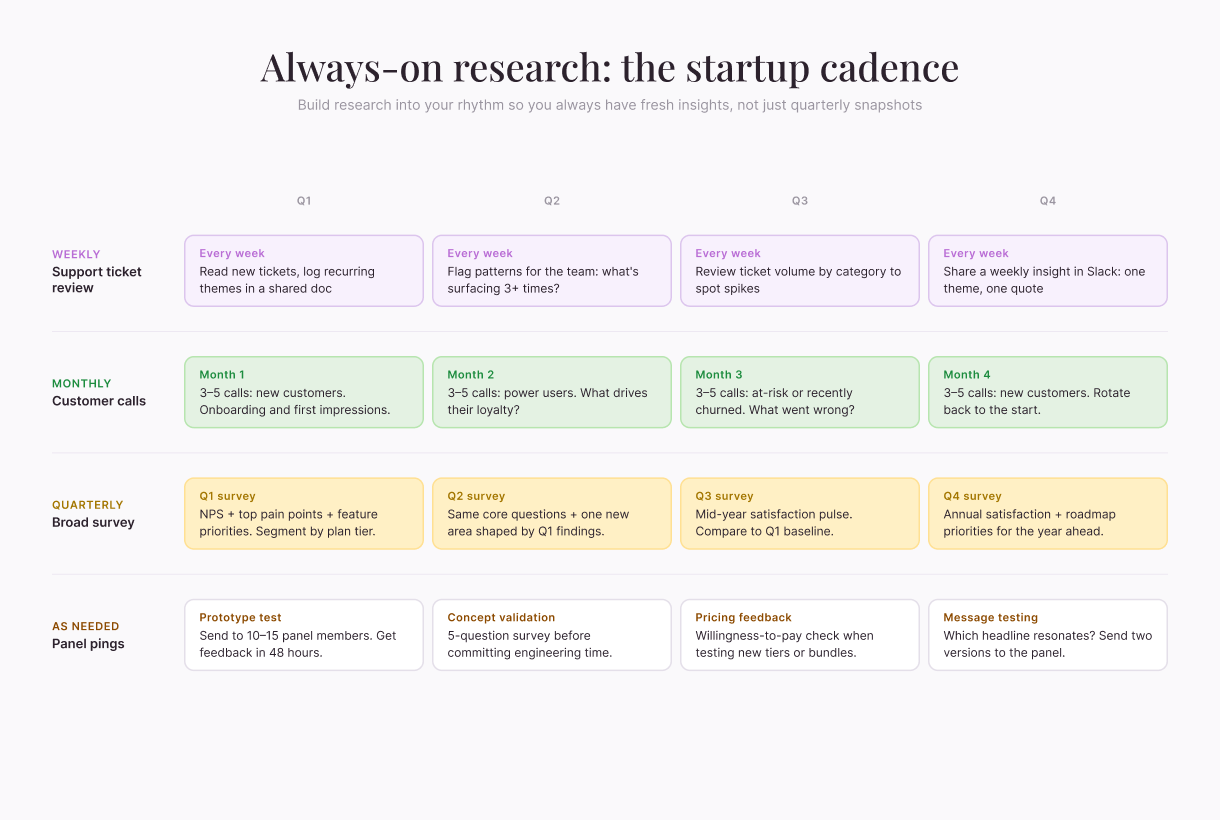
Research that happens sporadically is less useful than research built into your cadence.
So, schedule it. Every quarter, send a survey. Every month, hop on calls with a few customers. Every week, read through support tickets and note emerging themes. When you’re always learning, you always have recent insights to draw from.
Just make sure to assign someone ownership. It doesn’t have to be a full-time role, but someone should coordinate research, synthesize findings, and make sure they reach the team.
Share results openly. If 60% of customers want feature X, tell the team. If pricing is a blocker for a specific segment, let it shape the roadmap. Research only matters if it influences decisions.
Use your community
Your existing customers and community are often willing to help you learn. They use your product and care about it.
Create a Slack channel or Discord where customers discuss the product and offer ideas. Read those channels regularly—you’ll hear organic feedback you’d never get in a formal survey.
Host occasional community calls where you share what you’re working on and ask for reactions. They’re social and informal, but they generate valuable insights and deepen relationships.
Startups often feel they can’t afford market research. But community-driven research costs almost nothing and builds loyalty in the process.
Know when to bring in outside help
There comes a point where hiring a research consultant or agency makes sense. If you need rigorous validation of a major decision, or if you’re entering a new market with no customer base, external expertise pays for itself.
But don’t outsource everything. Keep some research in-house, so you stay connected to customers and maintain direct insight.
The practical takeaway
Startup market research doesn’t have to be expensive. It just has to be consistent and honest.
Start by synthesizing what you already know. Build a small panel for ongoing feedback. Run quarterly surveys. Do lean interviews. Build research into your rhythm. Stay connected to your community.
Do these things and you’ll have fresher, more actionable insights than most startups—even as you grow. You’ll avoid building features nobody wants. You’ll catch shifting needs before they become a crisis. And you’ll stay genuinely customer-focused instead of just saying you are.
The startups that scale well are the ones that never stop listening. Make sure that’s you.

Liked that? Check these out:

Opinions and Expertise
What’s actually slowing research teams down (Hint: it’s not the research)
From recruiting participants and scheduling interviews to building the actual surveys, the operational drag is taking researchers away from what they do best. See what's actually slowing them down and how Research Flow fixes it.
Read more