Systematic sampling: definition, formula and examples
Learn what systematic sampling is, the surprisingly easy formula, and real examples. And see when this method beats out using a random sample pick for your next survey.
You don’t need to survey every single person to understand a group. All that’s needed is the right slice of it.
Key takeaways
- Systematic sampling means choosing every kth person or item from a list, starting at a random point.
- The formula is simple: sampling interval (k) equals population size (N) divided by sample size (n).
- It’s often faster and easier to set up than simple random sampling, especially with larger lists or databases.
- Watch out for patterns in your list. If the data repeats in a cycle that matches your sampling interval, your results can become skewed.
- It works well for customer feedback, quality checks, employee surveys and other research where you need a manageable sample.
And that’s the basic idea behind sampling. Instead of trying to collect data from an entire population, you select from a smaller group that gives you a useful picture of the whole. Systematic sampling makes the process straightforward. Instead of randomly choosing each person individually, you pick a random starting point, then select every kth person or item from your list.
Say you have a spreadsheet with 5,000 customers listed and only need responses from 200 of them. Instead of spending hours figuring out who to pick, systematic sampling gives you a simple, repeatable way to build your sample.
Once you see how it works, it becomes one of those market research methods that feels far less complicated than it sounds.
What is systematic sampling
It’s a way of choosing a sample from a larger population using a regular, fixed interval.
Instead of picking names one at a time, you select every kth person or item on a list. That could mean every fifth transaction, 20th employee, or 15th customer.
The process starts at a random point. After that, you follow the interval until you’ve reached your sample.
It’s a type of probability sampling, and each member of your population has a known chance of being selected. Why does this matter? You want your sample to represent the larger group instead of simply including whoever happens to be the easiest to reach.
How systematic sample works
The process is pretty simple:
Step 1: Define your population.
Start with the entire group that you want to learn about. Everyone who purchased in the last year, for example.
Step 2: Decide your sample size.
Figure out how many people or items you actually need to include in your research.
Step 3: Calculate your sampling interval.
Use the formula below to figure out how often you should select someone from your list.
Step 4: Choose a random starting point.
Pick a number anywhere within that first sampling interval.
Step 5: Select every kth item.
Continue using the same interval until you have reached your target sample size.

And that’s really it. You really only need one random starting point. After that, the interval will do all of the heavy lifting for you.
The systematic sampling formula
Here is the formula that you will use:
k= N / n
Where:
- k: Sampling interval or how often you select an item
- N: Total population size
- n: Desired sample size
Let’s put that into practice.
Imagine you have 1,000 customers and want to survey 100 of them.
k = 1,000 / 100 = 10
Your sampling interval is 10, so you will select every 10th customer.
Now you will choose a random starting number between 1 and 10. Let’s say you get 4.
Your sample would then be: 4, 14, 24, 34, 44…
Keep going until you have your 100 customers.
Simple, right?
You don’t have to use special software to choose your starting point, either. In Excel or Google Sheets, you can use a formula like =RANDBETWEEN(1,10) to get a random number between 1 and 10.
One important detail: don’t skip the random starting point. If you always start with the first person on your list, you can introduce bias into your sample. The random start is an important part of what makes systematic sampling work.
Linear vs. circular systematic sample
The example above uses linear systematic sampling. You move through the list one direction and stop when you reach the end.
Then there is circular systematic sampling. If you reach the end of the list before selecting your entire sample, you loop back to the beginning and continue selecting items until you reach your target.
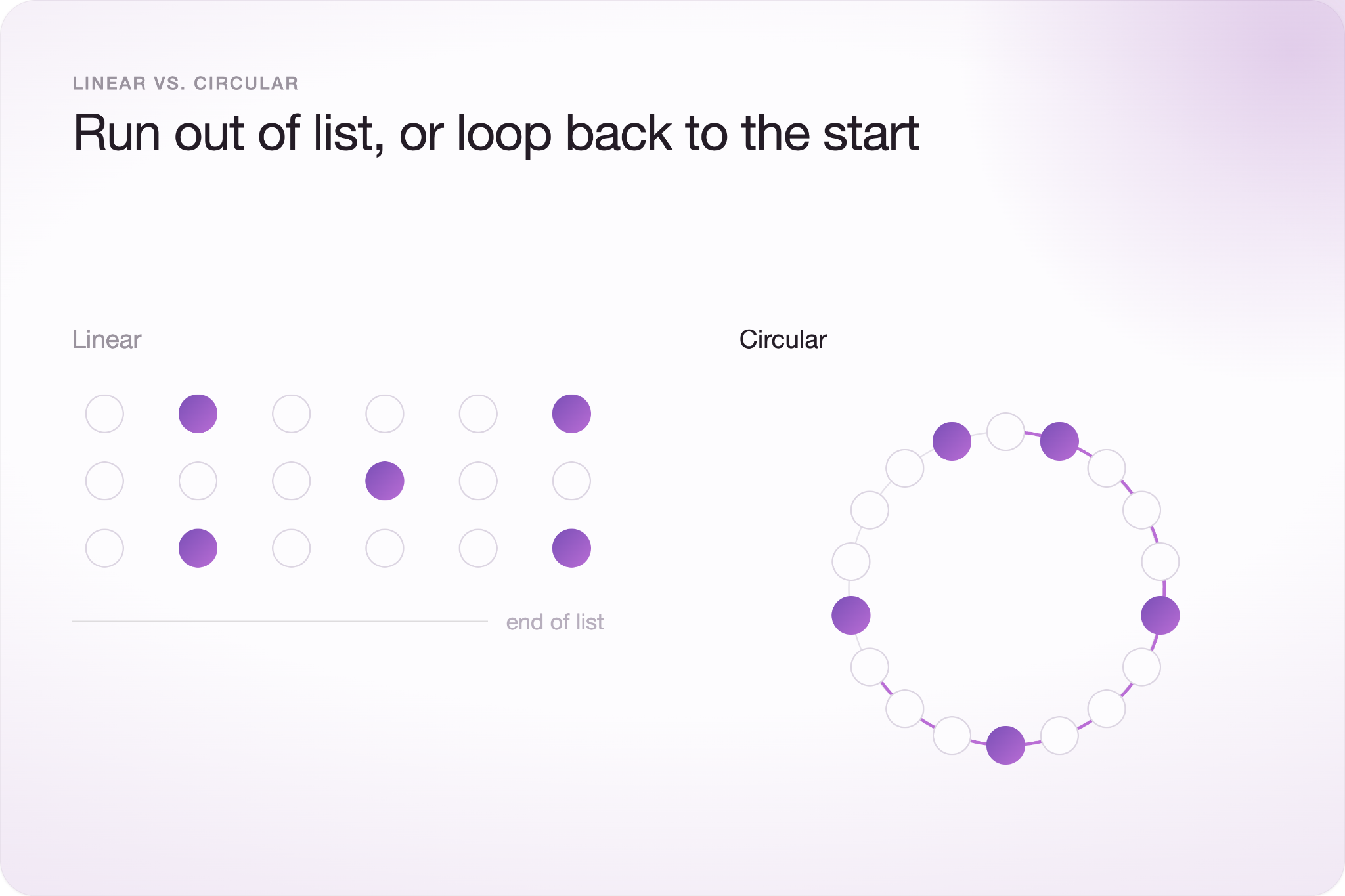
Circular sampling is often useful when your population size and sampling interval don’t divide evenly.
Systematic sampling vs. simple random sampling
Both are probability sampling methods, but they go about selecting participants differently.
With simple random sampling, each selection is made independently. A random number generator might be used to choose each person or item from the population. It’s a straightforward way to avoid the selection bias, but it can become tedious when you’re working with a large list.
Systematic sampling uses randomness from the starting point, then follows a consistent pattern, making it so much easier to set up and faster to execute.
So if you have a database of 10,000 customers, you can randomly generate 500 individual selections. Or you can calculate your interval, choose one random starting point, and work through the list from there.
The important caveat is that systematic sampling works best when your list doesn’t contain a repeating pattern that could interfere with your interval.
Real examples of systematic sampling
Systematic sampling shows up in all types of research. Below are just a few examples:
Customer feedback: An ecommerce company wants feedback from 200 out of 2,000 recent buyers. They calculate an interval of 10 and survey every 10th person on the order list.
Quality control: A factory inspects every 50th product coming off the production line rather than checking every single unit.
Employee research: An HR team has a list of 500 employees and selects every fifth person for a workplace culture survey.
Retail research: A store wants feedback from shoppers throughout the day, so a team member approaches every 10th person who enters.
Academic research: A researcher selects every 25th name from an eligible list to create a study sample.
Product testing: A software team samples every 100th user session from a week’s worth of activity to review for usability issues.
The common thread? You have an organized list or stream of data and need a manageable sample without manually selecting every participant.
Why systematic sampling works (and where it can go wrong)
Like any sampling method, systematic sampling has its pros and cons.
On the plus side, it’s quick and easy to explain, and relatively simple to carry out. It can also spread your sample evenly across a list, rather than accidentally bunching your selections together.
The biggest thing to watch out for is periodicity.
This is basically a repeating pattern in your population that lines up with your sampling interval. When that happens, your sample could become unrepresentative without it being obvious.
For example, imagine an employee list organized by department, where every 10th person happens to be a manager. If your sampling interval is also 10, you could end up selecting mostly managers—or consistently missing them.

That could give you a completely different picture of your workforce than you would get from the population as a whole.
The fix? Know your list.
Before using systematic sampling, take a look at how your population is organized. If you suspect there’s a pattern that could affect your results, consider randomizing the order of the list before selecting your sample.
When systematic sampling is not the right fit
This works best and most useful when you have a complete, organized list of your population with no obvious repeating pattern that could interfere with your interval.
If you don’t have a full list, this method may not work. After all, you need to know the size of your population to calculate your sampling interval.
It’s also not always the best choice for small, high-stakes studies where even a small source of bias could have major consequences. Depending on the research design, simple random sampling or stratified sampling may be more appropriate.
Think of systematic sampling as your practical option everyday research: customer feedback, quality checks, transaction reviews, employee surveys, and similar projects.
Putting systematic sampling to work
Once you have chosen your sample, there’s still one more thing to consider: getting people to actually respond. This is where that excellent research can sometimes fall apart. You can put time into creating a fair sample, only to send participants to a survey that feels like a chore.
If you are selecting every nth customer for feedback, that survey should be worth their time. Keep it short. Ask clear questions. Avoid unnecessary fields. The experience should feel like a conversation rather than an interrogation.
Remember: the sampling methods help you find the right people. A good survey experience gives them a reason to respond.
One formula. Zero guesswork
Systematic sampling isn’t flashy, but it’s a useful way to make research simpler without throwing accuracy out the window.
Know your population. Decide on your sample size. Calculate k = N / n. Choose a random starting point. Then follow the interval.
Do that, and you have a sampling method that’s simple to explain, easy to repeat, and practical for building your next survey.