Customer sentiment analysis: Tools, methods, and what to track
Customer sentiment is the metric companies use to measure how their customers feel about their brand, product, and services.
Key Takeaways
- Track sentiment to catch churn before it happens: Tracking sentiment helps identify customer risk while there's still time to act, not after customers leave.
- Combine CSAT, NPS, and CES to see the full picture: Each measures something different—satisfaction, loyalty, and friction.
- Pair what customers say with what they do: A neutral customer sentiment score paired with dropping usage often points to a problem that survey feedback alone won't catch.
- Close the loop on every fix: Track whether complaints actually lead to changes, and let customers know when their feedback made a difference.
Understanding how your customers feel about your brand directly impacts whether they'll stick around, spend more, or recommend you to others. Customer sentiment analysis measures and interprets those feelings, turning vague impressions into actionable data.
This guide walks you through what sentiment analysis is, why it matters, the main methods for capturing it, and the key metrics you should track.
What customer sentiment analysis is (and why it matters)
Customer sentiment is the emotional tone behind what people say about your company. It lives in survey responses, social media posts, support tickets, product reviews, and conversations. Sentiment analysis categorizes that feedback—positive, negative, or neutral—so you can spot patterns and act on them.
Sentiment is a leading indicator. It tells you where churn risk lives, which products are gaining traction, and where your team is dropping the ball. Measuring it systematically lets you prevent problems instead of reacting to complaints.
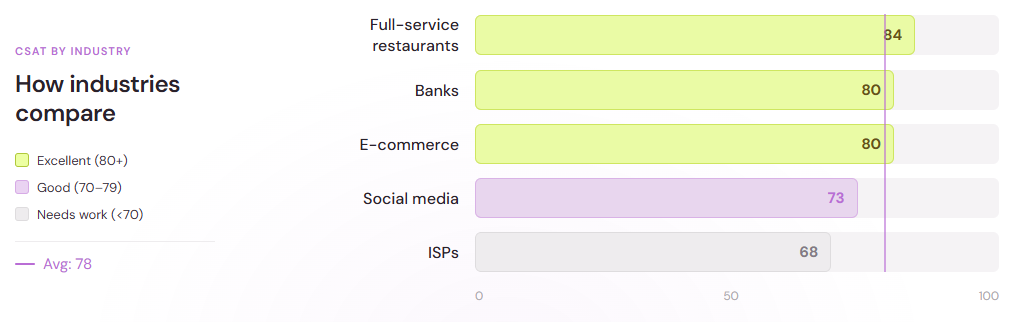
The stakes are real. Average customer satisfaction (CSAT) across industries sits at 77%, with excellent scores above 80. Full-service restaurants lead at 82, banks at 80, and e-commerce at 79. Internet service providers lag at 73, and social media platforms at 74.
Three main methods for capturing sentiment
1. Direct feedback collection
Ask people directly how they feel.
Customer satisfaction surveys (CSAT) ask: "How satisfied are you with [product/service]?" Usually scored on a 1-5 or 1-10 scale. CSAT is immediate and easy to interpret, but it only tells you how satisfied someone is, not why.
Net Promoter Score (NPS) asks: "How likely are you to recommend us to a friend or colleague?" Respondents fall into three camps: Promoters (9-10), Passives (7-8), and Detractors (0-6). NPS links sentiment directly to business growth; promoters tend to spend more and stay longer.
Customer Effort Score (CES) measures friction: "How easy was it to [resolve your issue/complete your purchase]?" It's useful for identifying pain points in specific processes.
All three work best when combined. CSAT tells you satisfaction, NPS tells you loyalty, and CES tells you where the work needs fixing.
2. Multi-channel feedback collection
People leave reviews on Google, tweet complaints, post on Reddit, leave voice notes in support tickets, and chat in live support. Modern feedback platforms integrate AI-powered analytics to pull sentiment from surveys, reviews, support tickets, chats, and in-app feedback in one place. This captures unsolicited feedback: the stuff customers share when they're not in a formal survey.

3. Behavioral tracking combined with feedback
Sentiment lives in what people say, but also in what they do. Someone might give a neutral CSAT score but abandon their account a week later. Someone else might leave glowing feedback but never upgrade their plan.
Combine what customers tell you (surveys, reviews, direct feedback) with what their actions reveal (usage patterns, churn, repeat purchases, time spent in your product). High sentiment scores coupled with increasing usage signal you're on the right track. High sentiment with dropping usage flags a problem, such as pricing, onboarding friction, or a competitive threat.
Key metrics to track
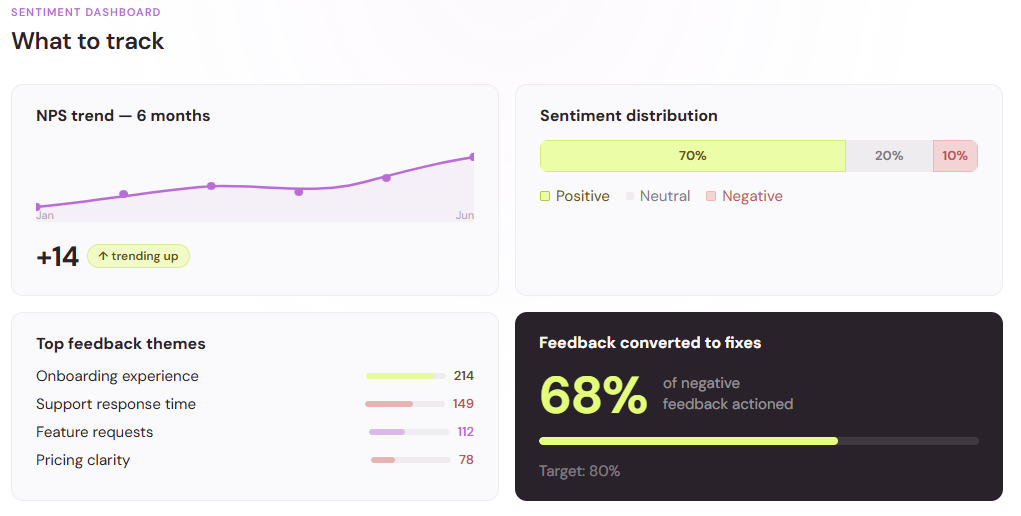
CSAT and NPS trends over time. Track these monthly or quarterly to spot whether sentiment is improving, declining, or flat. Changes often signal shifts in product quality, customer service, or market conditions.
Sentiment distribution. Break down feedback into positive, negative, and neutral percentages. A 70% positive, 20% neutral, 10% negative split looks different from 40% positive, 30% neutral, 30% negative. The latter flags that a third of your customers are unhappy.
Sentiment by segment. Enterprise customers might feel differently than SMB customers. New users might differ from power users who've been with you for three years. Slice sentiment data by cohort to address specific pain points for specific groups.
Themes and topics in feedback. Watch for patterns. Are multiple people complaining about the same feature? Praising the same part of onboarding? AI-powered sentiment tools now flag these themes automatically, so you don't have to manually read hundreds of comments.
Sentiment-to-action ratio. Capturing sentiment is half the work. Track whether negative feedback leads to fixes. If 100 customers complain about something and nothing changes, you've wasted that feedback. Tie sentiment data to product roadmaps and customer service playbooks.
How to act on sentiment data
Sentiment analysis is only useful if you do something with it.
Identify patterns first. Look for repeated themes rather than fixing every single complaint. If 15% of customers mention the same problem, that's a signal.
Prioritize by impact. A UX issue affecting your entire user base matters more than a bug affecting two users. Weight feedback by customer segment and business impact.
Close the loop. When you fix something based on customer feedback, tell them. A simple email saying "We heard you, and we've made this change" rebuilds trust.
Share wins internally. When positive feedback comes in, let your team see it. Sharing positive sentiment motivates teams and reminds them who they're building for.
Tools and platforms for sentiment analysis
The best sentiment tools combine manual collection methods with AI that reads between the lines. Modern platforms integrate multi-channel feedback, categorize sentiment automatically, and flag priority issues without requiring you to read thousands of comments.
Key platforms include Qualtrics, SurveyMonkey, InMoment, Medallia, and Mopinion. Each offers different strengths depending on scale, budget, and whether you need survey-only tools or broader feedback management.
When evaluating tools, ask:
- Does it collect feedback from where your customers actually are?
- Can it tag sentiment automatically, or do you read everything manually?
- Does it integrate with your CRM so you can tie feedback to customer segments?
- Can you set up alerts for urgent sentiment drops?
- Does it help track whether feedback leads to action?
Start with one method, build from there
Measuring how customers feel is foundational. But customer sentiment is only one signal. Layer it on top of behavior data and business metrics for the clearest insights.
Start by picking one sentiment method—NPS is the easiest entry point—and measure it consistently. Once you have baseline data, add a second method. Over time, you'll build a clearer picture of what your customers really think and act faster than competitors who rely on intuition alone.