Hotjar Alternatives for User Research
Learn about the best Hotjar alternatives for user research. Compare usability testing, surveys, heatmaps, and feedback tools to find the right fit.

Key takeaways
- Recordings show behavior, not motivation: Hotjar excels at capturing clicks and scrolls, but understanding why users act requires surveys, moderated testing, or interviews.
- Match the tool to the research question: Qualitative methods explain individual behavior, while quantitative methods validate patterns across hundreds of respondents. The strongest research programs combine both.
- Each alternative owns a niche: Maze for rapid task testing, UserTesting for moderated depth, Optimal Workshop for information architecture, and survey platforms for large-sample validation.
- Good research pays for itself: Usability research has been shown to return 100x its investment, but only when findings actually change decisions.
When you're gathering insights about how people interact with your product or website, the tools you choose shape what you learn, and how quickly you learn it. Hotjar built a reputation in session recording and heatmapping, but it's far from the only player in user research. Whether you're outgrowing Hotjar's feature set, hitting budget constraints, or simply want to explore what else is out there, plenty of alternatives deliver strong quantitative and qualitative data collection.
This guide walks you through the landscape of user research tools, what to look for when comparing options, and how different platforms handle the core challenges of understanding user behavior.
Why researchers look beyond Hotjar
Hotjar excels at showing you how users move through a page: their clicks, scrolls, and mouse movements. But understanding behavior isn't always the same as understanding why behavior happens. Some research goals demand different tools entirely.
You might need deeper quantitative validation. Online surveys rank as the most used quantitative method among market research professionals, with 85% using them regularly. Session recordings alone can't scale to validate hypotheses across hundreds or thousands of respondents.
Or you might need qualitative depth beyond what recordings provide. A user who bounces off your checkout page leaves a trail of clicks, but not an explanation. Moderated usability testing, open-ended surveys, and participant interviews fill that gap. These exist outside of Hotjar’s primary feature set.
Budget is another real constraint. Hotjar's pricing climbs steeply as you add team members or increase recording limits. Some alternatives offer better value for specific research needs.
Key capabilities to compare
Before evaluating any tool, clarify what research questions you're trying to answer. The right alternative depends entirely on your goals.
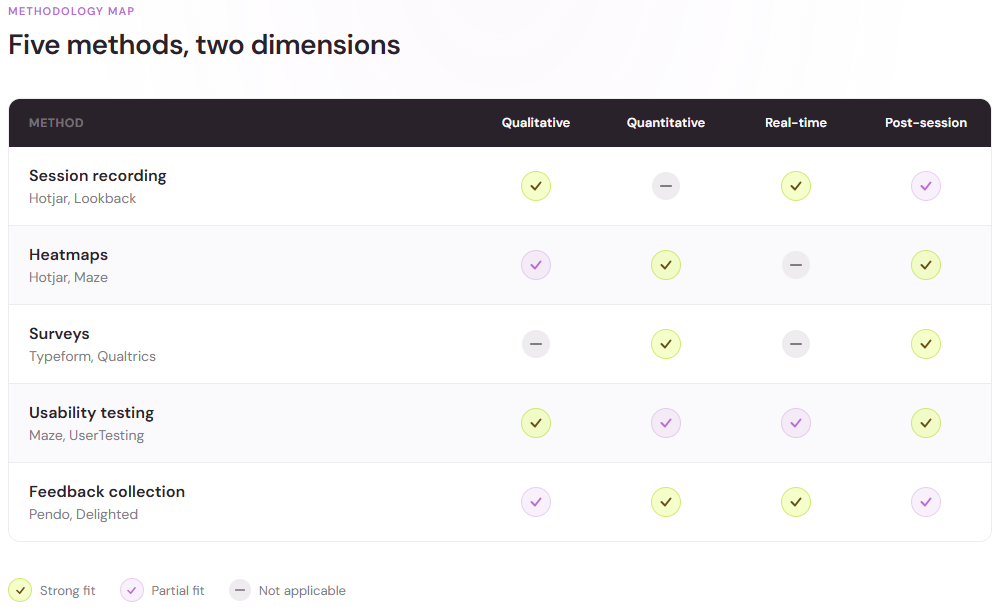
Quantitative vs. qualitative. Session recordings and heatmaps are inherently qualitative; they show individual behavior in real time. Surveys and rating scales are quantitative; they aggregate responses across a sample to reveal patterns. The best research combines both. Some tools lean heavily toward one side, while others balance them better.
Sample size and reach. Recording sessions work great for small participant groups (typically 5-50 people reveal most usability issues). But validating insights across your entire user base requires surveys or analytics that work with much bigger samples. If your research goal involves hundreds or thousands of respondents, session recording alone won't suffice.
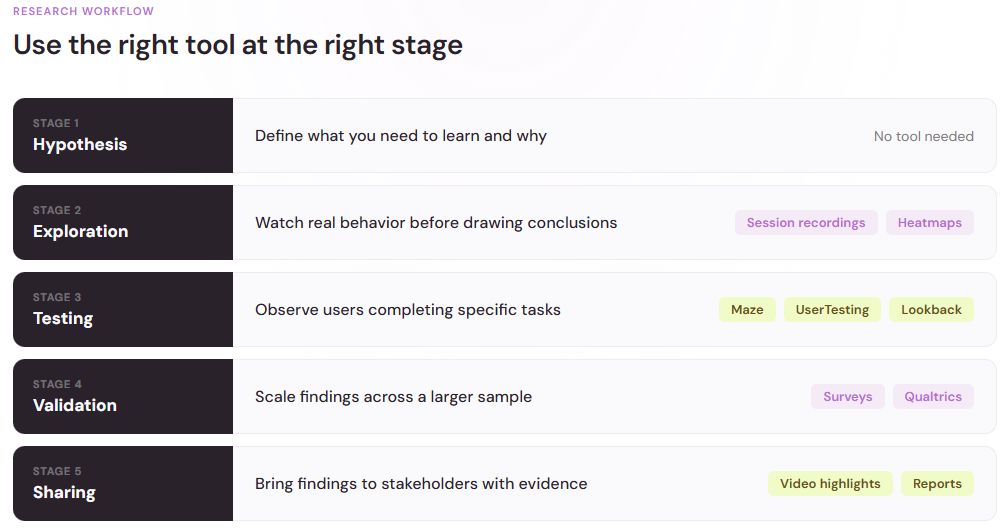
Speed of insight. Session recording is almost instant. Surveys and usability tests require participant recruitment, which adds days or weeks. Choose based on how quickly you need answers.
Integration with your workflow. Some tools feed data directly into Slack, Jira, or your analytics platform. Others require manual export. Tight integration saves time when running research continuously.
Top Hotjar alternatives
Maze
Maze started as a usability testing platform focused on startups and grew quickly. By early 2021, 40,000 companies were using Maze. It combines unmoderated usability tests, surveys, and prototype testing into one interface.
Strengths:
- Fast unmoderated testing. Recruit participants from Maze's built-in panel or bring your own. Get results in hours.
- Prototype testing. Test Figma designs, wireframes, or mockups before building the real thing.
- Clean participant insights. Maze shows exactly where users click, what they struggled with, and their feedback in one view.
- Affordable for startups. Plans scale well if testing infrequently or with small sample sizes.
Tradeoffs:
- Fewer session recordings. Maze focuses on task-based testing, not passive session recording like Hotjar.
- Limited heatmapping. Click data exists, but not the scroll and movement heatmaps Hotjar provides.
- Smaller ecosystem. Fewer integrations than competitors, though core ones (Slack, Jira, Google Sheets) are solid.
Best for: Teams running rapid unmoderated usability tests, testing designs before build, or validating specific user tasks.
UserTesting
UserTesting is a heavyweight in moderated user research. You write a scenario, recruit participants matching your target demographics, and watch them think aloud while interacting with your product.
Strengths:
- Moderated depth. A real person narrates their thoughts as they navigate. You hear frustration, confusion, and delight. Each click has a whole backstory.
- Massive participant pool. Recruit from millions of prescreened participants across dozens of countries and demographics.
- Video transcripts and highlights. Every session is recorded, transcribed, and highlightable for stakeholder buy-in.
- Flexible methodology. Run moderated sessions (you facilitate live) or unmoderated (participants record themselves).
Tradeoffs:
- Cost per participant is high. A single round of 5-10 sessions can cost $2,000-$5,000+.
- Time investment. Even unmoderated sessions require writing scenarios, recruiting, and reviewing video.
- Overkill for simple questions. If you just need to know whether users prefer option A or B, UserTesting will give you more noise than you need.
Best for: In-depth user research, stakeholder alignment, behavioral validation, teams with budget for quality insights.
Optimal Workshop
Optimal Workshop focuses on information architecture (IA) and navigation research—a niche Hotjar doesn't cover well. It includes tree testing, card sorting, and first-click testing.
Strengths:
- IA and navigation expertise. Tree testing and card sorting excel at validating menu structures.
- Unmoderated by design. Run studies with hundreds of participants without moderation overhead.
- Clear data visualization. Results are presented as easy-to-read dashboards and reports.
- Reasonable pricing. Cost-effective for information architecture research.
Tradeoffs:
- Narrow scope. Excels at IA research but doesn't touch session recording or broader usability testing.
- No moderation. You won't get the rich qualitative data of moderated sessions.
- Limited integration. Integrations exist but aren't as deep as some competitors.
Best for: Site restructuring, navigation testing, information architecture validation.
Lookback
Lookback blends moderated and unmoderated research. Run live moderated sessions, watch unmoderated video tests, or run surveys, all in one tool.
Strengths:
- Flexibility. Move between moderated, unmoderated, and survey research without switching tools.
- Video-first approach. Every research method produces video or richly annotated data.
- Easy collaboration. Teams can watch sessions live, leave comments, and build shared insight.
- Participant recruitment. Built-in panel recruitment or bring your own participants.
Tradeoffs:
- Learning curve. Flexibility is powerful, but it means more options to navigate.
- Pricing can climb. Per-participant and per-video costs add up with frequent studies.
- Video processing time. Unmoderated tests have to be uploaded and processed before they can be viewed, delaying insights.
Best for: Teams running mixed-method research, organizations valuing video evidence, ongoing user research programs.
Qualtrics
Qualtrics is enterprise research software—powerful, comprehensive, and expensive. It handles surveys, experience management, and advanced analytics.
Strengths:
- Enterprise features. AI-powered analysis, real-time dashboards, and advanced segmentation.
- Integrated XM approach. Combine surveys, feedback, and analytics to understand the full customer experience.
- Scalability. Built for organizations running hundreds of research projects simultaneously.
- Security and compliance. Enterprise-grade data handling for regulated industries.
Tradeoffs:
- Cost and complexity. Steep price tag and significant implementation time.
- Steep learning curve. Powerful but not intuitive; training is often required.
- Requires commitment. Better ROI with continuous research, not for ad hoc projects.
Best for: Enterprise organizations, regulated industries, sophisticated, high-volume research programs.
Hotjar competitors in feedback and NPS
If your goal is continuous customer feedback rather than structured user research, several lightweight alternatives work well. Medallia leans toward enterprise experience management, Delighted makes quick NPS pulse checks painless, and Wootric focuses on in-app microsurveys, each with strengths in specific feedback scenarios.
Quantitative research and the case for surveys
One key statistic: online and mobile quantitative research services accounted for 35% of worldwide revenue for market research companies in 2022. That concentration exists because online methods work. They scale, they're cost-effective, and they produce defensible data.
If you're using Hotjar mainly to validate hunches or find user pain points, a good survey platform might deliver faster answers at lower cost. The key is matching the format to the question: forms for structured data capture, surveys for measuring attitudes across a sample, quizzes and polls for quick engagement-friendly reads, and combining methods when one alone can't answer the question.
The ROI of good user research
One system used by over 100,000 people saw a usability investment of $68,000 generate $6.8 million in value within the first year. That 100:1 return is only on the table if the research actually changes decisions.
The best tool is the one your team will use. If Hotjar's session recording is your primary need and it's working, switching might not be worth the disruption. But if you're running surveys to validate insights from recordings, or if you need moderated testing to understand why users behave a certain way, exploring alternatives makes sense.
How to choose
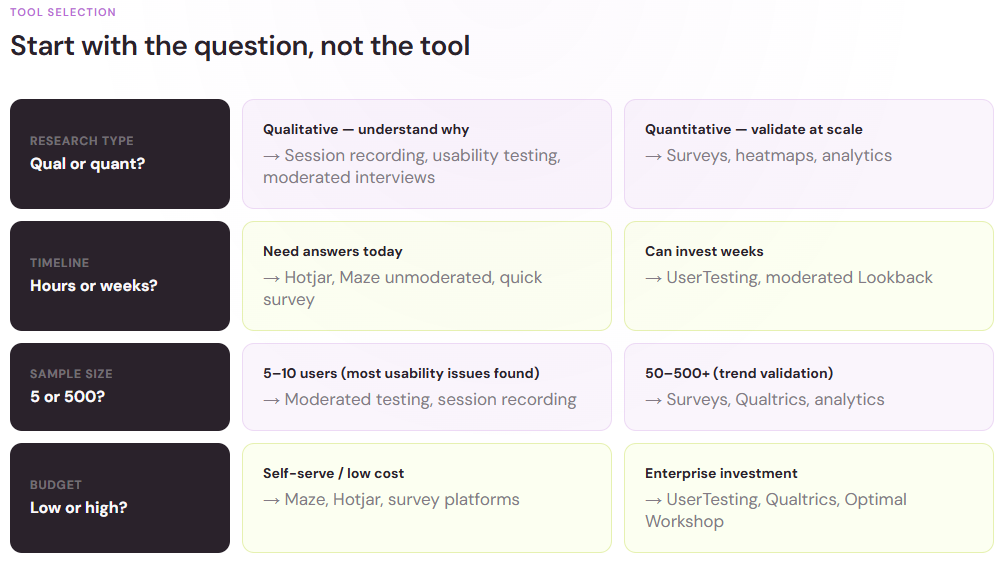
Start with your research question, not the tool. Ask yourself:
- Am I trying to understand behavior (qualitative) or validate a hypothesis across many people (quantitative)? This determines whether you need usability testing or surveys.
- Do I need to watch users in real time, or can I review data asynchronously? Moderated testing requires live facilitation. Unmoderated testing and surveys can run in parallel.
- What's my timeline? Session recording gives instant answers. Moderated research takes weeks. Surveys sit somewhere in between.
- How many participants do I need? Recording 5-8 users reveals most usability issues. Validating a trend across your user base requires 50+.
- What's my budget? Moderated research is expensive per participant but yields deep insights. Surveys are cheaper per response but require larger sample sizes.
The landscape beyond Hotjar
Hotjar remains a solid tool for session recording and heatmapping. But user research is broader than watching clicks. The alternatives above handle different research questions more effectively: Maze for rapid task testing, UserTesting for moderated depth, Optimal Workshop for information architecture, and Qualtrics for enterprise complexity.
Your choice depends on what you're trying to learn. Exploring Hotjar alternatives means matching the tool to the question, not the other way around.

Liked that? Check these out:

Opinions and Expertise
What’s actually slowing research teams down (Hint: it’s not the research)
From recruiting participants and scheduling interviews to building the actual surveys, the operational drag is taking researchers away from what they do best. See what's actually slowing them down and how Research Flow fixes it.
Read more