Using AI for thematic analysis in qualitative research
AI thematic analysis cuts coding time from days to minutes while reducing coder drift, here's how to use it without sacrificing rigor or methodology.
Thematic analysis—finding patterns and meanings in qualitative data—is one of the most powerful tools researchers have. It turns open-ended responses, interview transcripts, and unstructured feedback into actionable insights. But it’s also one of the most time-consuming parts of research.
Manually coding hundreds or thousands of responses to identify recurring themes requires patience, consistency, and hours of focused work. Researchers often find themselves rereading the same passages, second-guessing their category assignments, and struggling to stay objective as fatigue sets in. The cognitive burden compounds with scale; what takes a few hours with 20 responses becomes a weeks-long project with 200.
AI changes that equation. Modern AI tools can help researchers code faster, spot patterns humans might miss, and reduce the cognitive load of analysis, freeing up time for what AI can’t do: interpreting findings and connecting them to real business outcomes. By automating the initial coding phase, researchers can focus their expertise where it matters most: validating results and drawing meaningful conclusions.
Here’s what you need to know about using AI for thematic analysis, why it works, and how to make sure your results stay rigorous.
What thematic analysis does
Thematic analysis is the process of identifying, coding, and organizing patterns in qualitative data. Unlike quantitative methods that measure frequency or correlation, thematic analysis asks: what themes emerge when we look across many responses?
A product team might run interviews with 15 users about their onboarding experience. The researcher reads every transcript, marks sections where users mention “confusing” or “unclear,” then groups those mentions into a theme—say, “lack of clarity in setup.” Another theme might be “slow load times.” A third, “helpful customer support.” By the end, the team has a map of what’s working and what isn’t, told through the actual language of users.
This kind of analysis works across any qualitative source: interview transcripts, open-ended survey responses, customer feedback, social media comments, support tickets, or focus group notes. The output is always the same: a structured understanding of what your data contains. The richness of the method lies in how it preserves respondent language while organizing it into meaningful categories that reveal underlying patterns.
But here’s the challenge: thematic analysis requires reading through data multiple times, applying consistent definitions to codes, and staying alert to nuance. One person might code “the setup took a while” as “slow load times.” Another might code it as “confusing process.” Both are doing thematic analysis, but inconsistently, and that undermines the reliability of findings.
This inconsistency—sometimes called “coder drift”—becomes more pronounced as the analysis progresses and fatigue accumulates.
Scale that to 50 interviews or 500 survey responses, and the work becomes enormous—and the risk of inconsistency grows with it. The sheer volume of data makes it nearly impossible for a single person to maintain consistent coding standards throughout an entire project.
Why AI is suited for thematic analysis
AI doesn’t replace the judgment calls that make thematic analysis meaningful. It removes the grunt work that makes it slow.
Here’s where AI helps:
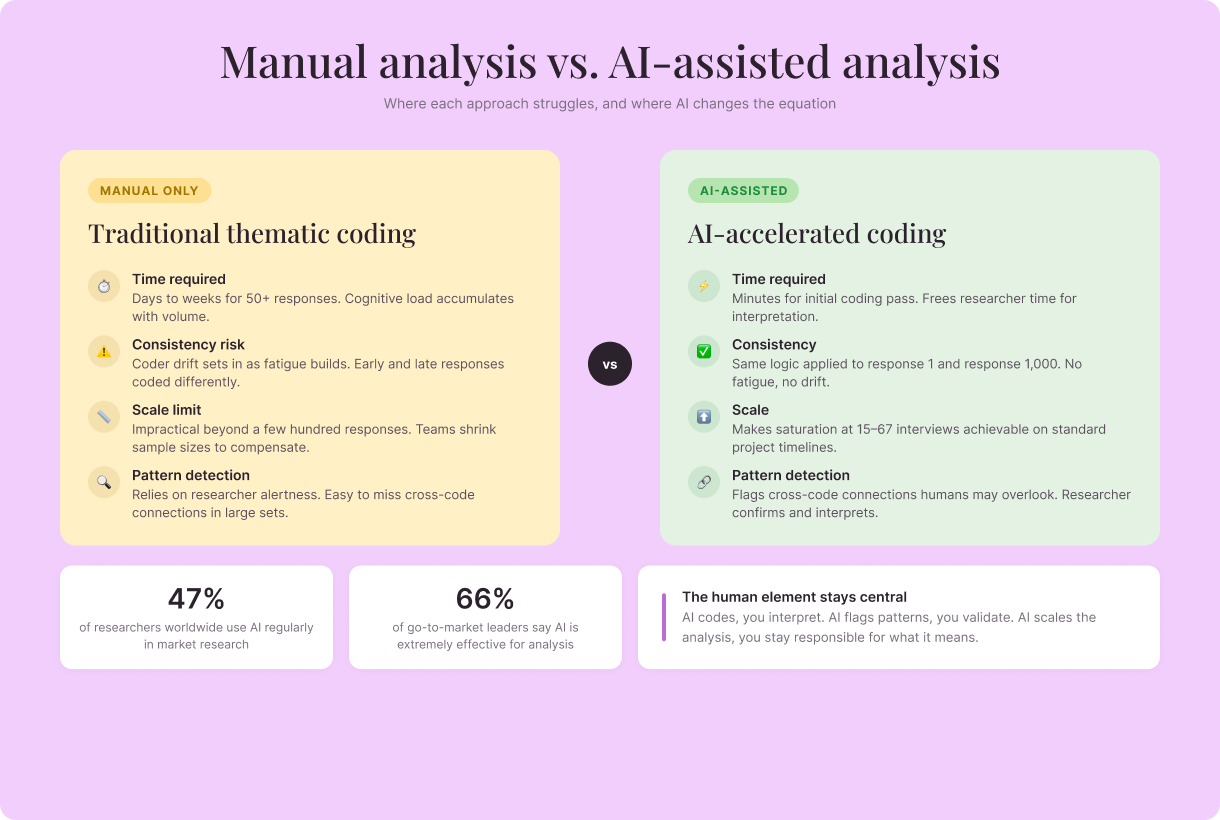
Speed in initial coding. AI can process large volumes of text in minutes instead of days. Once you give it coding rules or examples, it can apply those rules consistently across all your data. Researchers using AI for thematic analysis report that the tool handles initial coding in a fraction of the time manual coding would take. This acceleration opens possibilities for more ambitious research projects that would otherwise be constrained by time and resources.
Consistency across codes. AI doesn’t get tired, distracted, or biased by what it coded yesterday. It applies the same logic to the first response and the thousandth. That doesn’t make AI perfect—it can still miss nuance or misinterpret context—but it does reduce drift, which is a real problem in large qualitative projects. This consistency becomes increasingly valuable as datasets grow larger, where human consistency typically degrades.
Pattern spotting. AI can flag connections between codes that a human reviewer might overlook, especially in large datasets. If “confusing” and “steep learning curve” and “unclear instructions” are coded separately, AI might suggest they belong under a broader theme. Again, the researcher decides, but the tool surfaces possibilities that might otherwise remain hidden in a large corpus of data.
Faster iteration. Because AI does the initial pass quickly, researchers can refine their code definitions and re-run the analysis multiple times. That iteration leads to better, more rigorous findings. The ability to test different coding schemes without enormous time investment fundamentally changes how researchers approach their work.
Transparency and auditability. When AI codes your data, you have a record of how and why each code was applied. That’s valuable for peer review, compliance, or simply checking your own work. This documentation creates accountability that manual coding often lacks.
Two-thirds of go-to-market leaders say AI is extremely effective for market research, analysis, and measurement (ICONIQ State of Go-to-Market, 2025). Around 47% of researchers worldwide already use AI regularly in their market research activities (Backlinko, 2026).
In other words, the shift isn’t coming—it’s already here.
How to use AI for thematic analysis without losing rigor
AI is powerful, but thematic analysis still requires human judgment. Here’s how to keep your analysis rigorous:
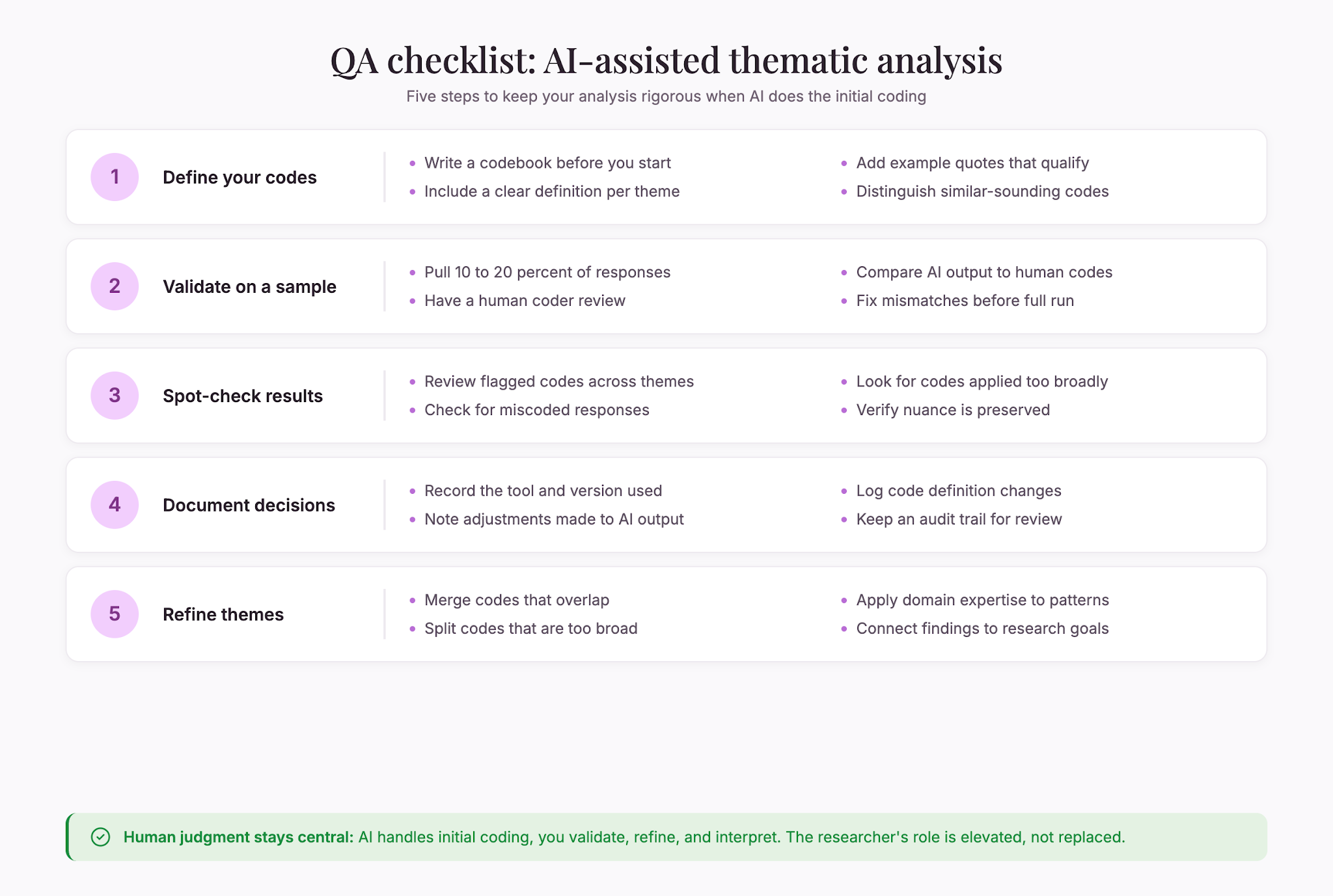
Define your codes before you code
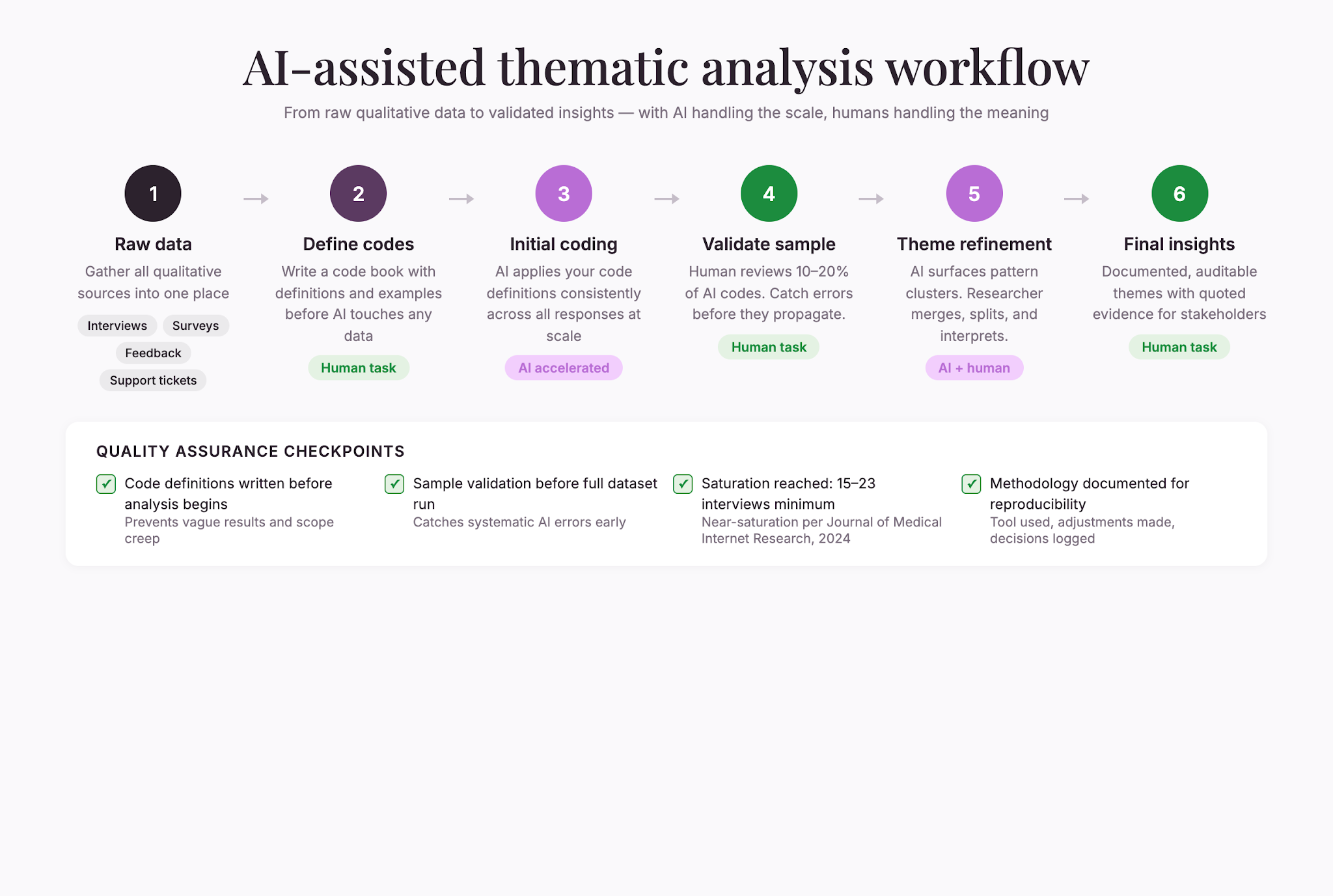
Don’t just feed AI your raw data and ask it to “find themes.” That’s too loose. Instead, start with a code book: a set of definitions for the themes you’re looking for, with examples of what qualifies.
For instance:
- Navigation confusion – Statements where users mention difficulty finding features, unclear menu structures, or taking longer than expected to locate something.
- Feature gap – Comments where users say they expected a feature but it doesn’t exist, or an existing feature doesn’t work the way they expected.
- Performance issues – Reports of slow load times, freezing, crashes, or other technical problems.
When you’re specific like this, AI has guardrails. It knows what you’re looking for, so it won’t conflate “slow” (performance) with “hard to find” (navigation). Detailed code definitions also serve as a communication tool—stakeholders understand exactly what each theme represents and why specific responses were assigned to particular codes.
Validate AI codes against a sample
Before you run AI coding across all your data, pull a small sample—maybe 10% or 20%—and have a human coder review it. This catches problems early. If the AI is misinterpreting your code definitions or missing obvious mentions, you’ll spot it before processing thousands of responses. This validation step acts as a quality gate, ensuring that systematic errors don’t propagate across your entire dataset.
Stay involved in theme refinement
After AI does the initial coding, review the results. Look for patterns it flagged. Spot-check coded responses to make sure they match the theme. Merge codes that should be combined. Split codes that are too broad. This is where your domain expertise shines: you understand context, industry norms, and what your stakeholders care about in ways AI doesn’t. Your role transforms from data entry to strategic interpretation, where you can add genuine value.
Track sample size and saturation
Thematic analysis is done when you’ve reached saturation—the point at which new data stops revealing new themes. For research to be credible, you need to know when you’ve hit that threshold.
Near saturation (capturing 90% of codes) typically occurs at 15 to 23 interviews, depending on your study characteristics and population homogeneity (Journal of Medical Internet Research, 2024). True saturation—100% of codes—requires 30 to 67 interviews. Earlier research found that high-level themes often plateau at just 10 to 12 interviews, though this varies by research quality and design (Journal of Medical Internet Research, 2024).
AI doesn’t change these numbers, but it does make it easier to reach them. You can code more interviews in less time, which means you can confidently say, “We’ve interviewed enough people to be confident in our findings.” This accelerated pathway to saturation removes a major constraint from qualitative research planning.
Document your methodology
Write down the code definitions you used, how you validated AI coding, which tool you used, and any adjustments you made to the AI’s output. This transparency—sometimes called “explainability”—is essential for credibility. Reviewers, stakeholders, and future researchers need to understand how you arrived at your conclusions. Documentation also serves a practical purpose: it makes your work reproducible and helps you remember your reasoning months later.
Tools and workflows for AI-assisted thematic analysis
Many research platforms now include AI-powered coding and theme identification. When evaluating a tool, look for:
Customizable code definitions. Can you input your own codes, or does the tool force you to use pre-built themes? The more flexible the tool, the better it fits your specific research question. Tools that allow customization give you control over what constitutes a valid interpretation of your data.
Explainability. Does the tool show you why it assigned a code? Can you see the exact text it’s responding to? A black box is less useful than a tool that lets you audit its decisions. Explainability builds trust and helps you catch errors before they compound across your dataset.
Integration with your data collection. If you’re running surveys or interviews within the same platform, you want coding and analysis built in. Switching between tools slows down your workflow and risks losing context. Integrated workflows keep your research contained in one place, reducing friction and maintaining continuity.
Speed and accuracy trade-offs. Some AI tools prioritize speed. Others prioritize precision. Understand which you need. If you’re doing exploratory research where speed matters, a faster tool might be better. If you’re doing compliance or clinical research where accuracy is non-negotiable, slower and more careful is right.
Tools like ResearchFlow are designed to keep qualitative researchers in one place—collecting data, coding responses, and analyzing themes without context-switching. That continuity matters more than it might sound; it reduces the friction in iterating on your findings. When using AI thematic analysis within an integrated platform, you benefit from real-time feedback and the ability to quickly pivot your coding strategy if early results suggest a different approach.
Common pitfalls to avoid
Trusting AI without verification. AI is fast, but it’s not always right. It can miss sarcasm, misread context, or apply codes too broadly. Always spot-check. Always have a human review high-stakes findings. Verification isn’t a sign of distrust—it’s a best practice that ensures quality.
Skipping code definition. The more precisely you define your codes, the better AI performs. Vague definitions lead to vague results. Spend time upfront on this. The investment in clarity at the beginning saves time and improves accuracy downstream.
Ignoring sample size. AI speed is tempting—you might code 8 interviews and call it done. But saturation still matters. Smaller samples miss themes. Use AI to make larger samples feasible, not to justify smaller ones. The goal is rigorous analysis, not fast analysis.
Losing the qualitative richness. Thematic analysis is powerful because it preserves quotes, context, and nuance. Don’t let AI efficiency tempt you to strip that away. Your findings should still be grounded in actual respondent language. Rich, quoted findings resonate with stakeholders far more than abstract theme lists.
Forgetting that coding is interpretation. There’s no perfectly objective code. Every definition you write is a choice about what matters. AI doesn’t change that. It just makes your choices visible and scalable. Own that responsibility.
Why this matters now
Qualitative research is becoming more common, not less. Surveys remain the most-used quantitative method among market research professionals—85% use them regularly (Backlinko, 2026)—but organizations increasingly recognize that understanding the why behind the numbers requires depth, and that depth comes from qualitative data.
At the same time, the volume of data organizations collect—open-ended survey responses, customer interviews, support feedback, social listening—has exploded. Manual analysis of that volume simply isn’t practical.
AI closes that gap. It makes it possible to do rigorous, large-scale thematic analysis in weeks instead of months. That means you can get insights faster, iterate faster, and make decisions with confidence.
But speed is only valuable if it doesn’t sacrifice rigor. That’s why the human element remains central. AI codes, you interpret. AI flags patterns, you validate and refine. AI scales analysis, you stay responsible for what it means. Using AI thematic analysis doesn’t diminish the researcher’s role—it elevates it, removing tedium so expertise can shine.
The future of thematic analysis isn’t AI replacing researchers. It’s researchers using AI to focus on what they do best: making sense of human insight.

Liked that? Check these out:

Opinions and Expertise
What’s actually slowing research teams down (Hint: it’s not the research)
From recruiting participants and scheduling interviews to building the actual surveys, the operational drag is taking researchers away from what they do best. See what's actually slowing them down and how Research Flow fixes it.
Read more