UX research methods: How to choose the right one
Not sure which UX research methods fit your project? Compare interviews, usability tests, surveys, and A/B tests, with a framework to match method to goal.
User experience research is the foundation of product decisions that stick. When you understand how real people interact with your product, what frustrates them, and what delights them, you can build something that genuinely works—not just something that looks good on paper.
But “doing research” is broad. There are dozens of methodologies, each suited to different questions, budgets, and timelines. Picking the wrong one wastes resources. Picking the right one gives you the insights that drive real change.
This guide walks you through the main UX research methods, when to use them, and how to pick the best fit for your goals.
What UX research methods exist
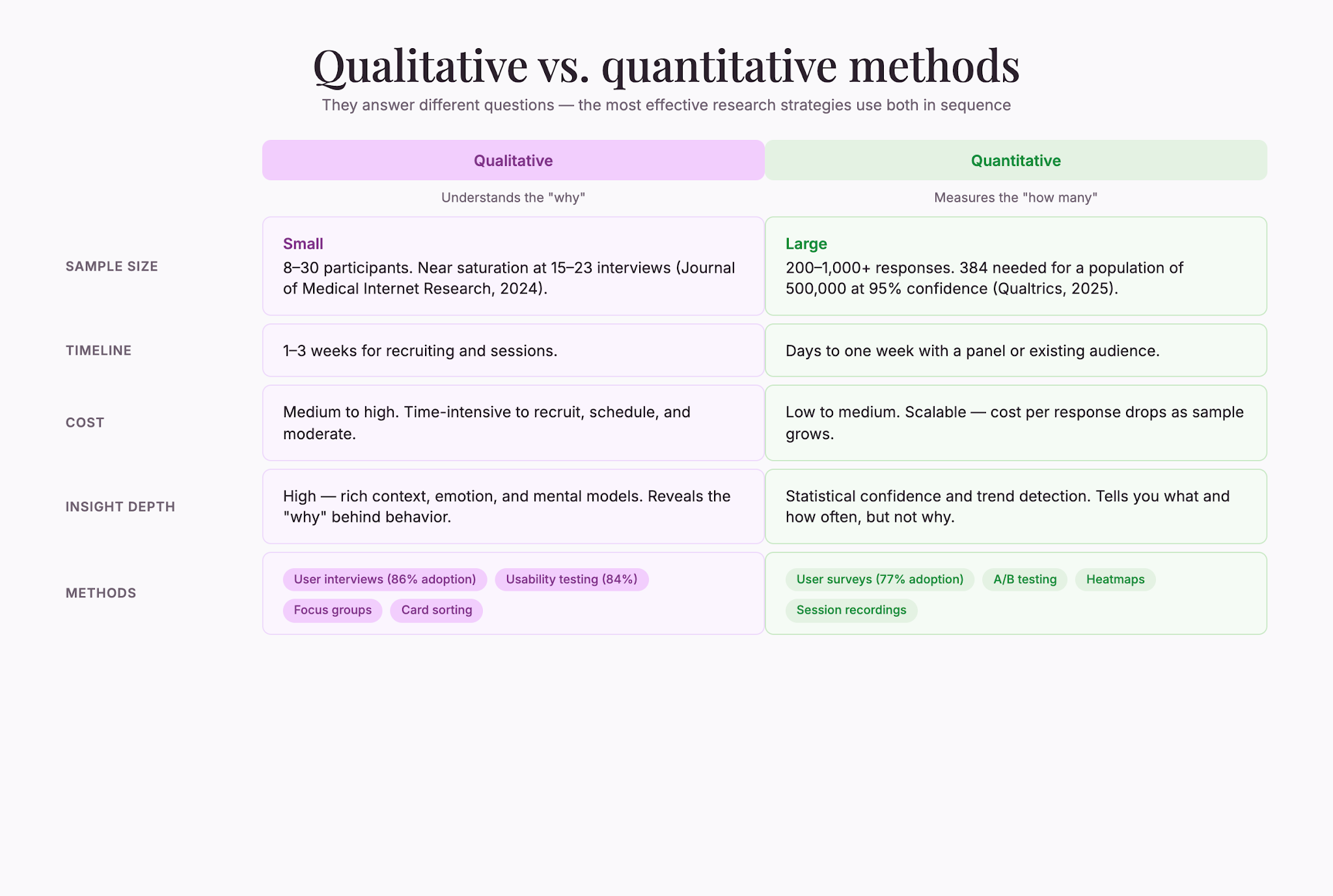
UX research falls into two buckets: qualitative and quantitative. They answer different questions and work best in different scenarios.
Qualitative research digs deep. It captures the why behind behavior—motivations, emotions, pain points, and unspoken needs. You work with smaller groups of people, but you get rich, nuanced insight. This depth is particularly valuable when you’re exploring new problems or trying to understand complex user behaviors that numbers alone can’t explain.
Quantitative research measures breadth. It tells you how many people experience a problem, how often they do, and whether a change actually moved the needle. You need larger sample sizes, but you get statistical confidence. This approach is essential when you need to make business cases or validate that patterns you’ve observed hold true across your entire user base.
Most teams use both. They’re not competitors; they’re partners. In fact, the most effective research strategies often layer qualitative insights with quantitative validation, ensuring you understand both the “why” and the “how much.”
The most common UX research methods
User interviews
User interviews are one-on-one conversations with your target users. You ask open-ended questions, listen carefully, and follow threads that surprise you.
User interviews rank among the most popular research methods, with 86% of teams using them regularly (TrueList, 2025). That’s because they work: you hear directly from people, catch nuances that surveys miss, and build empathy fast.
When to use interviews:
- Early in design, when you’re exploring the problem space
- When you need to understand context—the physical environment, workflow, frustrations around your product
- When your user base is small or highly specialized
- After a major release, to understand how real people are using your product
Challenges: Interviews are time-intensive. Recruiting the right people takes effort. And small sample sizes mean you can’t generalize results to your whole user base.
A good rule of thumb: near saturation of themes occurs at around 15 to 23 interviews, meaning you’ve heard most recurring patterns (Journal of Medical Internet Research, 2024). True saturation—where new interviews add almost no new information—typically requires 30 to 67 interviews (Journal of Medical Internet Research, 2024). Understanding when you’ve reached saturation helps you avoid both under-researching and wasting time on redundant conversations.
Usability testing
Usability testing asks users to complete realistic tasks on your product while you observe. You might ask someone to “find the pricing page” or “add an item to your cart.” You watch where they click, where they pause, where they get stuck.
Usability testing is used by 84% of teams (TrueList, 2025), making it one of the most trusted methods for spotting friction. Whether moderated (where a researcher guides the session) or unmoderated (where users complete tasks independently), usability testing reveals exactly where your product breaks down in real-world use.
When to use usability testing:
- Before launch, to catch problems early
- When you’ve made a major redesign and need to verify it works
- When you’re comparing two design approaches and need to know which one flows better
- Whenever you’ve changed information architecture or navigation
Challenges: Testing requires coordination—you need the product, testers, and a space or tool to run it in. It also doesn’t scale cheaply to large sample sizes.
But the investment pays off. Fixing a critical UX issue after launch costs 10 to 100 times more than catching it during early testing (UXPA, 2025). That math alone justifies planning usability testing into your timeline.
User surveys
Surveys ask many people the same set of questions—about their preferences, behaviors, pain points, or satisfaction. Surveys can be short and quick, or long and detailed.
User surveys are used by 77% of teams (TrueList, 2025) and are the backbone of quantitative research. Online surveys, specifically, are used by 85% of market research professionals regularly (Backlinko, 2026), making them the most common quantitative method in the industry. When designed well, surveys can reach hundreds or thousands of respondents, giving you the statistical power to spot patterns and make confident decisions.
When to use surveys:
- When you need to validate a hypothesis across a large audience
- When you want to measure satisfaction, NPS (Net Promoter Score), or other sentiment metrics
- When you need fast feedback—surveys can launch and collect responses in days
- When you’re testing messaging or positioning with your target market
Challenges: Surveys require careful question design. A poorly worded question leads to misleading data. Response rates can be low unless you have a captive audience or use incentives. And surveys capture what people say they do, not always what they actually do.
A/B testing
A/B testing (or split testing) shows two versions of a feature to different groups of users and measures which one performs better. It’s the most concrete way to know if a change works.
When to use A/B testing:
- When you have enough traffic to detect meaningful differences
- When you’re optimizing a specific metric (clicks, conversion rate, time on page)
- When you want to reduce bias—the data speaks, not opinions
- When changes are small enough to run in parallel without confusion
Challenges: A/B testing requires volume. If your audience is small, you may not have enough people to reach statistical significance. It also only works on live products—you can’t A/B test an idea that doesn’t exist yet.
Heatmaps and session recordings
Heatmaps show you where users click, scroll, and linger on a page. Session recordings let you watch how real people navigate your product in their own environment.
These are passive observation methods—you’re not asking people to do anything. They see what actually happens when users interact with your product on their own time.
When to use heatmaps and recordings:
- When you want to spot unexpected behaviors
- To understand drop-off points on key pages (like checkout or sign-up)
- To validate assumptions before investing in interviews or testing
- To see how people navigate across a whole product, not just one task
Challenges: These methods tell you what people are doing, but not why. You might see that 60% of users abandon a form at a particular field, but heatmaps won’t tell you if it’s confusing wording, privacy concerns, or something else. That’s when you pair them with interviews or surveys.
Focus groups
Focus groups bring together 6 to 10 people to discuss a topic, product, or idea. A moderator guides the conversation, and the group’s dynamic often brings out insights that individual interviews might miss.
When to use focus groups:
- When you want to explore attitudes and reactions to a new concept
- When group dynamics might surface ideas (e.g., brainstorming with users)
- When your product serves a tight-knit community and group discussion feels natural
Challenges: Focus groups are expensive to recruit, coordinate, and moderate. Dominant personalities can skew the conversation. And some users clam up in groups, so you may miss quieter perspectives. That’s why many teams now lean toward individual interviews or online surveys instead.
Card sorting
Card sorting asks users to organize concepts, features, or content into groups that make sense to them. You present cards with labels (like “Billing,” “Support,” “Account Settings”) and ask users to sort them into categories.
When to use card sorting:
- When you’re redesigning information architecture or navigation
- When you want to understand how users mentally organize your product’s features
- When you need to decide how to structure menus or categories
Challenges: Card sorting answers a narrow question—how should this content be organized? It doesn’t help with broader strategy or messaging. It also works best as a supplement to other methods, not a standalone approach.
How the ROI of UX research stacks up
Here’s what you need to know: UX research isn’t an expense—it’s an investment that pays for itself many times over.
Every $1 spent on UX returns approximately $100 (TrueList, 2025). In one documented case, a usability investment of $68,000 generated $6.8 million in benefit within the first year (UXPA, 2025). That’s a return of roughly 10,000% on the initial spend.
Yet only 55% of companies conduct any UX testing at all (TrueList, 2025).
The companies that do test have a competitive advantage, and the cost of* not *testing is steep. Fixing a critical UX issue after launch costs 10 to 100 times more than catching and fixing it early in the design process (UXPA, 2025).
The bottom line? Early testing saves money.
How to pick the right method for your goal
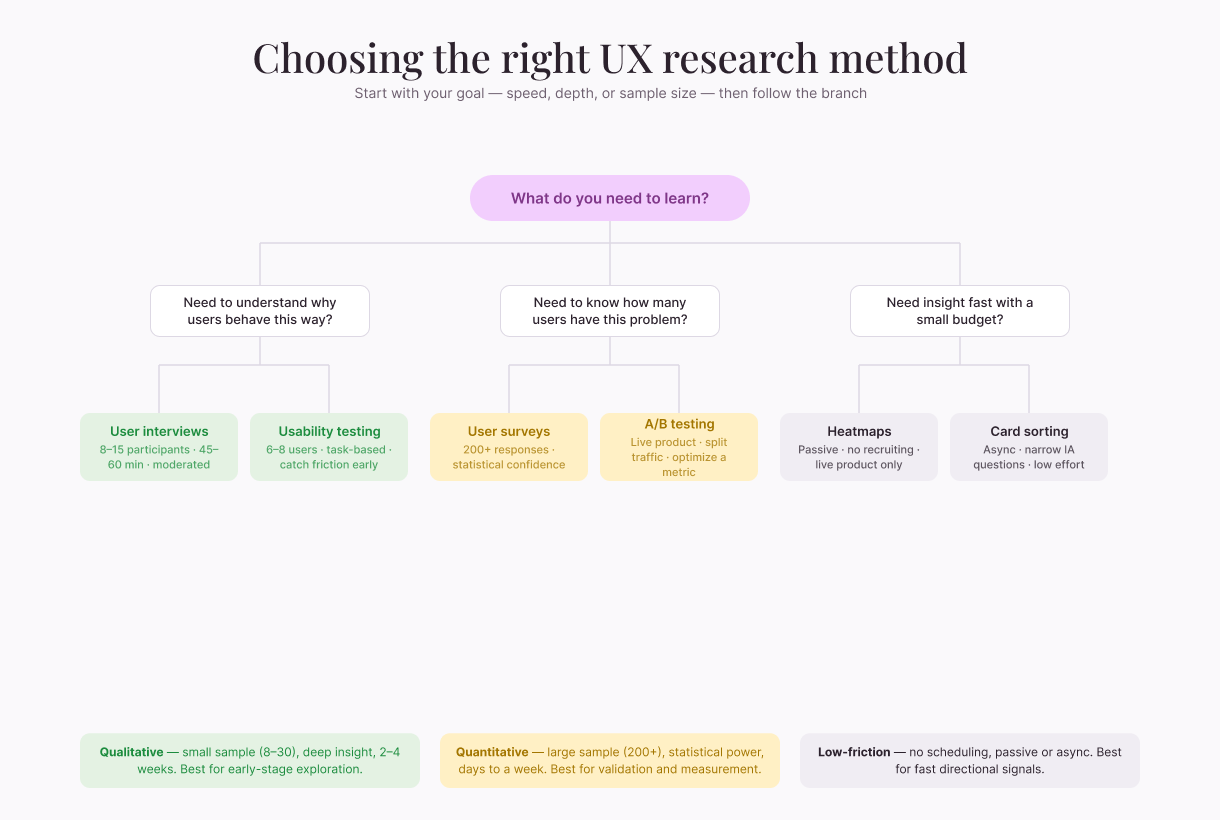
Start with your research question, not the method. What do you actually need to know?
If your question is “What problems do users face?” or “How do people think about this?” go qualitative. User interviews or usability testing will show you the friction and emotion behind the behavior.
If your question is “How many people have this problem?” or “Which version performs better?” go quantitative. Surveys or A/B testing will give you the statistical confidence you need.
If your question is “What do we need to build?” or “Should we invest in this feature?” use mixed methods. Run interviews first to understand the problem, then validate your hypothesis with a survey or A/B test.
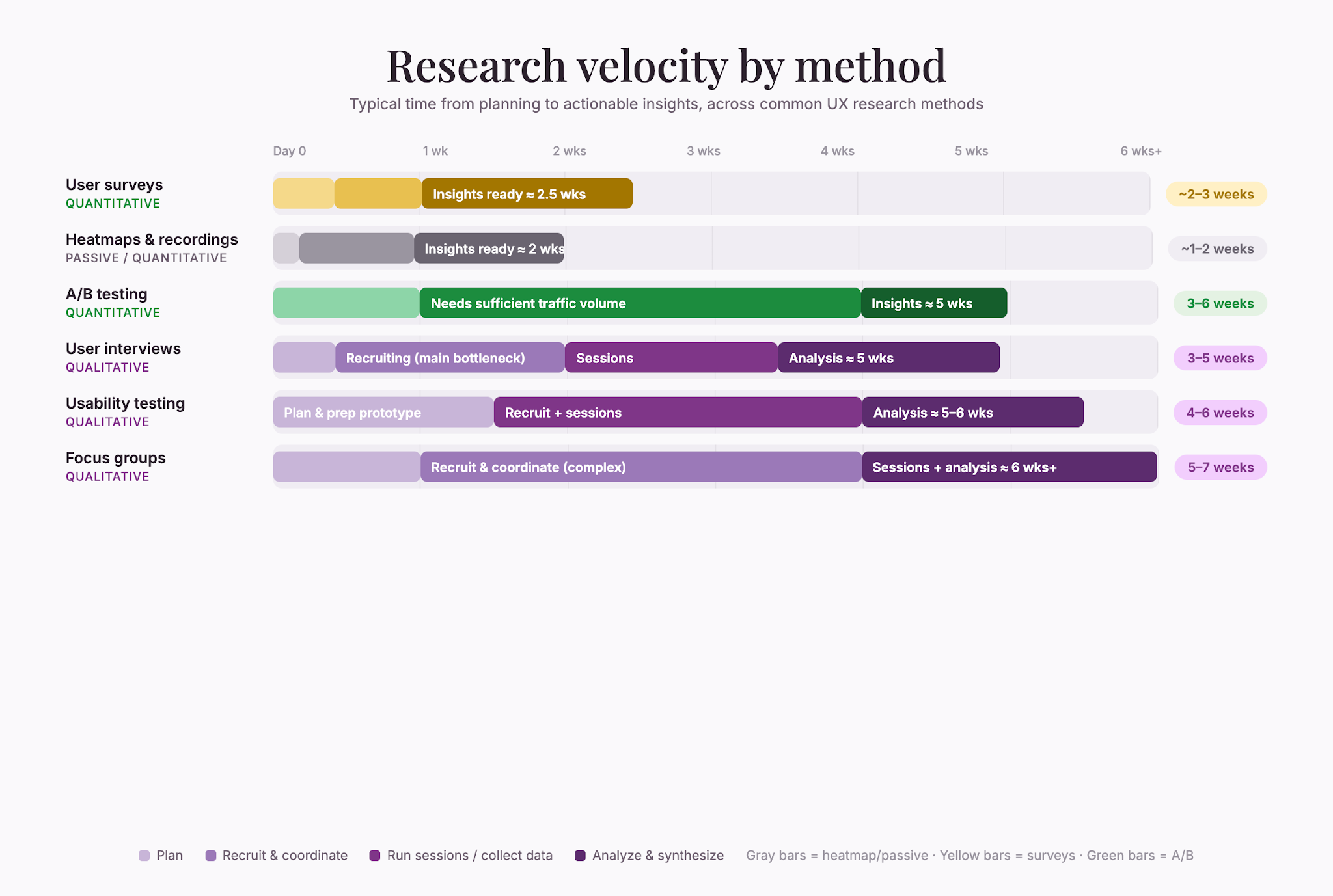
If you’re on a tight timeline, surveys and heatmaps launch fastest. Interviews and focus groups take longer to recruit and coordinate.
If your budget is limited, heatmaps and surveys cost less than moderated usability testing or focus groups. (Though you can run unmoderated tests at a lower cost too.)
If your user base is small or niche, interviews and usability testing work better than surveys. With fewer people, depth beats breadth.
If you have a large, diverse user base, surveys and A/B testing give you the coverage you need. Interviews still add value for specific segments.
Many teams work with multiple methods in tandem. A typical workflow might look like this:
- Run interviews with 8–10 early users to understand the problem
- Build a prototype and test it with 6–8 users in a moderated usability test
- Launch a survey to 200+ people to validate that the problem is widespread
- Ship the product and run a heatmap to spot unexpected behaviors
- Run an A/B test on a key metric (sign-up rate, feature adoption, engagement)
This combines depth and breadth, early learning and live validation. It also spreads the research across your development timeline, so you’re not doing everything at once.
Streamlining your research workflow
Running multiple UX research methods means coordinating teams, scheduling sessions, collecting data from different sources, and synthesizing what you’ve learned. That’s where the complexity creeps in.
Tools like ResearchFlow help you centralize the research process—from planning and screening participants to running surveys, interviews, and usability tests all in one place. With everything in one system, you spend less time on logistics and more time on the insights that matter.
Research methodologies come and go, but the principle stays constant: understand your users first, build second. Pick the UX research methods that answer your most urgent questions, run them lean, and let the data guide your next move.