From timing to question design, this guide covers everything you need to run a customer testimonial survey and turn responses into high-converting social proof.
Share
Latest posts on
Free online trivia maker: custom trivia quizzes in minutes
|
September 4, 2026
Read more
AI survey builder: create smart surveys in minutes
|
September 4, 2026
Read more
How to make a test online: tips and tricks
Typeform
|
September 4, 2026
Read more
How to build a landing page that converts
Typeform
|
September 4, 2026
Read more
Share
The ultimate guide to a customer testimonial survey
Your happiest customers already have opinions about you. They've told their colleagues. They've mentioned you to friends. Some have even posted about you online. The problem isn't that these stories don't exist—it's that you haven't captured them yet.
Whether you're a marketer building a case study library, a seller looking for social proof to close deals, or a founder trying to establish credibility in a crowded market, testimonials are among the most persuasive assets you can leverage. But collecting them takes more than hoping customers will leave a review on their own.
A customer testimonial survey is the key. It's a structured way to collect success stories, quotes, and endorsements from the people who know your product best. And, when done well, it gives you marketing material that no amount of copywriting can replicate: Real words from real people about real results.
Why testimonials carry more weight than marketing copy
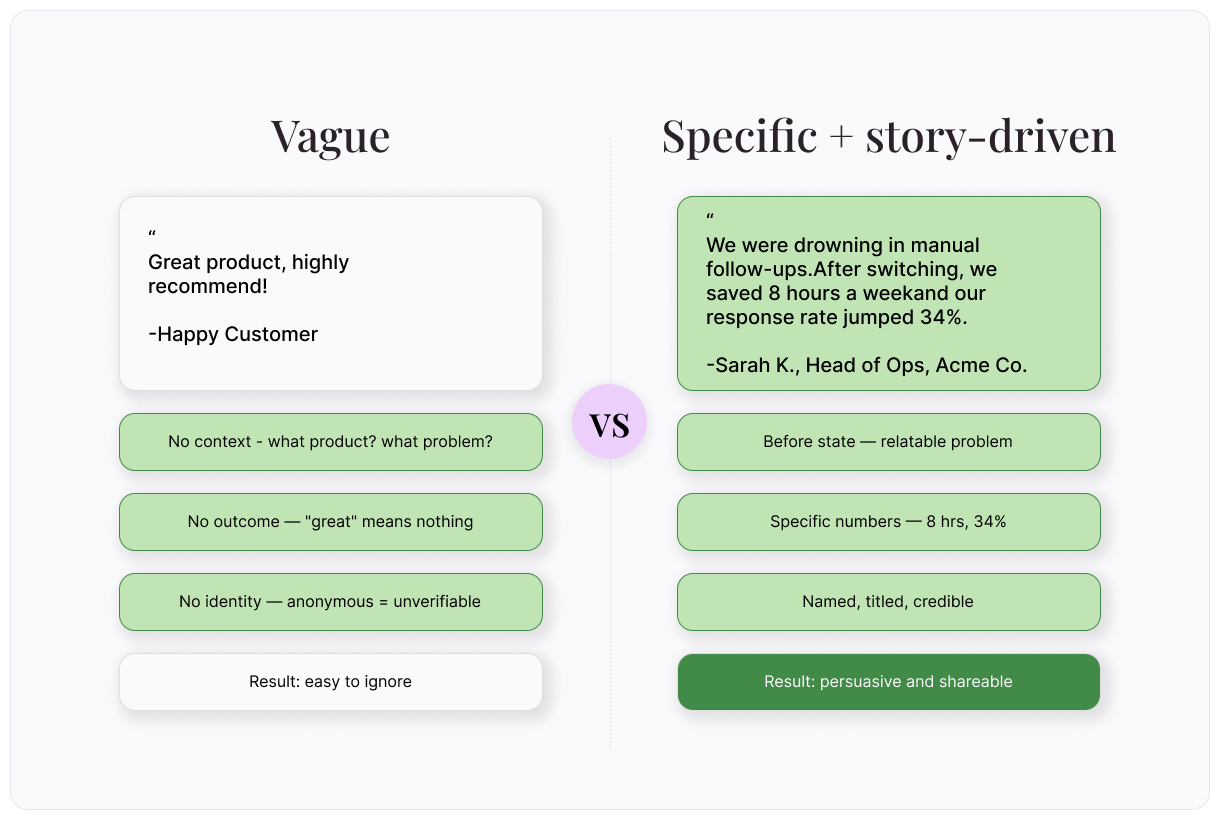
People trust other people more than they trust brands. That's not a criticism—it's human nature. When a potential customer reads that you "help businesses grow," they file it under "marketing." When they read that a specific company increased its signups by 40% after using your product, they pay attention.
Testimonials work because they offer:
Credibility – A third party is vouching for you, not your own marketing team.
Specificity – Real numbers, real outcomes, and real context are more persuasive than general claims.
Relatability – Potential customers see themselves in the stories of existing customers who faced similar challenges.
Objection handling – A testimonial that addresses a common hesitation ("I was worried about the learning curve, but...") does more than a FAQ ever could.
The catch? Great testimonials don't appear on their own. You have to ask for them, and asking well is a skill.
When to send a testimonial survey
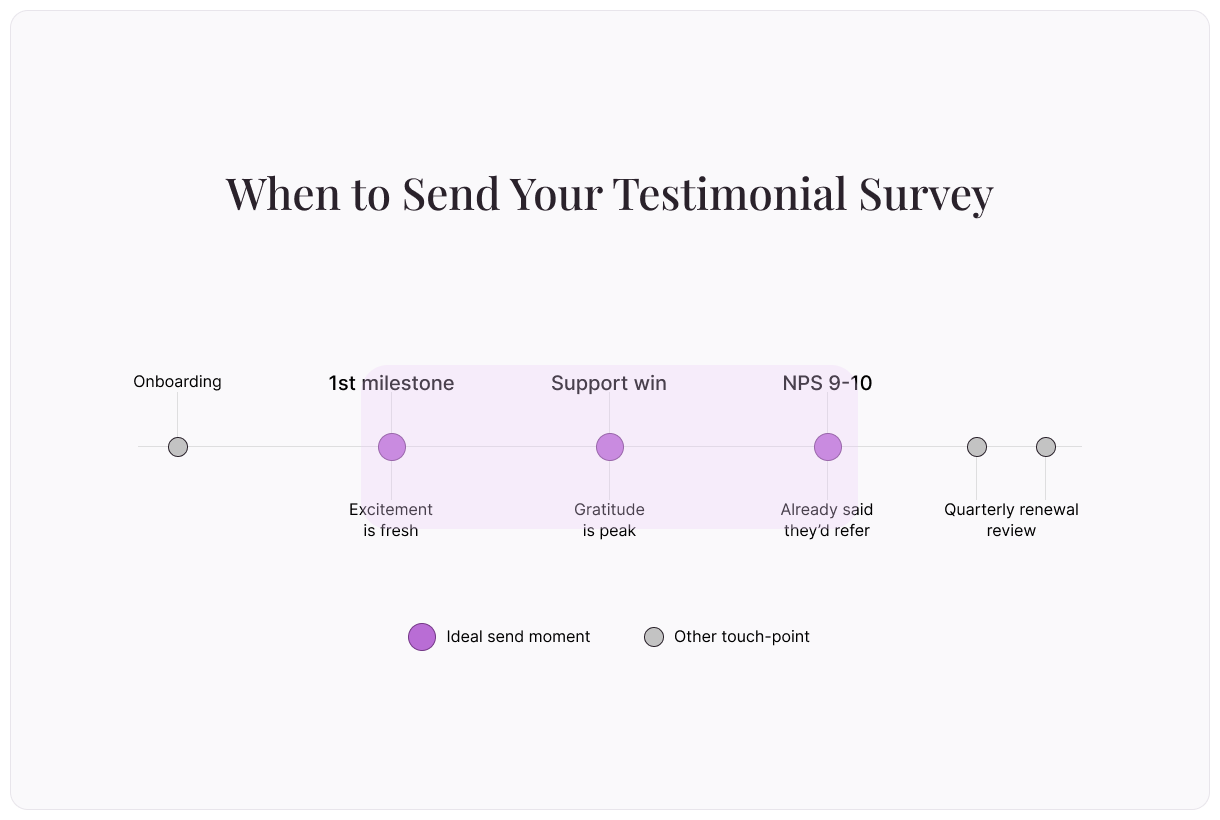
When it comes to testimonial surveys, timing shapes the quality of what you get back. Ask too early, and the customer hasn't experienced enough to say something meaningful. Ask too late, and the excitement has faded.
With that in mind, here are the best moments to reach out:
After a milestone. The customer just hit their 100th form response, completed their first project, or renewed for a second year. They've experienced enough value to speak about it concretely.
After a support win. Your team just solved a tricky problem, and the customer is genuinely grateful. That gratitude is authentic material—capture it before it fades.
After a positive net promoter score (NPS) response. If someone rates you a nine or 10 on an NPS survey, they've already told you they'd recommend you. A testimonial survey is the natural next step.
During a quarterly check-in. If you have regular touchpoints with customers, weave the testimonial ask into the conversation. It feels less transactional when it's part of an existing relationship.
After a case study interview. If a customer has already agreed to a case study, a follow-up survey captures additional quotes and data points you can use across channels.
What to ask: the questions that get usable answers
The biggest mistake in testimonial surveys is asking vague questions and getting vague answers. "How do you like our product?" gets you "It's great!" And "It's great!" doesn't persuade anyone.
Here's a better approach—questions designed to pull out specific, story-shaped responses.
Before and after
What challenge or problem were you trying to solve before you found us?
What were you using before, and what wasn't working about it?
What's different now? Can you describe a specific result or improvement?
These questions create a narrative arc—the situation before, the turning point, and the outcome after. That arc is the backbone of any compelling testimonial.
Specific outcomes
Can you share any numbers that reflect the impact (time saved, revenue gained, efficiency improved)?
What's one thing you can do now that you couldn't do before?
How has this affected your team or your day-to-day work?
Specificity is what separates a testimonial that converts from one that just fills space. "We saved 10 hours a week" is infinitely more persuasive than "It's been very helpful."
Emotional resonance
What surprised you most about working with us?
How would you describe your experience to a friend or colleague?
What would you say to someone who's on the fence about trying us?
These questions capture voice and personality. They give you quotes that sound like a real person talking, not a press release.
Permission and attribution
Would you be comfortable with us using your words on our website, social media, or other marketing materials?
How would you like to be credited (full name, first name only, job title and company, anonymous)?
Would you be open to us following up for a longer case study or video testimonial?
Always ask. Never assume. And make it easy to say no—it builds trust and ensures the testimonials you do collect are genuinely given.
Designing the survey itself
Similar to timing, the design of your survey can have a big impact on the quality of your responses, as well as general completion rates. Keep these tips in mind to gather helpful insights with as little friction as possible.
Keep it short
Five to eight questions is the sweet spot. Remember, you're asking people to do you a favor, so it’s important to respect their time. A testimonial survey should take no more than five minutes to complete.
Lead with easy questions
Start with simple, confidence-building questions ("How long have you been using our product?") before asking for detailed reflections. This eases respondents into the thoughtful mindset you need for quality testimonials.
Use open-ended questions (mostly)
Unlike most surveys, a testimonial survey should lean heavily on free-text responses. You want stories, not ratings. Use one or two multiple-choice questions for context (role, company size, industry) and leave the rest open.
Offer a text box, but suggest a length
"Please share a few sentences about..." sets a better expectation than an empty box with no guidance. Most people will match the effort level you suggest.
Include an opt-in for follow-up
Some of your best testimonial content will come from short follow-up conversations. A simple checkbox—"I'd be open to a 10-minute follow-up call"—lets you identify customers who are willing to go deeper.
Turning raw responses into polished testimonials
Survey responses are raw material. They need light editing to become effective marketing content. Here's how to handle that respectfully.
Edit for clarity, not meaning
You can tighten grammar, fix typos, and trim rambling responses. However, you can't change what someone said or add claims they didn't make. If a response needs significant rewording, go back to the customer and ask them to approve the edited version.
Preserve voice
The whole point of a testimonial is that it sounds like a real person. Resist the urge to polish the language into corporate-speak. Imperfect sentences, casual phrasing, and genuine enthusiasm are features, not bugs.
Format for impact
Pull the strongest sentence as a headline quote. Use the full response as supporting context. Pair it with the customer's name, title, and company (with their permission) for credibility.
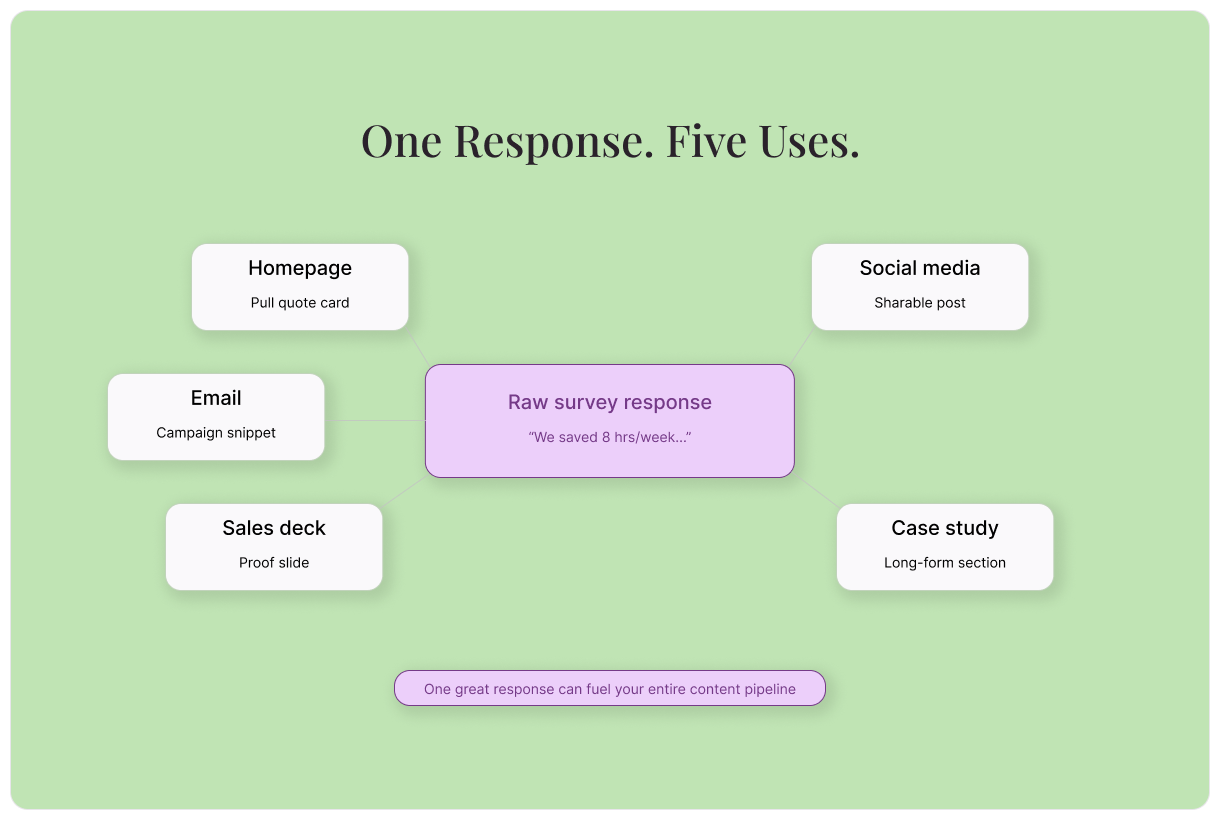
Create multiple formats from one response
A single great testimonial response can become:
A pull quote for your homepage
A social media post
A slide in a sales deck
A snippet in an email campaign
A section of a longer case study
Get the most value from every response by repurposing it across channels.
Common mistakes to avoid
A few pitfalls can undermine even a well-designed testimonial program. Here's what to watch for when collecting your testimonials:
Asking only satisfied customers. It sounds counterintuitive, but surveying a broader set of customers gives you more authentic material. A response like "I was skeptical at first, but..." is often more persuasive than unbridled praise.
Waiting too long to ask. The longer you wait, the harder it is for customers to recall specific details. Strike while the experience is fresh.
Burying the ask. Don't hide the testimonial request inside a longer customer satisfaction survey. Make it a standalone outreach so that respondents understand the purpose and can give it their full attention.
Not following up. Some of your best potential testimonials will come from people who meant to respond but got busy. A single, friendly follow-up reminder can double your response rate.
Neglecting to say thank you. A genuine thank-you note—not an automated response, but a real message—goes a long way. These customers just gave you something valuable, so it’s important to acknowledge it. A small gesture like a handwritten note, a discount code, or even a personal email from someone on your team turns a one-time favor into a lasting relationship.
Start collecting
You already have customers who'd happily share their experience. They're just waiting to be asked. A short, thoughtful testimonial survey—sent at the right moment, with the right questions—can turn their goodwill into your most credible marketing asset.
Send your first survey this week. Start with five customers who've recently had a positive experience—a successful onboarding, a support interaction that went well, or a milestone they just hit. Keep the survey short, make the ask clear, and give them an easy way to say yes. The responses you get back will be more specific, more authentic, and more persuasive than anything you could write yourself.
About the author
We're Typeform - a team on a mission to transform data collection by bringing you refreshingly different forms.
Free online trivia maker: custom trivia quizzes in minutes
Trivia is engaging. People love testing their knowledge, competing with friends, and proving they know random facts nobody asked them to memorize. That’s why trivia works as a learning tool, a marketing hook, an event activity, and just plain fun.
AI survey builder: create smart surveys in minutes
Creating effective survey questions is easier said than done. You need to ask the right things, in the right order, to the right people—and do it in a way that actually makes people want to answer. Most survey builders make this harder, not easier. You’re staring at a blank form, second-guessing every word, wondering if your logic flows or if you’ll get useful data back
.jpg)