Private School Scholarship
Scholarship decisions shouldn't ride on whichever documents a family remembered to mail in. Collect what your admissions team actually needs, financial information, academic records, essays, before the committee sits down to review.



Applications come in through whatever channel a family finds first: a PDF downloaded from the website and emailed back half-filled, a paper form picked up at an open house, a folder of documents that shows up over three separate emails. By the time the scholarship committee meets, someone's spent a week chasing a missing transcript or a tax form that never arrived.
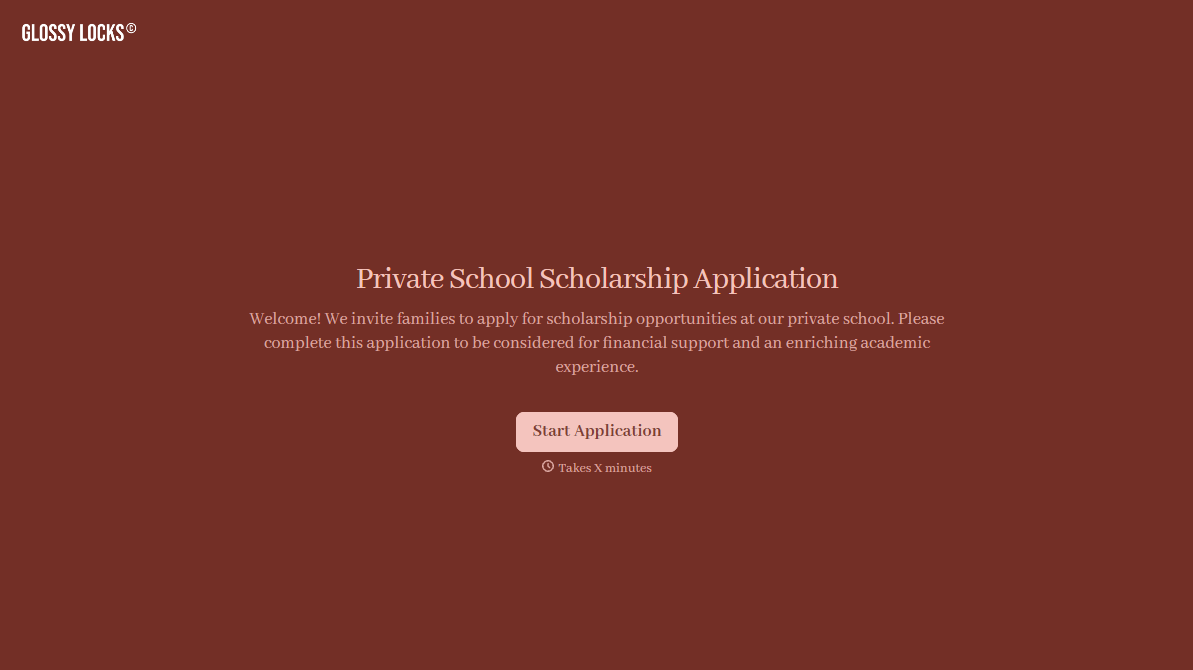
Typeform's private school scholarship application form asks for what the committee needs to evaluate a candidate, student and family information, financial documentation, academic records, and a short essay, and uses conditional logic to branch from there. A need-based applicant can route to household income and financial disclosure questions; a merit-based applicant can skip straight to transcripts, test scores, and the essay, instead of every family answering questions that don't apply to their scholarship type.
Every application lands in one place instead of a folder of email attachments and a stack of paper forms. Connect the form to your admissions system through Zapier, and a submission can flag a missing document or an incomplete financial disclosure automatically. Ask for tax forms or transcripts up front, and the committee starts the review with a complete file instead of a checklist of what's still missing.
A private school scholarship application form is an online form schools use to collect student, family, financial, and academic information needed to evaluate a scholarship request. Instead of a paper packet or a string of emailed attachments, the family submits everything themselves, and the committee starts with a complete application.
A PDF gets emailed back half-filled, or not at all. A form walks a family through exactly what's required for their scholarship type, and it flags what's missing before the file ever reaches the committee, instead of after.
Ask for what the committee will actually need to evaluate the application:
- Student and parent or guardian information
- Financial documentation, for need-based scholarships
- Academic records and transcripts
- A short essay or personal statement
- References or recommendation contacts
Not on its own. A submission gives the committee everything they need to evaluate a request, it doesn't decide the outcome until the committee reviews it against available funding and other applicants. Connect the form to your admissions system through Zapier, and a complete submission can move straight into the review queue, but a person still makes the award decision.
Yes. Add a file upload question and families can attach tax documents, transcripts, or letters of recommendation in the same submission, no separate email required. Pair it with conditional logic so the upload only appears for the documentation that the specific applicant's scholarship type actually needs.
Get inspired by relevant templates and categories
3200+ Templates, 300+ Integrations
Graduation Clearance Form
Move past a clearance process that assumes you can just withhold a transcript until every last fee is paid. Confirm what federal loan exit counseling actually requires, check what your state and the Department of Education actually allow you to hold, and keep a record of exactly what was cleared and when.
View template
With Typeform, you can customize everything
Change text, colors, and even logos to match the look and feel of your brand. Then embed forms smoothly onto web and email.
Make forms feel effortless to fill out. Pace questions, call people by their name, and adapt the flow based on the data they share.
Stay efficient by connecting forms to your workflow. Typeform integrates with 300+ tools including Slack, Zapier, and HubSpot.