15 market research methods you should know
15 market research methods, from user interviews to AI-assisted analysis, matched to your research goals, timeline, and budget.

Key Takeaways
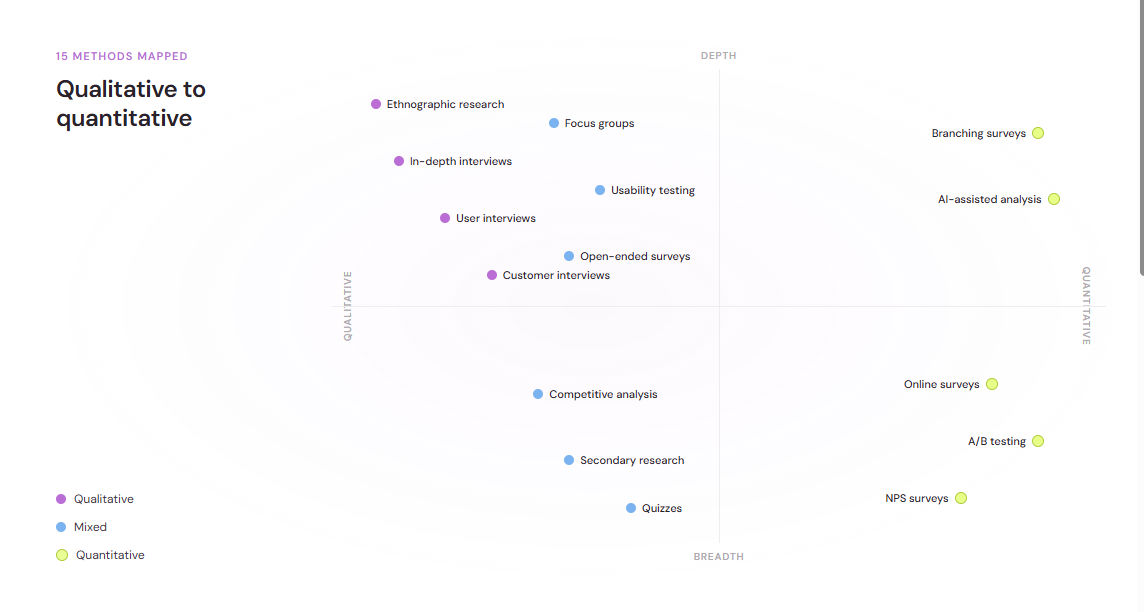
- Choose depth or breadth, not both from one method: Interviews and ethnography reveal why customers behave a certain way; surveys and A/B tests tell you how widespread that behavior is and which design or message performs best.
- Match the method to your constraints: Your research goal, timeline, budget, and team capacity determine what's realistic—ethnographic research takes months, while competitive analysis takes a day.
- Treat research as ongoing, not a one-time project: Teams that research regularly catch problems earlier and stay in tune with what customers actually need.
Market research shapes decisions. It tells you what your audience actually wants, not what you think they want. It reveals opportunities competitors miss and prevents costly mistakes. Yet many teams skip research or rely on guesswork instead.
Most teams recognize that research matters. The challenge is knowing where to start, especially when so many methods exist. Some are quantitative, some qualitative. Some dig deep into motivations; others capture broad trends. The right mix depends on what you're trying to learn.
This guide walks you through 15 market research methods: what each does, when to use it, and what kind of insight you'll get. You’ll come away knowing which methods fit your business, timeline, and budget.
1. User interviews
One-on-one conversations with your customers or target audience reveal the "why" behind their choices. You ask open-ended questions, listen to stories, and uncover motivations that numbers alone can't capture.
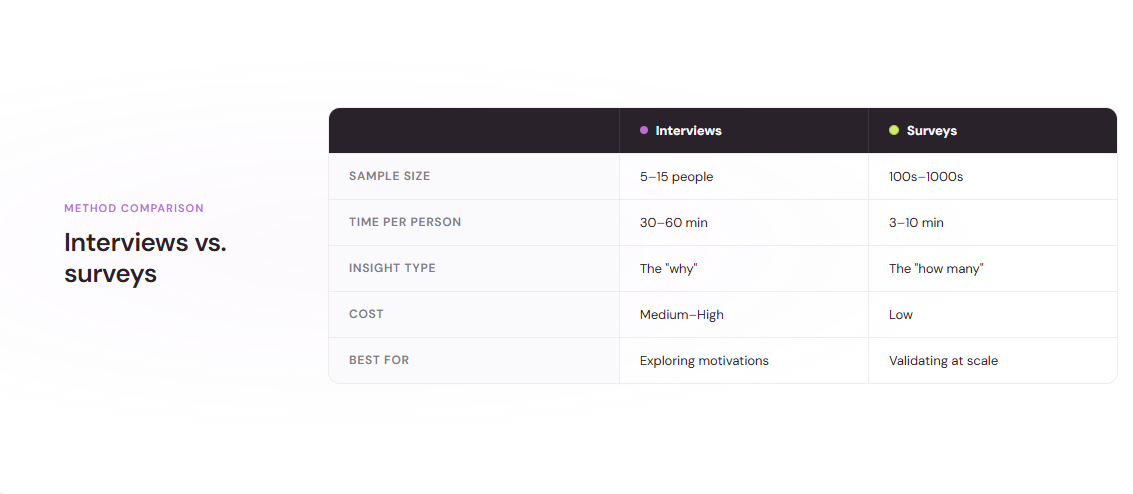
Interviews work best when you want to understand customer pain points, validate assumptions, or explore a new market. They're time-intensive—typically 30 to 60 minutes per person—so recruit 5 to 15 participants rather than 100.
The trade-off: deep insight, small sample size. You hear rich detail but can't generalize to a broad population. Still, user interviews consistently rank as the most popular UX research method, with 84% of researchers using them. This high adoption rate reflects how valuable researchers find the method for uncovering customer motivations and pain points that shape product decisions. When you listen directly to your customers explain their workflows, frustrations, and aspirations, you gain context that surveys and analytics dashboards simply cannot provide.
2. Usability testing
Put your product (website, app, prototype) in front of real users and watch them try to complete a task. Note where they struggle, what confuses them, and what delights them. Usability testing answers one specific question: Can people actually use what you've built?
This method is gold for product teams. It catches problems before launch and validates that your design decisions work in the real world. Usability testing ranks second among popular UX methods. The method is particularly effective because it bridges the gap between what designers intend and what users actually experience. Intention and reality often diverge in surprising ways.
The investment pays off significantly. Companies that prioritize UX see returns of $100 for every $1 spent—a 9,900% ROI. Yet only 55% of companies conduct UX testing, leaving money on the table. This gap suggests that many organizations underestimate the financial impact of user research or struggle to allocate resources toward it. The companies that do invest early and often in usability testing tend to ship products with fewer critical issues, achieve faster adoption, and enjoy higher customer satisfaction scores.
3. Online surveys
Surveys are a foundational market research method. You pose questions to a large group and collect quantitative data—numbers you can analyze, compare, and generalize. Online surveys reach 85% of market research professionals as their go-to quantitative method.
Surveys work when you want breadth: understanding how many people feel a certain way, what features matter most, or how satisfied customers are. They're scalable, cost-effective, and produce data you can slice by demographic, geography, or behavior. A well-designed survey can reach hundreds or thousands of respondents in days, making them ideal for time-sensitive decisions. When paired with the right market research methods, surveys provide quantitative validation for patterns you've observed in qualitative research.
The catch: surveys capture answers, not depth. A customer might rate your service 8 out of 10, but you don't know why. The number tells you satisfaction is high, but it provides no insight into what's driving that score or where improvements matter most. Combine surveys with interviews to get both the "how many" and the "why."
4. Focus groups
Gather 6 to 12 people in a room (or video call) with a trained moderator. The moderator poses questions and lets the group talk, debate, and build ideas together. You capture group dynamics alongside individual opinions.
Focus groups shine when you're developing a new product, testing messaging, or exploring how people react to ideas together. They reveal social influences—how one person's comment shapes another's thinking—which one-on-one interviews miss. A well-moderated focus group often produces unexpected tangents and creative sparks that emerge only when people think together.
Schedule 1.5 to 2 hours per session. Recruit carefully so the group represents your target audience. One outlier or dominating voice can skew the conversation. The moderator's skill matters enormously. They must balance encouraging honest discussion with keeping the group focused on research objectives.
5. In-depth interviews (IDI)
These are extended, one-on-one conversations, often 60 to 90 minutes or longer, that explore a topic with real nuance. Unlike quick user interviews, IDIs go deep into life histories, beliefs, and behaviors. They're the qualitative researcher's deep dive.
Use IDIs when exploring complex behaviors, sensitive topics, or when you need to understand context and backstory. They're labor-intensive, so recruit 10 to 20 participants. The payoff: rich narrative data that informs product strategy, positioning, or service design. IDIs produce the kind of detailed customer understanding that shapes entire business strategies, revealing not just what customers do but why their choices matter to them personally.
6. Ethnographic research
Immerse yourself in your customer's world. Observe them at home, at work, or in their natural environment. Watch how they actually use your product (or a competitor's). Take notes on context, rituals, pain points, and unmet needs.
Ethnography is research without asking. People often can't articulate why they do something. They just do it. Watching reveals behavior that surveys and interviews miss. It's especially valuable for understanding lifestyle, workplace dynamics, or how products fit into daily routines. An ethnographer might spend a day with a customer and discover that the biggest problem isn't with the product itself but with how it integrates (or fails to integrate) into their broader workflow.
Plan for weeks or months of observation and analysis. It's slow and expensive, but it generates insights competitors likely haven't found. The depth of understanding you gain from ethnographic research often uncovers entirely new product opportunities or reveals that your current value proposition misses what customers actually care about.
7. Surveys with branching logic
Standard surveys ask the same questions to everyone. Surveys with logic ask different follow-up questions based on earlier answers. If someone says they've never used your product, skip the satisfaction questions and ask about barriers instead.
Branching logic makes surveys shorter and more relevant. Respondents only answer questions that apply to them. It improves completion rates and data quality. It also creates a more personalized respondent experience. Someone exploring pricing gets different questions than someone evaluating competitors, resulting in richer insights tailored to where each respondent stands in their decision journey.
This approach requires a research tool that supports conditional logic. It's worth the setup time because the data is cleaner and the respondent journey feels less tedious. Respondents appreciate not wasting time on irrelevant questions, and your team gets data that's more focused and actionable.
8. Quizzes
Quizzes engage people while collecting research data. You pose questions, users answer, and they get a result: maybe a personality type, a product recommendation, or a score. Along the way, you're gathering insights about preferences and behavior.
Quizzes are strong engagement drivers. Most people who start a quiz finish it, with completion rates hitting 80 to 85 percent. That attention converts too: roughly 30 percent of quiz takers turn into leads, making quizzes one of the more reliable tools for engagement and lead generation alike.
The combination of data collection and entertainment value makes quizzes uniquely effective. People willingly provide information because the experience is enjoyable and they receive immediate value in return.
Use quizzes to understand customer segments, gauge interest in product features, or uncover which messaging resonates. They feel less like research and more like entertainment, which encourages high participation rates. A quiz might reveal that your audience cares far more about a specific feature than you'd assumed, or that there's a viable customer segment you hadn't considered targeting.
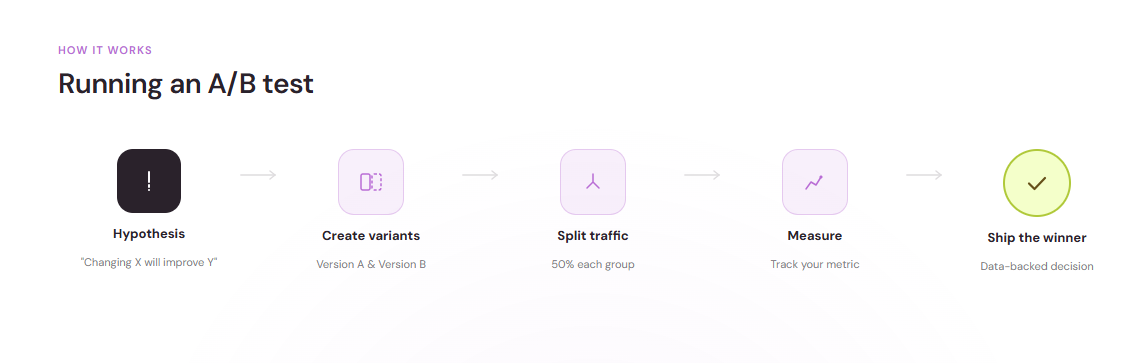
9. A/B testing
Show version A to one group and version B to another. Compare the results. A/B testing answers a simple, powerful question: which works better?
A/B tests are quantitative and designed. You control variables, measure outcomes, and draw conclusions with statistical confidence. Use them to refine website copy, email subject lines, call-to-action buttons, pricing, or design elements. A single A/B test might reveal that one word in a headline increases conversions by 15%, resulting in hundreds of thousands of dollars in additional revenue over time.
The advantage: low cost, quick turnaround, and clear winners. You get concrete data about what your specific audience prefers. The limitation: you're testing variations of something that already exists. A/B testing doesn't generate entirely new ideas, but it can improve existing ones. For breakthrough innovation, combine A/B testing with exploratory market research methods.
10. Competitive analysis
Study your competitors—their positioning, pricing, features, customer reviews, marketing messaging, and market presence. Competitive analysis answers: What are they doing? What are customers saying about them? Where are the gaps?
This research is often secondary (based on published information) rather than primary (research you conduct). Visit competitor websites, read customer reviews on third-party sites, analyze their social media strategy, and study their pricing pages. You might discover that competitors are struggling with customer retention or that an entire customer segment feels underserved by the current market.
Competitive analysis shapes your differentiation strategy. It's easier and cheaper than primary research and often overlooked. Spend a day on it, and you'll find opportunities your competitors haven't exploited. The insights you uncover might highlight where competitors are investing (suggesting that's where the market is heading) or reveal weaknesses you can exploit to win customers.
11. Surveys with open-ended questions
Not every survey question needs a multiple-choice answer. Open-ended questions ask customers to write their own responses: "What's your biggest frustration with this product?" or "How would you describe our brand to a friend?"
Open-ended responses are gold for understanding nuance. They capture language customers actually use, reveal unexpected concerns, and surface creative ideas. The trade-off: they take longer to analyze than multiple-choice answers. A single open-ended response might contain insights that change your entire product roadmap, but extracting those insights requires careful reading and interpretation.
Combine closed-ended and open-ended questions. Use closed questions to quantify, open questions to understand. When you ask "How satisfied are you?" and then follow with "Tell us why," you capture both the metric and the meaning behind it.
12. Customer interviews and feedback sessions
Schedule time with existing customers. Ask about their experience, what they love, what frustrates them, and what they need next. This is different from user interviews with potential customers; it's feedback from people already using your product or service.
Customer interviews shape product roadmaps. They reveal which features users actually value, which features sit unused, and where the product falls short. They also build loyalty, as customers feel heard when you ask for their input. A customer who participates in research becomes more invested in your success and more likely to advocate for your product.
Do this quarterly or whenever you're planning a major update. Aim for 10 to 20 conversations per cycle. The patterns you see across these conversations—the repeated complaints, the unexpected use cases, the feature requests that come up again and again—become the foundation for prioritizing what to build next.
13. Net Promoter Score (NPS) surveys
Ask one simple question: "On a scale of 0 to 10, how likely are you to recommend us to a friend or colleague?" Based on answers, segment respondents into Promoters (9–10), Passives (7–8), and Detractors (0–6).
NPS is a quick health check. It measures loyalty and satisfaction in a single question. It's also benchmarkable: you can compare your score to industry standards and competitors. An improving NPS over time signals that your product and customer experience are getting better; a declining NPS is an early warning that something needs attention.
Follow NPS with a follow-up question: "Why did you give that score?" Open-ended responses explain the number and guide improvement efforts. A Promoter who gives a score of nine but mentions slow support response times points you to a specific area to improve. A Detractor with a score of four might reveal a critical bug or unmet expectation.
14. Secondary research
You don't always need to collect new data. Secondary research means analyzing existing information: industry reports, published studies, government statistics, academic papers, and market analyses. Many of these are free or inexpensive.
Secondary research gives you context and validates or challenges assumptions. It's fast and cost-effective, especially for understanding market size, industry trends, or competitor positioning. A good industry report might show you that your target market is growing faster than you realized or that customer priorities have shifted in the last year.
The limitation: secondary data isn't custom to your business. It answers broad questions but might miss specifics about your niche or target audience. Pair it with primary research (surveys, interviews) for a complete picture. The market research methods you choose should combine secondary research for context with primary research for specificity.
15. AI-assisted analysis
More researchers are using artificial intelligence to speed up analysis. Instead of manually coding hundreds of survey responses, AI tools identify themes, sentiment, and patterns. AI can also generate initial hypotheses or suggest follow-up questions.
Around 47% of researchers worldwide use AI regularly in their market research activities. AI doesn't replace research. It accelerates the messy work of making sense of data so you can focus on insights and action. What once took days of manual review can now happen in hours, freeing your team to spend more time interpreting findings and planning next steps.
Use AI to synthesize open-ended feedback, tag responses by theme, or spot trends in large datasets. It's most useful when you've collected a lot of qualitative data and need to find signal in the noise. As AI tools improve, they'll likely become standard across most market research methods, changing how researchers work and what's possible at different budgets.
Putting it together
You now have 15 methods. The question is: which should you actually use?
Start with your research goal. Do you want breadth or depth? Are you validating an idea or exploring a new opportunity? Do you need numbers, stories, or both? Your goal drives everything else.
Next, consider constraints: timeline, budget, and team capacity. A startup with one month and limited budget can't run ethnographic research for three months. A large enterprise with budget and time can. Realistic constraints don't mean you can't do good research—they mean you choose methods that fit your situation.
Most research efforts blend methods. You might start with competitive analysis and interviews to understand the landscape, run surveys to quantify findings, and use A/B testing to refine what you've built. A combination is stronger than any single method alone. A startup might begin with 10 user interviews and competitive analysis in week one, launch a survey in week two, and test messaging variations in week three, compressing months of research into a sprint.
Research works better as an ongoing habit than a one-time task. The sooner you start listening to your audience—through whatever methods fit your situation—the sooner you'll make decisions with confidence. Teams that research regularly catch problems early, avoid expensive missteps, and stay connected to what their customers actually need.

Liked that? Check these out:

Opinions and Expertise
What’s actually slowing research teams down (Hint: it’s not the research)
From recruiting participants and scheduling interviews to building the actual surveys, the operational drag is taking researchers away from what they do best. See what's actually slowing them down and how Research Flow fixes it.
Read more