AI research platforms: What separates the serious tools
Not every AI research platform is equal. See which red flags expose shallow tools and what separates platforms that protect data quality and real insight.
AI is reshaping how researchers work. It speeds up data collection, surfaces patterns humans might miss, and automates tasks that once consumed entire afternoons. But not all AI research platforms are created equal.
Some tools bolt AI onto existing workflows as an afterthought. Others integrate it so deeply that AI and human insight work together from the very first question. The difference between a serious research platform and a superficial one comes down to a few core questions: Does the AI actually understand your research goals? Can it surface real insight or just summarize what you already know? Will it improve data quality or introduce new biases?
This piece walks through what makes an AI research platform worth your time—and what red flags to watch for.
Why researchers are adopting AI, and why it matters
Around 47% of researchers worldwide use AI regularly in their market research activities (Backlinko, 2026). That’s not a fringe practice anymore. It’s become a baseline expectation.
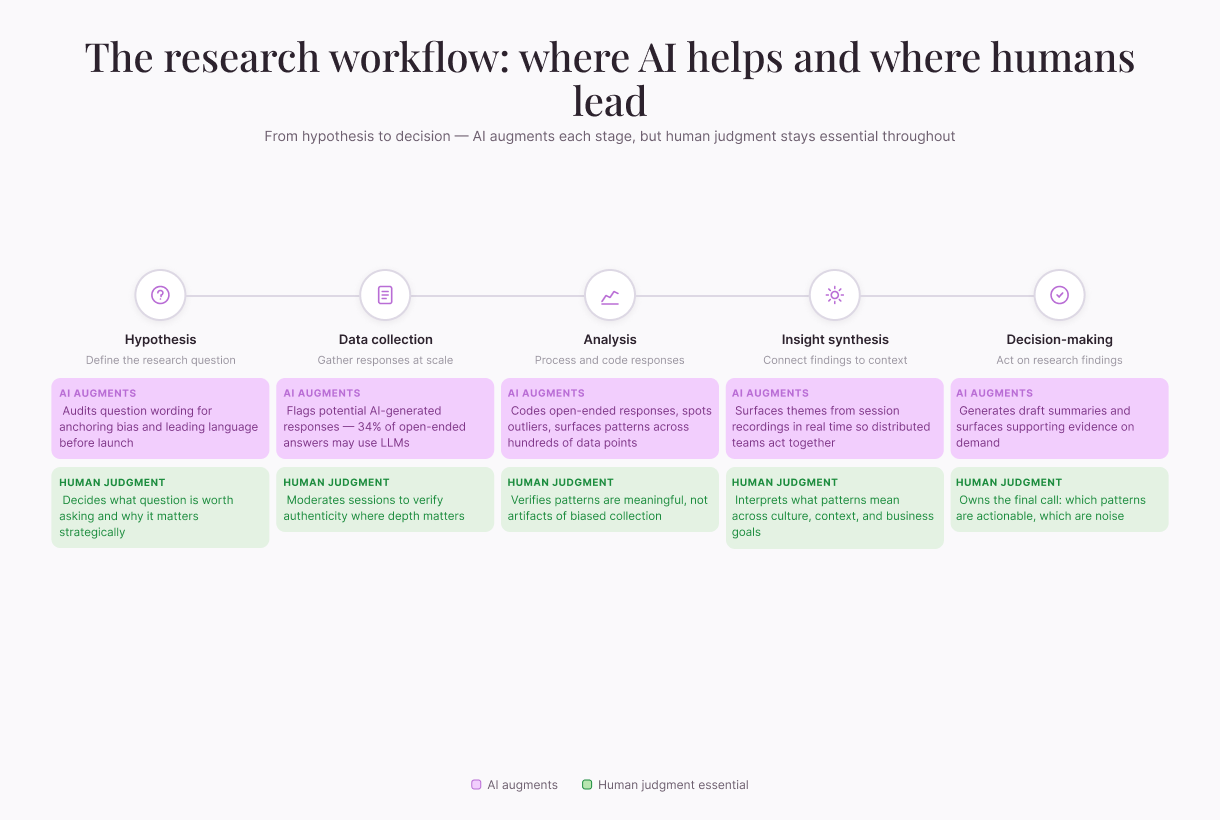
The appeal is clear. AI handles the grunt work: coding open-ended responses, spotting outliers in datasets, transcribing interviews, and flagging patterns across hundreds of data points. That frees researchers to focus on what machines can’t do—asking better questions, building rapport with participants, and making sense of findings in context.
But here’s the catch: AI is only useful if it produces better research outcomes. Two-thirds of go-to-market (GTM) leaders say AI is extremely effective for market research, analysis, and measurement (ICONIQ State of Go-to-Market, 2025). That’s a strong signal. Yet adoption isn’t universal, and for good reason. AI also introduces new risks.
The real separator between serious AI research platforms and gimmicky ones is how thoughtfully they handle those risks. Beyond just adopting AI, the platforms that matter are those that recognize research itself is evolving. Teams are distributed globally, respondent pools are more diverse, and the speed of decision-making has accelerated. An effective AI research platform accounts for these realities—it doesn’t just add algorithmic analysis to yesterday’s workflows. It asks fundamental questions: Are your respondents who they claim to be? Is your data collected in a way that preserves authentic human insight? Can your team collaborate across time zones and bring insights to stakeholders in hours rather than weeks?
The data-quality problem: garbage in, garbage out
The oldest rule in research applies even more sharply when AI is in the mix: garbage in, garbage out.
AI models are trained on patterns. When you feed them biased data, they amplify bias. When you feed them data collected carelessly, they magnify noise into false signal.
One concrete threat is response contamination. Researchers recently discovered that 34% of online research panel respondents reported using large language models (LLMs) to help answer open-ended survey questions (Zhang, Xu, Alvero, 2025). That means a third of your qualitative data might not be participant insight—it might be AI-generated filler that sounds plausible but reflects nothing about the actual person answering. This is particularly problematic when analyzing sentiment or motivation, where authenticity of voice matters profoundly to interpretation.
A serious AI research platform doesn’t ignore this. It either detects AI-generated responses or builds workflows that discourage the behavior in the first place. Some platforms include detection safeguards; others prioritize moderated or synchronous research formats where you can verify authenticity in real time. Detection itself is complex: language pattern analysis can flag suspicious uniformity or statistical improbability, but no method is perfect. That’s why the best platforms combine multiple safeguards and transparency about their limitations.
Another threat is anchoring bias in how questions are framed. Tversky and Kahneman’s classic 1974 study showed that the order of numbers in a sequence changes estimates by up to 4x, even when the underlying information is identical (Tversky & Kahneman, 1974). AI can amplify this if it’s not trained to recognize and flag anchoring patterns in question design. When AI analyzes thousands of responses biased by question framing, it crystallizes that bias into seemingly authoritative patterns.
Good AI research platforms include bias-detection features or prompt researchers to review question wording before launch. Serious tools help you prevent bad data rather than just analyze it after the fact. Some go further—they use AI to audit your questionnaire for leading language, unbalanced response scales, or assumptions hidden in phrasing. This kind of AI-assisted quality control is especially valuable because researchers themselves often miss their own biases.
Real-time collaboration and insight surfacing
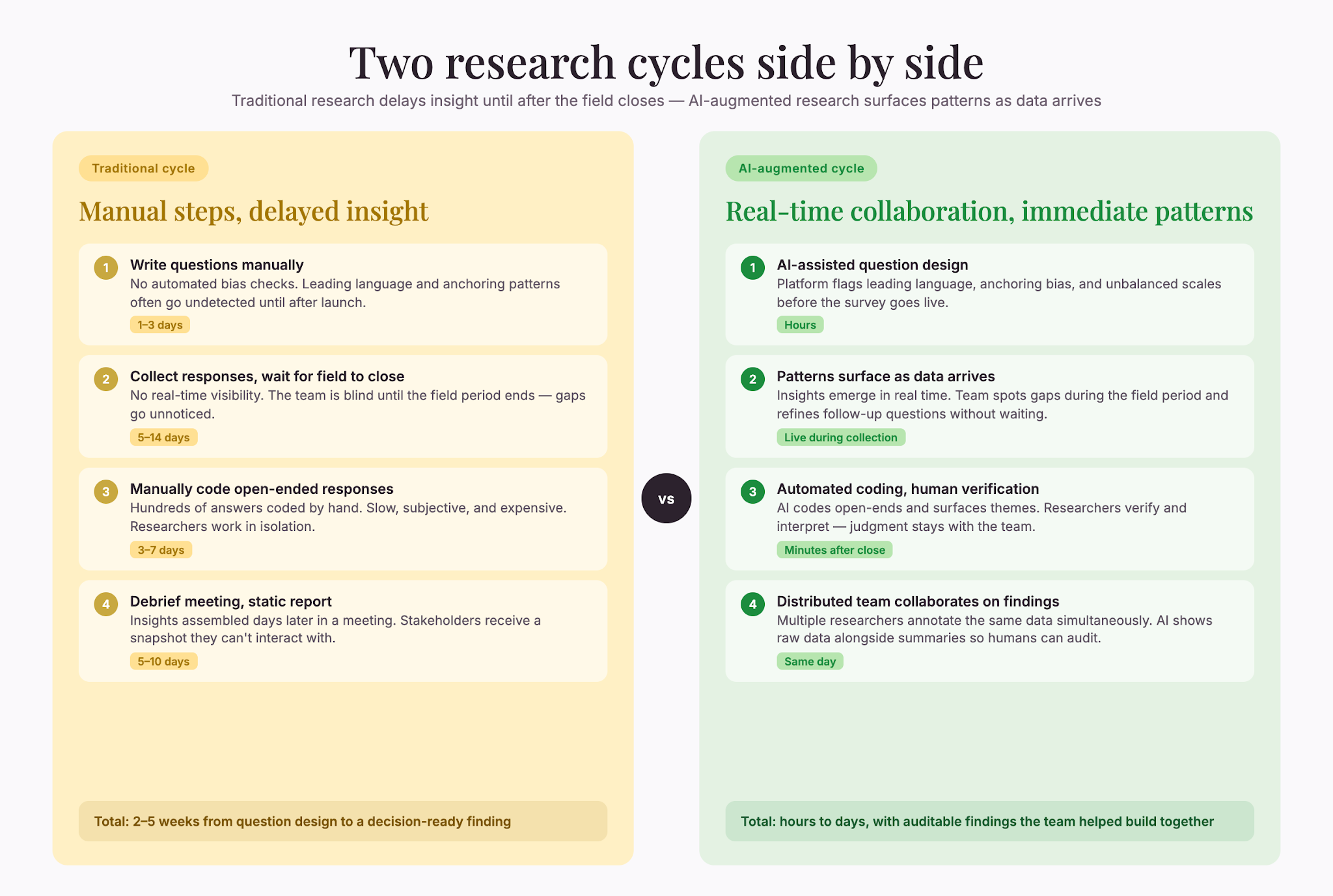
The platforms that stand out combine three things: they let multiple researchers work simultaneously, they surface insights as data comes in (not weeks later), and they use AI to aid human judgment, not replace it.
Lookback exemplifies this approach. It supports moderated and unmoderated usability studies across mobile and desktop with real-time team collaboration and an AI assistant called Eureka that surfaces insights from session recordings (Lookback, 2025). Notice the design: the AI highlights patterns, but the team decides what matters. The researcher stays in control. This model acknowledges that insight lives in context. What looks like a pattern of frustration might actually be delight expressed differently across cultures, or might reflect a misunderstanding rather than a product flaw.
This is the inverse of platforms that spit out pre-written reports. A serious tool trusts researchers to interpret findings. It offers guardrails and suggestions, but the final call—what the data means, which patterns are actionable, which are noise—remains human. That distribution of labor between AI and human judgment is what separates research augmentation from research automation.
Real-time collaboration matters because research is faster now. You’re not waiting weeks for a transcription service or manual coding. Insights emerge as respondents participate, which means your team can spot gaps in the data, refine follow-up questions, and adapt in real time if needed. A distributed team watching the same session recording with real-time AI annotations can surface observations immediately rather than in a debrief meeting days later. This speed compounds—faster feedback loops mean faster iteration, which means faster learning.
Moderation, authentication, and keeping humans in the loop
Not all research can be unmoderated. Sometimes you need to watch a participant interact with a prototype. Sometimes you need to ask follow-up questions based on what they just said. Sometimes you need to see their face to understand whether confusion or delight is driving their response.
Serious AI research platforms support moderated research natively. They don’t treat it as a second-class option. Moderation is where nuance lives. It’s where a skilled researcher can pick up on hesitation, sarcasm, or unspoken concern that no survey response captures.
Moderation also solves the authentication problem we mentioned earlier. When a human moderator is present—even remotely—they can verify that the person answering is real, that they understand the questions, and that their responses reflect genuine thought rather than AI-generated boilerplate. This human-in-the-loop approach costs more in researcher time, but for certain research questions—those where authenticity and depth are non-negotiable—it’s the only responsible approach.
The best platforms also let you choose your research method based on the question, not based on what the platform makes easiest. Some questions call for quick, unmoderated polling. Others need deep, moderated interviews. Still others benefit from asynchronous written responses or diary studies. A tool that forces you into one format is saving its own computational costs, not optimizing for your research quality. Flexibility here is a marker of maturity—it suggests the platform builders understand research methodology broadly rather than having optimized for a single use case.
The productivity myth vs. the insight reality
Here’s a tempting promise: AI will cut your research time in half. Your team will be twice as productive.
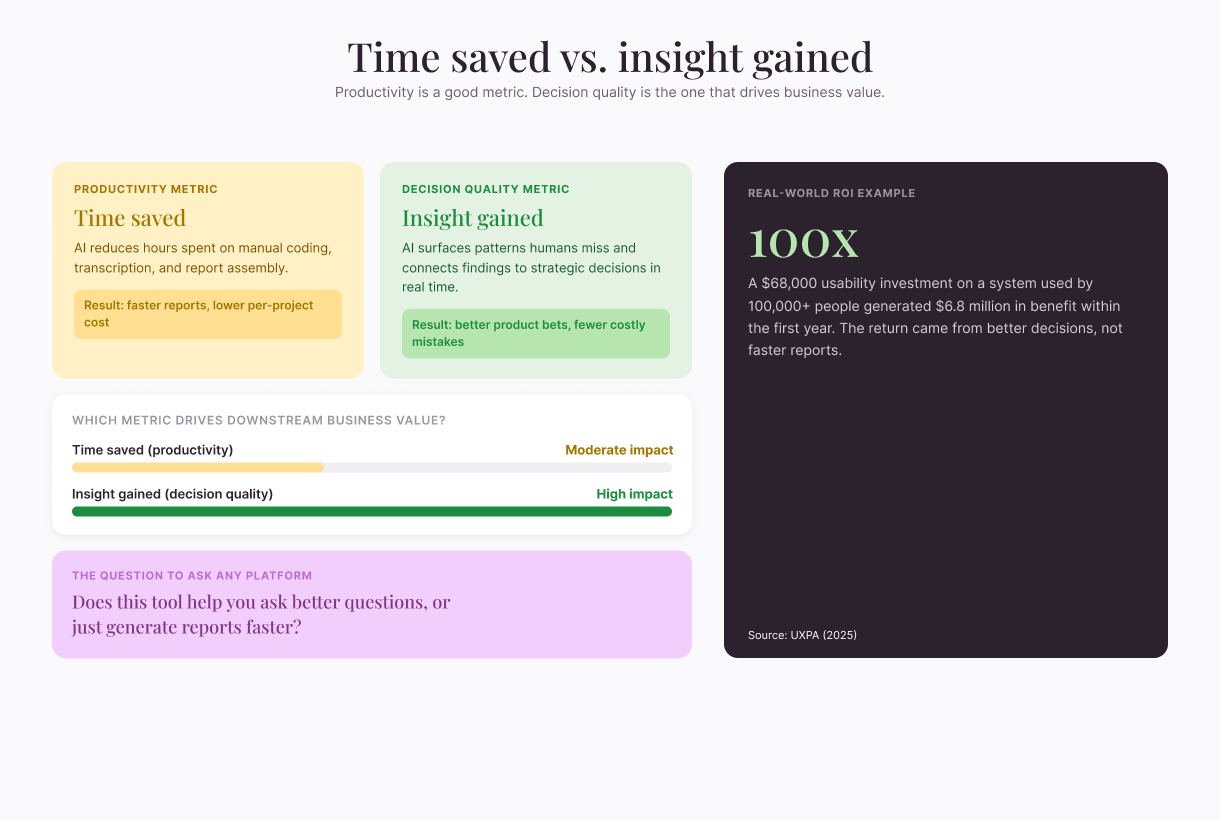
Productivity matters, sure. But researchers don’t optimize for hours saved—they optimize for insight gained. A study from the User Experience Professionals Association (UXPA) found that a usability investment of $68,000 on a system used by over 100,000 people generated $6.8 million in benefit within the first year (UXPA, 2025). The return came from better decisions, not faster reports. Organizations that shipped products faster but with weaker user understanding often paid the cost later with poor adoption or negative customer experience.
An AI research platform that saves you time but produces shallow findings is a net loss. One that takes the same amount of time but surfaces richer patterns is a win. This distinction matters especially for strategic research—the kind that informs product direction, market positioning, or long-term investment decisions. Shallow findings in those contexts can lead to million-dollar mistakes.
When you’re evaluating a platform, ask: Does this tool help me ask better questions? Does it help me understand why people behave the way they do? Or does it just help me generate reports faster? The best platforms do both, but if forced to choose, insight depth beats speed every time.
Integration and workflow fit
A serious AI research platform doesn’t exist in isolation. It connects to the tools you already use: survey platforms, analytics dashboards, CRMs, collaboration software, note-taking apps.
Disconnected tools create friction. Researchers end up exporting data, pasting it into spreadsheets, and re-uploading to another platform—and with each step, context is lost. Serious platforms minimize these handoffs.
Some platforms, like ResearchFlow, are built to integrate research collection with analysis and insight synthesis from the start. Instead of treating data collection and analysis as separate stages, they thread AI through the entire flow—from questionnaire design through response analysis to team collaboration and reporting.
The question to ask: Does this platform live where my team already works, or does it ask my team to adopt an entirely new workflow?
Red flags to watch for
As you evaluate AI research platforms, watch for these warning signs:
Opaque AI decisions. If the platform won’t explain how its AI categorized a response or flagged a pattern, be skeptical. You need to understand the logic so you can verify it.
Over-automation. Platforms that auto-generate insights without human review are offloading judgment to an algorithm. That’s not research—that’s guessing across teams.
No bias detection or disclosure. If the tool can’t tell you how it’s designed to prevent anchoring bias, leading questions, or response contamination, it’s not serious.
Poor moderation options. If the platform forces unmoderated research or makes moderation clunky, it’s optimizing for its own efficiency, not your research quality.
No way to audit or explain findings. Serious platforms let you see why a pattern emerged. They show you the raw data alongside the AI summary. They let you drill down and verify.
One-size-fits-all reporting. If every research project produces the same template, the tool isn’t adapting to your needs.
What to prioritize when choosing
If you’re looking for an AI research platform, prioritize these things in order:
- Data quality safeguards. Can it detect AI-generated responses? Does it flag biased question wording? Can you verify authenticity?
- Researcher control. Does AI augment your judgment or replace it? Can you override suggestions? Do you understand how insights were derived?
- Moderation support. Can you run moderated and unmoderated research depending on the question type?
- Integration with your workflow. Does it connect to tools you already use, or does it ask you to start from scratch?
- Transparency. Can the platform explain its AI decisions in plain language, or does it hide logic behind a black box?
- Real-time collaboration. Can multiple team members work on the same project at once and see insights emerge as data comes in?
A platform that nails these fundamentals will make your research faster, smarter, and more defensible. One that cuts corners on any of them will create more work downstream when you’re trying to verify findings or explain decisions to stakeholders.
The bottom line
AI is a powerful research tool. The right platform amplifies human insight and catches patterns across the organization. The wrong platform automates biases and creates false confidence in shallow findings.
The serious tools are the ones that respect research rigor, keep humans in the loop, integrate with your existing workflow, and make their reasoning transparent. They’re the ones designed by people who understand that faster isn’t always better—but smarter always is.

Liked that? Check these out:

Opinions and Expertise
What’s actually slowing research teams down (Hint: it’s not the research)
From recruiting participants and scheduling interviews to building the actual surveys, the operational drag is taking researchers away from what they do best. See what's actually slowing them down and how Research Flow fixes it.
Read more