AI user research: How AI is transforming qualitative research
AI user research automates transcription and pattern spotting across interviews, giving researchers more time for the nuanced judgment only humans can provide.
Qualitative research—the kind where you listen to what people actually say and think—has always been labor-intensive. Researchers conduct interviews, transcribe recordings, code responses by hand, and hunt for patterns that might take weeks or months to surface. But artificial intelligence is changing that equation.
More researchers than ever are turning to AI to handle the mechanical parts of qualitative work, freeing them to focus on what machines can’t do: asking better questions, spotting nuance, and turning raw insights into decisions that move the needle. This shift isn’t about replacing researchers. It’s about giving them superpowers.
Here’s what’s happening, why it matters, and how to make AI work for your research process.
Why qualitative research matters—and why it’s been slow to evolve
Qualitative research answers the questions that numbers alone can’t. Why do customers churn? What frustrates users most? What would make someone choose your product over a competitor’s?
These questions require depth. They demand listening, not just counting. And historically, that’s meant researchers spending enormous amounts of time on transcription, note-taking, and manual coding—the grunt work that kept valuable insights locked away.
That lag between collecting data and understanding it was a real cost. Meanwhile, markets move fast. By the time qualitative findings were ready, strategic windows had often closed.
The research shows the payoff when you do get it right: a usability investment of $68,000 generated $6.8 million in benefit within the first year of implementation on a system used by over 100,000 people (UXPA, 2025). But that kind of ROI requires not just good research—it requires research that’s acted on quickly.
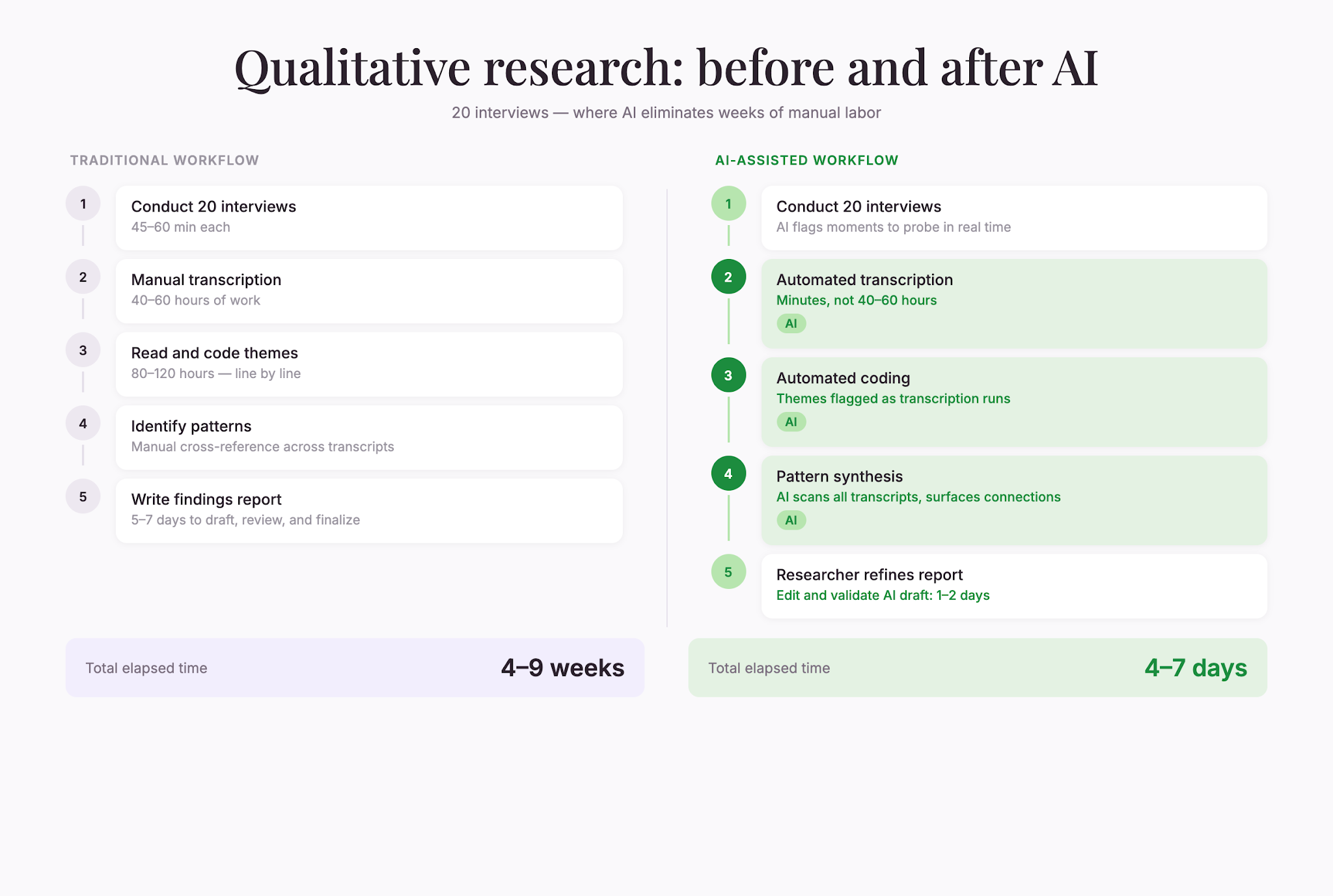
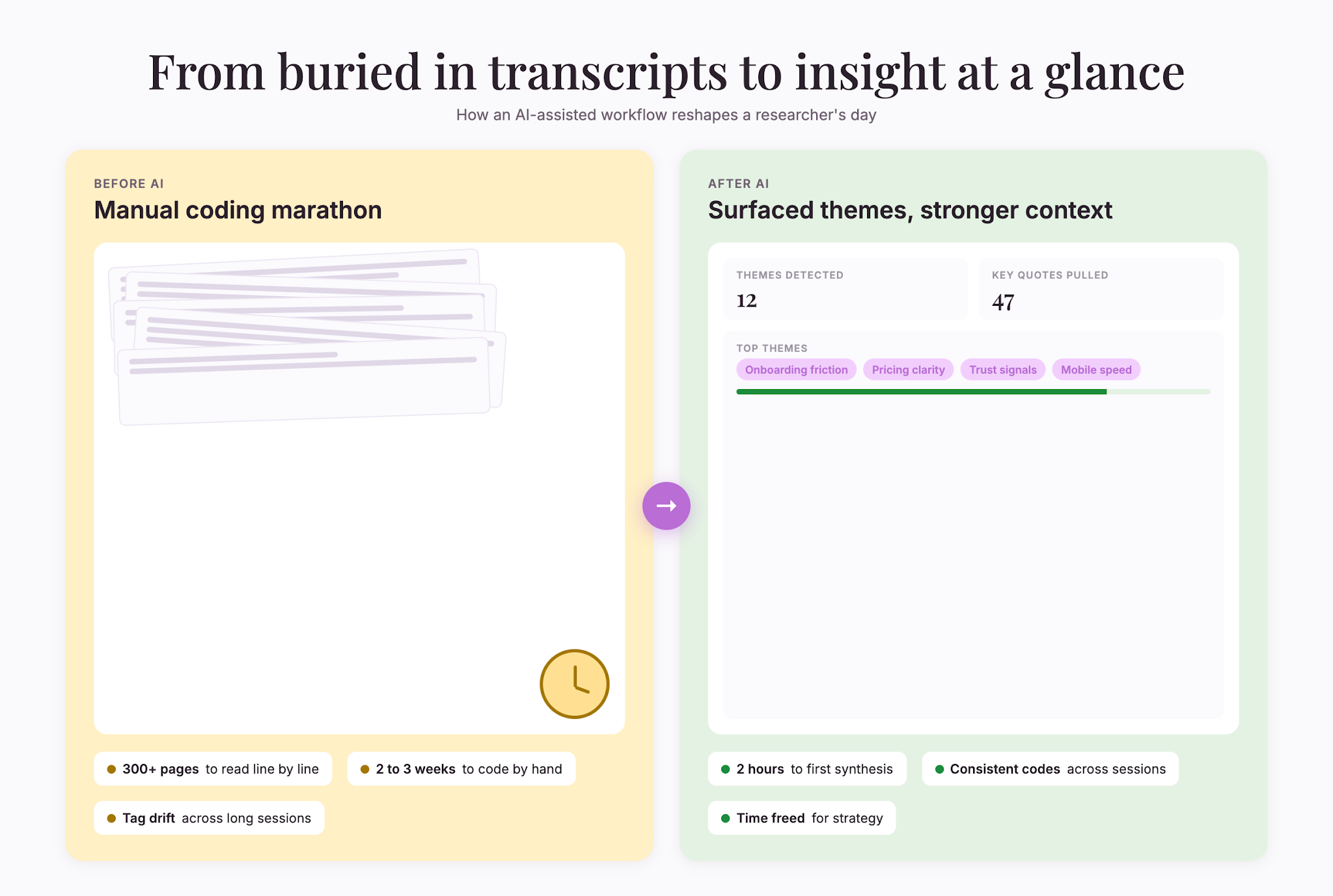
Consider what happens without acceleration. A typical qualitative research project might involve conducting 20 interviews with target users, each lasting 45 minutes to an hour. Transcribing those conversations manually could take 40–60 hours of work. Then comes the coding phase, where researchers read through transcripts, mark relevant passages, identify themes, and organize findings. This step alone often requires 80–120 hours for a project of that size, depending on the complexity of the research questions and the depth of analysis required.
The bottleneck compounds when stakeholders need findings quickly. In fast-moving industries like fintech, consumer tech, or healthcare, a 4–6 week turnaround from data collection to insights can mean missing market opportunities, delayed product decisions, or slower response to competitive threats. Teams that do get it right—that complete rigorous qualitative research and act on it promptly—see measurable returns.
How AI is speeding up the qualitative research workflow
AI doesn’t replace the research—it handles the parts that slow it down.
Transcription and preliminary coding
Manual transcription used to take weeks. Speech-to-text models now handle that in minutes, and they’re good enough for most purposes. More importantly, AI can start flagging themes and codes as it transcribes, giving researchers a head start instead of a blank slate.
Beyond simple transcription, modern AI tools can maintain speaker identification across long conversations, handle overlapping dialogue, and even flag sections that are unclear or require follow-up clarification. This preliminary layer of structure means that when a researcher opens the transcript, it’s already organized by topic rather than presented as a wall of unbroken text.
The time savings here are substantial. What took 40–60 hours of manual transcription work now takes a few clicks and a few minutes of processing. That frees researchers to spend time on what actually requires human judgment: listening for tone, emotion, and context clues that automated transcription can’t capture.
Pattern spotting across large datasets
When you’ve conducted 20 interviews or 50 usability sessions, finding the signal in all that noise is hard. AI tools can scan through transcripts, identify recurring phrases, surface contradictions, and highlight outliers—the stuff that makes patterns visible.
A researcher still decides what matters. But they’re not reading line-by-line through thousands of words first. Instead, they’re reviewing an AI-generated summary that says something like: “The phrase ‘too complicated’ appears 34 times across 12 interviews. Participants who mentioned this also mentioned frustration with onboarding, which appears 28 times. Three participants described workarounds they developed on their own.”
That synthesis gives the researcher something concrete to investigate. They can drill down into those specific moments, understand the context, and decide whether this pattern reflects a genuine problem or a misunderstanding that’s easily resolved through better communication.
Real-time synthesis during research
Some AI tools now sit alongside research sessions, flagging moments worth diving deeper into in real time. This is especially useful during moderated research, where a moderator can follow up on an interesting comment immediately, rather than circling back after reviewing notes.
Imagine a usability test where a participant expresses unexpected behavior—clicking on something that seems unintuitive, or skipping a section that’s supposed to be important. An AI-powered real-time analysis tool can flag that moment immediately, prompting the moderator to ask a follow-up question right then: “I noticed you skipped that step. Help me understand why.” The participant’s answer is fresh, not reconstructed from memory weeks later during analysis.
This real-time capability means researchers can be more responsive and adaptive in their interviews. They’re not following a rigid script where every question is planned in advance. They’re able to pursue interesting threads because the AI is handling the note-taking and flagging.
Synthesizing insights for stakeholders
Once patterns emerge, AI can draft findings summaries—not as the final word, but as a starting point. Researchers review, fact-check, and add context. What used to take a week of report-writing becomes a day of editing and validation.
The difference is meaningful for organizational speed. Where a traditional report might take 5–7 working days to write, review, and refine, an AI-assisted process can compress that to 1–2 days. The researcher isn’t creating text from scratch; they’re evaluating, refining, and validating what AI has drafted. It’s a much faster feedback loop.
The real impact: more research, faster
Around 47% of researchers worldwide use AI regularly in their market research activities (Backlinko, 2026). Among those who do, the pattern is consistent: they’re not cutting corners. They’re doing more research in the same amount of time.
That matters because sample size affects the quality of qualitative findings. Near saturation—when you’ve heard most of the major themes—typically comes at 15–23 interviews. True saturation, where you’ve captured nearly everything, requires 30–67 interviews (Journal of Medical Internet Research, 2024). Earlier research found that high-level themes often plateau around 10–12 interviews (Guest et al., cited in the same source).
In other words, more interviews mean more confidence in your findings. But more interviews also meant more work—until AI started shouldering the load.
With AI handling transcription, coding, and initial synthesis, research teams can run more sessions without proportionally increasing their workload. You’re not cutting the rigor. You’re multiplying it. A researcher who used to complete one major qualitative project every quarter might now complete two or three, because the labor-intensive middle steps are now automated.
This expanded capacity has concrete implications. Teams can afford to recruit more diverse participants, test iterations more frequently, and validate findings across different user segments. The quality bar for qualitative work doesn’t drop; if anything, it rises because there’s more data to work with.
The limits and gotchas of AI in qualitative research
AI is a force multiplier, not a magic wand. A few real constraints matter.
AI can homogenize responses
When survey respondents know AI tools exist, some use them to help answer open-ended questions. A recent study found that 34% of online research panel respondents reported using LLMs to help answer open-ended survey questions, raising concerns about data homogenization (Zhang, Xu, Alvero, Sociological Methods & Research, 2025). If your data starts looking too similar, you’ve lost some of what makes qualitative research valuable.
This risk is particularly acute if you’re relying on AI to spot patterns. If many respondents have already used AI to draft their answers, those answers will naturally converge toward certain language and framing. An AI tool analyzing those responses might flag a “strong consensus” that’s actually a consensus that ChatGPT helped create.
The solution isn’t to avoid qualitative research—it’s to be transparent with participants about how their data will be analyzed, and to supplement data collection with methods that are harder to game: in-person interviews, moderated discussions, or direct observation.
Context and nuance still need human judgment
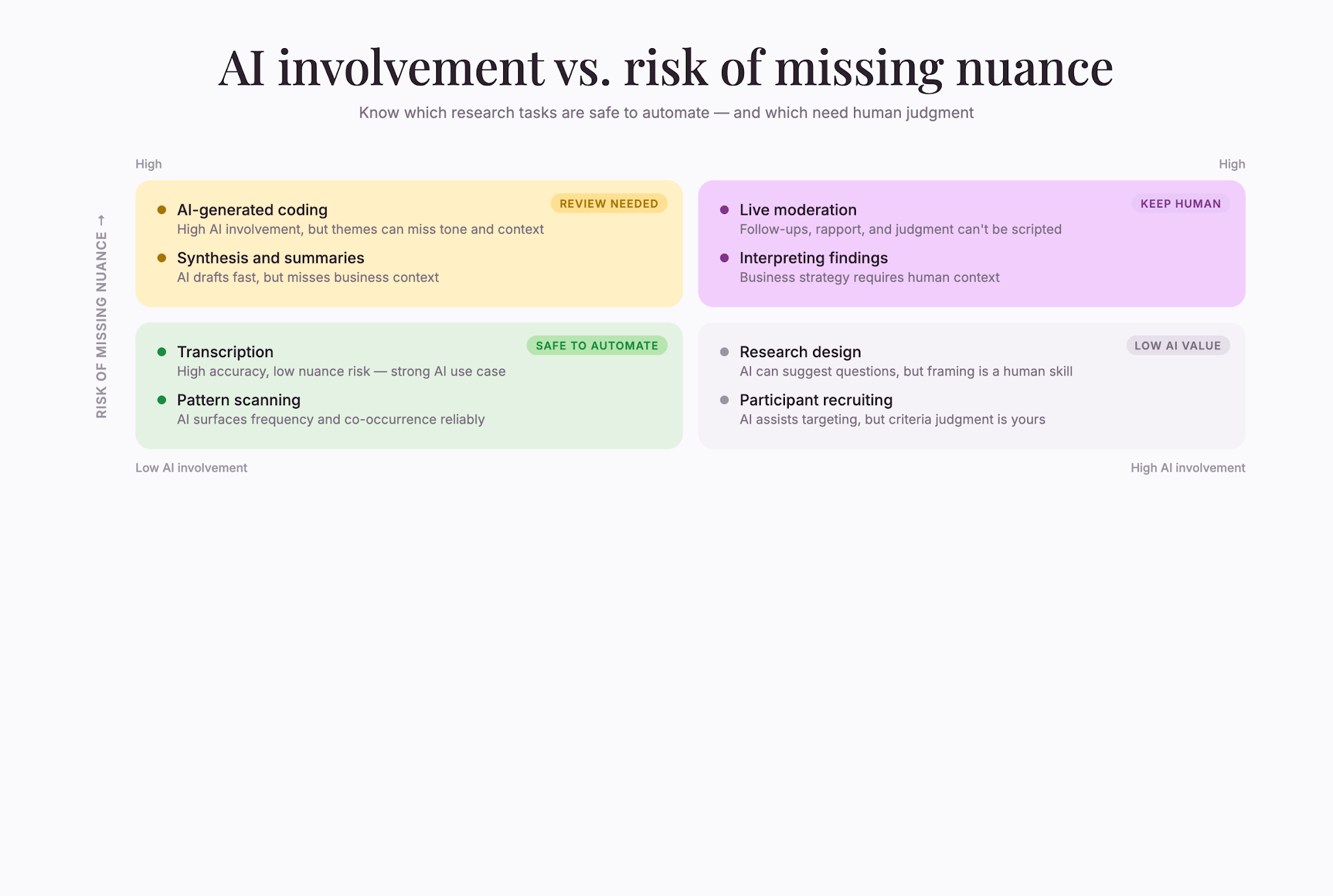
AI can spot that someone said “frustrated” 12 times. It can’t always tell whether they were frustrated with the product, the support team, or their own expectations. Researchers need to stay in the driver’s seat, using AI as a pair of very fast hands, not as a decision-maker.
A real example: An AI tool analyzing customer support transcripts might flag “billing” as a major frustration point because it appears frequently in complaints. A human researcher reviewing those same transcripts discovers that most “billing” mentions are actually about the clarity of invoice descriptions, not the price itself. The AI found the signal; the researcher interpreted it correctly.
Quality in, quality out
If your interview questions are vague or your usability test is poorly designed, AI won’t rescue the research. It’ll just process bad data faster. The research design itself—the questions you ask, the people you recruit, the scenario you create—remains entirely on the researcher.
This is perhaps the most important limitation to understand. AI user research accelerates what’s already there; it doesn’t fix fundamental problems with methodology or sampling. A poorly designed study will yield poor insights faster, which might actually make things worse if decision-makers act on flawed findings quickly.
How to integrate AI into your qualitative research practice
If you’re ready to bring AI into your process, start with the parts that are most obviously mechanical.
Begin with transcription and coding
The lowest-risk place to introduce AI is the back-end work: turning recordings into text and organizing that text into code. Human researchers validate and refine the code, but the heavy lifting is automated.
Start with a small pilot. Run 3–5 interviews, transcribe them with AI, and compare the transcripts to manual transcription of the same recordings. You’ll quickly see where AI handles things well (general dialogue, speaker identification) and where it needs human review (technical jargon, soft speech, accents). Once you know the failure modes, you can plan around them.
Use AI to surface patterns, not to make conclusions
Let AI flag recurring themes, outliers, and interesting contradictions. Then bring your expertise. Ask: Does this pattern actually matter for our business? Is it a sign of a real problem, or just a quirk of the sample?
Create a review process where researchers validate every AI-generated finding against the original data. This step is essential. It’s where you catch overreach, correct misinterpretations, and ensure that insights are grounded in evidence, not in correlations the AI found.
Keep researchers in interviews and moderation
Don’t automate away the human conversation. That’s where the real insight lives. Use AI to prep better questions, to surface something worth exploring, or to take notes while you focus on listening. But the craft of research—asking follow-ups, building rapport, knowing when to dig—is still on you.
The moderator’s skill matters more when AI is handling logistics. Because you’re not scrambling to take notes, you can pay full attention to what the participant is saying, watch their body language, and respond authentically to their reactions.
Invest in tools built for research collaboration
AI works best when it’s connected to the rest of your research workflow. Tools that integrate transcription, coding, analysis, and team collaboration in one place reduce friction and make it easier for researchers to stay in control while AI does the legwork.
For example, platforms that combine form design, response collection, and AI-powered analysis in a unified interface allow research teams to move from data gathering to insight generation without jumping between separate tools. This kind of integrated approach helps teams maintain consistency and makes it easier to apply AI throughout the research lifecycle without losing the human judgment that makes qualitative work meaningful.
When you’re evaluating tools, look for platforms that give you visibility into how AI made decisions, let you override or refine AI-generated codes, and make it easy to drill back down from high-level insights to the original data. The best AI user research tools are transparent about what they’re doing and why.
The future of qualitative research is human-led, AI-assisted
The researchers who will thrive in the next few years aren’t the ones who’ve delegated their work to AI. They’re the ones who’ve learned to work alongside it.
AI handles the repetitive, time-intensive parts. It surfaces patterns faster. It lets you run more research with the same team. But the quality of the questions you ask, the depth of the interpretation, and the courage to act on surprising findings—that’s still on you.
Here’s the good news: as AI gets better at the grunt work, there’s more room for researchers to do what they’re actually good at. Fewer hours lost to transcription means more hours spent with customers, thinking deeply about what you heard, and turning insights into strategy. That’s not automation. That’s amplification.
If you want that amplification without juggling four separate tools, ResearchFlow pairs AI-assisted analysis with survey design and team review in one workspace.

Liked that? Check these out:

Opinions and Expertise
What’s actually slowing research teams down (Hint: it’s not the research)
From recruiting participants and scheduling interviews to building the actual surveys, the operational drag is taking researchers away from what they do best. See what's actually slowing them down and how Research Flow fixes it.
Read more