Customer discovery for product managers
Customer discovery prevents expensive mistakes. Early interviews validate problems, user testing refines solutions, post-launch analytics guide iteration.

Key Takeaways
- Match the method to your product stage: Use interviews before you build; conduct user testing while developing; and leverage usage data or support tickets once you've launched.
- Ask open-ended questions: They surface real friction with context that yes-or-no questions can’t provide.
- Look for patterns, not individual opinions: One customer's complaint is a data point; three customers independently saying the same thing is a signal worth acting on.
- Discovery only matters if you act on it: Document what you learn, tie decisions to specific customer feedback, and tell customers when their input led to a change.
Customer discovery is the process of talking to potential and existing customers to understand their needs, pain points, behaviors, and preferences. For product managers, it's the foundation of building products people actually want.
Without customer discovery, you're essentially guessing. You might build features nobody needs, miss opportunities to solve real problems, or create experiences that frustrate the very people you're trying to serve. Customer discovery flips that equation. It grounds every decision in what customers actually say they need.
This guide walks you through why customer discovery matters, how to do it effectively, and the methods that work best at different stages of product development.
Why customer discovery matters for product managers
Customer discovery isn't a phase you complete once and move on. It's an ongoing practice that informs every major decision you make, from what to build next to how to position your product in the market.
The business case is clear. Acquiring new customers costs five times more than retaining existing ones. At the same time, a five percent increase in retention can lead to a 25-95% increase in profits, and 65% of revenue comes from existing customers, who spend 67% more than new customers. That means the customers you already have are your most valuable asset. Understanding what they need is how you keep them.
When you invest in retention through a better understanding of customer needs, the payoff is meaningful. Spending on retention efforts often returns more than equivalent spending on acquisition. This is why customer discovery matters at every stage: it's not just about keeping people happy; it's about making sound business decisions that directly impact your bottom line.
Beyond retention, customer discovery helps you avoid expensive mistakes. When you build without talking to users, you risk creating solutions to problems nobody has, or solving problems in ways that don't match how customers actually work. Customer discovery keeps you honest about what matters. A feature that seems essential to your engineering team might be completely irrelevant to the people paying for your product. Conversely, a small workflow improvement that came up in three customer conversations might unlock significant value. Only customer discovery reveals these truths.
It also builds empathy. When you hear directly from customers about their frustrations, their workarounds, and what they wish existed, you develop a deeper understanding of the human side of your product. That empathy often translates into more thoughtful, user-centered design decisions. Product managers who regularly sit down with customers make fundamentally different choices than those who don't. They see the person behind the data point. They understand the cost of confusion or friction in real terms, not abstract performance metrics. That shift in perspective creates products that feel different to use.
Customer discovery also protects you from the "curse of knowledge" bias that affects many product teams. When you've been working on a product for months or years, it becomes intuitive to you. You forget that new users don't share your mental model. Customer discovery snaps you back to reality. It shows you where your assumptions diverged from user expectations, where your documentation fails to clarify, and where your design logic needs rethinking. This regular reality check is invaluable.
Different methods for different stages
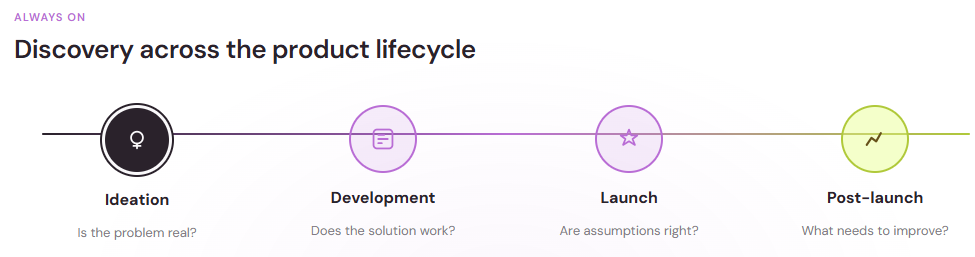
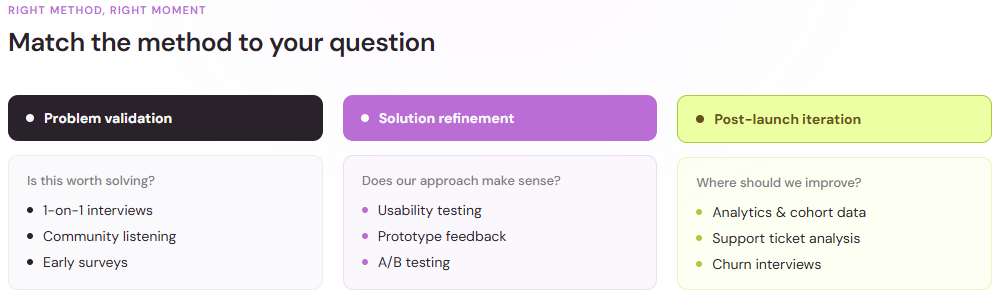
Customer discovery isn't one-size-fits-all. The questions you ask and the people you talk to change depending on where you are in the product lifecycle. Using the wrong discovery method at the wrong stage wastes time and produces unreliable insights. The most effective product managers match their discovery approach to what they need to learn.
Early-stage discovery: Finding the problem
When you're starting out, your goal is simple: do people actually care about this problem?
One-on-one interviews are your best tool here. Sit down (virtually or in person) with potential customers and ask open-ended questions about their current situation. How do they solve this problem today? What frustrates them? What have they already tried? How much time does this problem consume? What workarounds have they built?
The goal isn't to pitch your solution. It's to understand whether the problem is real, how acute it is, whether people would pay (or be willing to switch) to solve it, and what constraints they're working within. You're listening far more than you're talking. Early-stage customer discovery is about discovery, not validation. You're genuinely trying to understand, not confirm what you've already decided.
In these early conversations, pay attention to emotion. When customers describe the problem, do they sound frustrated? Resigned? Angry? These emotional signals tell you how much the problem matters. A problem that people have learned to live with is different from a problem that keeps them awake at night.
Surveys also work well at this stage, but use them to validate patterns you've already spotted in interviews—not as your first source of discovery. Surveys are great for reaching more people once you know what questions to ask. An early-stage survey that asks the wrong questions yields meaningless data. But once you've run 10-15 interviews and identified consistent themes, a survey to 100 people confirms whether those themes are widespread or just the opinions of the people you happened to talk to.
Customer research through existing channels can accelerate this process. If you have access to support forums, online communities, or social media where your target audience hangs out, spend time there first. See what problems people are talking about. What complaints appear repeatedly? What questions do people ask? This background research makes your interviews more informed and efficient.
Development stage: Refining the solution
Once you've confirmed that a problem is real, your focus shifts: how should you solve it?
User testing becomes critical here. Show prototypes, rough versions, rough sketches, or even detailed mockups to a small group of customers. Watch how they interact with your solution. Do they understand the workflow? Do they get stuck? Where do they hesitate? Which options confuse them?
User testing is less about "Is this feature good?" and more about "Does this approach make sense to the people who'll use it?" You're looking for friction, confusion, and moments where the design doesn't match how users actually think. Sometimes, a single user testing session reveals a fundamental flaw in your approach that would have wasted months of development time to discover later.
The best user testing at this stage is lean and fast. You don't need polished prototypes. Rough clickable wireframes work. The goal is to test whether your core approach is sound before you invest heavily in building it. A product manager who tests assumptions early catches problems when they're cheap to fix.
In-depth interviews during this phase focus on the "why" behind observed behavior. If someone got confused by a button, ask them what they expected to happen. What would have made it clearer? What mental model were they using? These "why" conversations often reveal gaps in your design thinking.
A/B testing and multivariate testing can also inform development-stage decisions. If you have existing customers, small experiments show which approaches resonate more. You might test two different workflows, two different ways of explaining a feature, or two different visual hierarchies. Data from real users beats opinions every time.
Launch and beyond: Validating and iterating
After launch, your discovery shifts to understanding how real customers use your product in the wild, not in a test environment. Post-launch customer discovery is about continuous improvement and spotting where your assumptions about how people would use the product diverged from reality.
Support tickets and chat logs are goldmines. Your support team hears what confuses people, what they love, and what they need but don't have. Mining this data for patterns reveals priorities that should inform your roadmap. A product manager who regularly reviews support conversations learns things that data dashboards never show. They see the human frustration behind the support ticket. They understand not just that people are confused, but why.
In-app surveys and feedback widgets let you ask quick questions at the moment customers are using your product. "What brought you here today?" or "What would make this easier?" yield responses grounded in real context. Because the question arrives when customers are actively engaged with the feature, their feedback is concrete and specific. They're not trying to remember what they were doing last week; they're telling you right now.
Usage data and analytics show you how people actually behave. The feature you thought would be popular might sit unused. A button you buried in the interface might get clicked thousands of times. Let the data guide your assumptions. Segment your analytics by customer type, company size, and use case. Usage patterns often differ dramatically between customer segments, which means different segments may have different priorities.
Cohort analysis reveals whether new features are actually moving the needle. If you launched a feature and activity around it dies off after a few days, that tells you something different than if usage grows over time. Cohort data shows you not just what customers do, but whether they keep doing it.
Churn analysis is a critical discovery tool. When customers leave, ask them why. Even if they don't respond to your exit survey, their usage data can tell a story. Did they stop using a specific feature right before they left? Did their engagement drop? These patterns point to problems you need to solve.
How to run effective customer discovery conversations
The way you talk to customers shapes what you learn. Here are the principles that lead to honest, useful feedback.
Ask open-ended questions
Avoid yes-or-no questions. "Do you like this?" isn't helpful. "What would make this work better for you?" opens the conversation up. You want customers describing their experience in their own words, not confirming what you've already decided. Open-ended questions are harder to ask well because they require you to be comfortable with silence and unexpected answers. But that discomfort is exactly what leads to learning.
Some strong starting questions:
- "Walk me through how you currently solve this problem."
- "What's the most frustrating part of your workflow?"
- "What have you tried that didn't work?"
- "What would the ideal solution look like?"
- "Tell me about the last time you ran into this problem. What did you do?"
These questions aren't loaded. They don't suggest an answer. They invite customers to tell their story.
Listen more than you talk
It's tempting to explain your solution or defend a design choice when you hear pushback. Don't. Your job in discovery is to understand, not to convince. Sit with discomfort. If a customer criticizes something, that's data—even if you disagree. The best discovery conversations feel one-sided because they are. You're asking questions and listening, not pitching.
When customers offer criticism, resist the urge to explain or justify. A customer saying "This is confusing" doesn't need your explanation of why it's actually intuitive. They've just told you it's confusing to them, which is all the information you need. Your job is to understand their perspective, not change their mind.
Talk to the right people
A product manager at a Fortune 500 company has different needs than a solopreneur. Talk to people who represent your actual target market. If your product serves multiple personas (like marketing teams and support teams), make sure you're hearing from both. Talking to the wrong customers produces insights that look valid but don't apply to your actual market. If you build based on feedback from non-target customers, you'll miss what matters to the people who actually use your product.
Consider creating a customer persona framework before you start conducting interviews. Who do you most want to understand? What defines their role, company size, and situation? This clarity helps you recruit the right people.
Recruit with intention
Don't just grab anyone willing to chat. You want people who have the problem you're solving, or who use products like yours. Recruitment services, user testing platforms, and even direct outreach to existing customers work well. The investment in finding the right people pays back tenfold in quality feedback. A conversation with one person who exactly matches your target customer yields more useful information than five conversations with people who are "close enough."
Analyze patterns, not individual opinions
One customer saying, "I hate this button," is feedback. Three customers independently saying, "I didn't know that was clickable," is a pattern. Patterns are what should drive your decisions. Individual preferences are less reliable. The challenge is that one strong personality can feel like a pattern if you're not careful. Track who said what and look for independent confirmation. If the criticism comes from someone with a specific agenda or background, that context matters.
Documenting and acting on what you learn
Discovery is only as valuable as what you do with it. That means capturing insights in a way your team can actually use. Too many teams run customer discovery, and then the insights sit in someone's email or notes app, never influencing decisions.
Record themes, not transcripts. You don't need word-for-word notes. After an interview, jot down the key insights: what problem did they mention? What workflow issue came up? What surprised you? Share these notes with your team so everyone knows what you're learning. The goal is signal, not completeness.
Create a discovery tracking document. Keep a running list of insights by theme or product area. As patterns emerge across multiple conversations, the priorities become clearer. Update this document after each customer conversation and share it regularly with your team. Seeing the same insight appear multiple times makes its importance obvious.
Create a decision log that references customer discovery. When you make a significant product decision, document which customer insights informed it. "We decided to move the export button because four customers mentioned wanting faster access to that feature." This creates accountability, as decisions are traceable to customer feedback rather than gut feelings.
Close the loop with customers. When you implement a feature or change based on customer feedback, tell them. "You mentioned this was frustrating, so we built this." It reinforces that you listen, and customers often become your best advocates. They also feel invested in the product's success, which strengthens loyalty.

Building a discovery habit
The best product managers treat customer discovery as part of their regular rhythm, not a one-off event. That might mean:
- Weekly customer calls – Block time each week for one or two customer conversations. Rotate between new prospects and existing customers. Consistency matters more than quantity. Regular, small conversations beat one big quarterly research project.
- Quarterly user testing – Set aside time each quarter to test major changes with users before they ship. This becomes a gate: you don't launch without user testing feedback.
- Monthly analytics reviews – Look at usage data, churn metrics, and support trends to spot what's working and what's not. Make it a team ritual so insights flow into roadmap planning.
- Continuous feedback loops – Integrate customer feedback into every sprint retrospective and roadmap planning session. When you're debating priorities, pull up recent customer insights. Let that context shape decisions.
Less than 35% of organizations report having a comprehensive data strategy, which means most teams are flying blind on what customers actually need. By building discovery into your regular practice, you're creating a competitive advantage. You know things your competitors don't because you're actually asking customers. That knowledge compounds over time.
Tools that support customer discovery
Modern platforms make it easier to collect feedback from multiple channels—surveys, support tickets, chat, in-app interactions—and spot patterns across them all. The right tool helps you organize customer insights so you can actually use them to inform decisions. However, tools are only as valuable as the discipline with which you use them.
When evaluating tools, look for:
- Multi-channel collection – Gather feedback from surveys, reviews, support tickets, chats, and in-app widgets in one place. Fragmented feedback across different tools means insights get lost.
- AI-powered analysis – Tools that help you spot themes across hundreds of responses save hours of manual work. When customer discovery yields hundreds of responses, manual analysis becomes impractical. AI tagging and categorization accelerates pattern recognition.
- Integration with your workflow – The tool should feed insights into your project management, roadmap, or CRM so feedback influences real decisions. If insights live in a separate system that nobody checks, they won't influence product decisions.
- Easy sharing – Team members should be able to access insights without friction. Insights locked behind complicated interfaces don't get used.
- Qualitative and quantitative capability – The best tools combine the richness of written feedback with the breadth of surveys. You want both depth and reach.
The right platform depends on whether you're doing primarily user testing, post-launch feedback collection, or enterprise-scale listening. Consider your immediate needs before overcommitting to an expensive platform.
Make customer discovery your unfair advantage
The product managers who build products customers love aren't guessing. They're talking to users constantly, listening without judgment, and letting those conversations drive their roadmap. Customer discovery isn't a luxury reserved for well-funded startups or large enterprises. It's the most fundamental practice available to any product manager, regardless of resources.
Customer discovery sounds simple—just ask people what they need—but the discipline of doing it well takes practice. It requires patience to sit with silence. It requires humility to hear criticism without defending. It requires discipline to actually use what you learn instead of reverting to your original assumptions when they're challenged.
Start with one-on-one interviews to understand the problem. Move to user testing as you develop solutions. Launch and then listen to how real customers use your product. Keep cycling through this process, and patterns will emerge. Those patterns become your strategy. You'll notice that certain customer segments have different needs. You'll spot problems that your analytics miss entirely. You'll discover opportunities you never would have built without talking to customers.
The companies winning in their markets aren't building in the dark. They're staying close to customers and letting that proximity inform every move. You can do the same. Begin this week. Block two hours and schedule one customer call. Ask questions. Listen. Take notes. That single conversation will shift your perspective in ways that data dashboards never can.
To structure this discovery work into a larger customer experience strategy, look into customer journey mapping and how it informs product decisions. It's also worth exploring how to use customer feedback to build loyalty and reduce churn—both outcomes of truly understanding your audience.

Liked that? Check these out:

Opinions and Expertise
What’s actually slowing research teams down (Hint: it’s not the research)
From recruiting participants and scheduling interviews to building the actual surveys, the operational drag is taking researchers away from what they do best. See what's actually slowing them down and how Research Flow fixes it.
Read more