Customer satisfaction survey software: 9 tools ranked
9 customer satisfaction survey software tools ranked by use case, AI analytics, and price, CSAT benchmarks and a framework for choosing the right one.
When customers feel heard, they stick around. But understanding what your customers actually think requires the right tool—one that makes it easy to ask the right questions, collect responses reliably, and act on what you learn.
Customer satisfaction survey software has evolved well beyond simple questionnaires. Modern platforms combine AI-powered analytics, multi-channel collection (surveys, reviews, support tickets, chats, in-app feedback), and automation to turn raw responses into actionable insights. The best tools go further, offering real-time dashboards, predictive analytics, and intelligent workflows that help teams respond to feedback before dissatisfaction grows into churn.
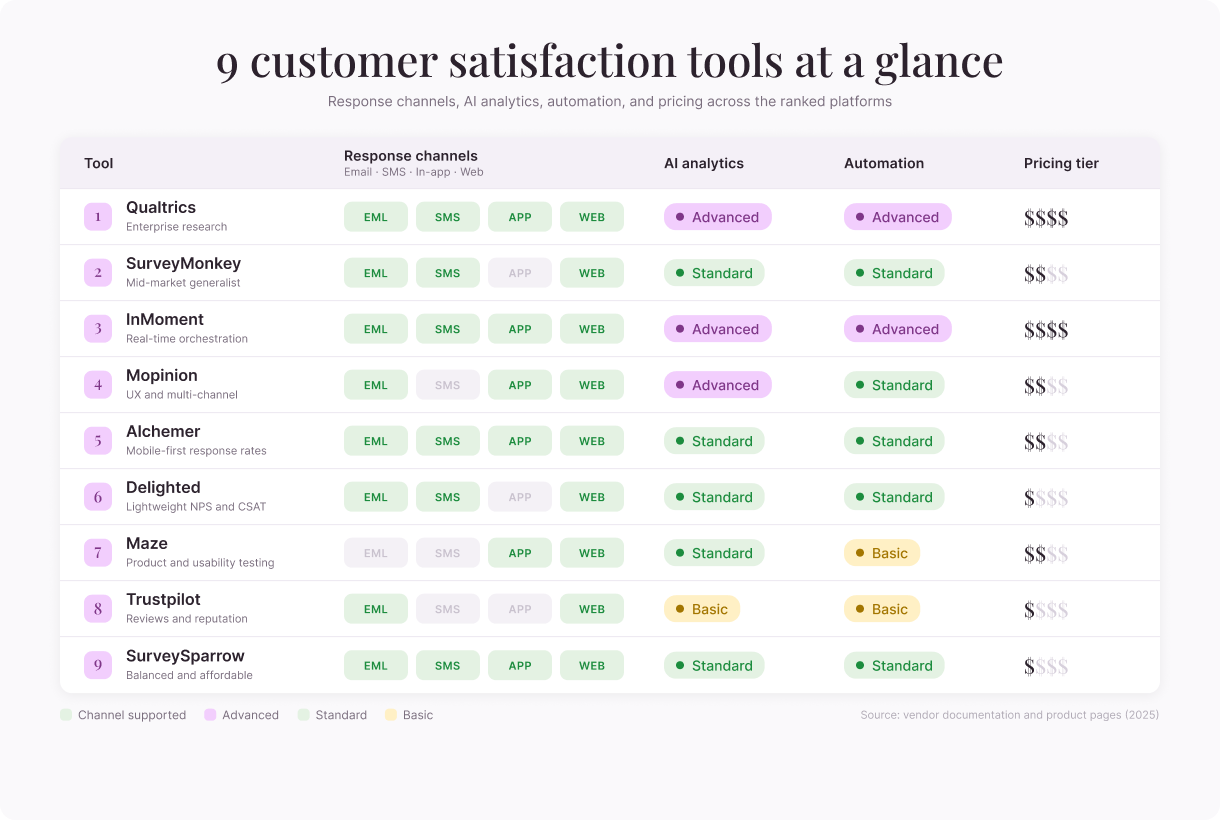
This guide ranks 9 leading tools to help you choose the one that fits your team’s needs, budget, and use case.
What to look for in customer satisfaction survey software
Before comparing specific platforms, understand the features that matter most.
Response channels and reach
The best customer satisfaction survey software lets you collect feedback wherever your customers are: email, SMS, in-app, web embed, or even QR code.
Email surveys typically see 15-25% response rates in 2025 (SurveySparrow Survey Response Rate Benchmarks, 2025), while in-app surveys average 27.52% (SurveySparrow Survey Response Rate Benchmarks, 2025). SMS surveys perform best, achieving 40-50% response rates (SurveySparrow Survey Response Rate Benchmarks, 2025).
The more channels your tool supports, the higher your chances of reaching busy respondents. Multi-channel deployment also allows you to test which channels resonate most with your audience, letting you optimize future campaigns.
Survey design and question types
Not all survey questions are created equal. Yes/No questions are fast to answer, reduce respondent fatigue and dropout, produce categorical data that’s easy to quantify and graph without complex stats software, and are well-suited to screening and quick assessments (SurveySparrow Dichotomous Questions Best Practices, 2024). What’s more, short surveys with 1-3 questions are completed by 83.34% of respondents (SurveySparrow Survey Response Rate Benchmarks, 2025).
Look for tools that make it simple to build concise surveys and offer pre-written question templates based on proven methodologies. The best platforms also provide guidance on question sequencing and logic to prevent respondent confusion.
AI-powered analytics
Manually sorting through hundreds of open-ended responses wastes time. AI-powered text analysis can identify themes, sentiment, and trends without you reading every comment. This is table stakes for modern customer satisfaction survey software in 2026. Advanced platforms now use machine learning to predict which feedback signals suggest churn risk, allowing proactive interventions.
Automation and integrations
When a negative response comes in, minutes matter. Tools that trigger automated follow-ups, route tickets to the right team, or escalate urgent feedback save your team time and help you respond faster. Integration with your CRM, help desk, or Slack lets insights flow into your existing workflow. Seamless integrations also reduce manual data entry and the chance of insights getting lost in transition between systems.
Sample size and statistical confidence
An acceptable margin of error is typically 3-6% at the 95% confidence level (Qualtrics, 2025). To survey a population of 500,000 at 95% confidence with 5% margin, a sample of 384 is needed (Qualtrics, 2025). Choose a tool that either provides sampling guidance or connects you to a panel of real respondents.
The top 9 tools ranked
1. Qualtrics
Best for: Enterprise-scale research and complex statistical analysis
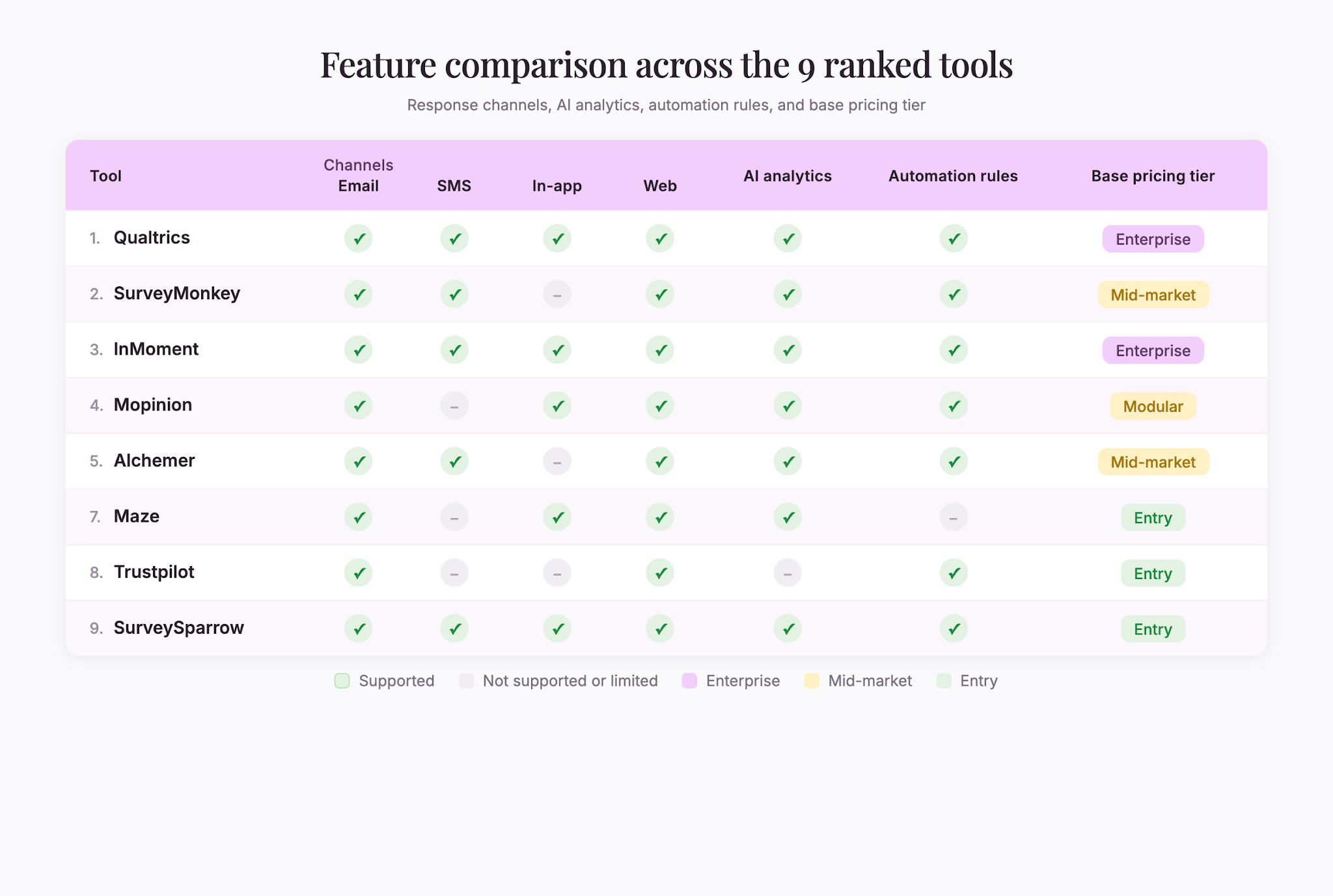
Qualtrics is the heavyweight champion of feedback platforms. It offers enterprise-grade survey design, advanced analytics, and a broad suite of customer experience research tools. If your organization needs rigorous statistical confidence, multiple research methodologies, and deep integration with enterprise systems, Qualtrics delivers.
The platform shines for teams that need customizable logic, advanced weighting, and complex cross-tabulation analysis. However, the price tag and learning curve make it overkill for smaller teams or basic satisfaction surveys.
Ideal for: Large enterprises, regulated industries, academic research
2. SurveyMonkey
Best for: Mid-market teams balancing ease-of-use with power
SurveyMonkey hits a comfortable middle ground. Its survey builder is intuitive, the template library is extensive, and the analytics dashboard is accessible to non-researchers. The platform supports multiple collection methods (email, SMS, web link, embed) and integrates with Salesforce, HubSpot, and Slack.
The in-built panel, SurveyMonkey Audience, lets you buy targeted responses quickly if you need external feedback. For teams running regular satisfaction surveys without needing doctorate-level statistics, SurveyMonkey is a sensible choice.
Ideal for: Small to mid-size teams, marketing departments, customer success teams
3. InMoment
Best for: Real-time feedback across teams
InMoment specializes in closing the feedback loop fast. The platform excels at collecting voice-of-customer data across touchpoints—surveys, reviews, support interactions, social listening—and using AI to surface patterns in real time. Automated workflow rules can route feedback to the right team instantly.
If your business lives and dies by quick response to customer sentiment, InMoment’s real-time orchestration is compelling. The cost is high, and the platform is oriented toward enterprise deployments.
Ideal for: Large enterprises, hospitality, retail, financial services
4. Mopinion
Best for: Multi-channel feedback collection and UX research
Mopinion blends surveys, user testing, and behavioral data to give you a full picture of customer sentiment. The platform captures feedback through surveys, heatmaps, session recordings, and form analytics on your website. AI-powered text analytics can summarize open-ended feedback automatically.
The tool is particularly strong if you want to correlate survey sentiment with user behavior on your site. Pricing is modular, so you can start lean and add capabilities as your feedback program grows.
Ideal for: Product teams, UX researchers, e-commerce, SaaS
5. Alchemer (formerly SurveySparrow)
Best for: High-response-rate surveys with mobile-first design
Alchemer focuses on survey completion rates. The platform is built mobile-first, and its question format options—including conversational surveys that feel less like forms—tend to pull higher response rates. The system offers conditional logic, branching, and integrations with common business tools.
If your priority is getting more people to finish your survey, Alchemer’s design philosophy pays dividends. It’s simpler than Qualtrics but more flexible than basic survey builders.
Ideal for: Customer success teams, product feedback loops, SMBs
7. Maze
Best for: User testing and product validation
Maze started as a startup-focused usability testing platform and now serves more than 3,000 companies as of 2025 (Maze, 2025). While it includes survey capabilities, its sweet spot is unmoderated user testing—task completion, click tracking, and qualitative feedback all in one.
If you’re testing product changes or new features before launch, Maze’s built-in testing framework is faster than cobbling together separate tools. The survey-only use case is covered, but you’ll get more value if you use the full testing suite.
Ideal for: Product teams, UX/UI researchers, agile development
8. Trustpilot
Best for: Review collection and reputation management
Trustpilot is primarily a review platform, but it includes survey capabilities for collecting feedback before the review stage. If managing your online reputation and encouraging customer reviews is part of your satisfaction strategy, Trustpilot consolidates that workflow.
The tool is less flexible for custom survey logic but shines at converting satisfied customers into public advocates. Pricing is competitive if reviews are your main use case.
Ideal for: E-commerce, hospitality, service businesses
9. SurveySparrow
Best for: Balanced feature set and affordability
SurveySparrow offers a robust survey builder with AI-powered text analysis at a price point that won’t break smaller budgets. The platform supports multiple collection channels, automated workflows, and integrations. The interface is clean, and the templates are solid.
SurveySparrow is a generalist tool—not trusted at any one thing but competent across the board. It’s a good fit if you want to avoid vendor lock-in and need flexibility without paying enterprise prices.
Ideal for: Growing teams, customer feedback programs, market research
How to choose the right tool for your team
Define your use case first
Are you tracking Net Promoter Score (NPS) monthly? Running one-off product feedback surveys? Collecting real-time feedback across multiple touchpoints?
Your use case shapes the tool. A simple monthly NPS check doesn’t justify an enterprise platform; a large-scale voice-of-customer program does. Consider how the tool will integrate with your existing feedback processes and whether you’ll need to scale in the future.
Understand CSAT benchmarks in your industry
Average CSAT across industries is 78% (American Customer Satisfaction Index (2024-2025)). Scores above 80 are excellent, while scores below 70 indicate issues (American Customer Satisfaction Index (2024-2025)). Full-service restaurants lead at 84, banks at 80, and e-commerce at 80 (American Customer Satisfaction Index (2024-2025)). ISPs lag at 68, and social media stands at 73 (American Customer Satisfaction Index (2024-2025)).
Know what “good” looks like in your industry so you can set realistic targets and benchmark your progress over time. Tracking your scores against benchmarks helps you identify whether improvements are meaningful or lag behind peers.
Start with survey length and frequency
The temptation is to ask everything at once. But short surveys with 1-3 questions are completed by 83.34% of respondents (SurveySparrow Survey Response Rate Benchmarks, 2025).
Translation? Frequent, short surveys beat infrequent, long ones. Plan to ask the fewest questions needed to answer your core question, then iterate. This approach also makes it easier to run follow-up surveys that dig deeper into specific areas.
Consider total cost of ownership
Pricing varies wildly. Some tools charge per response; others charge per survey; still others use a per-user or per-month model. Factor in integrations, support, and the time your team will spend on setup and analysis. The cheapest tool isn’t always the most economical when you account for implementation hours and opportunity costs of slower workflows.
Test before committing
Most platforms offer a free tier or trial. Use it to build a real survey, send it to a small group, and see if the experience—both for you and your respondents—feels right. The tool that looks best in a demo might feel clunky in practice. Pay attention to how intuitive the interface feels and whether the analytics output answers the questions that matter to your business.

Liked that? Check these out:

Opinions and Expertise
What’s actually slowing research teams down (Hint: it’s not the research)
From recruiting participants and scheduling interviews to building the actual surveys, the operational drag is taking researchers away from what they do best. See what's actually slowing them down and how Research Flow fixes it.
Read more