Customer feedback tools: the 15 best, reviewed
Collecting customer feedback has never been easier. Dozens of platforms promise to help you survey customers, analyze sentiment, and turn responses into action. The hard part isn't finding a tool. It's finding the right one for how your business actually works.

Key Takeaways
- Match the tool to your use case, not just features: Quick satisfaction checks fit lightweight, easy-to-set-up tools, while omnichannel feedback across email, chat, and reviews needs an enterprise-grade platform built for breadth.
- Response channel affects how many people actually respond: SMS surveys reach about 35% response rates, well above email's 20-25%, so channel choice matters as much as question design.
- Qualitative depth requires different tools than quantitative surveys: Video-based research platforms capture narrative and emotional context that a standard survey can't.
- The tool matters less than using it consistently: Feedback only becomes valuable when your team picks one platform that fits its workflow and sticks with it as a habit.
Customer feedback is how you learn what's actually working for your audience. Without it, you're making decisions based on guesses instead of what real people are telling you.
The challenge is choosing the right tool to collect that feedback. There are dozens of platforms out there, each with different strengths. Some are built for speed, some for depth. Some handle surveys beautifully but struggle with open-ended responses.
We've reviewed 15 of the most popular customer feedback tools to help you find the one that fits your needs, budget, and workflow.

What makes a good customer feedback tool
Ease of setup and use
You shouldn't need a degree in data science to create a feedback survey. The best tools let you build something in minutes, not hours.
Response rates
Email surveys typically see 20–25% response rates, while in-app surveys average 20–30%. SMS surveys do even better at 35%. The right channel reaches your audience and boosts responses.
Analysis and insight generation
Raw data is just noise. You need a tool that spots patterns and helps you act on findings. Modern tools integrate AI-powered analytics and automation.
Integrations
Your feedback tool shouldn't live in isolation. It needs to connect to your CRM, help desk, analytics platform, or other tools you use. Strong integrations save time and keep data flowing where it's needed.
Conversation design
How feedback is asked matters as much as what's asked. One-question-at-a-time approaches tend to see better completion rates than long, all-at-once forms.
The platforms: 15 customer feedback tools worth considering
1. Qualtrics
Enterprise-grade survey and feedback platform built for large organizations. Handles customer satisfaction, employee engagement, and market research across departments.
Strengths: Advanced reporting, extensive integrations, powerful logic and branching, AI-driven text analytics.
Drawbacks: Steep learning curve, premium pricing.
Best for: Large enterprises, research teams needing deep analytics.
2. SurveyMonkey
One of the most popular survey platforms, offering ease-of-use balanced with capability and a massive template library.
Strengths: Beginner-friendly, affordable entry point, large question bank, reliable reporting.
Drawbacks: Can feel dated compared to newer competitors.
Best for: Small to mid-size teams, companies new to feedback collection.
3. Userlytics
User research and testing platform that captures video feedback alongside task-based responses.
Strengths: Flexible testing formats, video and screen recordings, global participant pool.
Drawbacks: Less suited for traditional satisfaction surveys.
Best for: UX teams, product researchers running remote studies.
4. Hotjar
Combines feedback collection with heatmaps and session recordings to reveal what users think and how they behave.
Strengths: All-in-one behavior and feedback platform, affordable, visual heatmaps reveal pain points.
Drawbacks: Feedback features less powerful than dedicated survey tools.
Best for: Web teams, product managers wanting behavioral data plus feedback.
5. InMoment
Enterprise feedback and experience management platform designed for organizations monitoring feedback across all customer touchpoints.
Strengths: Advanced AI analytics, omnichannel feedback collection, real-time insights, case management.
Drawbacks: Expensive, complex setup.
Best for: Large enterprises managing feedback across many channels.
6. Mopinion
Specializes in multi-channel feedback collection—web surveys, in-app feedback, email, and mobile—with visual feedback alongside text and ratings.
Strengths: Multi-channel approach, visual feedback capture, straightforward reporting.
Drawbacks: Smaller community, fewer third-party integrations.
Best for: E-commerce teams, media companies managing feedback from many channels.
7. Medallia
Enterprise platform focused on experience management. Helps organizations collect, analyze, and act on feedback from customers, employees, and operations.
Strengths: Comprehensive analytics, AI-powered insights, omnichannel collection, case management.
Drawbacks: High cost, steep learning curve.
Best for: Enterprise organizations managing feedback as a core function.
8. Alchemer
Mid-market survey platform with strong mobile optimization and conversational design that feels less like traditional questionnaires.
Strengths: Mobile-first design, conversational surveys, reasonable pricing, good analytics.
Drawbacks: Smaller integrations ecosystem.
Best for: Teams wanting conversational surveys without premium pricing, mobile-first feedback collection.
9. Maze
Usability testing platform expanded to include broader user research. Particularly strong for product and design research.
Strengths: Built for design teams, easy prototyping and testing, clear reporting.
Drawbacks: Less suitable for traditional customer satisfaction surveys.
Best for: Product teams, design research, UX teams.
10. UserTesting
Provides on-demand user feedback from real people completing tasks or answering questions via video and written responses.
Strengths: Real human feedback across audiences, video insights, flexible request options.
Drawbacks: Higher cost-per-response than automated surveys.
Best for: Product teams, UX research, companies testing prototypes.
11. Lookback
Remote user research platform combining video interviews with screen recording for in-depth qualitative research.
Strengths: High-quality interview data, easy video analysis, flexible formats.
Drawbacks: Slower than quantitative tools, higher cost.
Best for: Qualitative research teams, user research, product discovery.
12. UsabilityHub
Offers quick feedback on design, copy, and user flows through simple tests with real-time reactions.
Strengths: Quick turnaround, affordable, good for design validation.
Drawbacks: Limited to quick feedback, not suitable for complex surveys.
Best for: Design teams, UX validation.
13. Optimal Workshop
Focuses on UX research tools like card sorting, tree testing, and prototype testing for understanding information architecture.
Strengths: Purpose-built for UX research, strong information structure analysis.
Drawbacks: Narrow focus on UX research only.
Best for: UX researchers, information architects.
14. Zendesk Surveys
Integrates survey capabilities directly into Zendesk's support platform, providing a natural fit for existing Zendesk users.
Strengths: Tight support ticket integration, automated post-interaction surveys.
Drawbacks: Limited flexibility compared to dedicated survey tools.
Best for: Companies using Zendesk support software.
15. Jotform
Form builder with survey capabilities, highly customizable with a large template library.
Strengths: Affordable, highly visual customization, large template library.
Drawbacks: Basic analytics compared to specialized survey tools.
Best for: Small teams, non-technical users.
How to choose the right tool for your needs
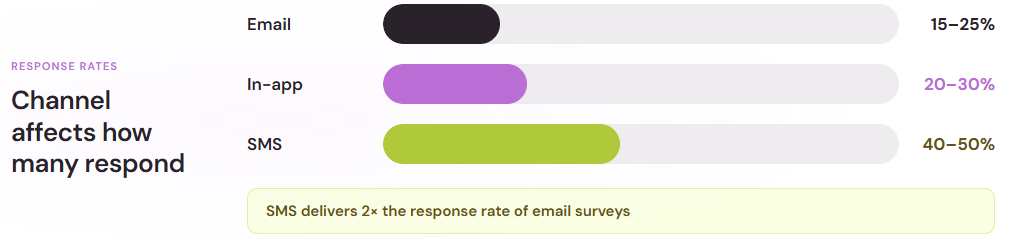
For quick customer satisfaction checks
If you're measuring how happy customers are with a recent purchase or support interaction, a lightweight survey tool like SurveyMonkey or Alchemer works well. Keep surveys short. Surveys with one to three questions see 83.34% completion rates (SurveySparrow, 2025).
For product feedback and feature requests
Product teams benefit from tools that let respondents explain their thinking. Conversational survey design or Hotjar's comment boxes help you understand why users feel as they do.
For enterprise or omnichannel feedback
If you're collecting feedback across email, SMS, chat, reviews, and support tickets simultaneously, you need a platform built for breadth. Qualtrics, InMoment, and Medallia integrate analytics so feedback drives business decisions.
For UX and design research
Specialized research tools like Maze, Optimal Workshop, or UsabilityHub are more efficient than general survey platforms for testing designs or information architecture.
For qualitative depth
When you need the story behind the data—emotional context, workflow, pain—UserTesting and Lookback capture video and narrative that surveys alone can't.
Benchmarks: What good customer feedback looks like
Customer satisfaction scores
Average CSAT across industries is 77%. Scores above 80 are excellent, below 70 indicate issues. Full-service restaurants lead at 82%, banks at 80%, and e-commerce at 79%. Internet service providers lag at 73%, social media platforms at 73%.
Response rates
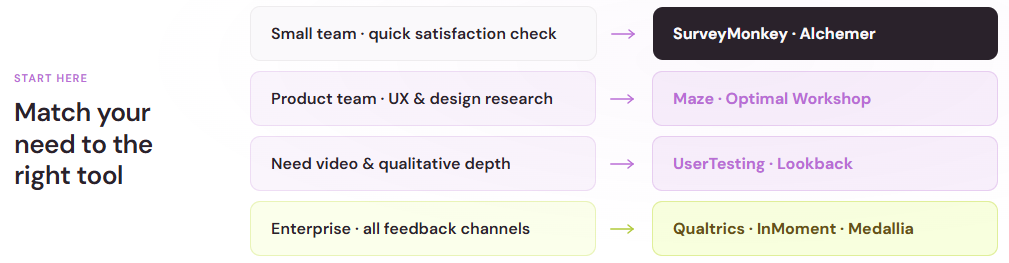
Email surveys typically see 20–25% response rates. In-app surveys average 20–30%. SMS surveys achieve 35%. If you're below these benchmarks, your collection method may need adjusting.
Getting started: Next steps
Once you've picked a tool, remember that the technology is just the beginning. How you design your questions and what you do with the feedback matters more than the platform itself.
Start small with one feedback channel and one clear question. The best customer feedback tools are the ones your team will actually use. Pick one that fits your workflow and budget, then use it consistently. Feedback only becomes valuable when it becomes a habit.

Liked that? Check these out:

Opinions and Expertise
What’s actually slowing research teams down (Hint: it’s not the research)
From recruiting participants and scheduling interviews to building the actual surveys, the operational drag is taking researchers away from what they do best. See what's actually slowing them down and how Research Flow fixes it.
Read more