Data collection methods: a practical guide
Compare eight data collection methods, their costs and trade-offs, and learn how to choose the right approach for your research.
Key Takeaways
- Primary data is collected for the current question. Secondary data already exists.
- Quantitative data answers “how many?” Qualitative data collection explains “why?”
- Choosing a familiar method before defining the research question can produce precise answers to the wrong problem.
- Combining methods can reveal a pattern and explain what is driving it.
- Every method gives something up. Faster collection may mean less depth, while wider reach may come with less control over data quality.
Choosing the wrong data collection methods can mean spending weeks collecting data that cannot answer your question. Start with the decision the research needs to support.
A product team investigating checkout abandonment may use behavioral data to locate the drop-off, then interviews to learn why. This guide compares eight methods, when each one fits, and what each may cost in time, money, access, or data quality.
What Are Data Collection Methods?
Data collection methods are structured approaches researchers use to gather information that answers a specific question.
A method effectively locks in three parts of the project:
- Who can participate
- What depth and type of evidence you can collect
- How the data can be analyzed, and what the project may require in time and budget
A method mismatch is difficult to repair after collection. Researchers at the U.S. Census Bureau use qualitative and quantitative approaches to identify and reduce problems in surveys.
If you build the survey before considering the likely answers, respondents may have no way to choose an option you missed. For a small exploratory project, eight to ten interviews can reveal motives and language that produce better response options.
Data collection tools serve a different role. A survey platform, recorder, analytics system, or form administers a method, but it cannot decide whether the method fits the question.
Primary vs. Secondary Data
Primary data is information you collect yourself to answer a current question you have. Secondary data is information someone else collected for a different purpose, such as an earlier study.
For example, customer interviews run specifically for a current churn study are primary data. A published government report reused to benchmark the market is secondary data.
Primary data can closely match your project’s question because you collect it specifically for that purpose, but gathering it takes time and money. Secondary data is faster and less expensive to use, though it may not fully match your needs.
Here’s a useful first check to see if you need primary or secondary data:
- Use primary data when available sources leave an important part of your question unanswered
- Look at secondary data first when you need background, comparison points, or a clearer sense of what deserves further study
- Combine both when existing evidence can shape a more focused primary study
Already available data doesn’t always mean it’s suitable for your needs. Secondary data may cover the wrong population, use different definitions, come from an outdated period, or rely on a collection method that doesn’t fit your decision.
Quantitative vs. Qualitative Data Collection
Quantitative data collection answers “how many,” “how much,” and “how often.” Qualitative data collection explains “why,” “how,” and what the team may have missed.
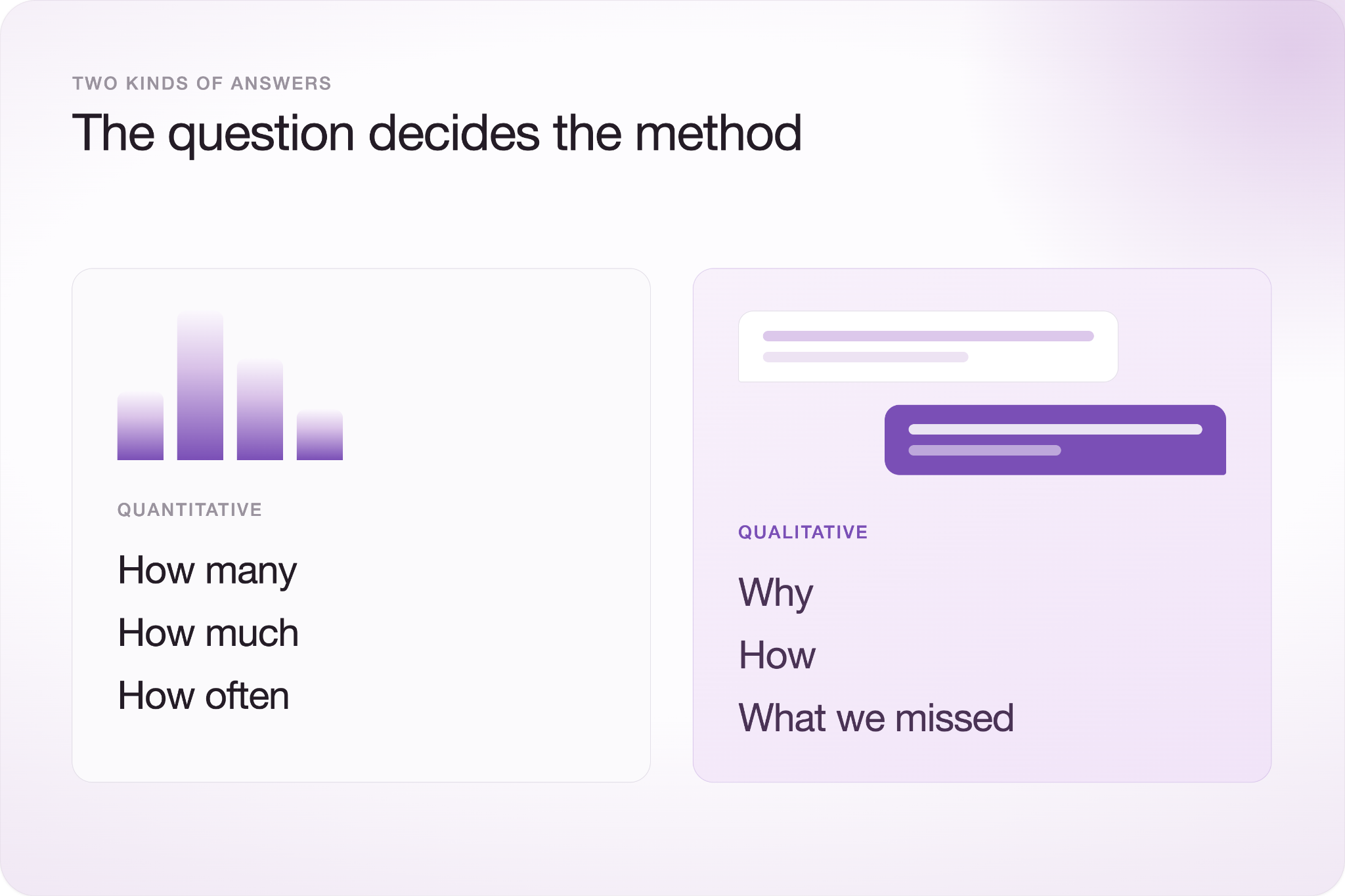
Quantitative research produces information you can count or compare. Qualitative research captures explanations in participants’ own words. The research question decides which belongs first.
When you do not yet know which survey answers to include, start with eight to ten qualitative interviews. Participants’ explanations can reveal recurring language, needs, and options the team may not have considered. Use those findings to build a quantitative survey, then send it to a larger group to measure how common each pattern is.
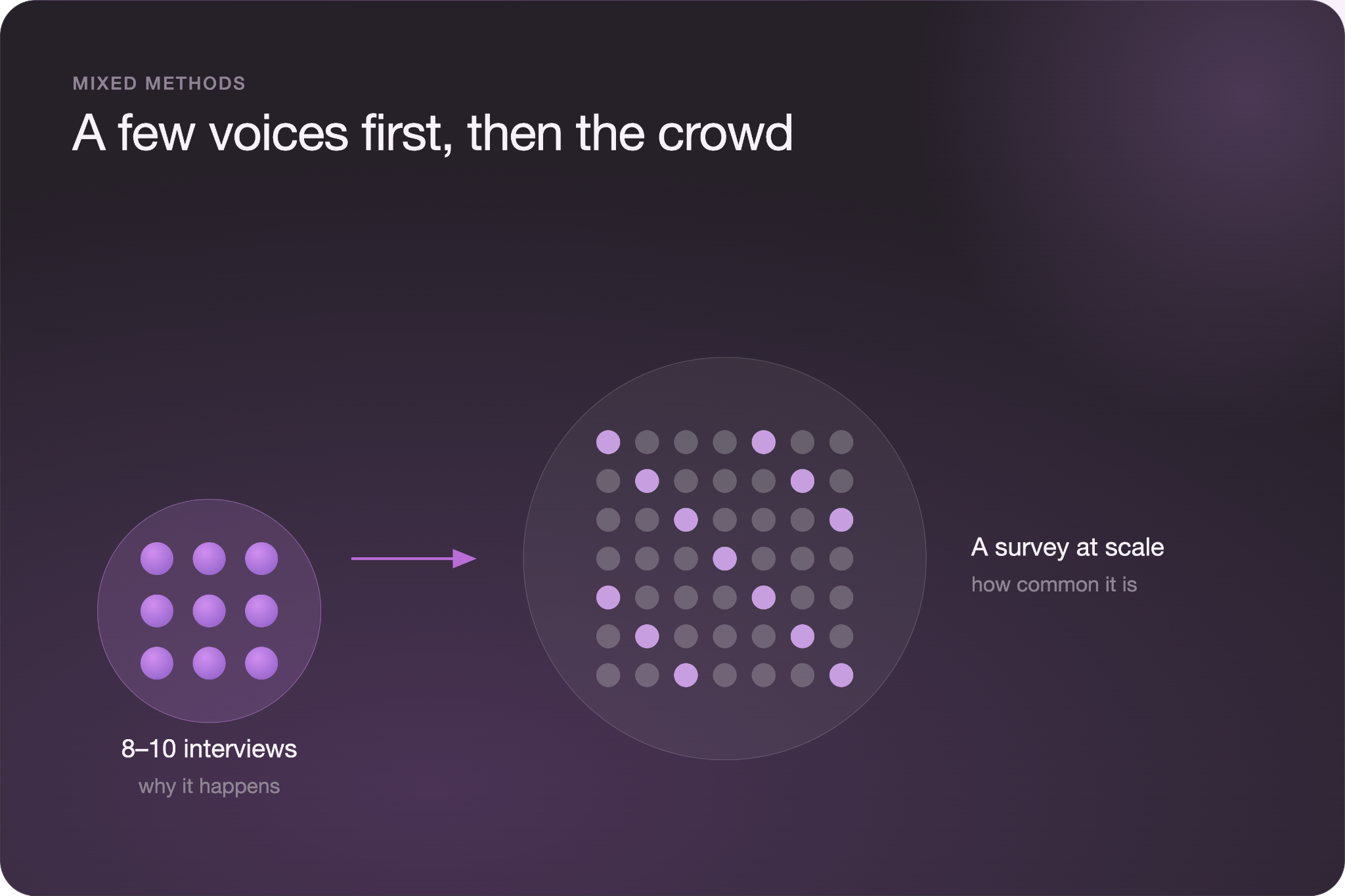
One 2025 Pew Research Center project examined how Americans define news. It used a mixed-methods approach: an online discussion board and individual interviews to explore participants’ views in depth, plus a nationally representative survey to measure how widely those views were shared. Pew’s survey-question guidance also recommends piloting open-ended questions before building closed-ended answer choices.
Typeform’s guide to qualitative and quantitative research offers a closer comparison of the two approaches.
The Eight Main Data Collection Methods
The eight main data collection methods differ in the evidence they produce and the resources they require. Use the table for a quick comparison, then review each method’s main trade-off.
MethodBest Used WhenMain Cost or LimitationSurveys and questionnairesMeasuring patterns across groupsLimited depth; sample quality mattersInterviewsExploring motives and contextTime-intensive to recruit and analyzeFocus groupsComparing reactions in a group discussionParticipants can influence each otherObservationSeeing real behaviorAccess and interpretation challengesForms and web captureCollecting standardized informationExtra fields can cause abandonmentExperiments and A/B testsTesting a specific changeNeeds a valid comparison and enough trafficBehavioral and analytics dataTracking actions and journeysShows what happened, not whySecondary sourcesAdding context from existing dataLimited control over data quality
Surveys and Questionnaires
Use surveys once the questions and likely response choices are clear. Survey methods collect standardized answers from a defined group, making them useful for measuring known issues or comparing segments.
But what if you do not yet know the likely answers to the survey questions? A closed-ended survey can limit respondents to categories that miss an important issue. Poor wording or incomplete response options can also weaken the results. Pew Research Center’s survey-question guidance explains how wording and answer choices can affect responses.
Typeform can create, share, and collect responses to surveys and questionnaires, but it does not decide whether a survey or questionnaire is the right research method for your question. See Typeform’s survey and questionnaire guide to learn how the two differ.
Interviews
Interviews gather detailed answers through direct conversation. Choose them when you need motives, language, processes, or context that fixed response options cannot capture.
Follow-up questions are what make interviews especially useful: they let you ask participants to explain, clarify, or expand on an answer. Recruiting, conducting, documenting, and analyzing interviews all take time, and this method usually favors depth over reach.
Focus Groups
Use a focus group when the conversation between participants is part of the evidence you want. Hearing people agree, push back, or borrow one another’s language can reveal reactions that separate interviews may not surface.
The same group dynamic can also skew the results. More vocal participants may shape the conversation, while others may hold back or agree publicly with views they do not share. Recruitment, scheduling, and moderation also take time.
Observation
Observation is the right call when behavior matters more than recollection. Watching a workflow, usability session, or physical task can reveal where people hesitate, take workarounds, or run into problems in their environment.
Watching someone struggle through a checkout flow may reveal friction they never mention in a survey. Observation still has limits:
- Access can be difficult
- Privacy needs careful handling
- Researcher interpretation can introduce bias
Most importantly, observation can show what people do, but not always why they do it.
Forms and Web Capture
Forms and web capture collect structured information during registrations, applications, purchases, or requests. They fit routine operational collection better than exploratory research.
Extra fields can increase abandonment, especially on mobile. Remove any field whose responses you do not plan to use. Typeform’s guide to building online forms covers form design and web-based collection.
Experiments and A/B Tests
Use an experiment when you need to know whether a specific change affects an outcome. The comparison only helps when the design limits other plausible reasons for the difference.
GOV.UK guidance on A/B tests recommends starting with a hypothesis, comparing a control with a variation, and randomly assigning participants. But a test can still miss the bigger issue, like why users dislike the page in the first place.
Behavioral and Analytics Data
Behavioral and analytics data show what people do across a digital journey, including where they move forward, stall, return, or leave.
Analytics rarely explains motivation by itself. It can miss parts of the journey when events are not tracked properly. Pair it with interviews, surveys, or another method that helps explain the reasons behind the behavior.
Secondary Sources
Secondary sources reuse information from governments, academics, companies, or earlier research. They help with market context, benchmarks, and early scoping.
Existing data saves collection time, but its definitions, date, or sample may not fit your question. Typeform’s data-gathering guide covers additional collection approaches.
How to Choose a Data Collection Method
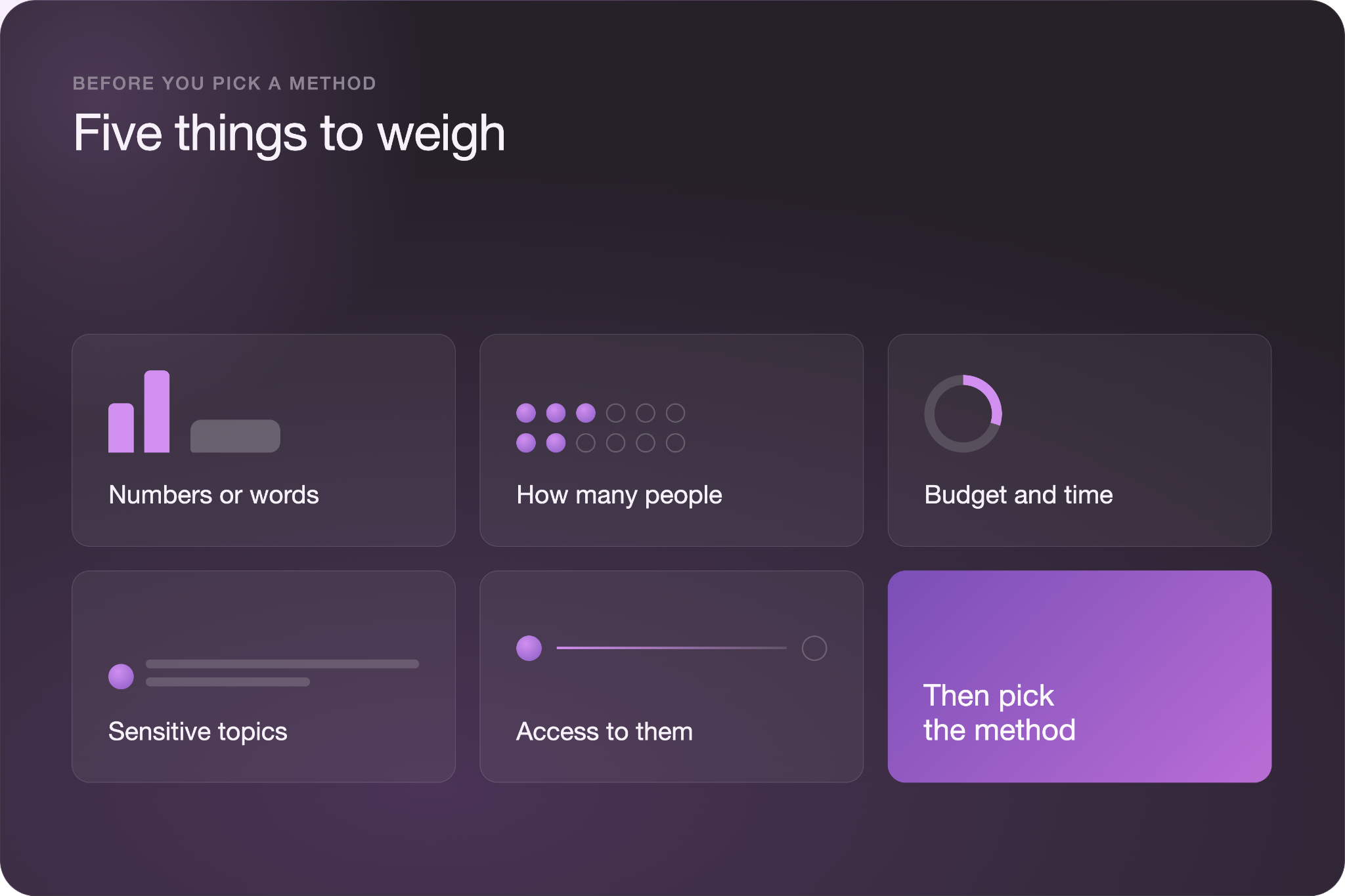
Define the answer you need before choosing a method or tool. Start with five filters:
- What kind of answer do I need? Use quantitative data collection for “how many” questions and qualitative data collection for deeper “why” questions.
- How many people do I need to hear from? Broader comparisons often point toward surveys, while depth may favor interviews or observation.
- What are the budget and timeline? Interviews take more hands-on work. Secondary data may answer the question faster.
- How sensitive is the topic? Consider whether people will answer more openly in a self-administered format or a private conversation.
- Can I reach the right people? Easy access is not enough if the sample misses the population behind the decision.
Here are two ways to apply the framework:
- If you know the problem and want to measure how common it is, use a large enough survey sample.
- Still shaping the answer choices? Start with exploratory interviews and use what you hear to build the survey.
There is no universal minimum sample size. Pew Research Center notes that sample size and desired precision should reflect the population and any subgroups the study will analyze.
Common Data Collection Mistakes
Weak data often results from avoidable mistakes in research design or sampling—not from the data-collection tool itself.
Watch for these problems:
- Choosing the method before defining the question
- Writing leading or double-barreled questions
- Sampling only easy-to-reach participants
- Collecting information nobody plans to analyze
- Planning analysis after collection begins
- Treating a large sample as a cure for biased sampling
- Requesting sensitive information without a clear reason
Pew Research Center’s total survey error framework separates coverage, sampling, nonresponse, measurement, processing, and adjustment errors. More responses cannot repair every kind of design error.
How to Get Cleaner Data From Any Method
A small pilot can expose unclear wording, missing choices, technical friction, and analysis problems before the full project begins.
Run a quick preflight:
- Test the method with a small group
- Keep questions short and focused
- Ask one thing at a time
- Use language participants understand
- Keep surveys and forms easy to complete on a phone
- Decide who will analyze each field or question
- Remove information that will not support a decision
- Confirm participants match the population you need to understand
FAQ
Can a study combine qualitative and quantitative data collection?
Yes. Interviews can reveal the language people use and possible survey responses. A survey can then measure how common those patterns are. Each method should answer a different part of the research question.
What is the difference between a data collection method and a data collection tool?
A data collection method is the approach used to gather information. A data collection tool is the software or equipment used to carry out that approach. For example, a survey is a method, while an online survey platform is a tool.
How many participants do you need for data collection?
There is no universal number. Quantitative studies need enough participants to produce reliable estimates and compare relevant groups. Qualitative studies need enough participants to capture the range of relevant experiences and answer the research question.