27 employee feedback examples (and how to deliver them)
Find 27 employee feedback examples for peer reviews, remote check-ins, and everything in between, plus a simple framework for delivering them well.
Most feedback ends up going wrong before anyone gets a chance to say a word. This isn’t because the person giving it has bad intentions, but it’s because the feedback is vague, late, or entirely one-sided.
Key takeaways
- Anchor it in specifics with the Situation-Behavior-Impact model, not vague labels like “good job.”
- Deliver it close to the moment, not months later in a quarterly review.
- Make it two-way by ending with a real question instead of a verdict.
- Build it into a habit with regular pulse checks and peer feedback, not just the annual review.
Be honest. Have you stared at a blank feedback form and thought about how to phrase something without sounding too harsh, soft, or like a motivational poster? You’re not alone, and this is quite common. Most managers are not given a feedback playbook when they become managers. They’re often copying the style that they experienced themselves (good or bad).
That’s how we end up with the classic feedback sandwich: compliment, criticism, compliment. Everyone knows it is coming, so they spend the first compliment waiting for the “but” to happen.
There’s good news: feedback isn’t a personality trait that you either have or don’t. It’s a skill. And once you have a bank of solid employee feedback examples to pull from, it gets so much easier.
What causes most employee feedback to fall flat
Three things often get in the way.
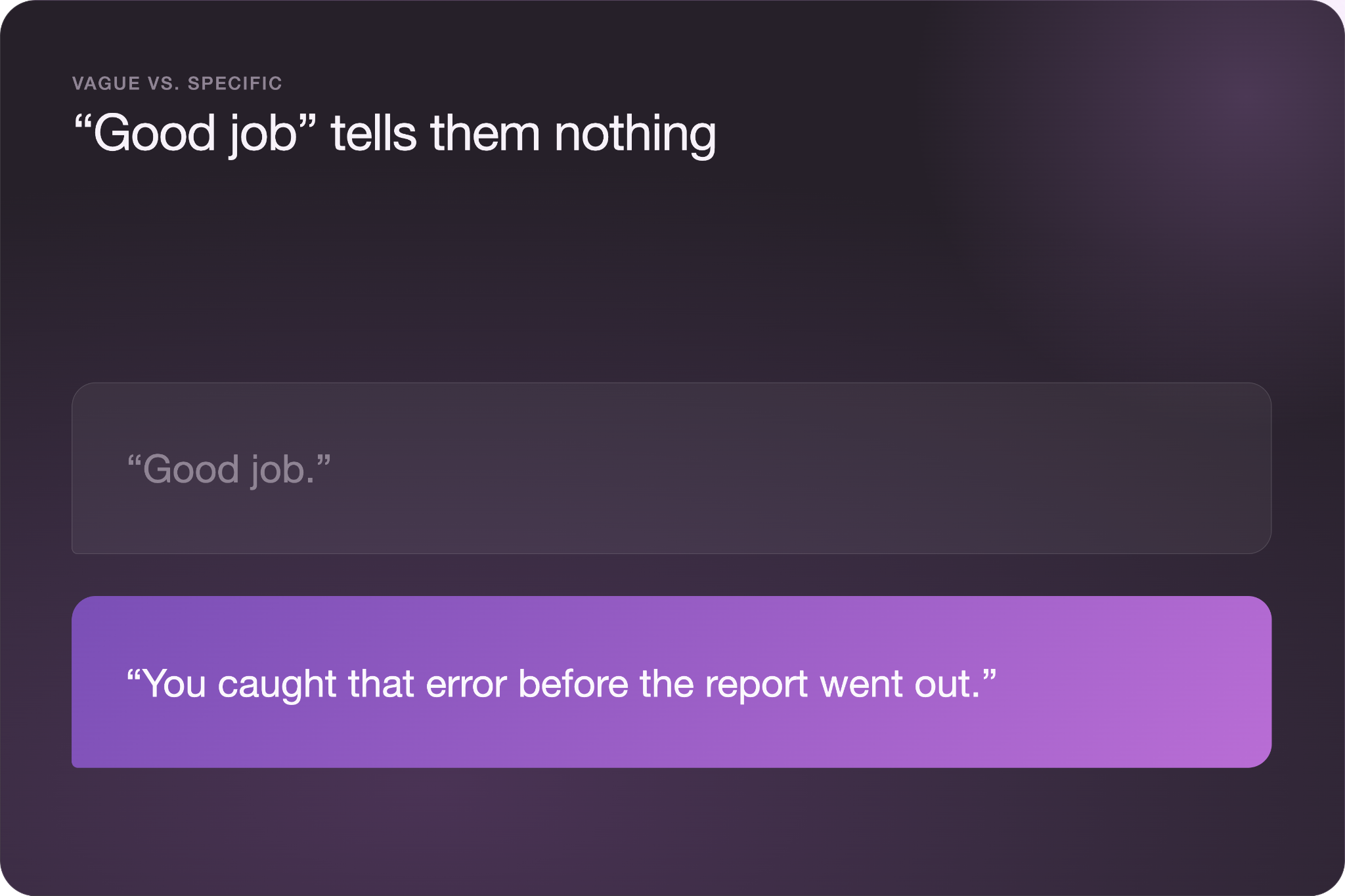
- It’s vague. “Good job” sounds nice, but it doesn’t tell a person what they did well or what they should keep doing. Same with “needs improvement,” it’s just not helpful.
- It’s late. Feedback about a project that happened six weeks ago has lost some of its context. The person may not even remember the situation that you are talking about.
- It’s one-sided. When feedback is delivered at someone instead of with them, it can feel like a harsh judgement instead of a chance to talk things through.
Fix those three things and you’ll be right on track.
27 employee feedback examples you can actually use
We have grouped these by situation so you can find an example that sounds like something you would actually say, not something pulled from a corporate training manual.
Positive feedback examples that actually registers
Positive feedback is easy to skip when everything is going smoothly. But specific praise helps people understand what to repeat, and it makes good work feel noticed.
- “The client specifically called out how well you handled their questions on the call yesterday. You stayed calm and clear, even when things got a little tense. That made a great impression.” — It points to a specific moment and explains impact.
- “You caught that error in the report before it went out. No one would have known if you hadn’t flagged it, and that kind of attention to detail saves the team from a lot of headaches.” — It recognizes the effort and work that could easily go unnoticed.
- “You have been the person everyone goes to when the CRM breaks. That’s a skill, and I want to make sure we recognize it, instead of just quietly relying on you.” — It turns an informal habit into something worth recognizing.
- “Your onboarding guide made it so much easier for new hires to get up to speed. That kind of process thinking is something we need more of” — It connects the person’s work to a meaningful outcome.
- “You stayed late to help Priya hit her deadline even though it wasn’t your project. That kind of teamwork makes a difference, and I really appreciate you stepping in.” — It reinforces collaboration without making it sound like working late is an expectation.
- “You took the harder assignment without being asked. I noticed, and I appreciate it.” — It’s short, specific, and shows that you are paying attention.
Constructive feedback examples that focus on growth
Constructive feedback is great when you address an issue before it becomes a pattern. The goal isn’t to catch someone doing something wrong. It’s to give them a chance to adjust.
- “In yesterday’s stand-up, you spoke over Marcus twice while he was giving his update. I want to make sure that everyone gets a chance to finish their thought before we jump in.” — It addresses a specific behavior rather than labeling the person as a poor listener.
- “The last two deliverables came in a day late without a heads-up. If something is blocking you, let me know earlier so we can figure it out together.” — It identifies the problem while giving the person a clear way to handle it next time.
- “Your reports have been thorough, but they are taking twice as long as expected. Let’s take a look at where the extra time is going and see if there’s anything we can streamline” — It opens the door to solving the problem instead of simply criticizing the person.
- “I’ve noticed that you are quieter in meetings than you were a few months ago. Is there anything making it harder for you to speak up?” — You’re noticing a change without assuming you know why it’s happening.
- “There were formatting errors in the last few client decks. Before we send the next one, let’s build in a quick proofreading step so we can catch those before they go out.” — It focuses on the behaviour and offers a practical solution.
- “It seems like you’re spending a lot of time responding to the loudest requests instead of the most important ones. Let’s talk through how we can prioritize when everything feels urgent.” — It turns a complaint into a coaching conversation.
- “When you challenge a decision in the group chat after it’s already been made, it can make things harder for the person who owns that. If you disagree, bring it to me directly so we can talk it through” — It explains the impact and gives the person a better alternative.
Peer-to-peer feedback examples
These can be awkward. They are the ones that don’t happen often unless there is a nudge, like a peer feedback form built into your review cycle.
- “Your slides made our presentation so much clearer. I’d love to use your approach for my next one” — It gives genuine recognition while opening the door to learn from a colleague.
- “When you jump in to answer questions directed to me during client calls, I sometimes feel like I’m losing ownership of the account. Could we sync beforehand so we know who’s handling what?” — It names how the behavior affects you without making it personal.
- I have noticed that you have been carrying more of the workload on this project than we agreed on. I want to make sure that we even that out.” — It addresses the imbalance directly without turning it into a blame game.
- “I noticed you gave me credit for the idea in front of leadership. That meant more to me than you probably realize.” — Not all useful feedback needs to involve something that went wrong.
- “Sometimes your Slack messages come across a little more abruptly than I think you mean them to. A quick ‘hey, just following up on this’ can change how the message comes across.” — It offers a specific adjustment instead of simply saying someone has a “bad tone.”
Manager-to-employee feedback examples that build trust
There is always a power dynamic when a manager gives feedback, which means employees may not always feel comfortable pushing back. One of the best ways to change that is for managers to show that feedback goes both ways.
- “I know I have been in meetings more than usual and I haven’t been available for quick questions. Has that made things harder for you?” —You’re showing that managers are not above feedback.
- “You’re ready to take on more ownership. Is there a project coming up that you would be interested in?” — It turns positive feedback into a growth opportunity.
- “I gave you unclear direction on the launch timeline, and that’s on me. Let’s rebuild the plan together so we’re working from the same information.” — accountability isn’t only going in one direction.
- “You’ve hit every deadline this quarter, but I sense you’re stretched pretty thin. Is there anything we can take off your plate?” — Strong performance doesn’t mean someone has unlimited capacity.
- “You mentioned in our last two 1:1s that you have been feeling stuck. I don’t want that to get brushed aside, so let’s talk about what’s getting in the way.” — It shows that you’re listening during the 1:1s instead of treating them like another calendar obligation.
Remote and hybrid team feedback examples
Remote work can make feedback harder because you lose a lot of the little moments that naturally happen in an office environment. That’s why a standing employee feedback and check-in survey has become more important for remote teams.
- “I’ve noticed that you’ve been keeping your camera off during the team calls. That’s completely fine if it works better for you, but I wanted to check in and see if there’s anything about the meetings that isn’t working for you.” — It avoids assuming why someone has their camera off.
- “Your updates in the shared doc have been so clear that people rarely need to follow-up with questions. That makes everyone’s job easier.” — It recognizes a behavior that can be easy to overlook because it happens asynchronously.
- “I’ve noticed that you’re online pretty late most nights. I just want to make sure that’s a choice and not something that you feel like you have to do to keep up.” — It opens a conversation about workload without accusing someone of working too much.
- “We haven’t had a real conversation about how remote work is going for you. Give me the honest version, not the polished status update.”— It allows the employee to talk about what’s actually working and what isn’t.
How to deliver employee feedback so it actually lands
Having the right words helps, but delivery is equally as important. You can have a perfectly written feedback statement and it can still miss the mark if you deliver it at the wrong time or in the wrong way.
Anchor it in specifics, not character
A simple way to achieve this is with the Situation-Behavior-Impact model.
Name the situation (“in yesterday’s client call”), then talk about the observable behavior (“you interrupted the client twice while they were explaining their budget”), and finally explain the impact (“I was worried it came across as dismissive”).
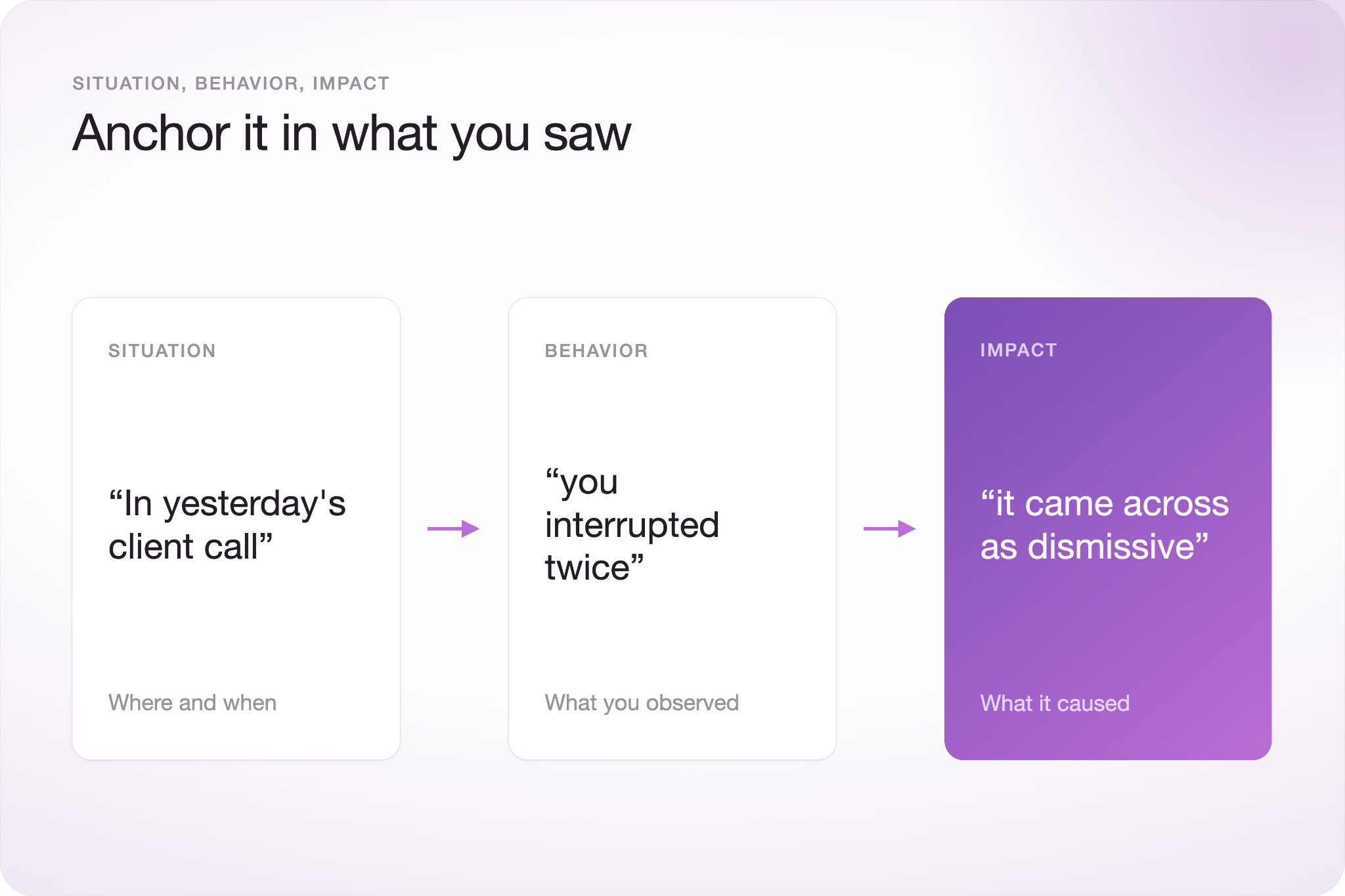
The important part is sticking to what you observed. Skip the labels or guessing sometimes intentions.
Give the feedback while it’s fresh
Something important shouldn’t wait until the next quarterly review. Sometimes a quick conversation after a meeting is enough. The closer you are to the situation, the easier it is for both parties to understand what happened.
Make it a conversation, not a memo
End the conversation with a real question. “How did that land for you?” or “What got in the way here?” This turns feedback into a two-way exchange as opposed to something that happens to someone else.
Skip the feedback sandwich
If the positive feedback is genuine, give it. If constructive feedback is necessary, give that as well.
You don’t need to wrap criticism in two compliments to make it easier for a person to swallow. People will catch on quickly, and they’ll start thinking, “Okay, what’s the bad news?”
Clear and honest is often kinder.
Ask before you assume
Most employee feedback examples work because there is plenty of room for the context you don’t currently have. For example, the late deliverable could have been blocked by someone else.
Close the loop
Feedback shouldn’t disappear once the second conversation ends.
After a few weeks, try something as easy as:
“Hey, I noticed that you’ve been jumping into more meetings with confidence, that shift is real.”
This followup shows that the conversation mattered and gives people a chance to see that feedback is about development, not just correction.
Match the setting to the message
Positive feedback usually lands better in public. A shout-out in a team channel or during a meeting can recognize someone while also showing the rest of the team what good work looks like.
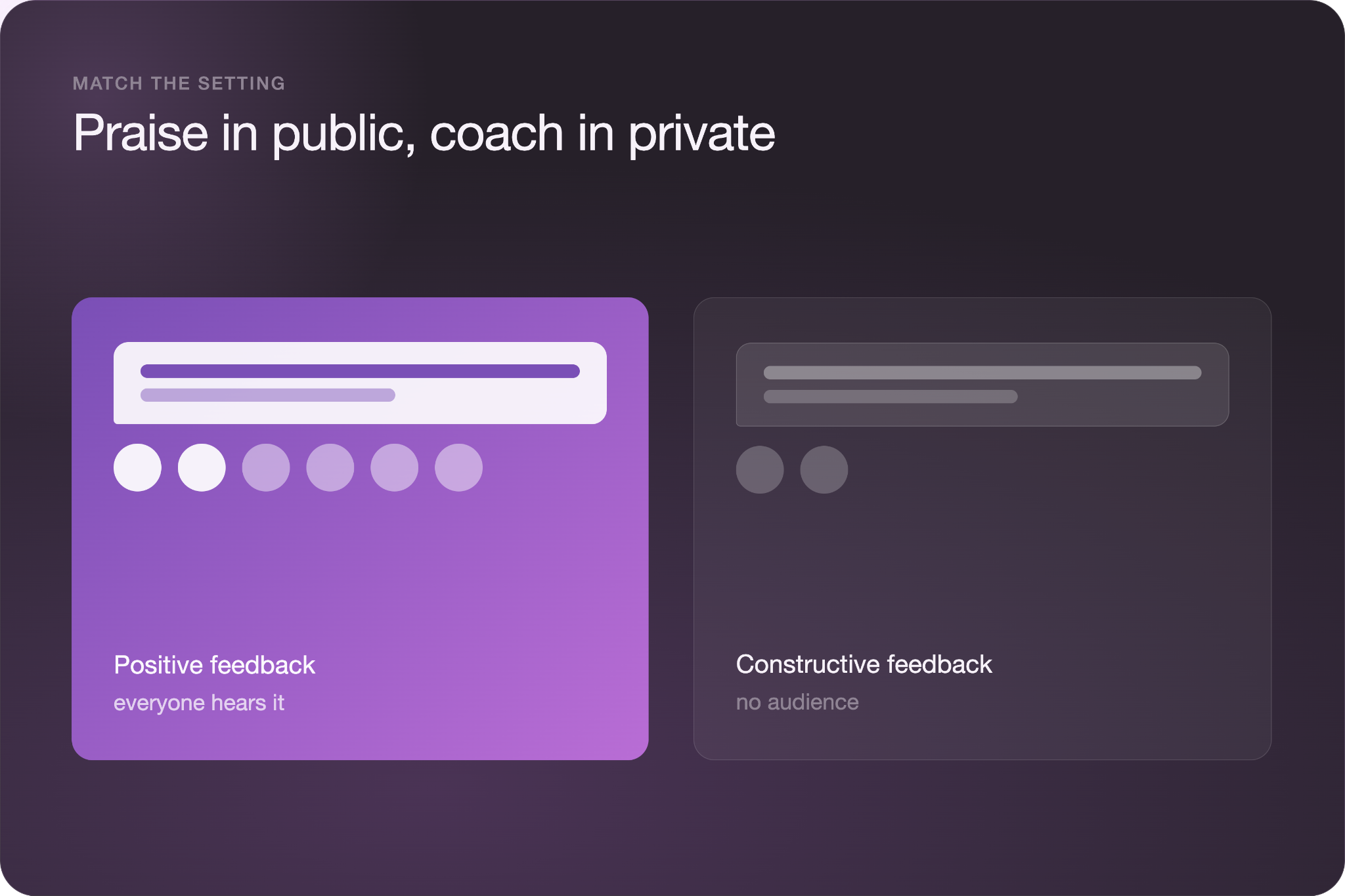
Constructive feedback is different. Unless there’s a good reason otherwise, it’s best to keep it private. People will respond honestly when they don’t have an audience.
Practice beats the perfect script
You don’t have to memorialize 27 employee feedback examples. The more often you give feedback, the less you’ll even need a script at all.
For more information on building better habits, Harvard Business Review has lots of practical management advice and tips. And if you want to see how feedback can become part of a company culture, Typeform has shared how its own team approaches feedback.
One more thing: not every piece of feedback needs to happen face-to-face.
A short, anonymous feedback form between 1:1s can surface the things employees might not feel comfortable saying directly to their manager. That’s one reason regular pulse surveys and feedback forms can be useful alongside regular conversations, not instead of.