Focus group questions: 40+ examples by topic
Browse 40 focus group questions organized by topic, from product testing to pricing and brand voice, so every session gets real, actionable answers.
Key takeaways
- Good questions are open, neutral, and single-focus. The most useful focus group questions invite explanation, avoid leading language, and ask about one idea at a time.
- Match questions to your research goal. Our guide organizes 40 examples across product testing, messaging, pricing, customer experience, audience insights, competition, and brand voice.
- Less is more per session. Pick 5-8 questions, start broad and go narrow, and leave room for follow-ups. The real insight usually lives in the "why" behind the first answer.
- Facilitation matters as much as the questions. Stay neutral, let silences exist, watch non-verbal cues, and record sessions (with permission) so nothing gets lost.
Focus groups bring real people into a room (or video call) to talk about your product, service, or idea. What makes them valuable isn't just what people say, but why they hold those beliefs or opinions. The right questions reveal honest thoughts, pain points, and motivations you'd never find in a yes-or-no survey.
But asking the wrong questions wastes everyone's time. Bad questions lead to short answers, groupthink, or responses that don't actually tell you anything useful.
This guide gives you 40 focus group questions organized by topic, so you can pick the ones that fit your research goals. Whether you're testing a new product, refining messaging, or understanding your audience better, these examples show you how to ask questions that get real, actionable answers.
What makes a good focus group question
Before we get into the examples, let's cover what separates a useful question from a dead end.
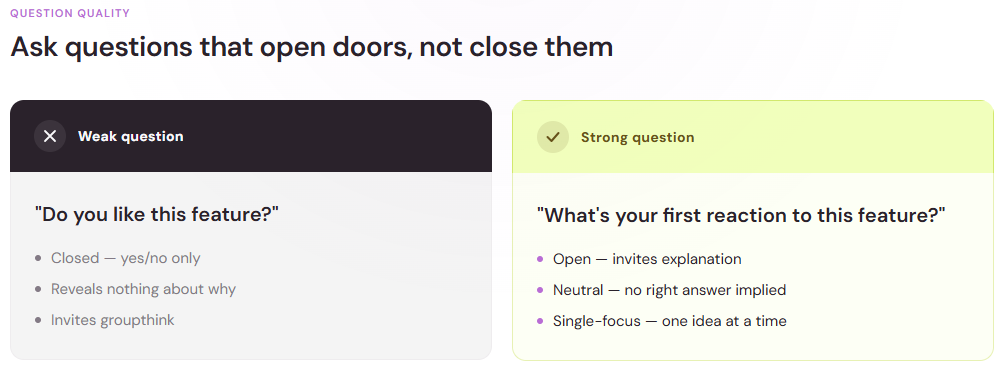
Open-ended, not closed. Good focus group questions invite people to explain their thinking. "What do you think about this design?" beats "Do you like this design?" because the first one lets people tell you what's actually on their mind. The second one just gets a yes or no.
Neutral tone. Avoid leading questions that hint at the answer you want. "Isn't this feature amazing?" steers the conversation. "What's your first reaction to this feature?" lets people form their own opinion.
One idea at a time. Double-barreled questions ask about two things in one breath, which confuses respondents and makes it impossible to know which part they're answering. Split them apart instead.
Specific enough to guide the conversation, broad enough to allow real answers. "Tell me about your morning routine" is too vague. "Walk me through how you choose what to wear in the morning" gives people a clear frame without boxing them in.

Product and feature testing (eight questions)
Use these when you're evaluating a new product, feature, or design before launch.
- What's your first impression of this? (Hold back any explanation. Watch their instinctive reaction.)
- Walk me through what you see here. What stands out to you? (Listen for what they notice first. That tells you about hierarchy and clarity.)
- What would you use this for? (Reveals whether people understand the purpose the way you intended.)
- What's missing or what would make this better? (Direct path to improvement ideas.)
- How would this fit into your current workflow? (Tests whether it solves a real problem in a realistic context.)
- What concerns do you have about using this? (Will get at the friction points people might not volunteer unprompted.)
- Compare this to solutions you currently use. How is it different? (Positions your product against actual alternatives people know.)
- Who in your life or work would benefit most from this? (Helps you understand secondary audiences and use cases you might've missed.)
Messaging and positioning (six questions)
Test whether your value proposition and brand messaging actually land with your audience.
- What problem do you think this solves? (Check if your messaging conveys the core value.)
- In one sentence, how would you describe this to a friend? (Reveals what sticks. If people can't summarize it simply, your messaging may be unclear.)
- What kind of person or company do you think this is made for? (Exposes whether you're reaching the right audience perception.)
- Does this feel trustworthy to you? Why or why not? (Taps into credibility signals, or the lack of them.)
- What emotion does this brand or message evoke? (Tells you if your tone and visuals are landing as intended.)
- What would make you feel more confident about trying this? (Surface real barriers to adoption.)
Pricing and willingness to pay (five questions)
These questions help you understand price sensitivity and perceived value.
- What price would feel fair for this? (An open-ended pricing question that often yields more honest answers than price-anchoring techniques.)
- At what price would you consider this a bargain? (Tests the low end of acceptable pricing.)
- At what price would you think it's too expensive? (Finds the ceiling.)
- How would you feel about a subscription model versus a one-time purchase? (Gauges preference for payment structure.)
- What features or guarantees would justify a higher price to you? (Links value perception to specific attributes.)
Customer experience and satisfaction (six questions)
Dig into what drives loyalty, frustration, and repeat use.
- Tell me about a time you had a really good experience with a company like ours. (Sets a benchmark. What exceeded their expectations?)
- What's the most frustrating part of using products in this category? (Gets at pain points competitors might be ignoring.)
- If you could change one thing about your current solution, what would it be? (Prioritizes improvements by importance to actual users.)
- How would you describe your experience to someone who's never used something like this? (Reveals emotional drivers and memorable moments.)
- What would make you stop using a product like this? (Identifies dealbreakers and churn risks.)
- How likely are you to recommend this, and what would make you more likely? (Combines sentiment with actionable improvement levers.)
Audience and persona insights (six questions)
Build a deeper understanding of who your users are, what they value, and how they think.
- Walk me through a typical day. Where does this fit in? (Context reveals how people actually live and interact with your category.)
- What are your top three priorities right now in your work (or life)? (Helps you understand what competes for their attention and budget.)
- What sources do you trust when making a decision like this? (Shows where they look for information and who influences them.)
- Tell me about the last time you switched from one brand or product to another. What made you do it? (Real-world examples of decision-making drivers.)
- What frustrates you most about tools or services in this space? (Uncovers systemic problems across the category.)
- If you had an unlimited budget, how would your approach change? (Reveals wants versus needs, and what money removes as a blocker.)
Competitive landscape (five questions)
Understand how your product stacks up against what people actually use.
- What are you currently using to solve this problem? (Identifies real alternatives rather than presumed competitors.)
- What do you like most about what you're currently using? (Reveals table-stakes features and emotional drivers.)
- What would make you switch to something else? (High-value competitive intelligence.)
- How is [competitor or alternative] different from what we're showing you? (Helps you sharpen positioning.)
- If all options were the same price, which would you choose and why? (Removes price as a variable; reveals pure preference.)
Messaging tone and brand voice (four questions)
Test whether your words, voice, and personality align with how your audience wants to hear from you.
- Which of these two messages resonates more with you? (A/B test copy, tone, or framing.)
- Describe the personality or voice you'd expect from a company like this. (Alignment check on tone.)
- Would you want to hear from this brand via email? Social? In-person? Why? (Channel preference tied to brand perception.)
- What would turn you off about a brand in this space? (Avoid-at-all-costs messaging territory.)
How to run a focus group with these questions
Pick five to eight questions per session. Don't cram all 40 in. Too many questions exhaust participants and dilute the depth of each answer. By being selective about which focus group questions you choose, you protect the quality of your discussion and give each topic room to breathe.
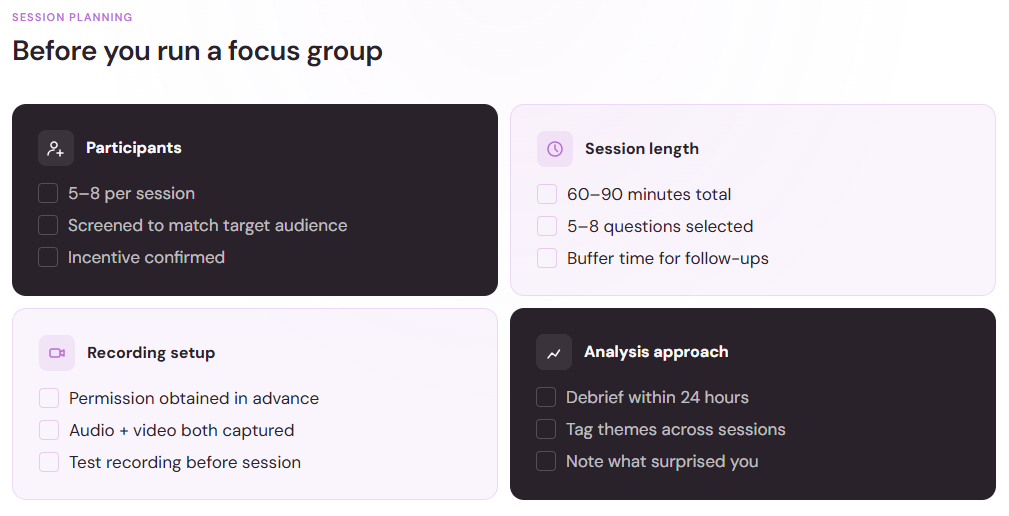
Start broad, go narrow. Begin with open-ended reactions, then zoom in on specific details as the conversation builds. This approach works because people warm up to deeper thinking once they've shared initial impressions.
Listen for the why. When someone gives you an answer, follow up. "Tell me more about that," or "What do you mean by that?" often unlocks the real insight buried in a first response. The most valuable data frequently emerges from these natural conversational probes rather than from the prepared questions alone.
Watch non-verbal cues. In in-person or video focus groups, confusion, frustration, and excitement show up in body language before (or instead of) words. Note when people hesitate, light up, or seem uncomfortable. These signals often reveal what people are hesitant to say aloud.
Stay neutral. Don't signal approval or disapproval. Your job is to learn what people think, not convince them to think what you want. Neutrality builds trust and encourages candid responses.
Let silences linger. People need a moment to think. Resist the urge to fill every gap with the next question. A few seconds of quiet often leads to more thoughtful, genuine answers than rushing into the next set of focus group questions.
Record the session (with permission). Notes alone miss tone, hesitation, and the exact words people use. A recording lets you stay present in the conversation instead of scribbling, and you can revisit the details later. Asking permission up front also builds trust with participants.
Picking the right questions for your research goal
Different research goals call for different question sets. Here's how to think about it:
- Are you testing a new product or feature? Pull from product testing and customer experience sections. These will give you concrete feedback on usability and appeal.
- Is messaging your priority? Focus on messaging and positioning, plus brand voice. This combination reveals how clearly your value lands with your audience.
- Are you struggling with pricing? Combine pricing questions with value perception questions from the audience insights section. Together, they show what people believe your offering is worth.
- Do you want to understand your audience better? Start with persona and context questions. They often reveal opportunities you hadn't considered. Deep audience understanding frequently uncovers unmet needs that competitors have overlooked.
The best focus groups feel like conversations—not interrogations—where someone genuinely wants to understand your point of view. Use these 40 questions as a starting point, then customize them based on what you're actually trying to learn.
Final thoughts
A good focus group question opens doors. It respects people's time and intelligence, inviting them to give real answers, not the ones you're hoping to hear.
The questions above are tested tactics that work. Adapt them to your industry, your product, and your specific research goal. Test a few with a pilot group before you run your main session. And always remember: the best insights often come not from the question itself, but from the follow-up—from listening closer when someone says something unexpected.
One more habit worth building: after each session, spend ten minutes writing down what surprised you. Those quick reflections, captured while the conversation is fresh, often shape your next round of questions more than the formal analysis does.