Market segmentation: types, examples, and frameworks
Market segmentation divides customers into actionable groups. Compare behavioral, demographic, psychographic, and value-based approaches to improve conversions.

Key Takeaways
- Segment based on the decision you're trying to make: Pricing and packaging call for value-based or needs-based segmentation, retention campaigns call for behavioral and RFM (recency, frequency, and monetary value) data, and new features call for psychographic or jobs-to-be-done research.
- Behavioral and psychographic data predict more than demographics alone: Two people in the same age bracket can want completely different things, so what customers do and why they buy matters more than who they are on paper.
- Fewer, well-used segments beat many forgotten ones: Start with three to five segments your team will actually act on, then add more only as resources allow.
- Segmentation only works if you validate and revisit it: Test your assumptions against real customer behavior, and review segments annually since customer needs and markets shift.
Market segmentation divides your audience into smaller, more manageable groups based on shared characteristics, whether behavioral, demographic, or motivational. You can then tailor messaging, products, and pricing to match what each group needs.
This matters because one-size-fits-all marketing rarely works. A 25-year-old entrepreneur has different needs than a 55-year-old executive, even if buying the same software. By segmenting, you speak directly to each group's pain points and preferences, which means higher conversion rates, better retention, and smarter spending.
Rather than casting a wide net, segmentation lets you fish with precision. Companies that segment effectively report conversion rate improvements of 20% to 30% compared to those using generic campaigns. They also see better customer fit, meaning customers acquired for the right reasons stay longer and generate more revenue over their lifetime.
What is market segmentation?
Market segmentation divides your target market into distinct subgroups, each with its own characteristics, needs, or behaviors. It's the bridge between understanding your overall market and understanding the specific people within it.
Without segmentation, you might create a feature that delights power users but confuses beginners, or spend marketing budget reaching people who will never buy. Segmentation forces you to ask: Who exactly am I talking to? Once you answer that, you can customize everything: your value proposition, tone, feature roadmap, pricing model, and customer support approach.
Organizations that skip segmentation often find themselves competing primarily on price, eroding margins and making sustainable growth difficult. When you understand your customers at a granular level, you communicate with authenticity and specificity, building trust rather than broadcasting impersonal messages. A poorly targeted campaign might acquire customers with low lifetime value, making the entire effort unprofitable. Segmentation helps you identify high-value customers early, allowing you to invest more heavily in their acquisition and retention.
The fundamental principle underlying effective segmentation is that customers are not monolithic. Even within the same industry or geography, different customer groups have distinct pain points, buying behaviors, and success criteria. By recognizing these differences and building your marketing and product strategy around them, you create relevance. This translates directly to business outcomes: higher engagement, better conversion rates, improved customer satisfaction, and stronger competitive positioning.
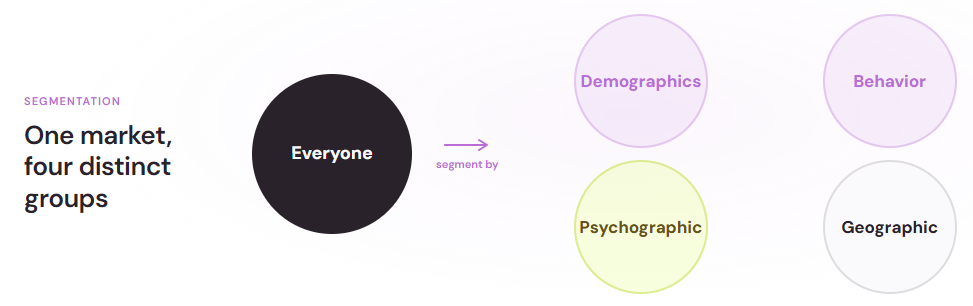
Four main types of market segmentation
Most segmentation strategies fall into one of four buckets. Successful companies often use multiple types at once, layering them for clearer customer understanding.
Demographic segmentation
You divide your market by objective, measurable characteristics: age, gender, income, education level, family status, location, or company size.
Example: A fitness app might segment by age (18–25, 26–35, 36–50, 50+) because workout preferences differ across these groups. A 22-year-old wants intense HIIT training; a 55-year-old wants mobility work focused on long-term health.
Demographic segmentation is easy to execute because the data is public and straightforward. Census data, social media analytics, and surveys readily provide this information. However, two people in the same demographic can want completely different things. This limitation means demographic segmentation works best combined with other approaches.
Beyond basic age and gender, demographic segmentation can incorporate household income, education attainment, and family status. These variables often correlate with different purchasing power and life stage priorities. A college student has different discretionary income and time availability than a mid-career professional. The advantage of demographic segmentation is its accessibility. You can purchase demographic data from third-party providers, extract it from your own customer database, or gather it through surveys.
Behavioral segmentation
You segment based on how people act: purchase history, frequency of use, loyalty, or engagement level.
Example: An e-commerce retailer might segment customers into "frequent buyers," "seasonal shoppers," and "one-time purchasers." Frequent buyers get exclusive early access to sales and loyalty rewards. Seasonal shoppers get targeted reminders around major shopping seasons. One-time purchasers get a "we miss you" discount to encourage a second purchase.
Behavioral segmentation is powerful because it predicts future action. Someone who buys monthly is more likely to keep buying monthly than someone who hasn't purchased in two years. Customers using advanced features show higher retention and lifetime value, so they deserve different onboarding, support, and feature development priorities.
This segmentation type captures the actual patterns of how customers interact with your business. Are they power users who depend on your product daily, or occasional users who return only seasonally? Have they expanded their usage over time, or plateaued? These behavioral patterns reveal motivation, satisfaction, and future value more accurately than demographics alone. Behavioral data also helps you identify churn risk early; when a previously active customer's engagement drops below historical patterns, it's a warning sign that intervention might prevent them from leaving entirely.
Psychographic segmentation
This digs into mindset: values, lifestyle, personality, attitudes, and interests.
Example: A luxury car manufacturer might segment by lifestyle. One segment values performance and speed, seeing their car as an expression of ambition. Another values sustainability and community impact. A third values status and exclusivity. The same car gets marketed completely differently to each group: one emphasizes acceleration, another highlights emissions and sustainability, and the third emphasizes limited production and heritage.
Psychographic segmentation requires deeper research—surveys, interviews, focus groups—but yields the most valuable insights. People buy based on identity and values, not just demographics. Understanding these motivations helps you communicate authentically to each segment and reveals which features matter most to each group.
This form of segmentation goes beyond who customers are to explore why they make the choices they do. What are their underlying values and worldview? Are they early adopters excited by innovation, or pragmatists who prefer proven solutions? Someone might choose a premium product because they value quality and craftsmanship, while another chooses the same product because they want visible status. The product is identical, but the messaging that resonates differs completely. Psychographic segmentation helps you understand these deeper motivations, allowing you to craft messaging that speaks to identity and values rather than just functional benefits.
Geographic segmentation
You segment by location: country, region, city, or urban versus rural. Geographic differences often correlate with different needs, preferences, and purchasing power.
Example: A restaurant chain opening in five countries would segment by geography. Marketing in the UK might emphasize affordability and quick service. Marketing in Japan might emphasize quality and craftsmanship. Marketing in Brazil might emphasize vibrant social atmosphere. The same restaurant succeeds in each location by emphasizing benefits relevant to local culture and values.
Geographic segmentation acknowledges that location profoundly influences customer needs and preferences. Climate differences mean a product that sells well in cold climates might need repositioning in warm ones. Cultural differences affect how people prefer to interact with businesses: communication style, decision-making speed, and relationship-building expectations all vary by region. Economic development also matters. A product positioned as luxury in one country might need to be repositioned as value in another.
Hybrid and advanced segmentation
Most mature marketing organizations combine multiple segmentation types to create richer, more actionable profiles.
Firmographic segmentation
For B2B companies, you segment by company characteristics: industry, company size, revenue, growth stage, or technology stack.
Example: A project management software might segment by company size (startup, mid-market, enterprise). Startups need simplicity and low cost. Mid-market companies need scalability and customization. Enterprises need security, integrations, advanced permissions, and dedicated support.
A startup founder might trial the product and decide within days. A VP of Operations at a large corporation might need security audits, executive sign-offs, and multi-month procurement processes. Industry vertical is another crucial dimension: healthcare companies have different compliance requirements than retail companies. By segmenting on these firmographic dimensions, B2B companies can tailor their entire go-to-market strategy, from which pain points they highlight, to pricing models, to sales cycle length, to support structure.
Needs-based segmentation
You segment by the specific problems customers are trying to solve, regardless of who they are.
Example: A productivity software might identify three segments: "people trying to save time," "people trying to collaborate better," and "people trying to stay organized." The same feature—templates—gets positioned differently for each group. For the time-saving segment, templates cut setup time in half. For the collaboration segment, templates ensure team consistency. For the organization segment, templates create structure and prevent chaos.
Needs-based segmentation often reveals the most powerful insights because it gets directly at why customers consider your product in the first place. Two customers of completely different demographics, industries, and geographies might be trying to solve the same underlying problem. By identifying and segmenting on these common underlying needs, you can speak directly to what matters most to each group.
Value-based segmentation
This segments by customer lifetime value: how much revenue each customer generates or will likely generate.
Example: A SaaS company might segment into high-value, mid-value, and low-value customers. High-value customers get dedicated account managers. Mid-value customers get tiered support with faster response times. Low-value customers get self-service resources and community support.
Value-based segmentation forces you to acknowledge that not all customers are equally important to your business's sustainability. Identifying which customer types become high-value allows you to acquire more like them. Understanding which segments are most valuable also influences your product roadmap. Features that matter to high-value segments might deserve priority over features needed only by low-value segments.

Segmentation frameworks you can use
The RFM framework
RFM stands for Recency, Frequency, and Monetary. It's a behavioral segmentation approach that works especially well for e-commerce and subscription businesses.
- Recency – when was the last purchase?
- Frequency – how often do they buy?
- Monetary – how much do they spend?
You score customers on each dimension and create segments. This data is easy to extract from transaction records and directly predicts future behavior. Identifying customers with high monetary but low recency helps you catch valuable customers who might be slipping away before it's too late. RFM is particularly attractive because you need only transaction data—no surveys or guesswork required.
The jobs-to-be-done framework
Instead of segmenting by who people are, you segment by what they're trying to accomplish.
Example: A kitchen appliance manufacturer might discover three jobs: "meal prep for the week," "cook restaurant-quality dinners," and "clean up fast." Customers pursuing meal prep value large capacity and durability. Those pursuing restaurant-quality cooking value precision and advanced features. Those focused on speed value simplicity and quick cleanup.
Understanding the jobs each segment is pursuing prevents you from building features no one wants while missing features customers desperately need. The jobs-to-be-done framework shifts perspective from "what are our customers like?" to "what are our customers trying to accomplish in their lives?" A parent buying a car might be trying to accomplish "keep my family safe," while a young professional buying the same car model might be trying to accomplish "project success and ambition to peers." The product is the same, but the jobs are different, requiring different marketing emphasis.
The personas framework
You create detailed profiles representing each segment. Each persona gets a name, background story, goals, pain points, and decision-making criteria.
Example: "Enterprise Evan" is a 45-year-old VP of Operations needing tools that integrate with legacy systems and come with white-glove support. "Startup Sarah" is a 28-year-old founder needing low-cost, flexible tools she can set up quickly without extensive training.
Personas keep your entire organization aligned. Good personas include not just demographic details but also psychographic elements: what keeps them up at night, what success looks like to them. Teams should update personas annually as your customer base evolves. The best personas are grounded in real customer interviews and data, not imagination. Interview actual customers representing each segment and let their real words and concerns shape the persona.
The data-driven approach
Modern segmentation increasingly relies on data. You might use clustering algorithms to identify natural groupings in your customer data, or rely on surveys to enrich your understanding.
Nearly 90% of marketers are shifting personalization tactics toward first- and zero-party data, meaning information customers willingly share with you. First-party data comes from your direct interactions with customers. Zero-party data is information customers actively provide like stated preferences, goals, and feedback.
Around 47% of researchers worldwide now use AI regularly in market research activities. AI-assisted analysis helps you spot patterns in customer data faster than manual methods. Advanced techniques like cohort analysis, clustering algorithms, and predictive modeling can reveal natural segments that might not be obvious from manual observation. This data-driven approach removes guesswork and bias, allowing segments to emerge from actual customer behavior rather than assumptions.

How to choose a segmentation approach
Start by asking: What decision am I trying to make?
- If you're deciding how to price or package your offering, value-based or needs-based segmentation serves you best
- If you're building a new product feature, psychographic and jobs-to-be-done segmentation reveal what matters most
- If you're planning a retention campaign, behavioral and RFM segmentation show who's at risk
- If you're launching in a new geography, geographic segmentation is obvious, but don't stop there
- If you're a B2B company, firmographic segmentation helps you identify which company profiles to target
Most teams use a mix. You might start with demographic and firmographic segmentation (easy to collect), layer on behavioral data (predictive patterns), then enrich with psychographic research (underlying motivations). The goal is to choose a segmentation framework that helps you make better decisions about how to serve your customers, even if it’s not the “perfect” approach.
Common segmentation mistakes to avoid
Segmenting without a purpose
You segment because you need to make a decision. Without a clear reason, you're creating busywork. If you're not going to change something—messaging, features, pricing, or support—based on a segment, why segment? Before investing in segmentation work, identify the specific business decision or strategic question the segmentation will address.
Creating too many segments
Five segments you actually use beats 15 you forget about. Complexity kills execution. Start with three to five segments and add more only if you have resources to act on them. When segments become too numerous, they overwhelm the organization. Sales teams can't remember which approach to take for each segment. Marketing loses focus across too many messaging variations.
Ignoring segment size
A segment of 50 customers might have rich insights, but if it's too small to build a sustainable business around, pursuing it might distract from larger opportunities. A micro-segment with unique needs might not justify building a separate product version or marketing campaign. However, this doesn't mean ignoring small segments entirely. Sometimes, a small segment with high willingness to pay or strong growth potential deserves attention despite its current size.
Forgetting to validate
Your segmentation hypothesis isn’t worth much until it’s tested. Survey, interview, and watch how customers use your product. Let reality reshape your segments. Many teams build elaborate segments based on assumptions and discover that real behavior differs significantly. Validation often reveals that assumptions you thought were obvious are actually wrong. The only way to know if your segmentation strategy is working is to test it. Expose different segments to different messaging or products and measure whether they respond as expected.
Assuming segments are static
People change. Review and refresh your segmentation annually. New competitors, technology changes, and market conditions all affect what matters to customers. An annual review cycle ensures your segmentation stays relevant and actionable.
Putting segmentation into practice
Once you've identified your segments, operationalize the strategy. This means different messaging, products, pricing, or support for different groups.
Start with marketing and messaging. Craft different messages for each segment, tailoring language and benefits to what each group cares about. A message for "time-strapped entrepreneurs" emphasizes speed. A message for "meticulous perfectionists" emphasizes control. Same product, completely different value proposition.
Product development benefits from clear segmentation. Rather than building features for everyone, prioritize features that specific high-value segments need. You might create product variants, such as a basic version for price-sensitive segments and an advanced version for segments willing to pay for complexity. However, variants also create complexity, as each version needs ongoing maintenance and support.
Sales and customer support can leverage segmentation, too. Sales teams can tailor their pitch using language and examples relevant to each prospect type. Support teams can design documentation differently for different segments. A basic user needs step-by-step guidance; an advanced user needs technical reference documentation.
This requires discipline and clear communication across teams. Document your segmentation in a shared wiki, sales playbook, or messaging guide so everyone works from the same understanding. Create easy-to-remember segment names that teams will actually use in conversation. Share customer stories and quotes that illustrate each segment's perspective and needs.
The best segmentation strategies are living documents. Gather data, learn, and refine your segments continuously. When you understand not just who your customers are but why they chose you and what they're trying to achieve, segmentation becomes the foundation of everything you build.

Liked that? Check these out:

Opinions and Expertise
What’s actually slowing research teams down (Hint: it’s not the research)
From recruiting participants and scheduling interviews to building the actual surveys, the operational drag is taking researchers away from what they do best. See what's actually slowing them down and how Research Flow fixes it.
Read more