Survey questions to ask: 50 worth asking (and why)
50 ready-to-use survey questions by category, from customer satisfaction to pricing, plus writing principles that reduce bias and improve response quality.

A good survey question gets honest, usable answers. A bad one confuses people, invites bias, or wastes time. Respondents are already giving you their attention—every question should earn it.
This guide covers 50 survey questions organized by purpose, plus the principles that make any survey question work. Whether you’re gathering customer feedback, conducting research, or running internal polls, you’ll find templates here to adapt.
Why survey questions matter
Online surveys are the most used quantitative method among market research professionals, with 85% using them regularly (Backlinko, 2026). The format works, but execution varies. The difference between a thoughtfully written question and a sloppy one is the difference between insight and noise.
With that in mind, let’s take a look at 50 thoughtfully written survey questions organized by purpose.
Customer satisfaction and loyalty
- “I would recommend this product to a colleague or friend.”
- “How likely are you to purchase from us again?”
- “Our customer service team resolved my issue satisfactorily.”
- “The value of this product matches the price I paid.”
- “This product solved a real problem for me.”
- “I feel like a valued customer.”
- “Our company stands out from competitors.”
- “I trust this brand.”
- “After using this product, I feel more capable in my role.”
- “The product quality is consistent with what was promised.”
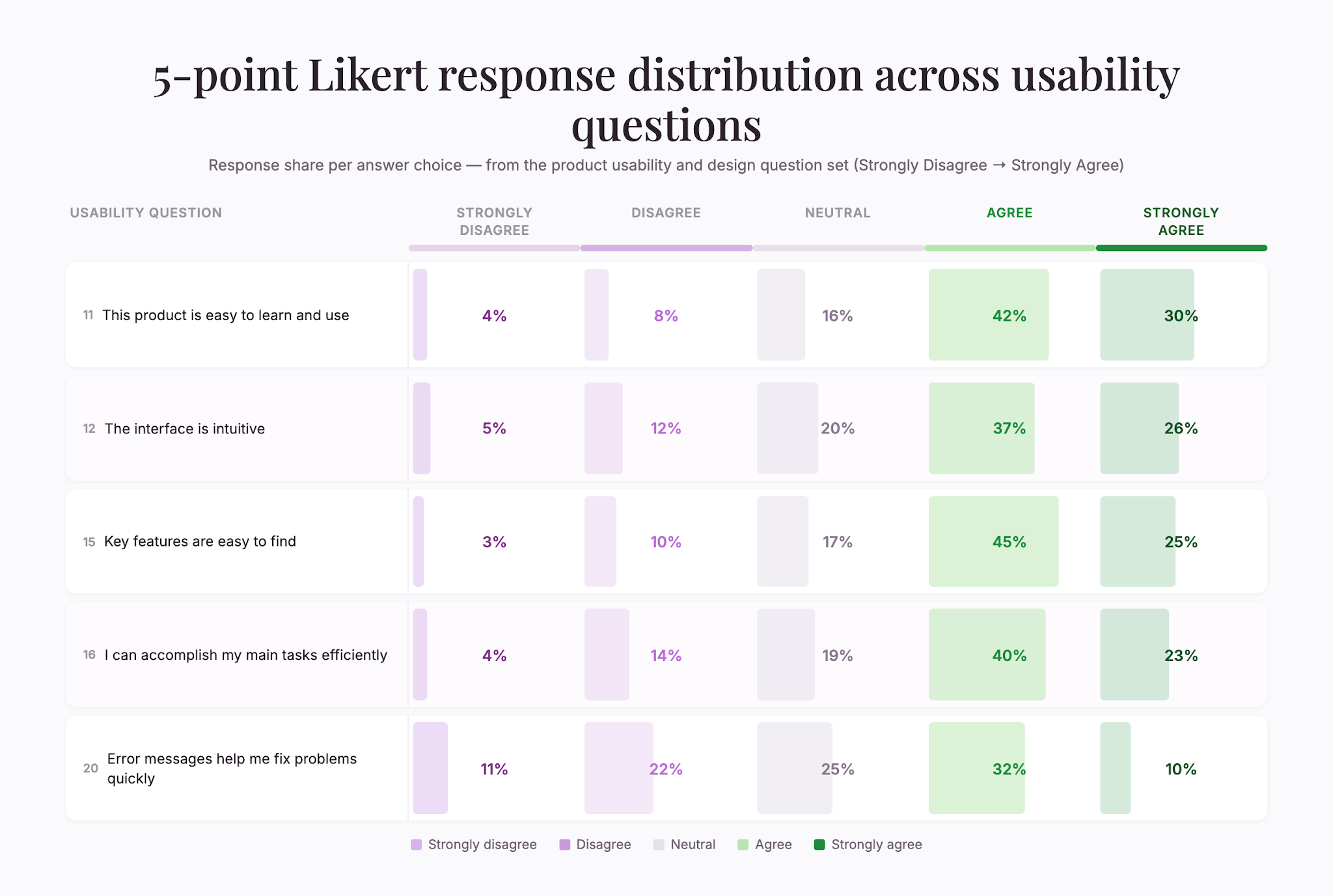
Product usability and design
- “This product is easy to learn and use.”
- “The interface is intuitive.”
- “I rarely feel lost or confused when using this product.”
- “The design is clean and uncluttered.”
- “Key features are easy to find.”
- “I can accomplish my main tasks efficiently.”
- “The product works smoothly without lag or crashes.”
- “Mobile and desktop experiences are equally usable.”
- “I understand what each feature does.”
- “Error messages help me fix problems quickly.”
Feature relevance and gaps
- “Which features do you use most? (Select all that apply)”
- “There are features I’d like to see added.”
- “The current feature set meets my needs.”
- “What feature would most improve your workflow?”
- “Are there integrations or tools you wish we connected with?”
- “This product covers more of my use case than competitors.”
- “Advanced features are accessible without overwhelming beginners.”
- “I understand why each feature exists and how it benefits me.”
Onboarding and initial experience
- “The sign-up process was straightforward.”
- “I understood what this product does within the first visit.”
- “The onboarding process was helpful.”
- “I felt confident using the product after initial setup.”
- “I knew where to go for help when I got stuck.”
- “I experienced technical issues during initial use.”
- “The product’s purpose and main features were clear immediately.”
Performance and reliability
- “This product is reliable and rarely crashes.”
- “Loading times are acceptable.”
- “The product performs well on my device and internet speed.”
- “I can trust this product with important data or tasks.”
- “Uptime and availability meet my needs.”
Support and resources
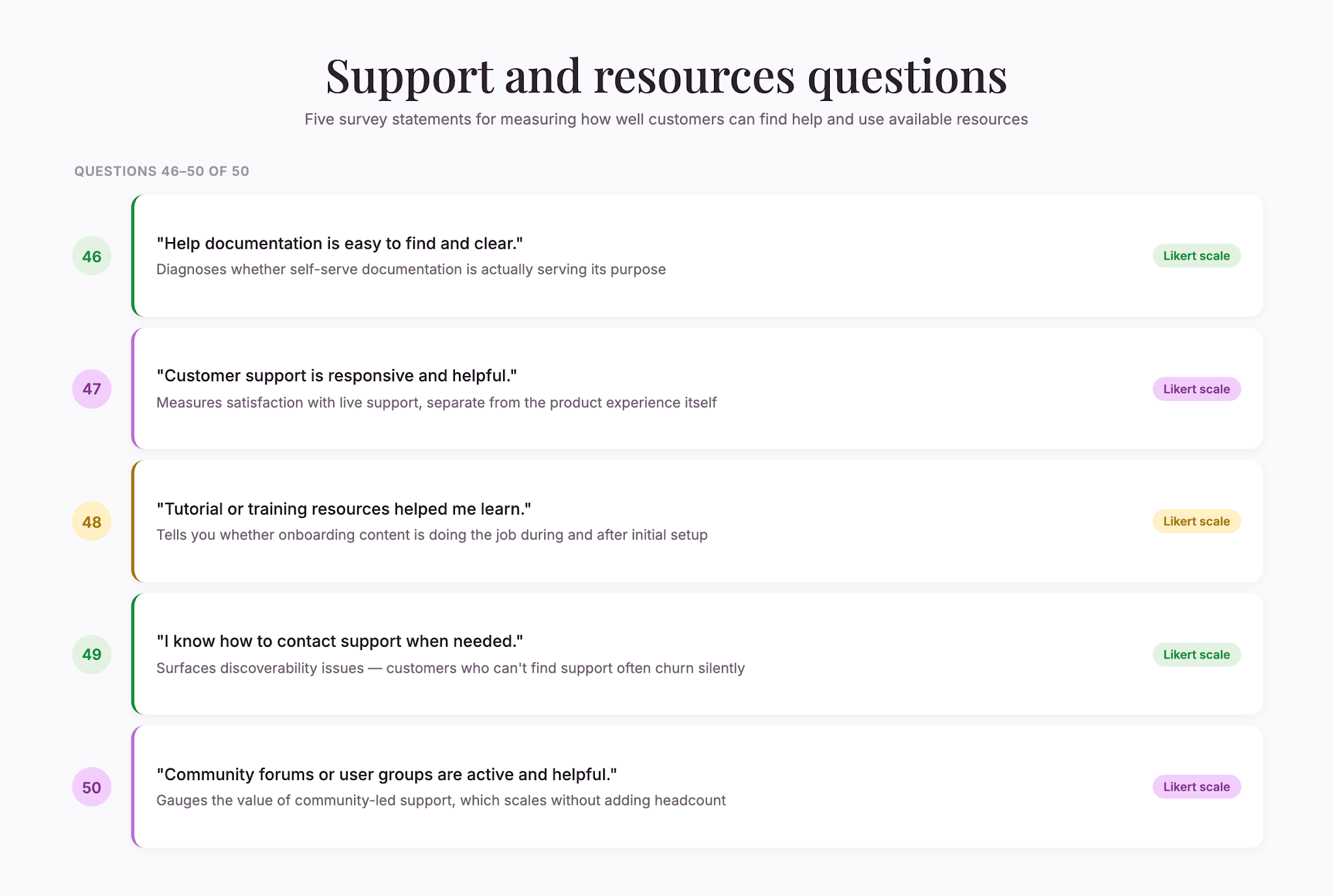
- “Help documentation is easy to find and clear.”
- “Customer support is responsive and helpful.”
- “Tutorial or training resources helped me learn.”
- “I know how to contact support when needed.”
- “Community forums or user groups are active and helpful.”
Price and value perception
- “The price is fair for the value provided.”
- “I’d be willing to pay more for additional features.”
- “Pricing is transparent with no hidden fees.”
- “I understand what I’m paying for.”
- “Compared to alternatives, this pricing is competitive.”
Foundational principles for good survey questions
Be specific. “Is this good?” is vague. “This product is easy to use” is measurable.
Avoid leading language. “Wouldn’t you agree this is the best solution?” pushes toward agreement. “This solution meets my needs” lets people answer honestly.
Use consistent scales. If you use Likert, keep “Strongly Disagree to Strongly Agree” across all items. Switching scales confuses respondents.
Keep it concise. One idea per question. Surveys with 1–3 questions are completed by 83.34% of respondents (SurveySparrow Survey Response Rate Benchmarks, 2025); longer surveys see a steeper drop-off.
Watch for biases. Acquiescence bias (agreeing regardless of content) and social desirability bias (overreporting good behavior on sensitive topics) are common (Qualtrics, 2025). Neutral wording and anonymous responses help.
Understand framing. People avoid risk when options are positively framed but seek risk when negatively framed (Frontiers in Psychology, 2020). Word and order options carefully.
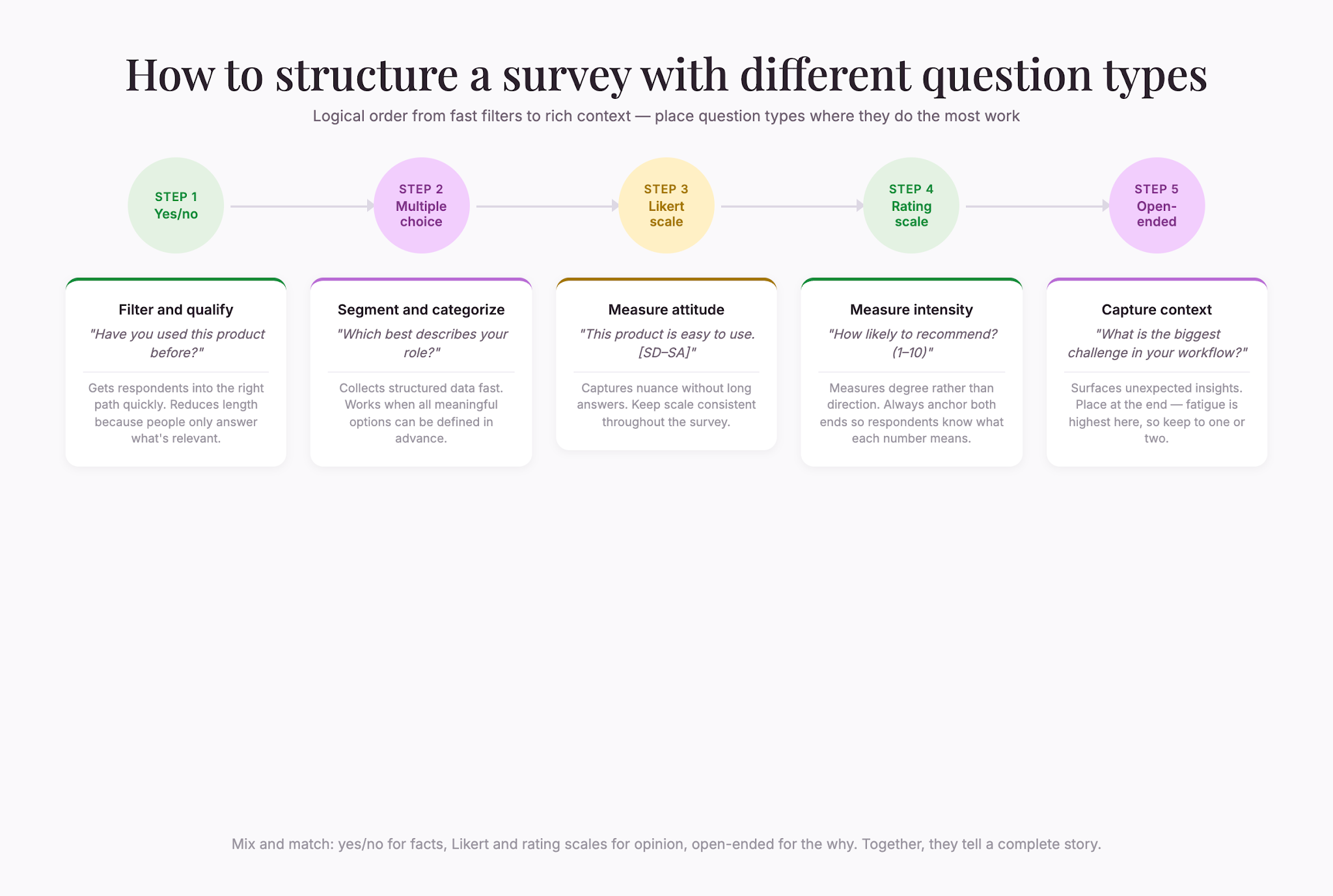
Mix question types. Yes/no for filtering. Likert for attitudes. Open-ended for explanation. Each serves a purpose.
Test before deploying. Read questions aloud, ask colleagues what each means, then pilot with a small group.
Response rates and delivery methods
Distribution affects response. Email surveys typically see 15–25%. In-app averages 27.52% (mobile 36.14%, web 26.48%). SMS achieves 40–50% (SurveySparrow, 2025).
In-app and SMS outperform email, but the right method depends on audience and goal. Web reaches breadth; in-app catches feedback when engagement is highest; SMS works for quick pulses.
Multiple-choice and Likert see higher completion than open-ended—keep a couple of open-ended items at the end for context, but don’t stack them; people give shorter answers when fatigued (SurveySparrow, 2025).
From questions to action
Collecting feedback only matters if you act on it. Here’s how:
- Ask the right survey questions (use the templates above)
- Collect responses from a meaningful sample
- Analyze the data—patterns, segments, percentages
- Prioritize insights by reach and impact
- Take action—fix top friction, double down on what works
- Close the loop with respondents
- Repeat in a few months
Listen, act, confirm—that’s how products improve.
Final takeaway
The best survey questions are specific, unbiased, and earn their place in your survey. You’re asking for time and honesty—respect both by asking things that matter, wording them clearly, and acting on what you learn. These 50 templates adapt to any context. Choose the relevant ones, keep the survey short, and close the loop by improving based on feedback.