User Interview Questions: 50+ Examples for Every Stage
Learn the 50 proven interview questions by stage, how they will evolve, and how to adapt them to your context.

Key takeaways
- Interviews reveal the "why" behind behavior: Unlike surveys that cast a wide net, user interviews go deep. Follow-up questions and tone uncover what people actually value and why they act the way they do.
- Match your questions to your research stage: Discovery, validation, problem-solving, and feedback interviews each serve a different purpose, and the right questions change as you move through them.
- Neutral beats leading every time: Open, unbiased questions like "What's your experience with X?" yield honest answers, while leading questions steer participants toward telling you what you want to hear.
- Workarounds and conditions are gold: The hacks people invent and the "yes, but only if..." caveats they attach reveal true priorities, minimum requirements, and potential blockers to adoption.
User interviews are conversations with real people about their needs, behaviors, and experiences. Unlike surveys that cast a wide net, interviews go deep. They let you ask follow-up questions, pick up on tone, and uncover the "why" behind what people do.
Whether you're building a product, improving a service, or understanding your market, the right questions turn interviews into goldmines of insight. The wrong questions—vague, leading, or off-topic—waste everyone's time. This is particularly true when you're developing user interview questions, as each question serves as a building block for deeper understanding. Well-crafted user interview questions can reveal not just what people do, but why they do it and what they truly value.
This guide gives you 50 proven user interview questions organized by stage: discovery, validation, problem-solving, and feedback. Use these as starting points and adapt them to your context. Throughout this guide, you'll see how user interview questions evolve depending on what you're trying to learn and where you are in your research journey.
Discovery questions: understanding who people are
Discovery interviews happen early, when you're still learning about your audience. Your goal is to understand their world, their habits, and what matters to them, without steering the conversation toward your solution. The more open and genuine your approach during discovery, the more honest and detailed your participants will be in their responses.
General background and context
These questions help you build a picture of who your participant is and what their day-to-day looks like:
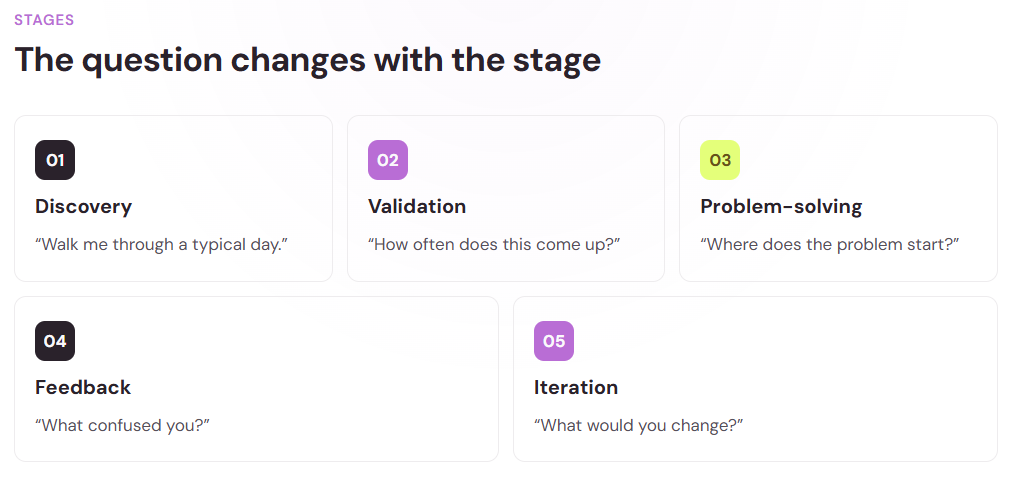
- Walk me through a typical day for you. What does that look like from morning to night?
- What's your role, and what does a typical week look like for you?
- What are the main responsibilities you handle at work (or in this area of your life)?
- How long have you been doing this work or managing this part of your life?
- What tools or systems do you currently use to [accomplish X]?
Motivations and goals
Understanding what drives people tells you what actually matters to them. When you understand someone's motivations, you're better positioned to design solutions that align with their real priorities rather than assumptions about what you think they need.
- What are you trying to accomplish right now—either at work or in your personal life?
- When you think about success in [this area], what does that look like for you?
- What's the biggest goal you're working toward over the next year?
- If you could change one thing about how you currently [accomplish X], what would it be?
- What would make your life or work easier in this area?
Pain points and frustrations
Listen for where things break down. This is where real problems live. Pain points often cluster around specific moments or situations, perhaps certain times of day, particular team members, or unique project types. By identifying not just what the pain point is but when and why it occurs most intensely, you gain insight into the conditions that create friction.
- What's the most frustrating part of [current process or tool]?
- Where do you spend the most time, and does that feel like time well spent?
- What manual or repetitive tasks do you wish you could automate or skip?
- When was the last time you felt stuck or unable to move forward? What happened?
- Are there any workarounds you've had to create to make [current solution] work?
Influences and decision-making
These questions reveal what shapes their choices. People's decisions are influenced by a complex mix of factors: recommendations from trusted peers, past experiences with similar solutions, organizational constraints, budget limitations, and personal preferences. By understanding these influences, you can see how your solution might fit (or not fit) into their existing ecosystem of tools, processes, and decision-making frameworks.
- Who do you turn to for advice when you're facing a challenge in this area?
- How do you typically research or learn about new solutions for [this problem]?
- What would need to be true for you to try a different approach or tool?
- What matters most to you when evaluating a new [product/service/approach]?
- Have you tried other solutions before? What did you like or dislike about them?
Validation questions: confirming your assumptions
Once you've identified a problem or opportunity, validation interviews test whether your understanding is correct and whether your proposed direction resonates. Craft these questions with the same thoughtfulness you'd apply to designing a survey, ensuring they're clear and unbiased. The goal in this phase is to move from theory to confirmation—to validate that the problem you've identified isn't just your interpretation, but something your participants genuinely experience. This prevents you from building solutions to problems that don't actually exist or that matter less than you think.
Problem validation
These questions confirm that the problem you've identified is real and matters. When validating problems, you're looking for consistency across participants. If only one person mentions a pain point, it might be an outlier. But if multiple people independently bring up the same issue, you've likely found something worth solving. A problem that happens daily has different urgency than one that happens once a year.
- Does [the problem I've identified] match what you experience?
- How often does this problem come up for you?
- What impact does this have on your work or life—financially, time-wise, or otherwise?
- Have you tried to solve this problem before? If so, what happened?
- If this problem were solved, how would that change things for you?
Solution direction validation
Now test whether your proposed direction makes sense. This is where you present your idea carefully, without overselling it or leading people toward saying "yes." The best approach is to describe your concept clearly and neutrally, then observe whether people's eyes light up or whether they respond with hesitation. Sometimes people will tell you directly that your solution addresses the wrong problem, or that they'd prefer a different approach entirely. These responses, while potentially disappointing, are invaluable because they save you from building the wrong thing.
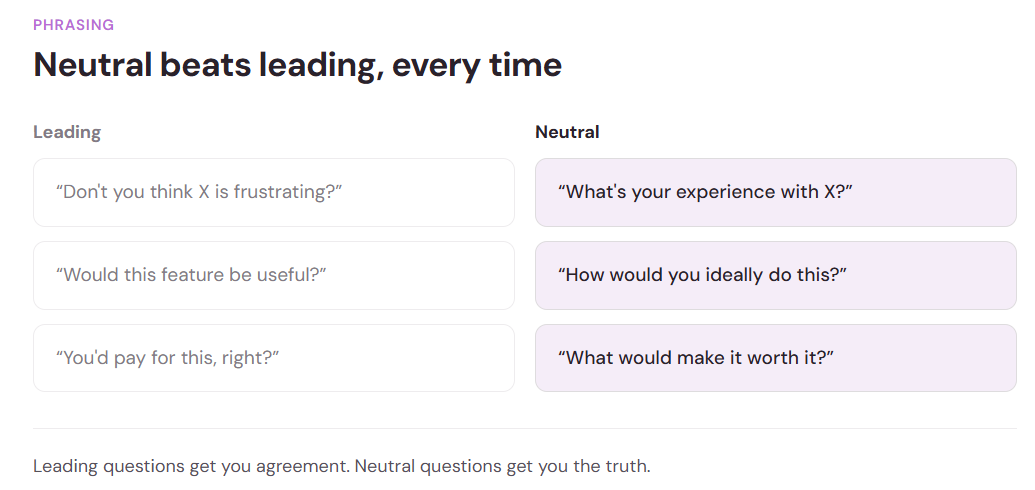
- If a tool existed that [describe your solution], would you use it?
- What would need to be true for you to switch from your current approach to something new?
- Of these three approaches, which one would be most helpful to you and why?
- How would you ideally want to [accomplish X]? Walk me through that.
- What features or capabilities matter most to you in a solution like this?
Willingness and adoption
These questions gauge whether someone would actually use what you're building. There's often a gap between what people say they'd do and what they actually do, so listen for any hesitation or conditions attached to their willingness. If someone says "yes, I'd use it, but only if it integrates with [tool]," that's crucial information. It's not a simple yes, it's a conditional yes. Understanding these conditions helps you prioritize features and identify potential blockers to adoption.
- Would you be willing to change your current process if it meant [specific benefit]?
- What would make adopting a new solution feel worth it to you?
- How much time or effort would you invest in learning a new approach?
- What would your concerns be about switching to something new?
- Who else would need to be on board for you to make this change?
Problem-solving questions: diving deeper
Once you've validated the core problem, these questions help you understand the nuances, edge cases, and specific contexts that shape the challenge. At this stage, you're moving beyond confirming the problem exists to understanding its full complexity: the scenarios where it's worse, the people most affected, and the systems that contribute to it.
Digging into context
These questions uncover the layers beneath the surface. Context shapes how problems manifest and how severe they are. A process that's frustrating when you're working alone might be catastrophic when you're managing a large team. A workflow that's tolerable during normal periods might break down entirely during peak seasons. By exploring these contextual variations, you build a more complete picture of the problem's scope and impact.
- Tell me about the last time this problem caused you real trouble. Walk me through what happened.
- How does this problem change depending on [context: the season, the team size, the project type]?
- What's different about how you handle this when [specific scenario] versus [other scenario]?
- Who else is affected by this problem, and how do they experience it differently?
- What systems or processes feed into this problem? In other words, where does it actually start?
Exploring workarounds
Workarounds tell you what people need when the standard solution doesn't work. People create them because they're determined to get their work done despite inadequate tools or processes, revealing ingenuity and resilience. But workarounds are also inefficient band-aids, usually consuming time and creating friction. By understanding these “necessary evils,” you learn what people truly value and what minimum requirements your solution needs to meet. Sometimes the workaround is so clever that it suggests a feature you hadn't considered.
- You mentioned you use [workaround]. How did you come up with that?
- How often do you need to use that workaround? What triggers it?
- What's frustrating about having to do that workaround?
- If that workaround disappeared tomorrow, what would you do instead?
- How much time does that workaround save or cost you?

Feedback and iteration questions: understanding the experience
Once you've built or iterated on something, feedback interviews help you understand whether it's solving the problem and where it might be missing the mark. This is the phase where you observe people actually using what you've built and listen to their honest reactions. Unlike earlier phases where you're exploring abstract problems, here you have concrete feedback to work with. This is also where post-event feedback and iteration techniques become especially valuable for closing the loop.
Reaction and usability
These questions focus on the immediate experience, because first impression matters. If something feels confusing or off-brand from the start, people might dismiss it before discovering its benefits. As people use your product or service, usability becomes critical. Where do they get stuck? What's confusing? Where do they need more guidance? These observations help you prioritize improvements and identify whether your solution is actually solving the problem you set out to tackle.
- What was your first impression when you saw this for the first time?
- As you used it, what felt intuitive, and what confused you?
- Were there any moments where you got stuck or didn't know what to do next?
- If you had to describe this in one sentence to a colleague, what would you say?
- What would you change if you could?