What Is a customer feedback loop? How to build one that actually closes
A customer feedback loop sounds simple in theory: you ask customers what they think, they tell you, you act on it, and they see the results. But in practice, most companies collect feedback and then... nothing happens. The loop breaks. Customers get frustrated. You miss the chance to improve.

A customer feedback loop sounds simple in theory: you ask customers what they think, they tell you, you act on it, and they see the results. But in practice, most companies collect feedback and then... nothing happens. The loop breaks. Customers get frustrated. You miss the chance to improve.
A real customer feedback loop is different. It’s a continuous cycle where customer input directly shapes your product, service, or experience, and customers witness the changes they helped inspire. When a feedback loop actually closes, it builds trust, increases loyalty, and gives you a competitive edge because you’re always improving based on what your audience actually needs.
Let’s break down what makes a customer feedback loop work, and how to build one that doesn’t stall halfway through.
What is a customer feedback loop?
At its core, a customer feedback loop is a system where information flows in a circle. You collect input from customers, analyze it, make decisions based on what you learn, implement those decisions, and then communicate back to customers about what changed. That final step—closing the loop by sharing results—is what most companies miss.
Without closure, customers feel unheard. They gave you their time and opinion, but they never see anything come from it. So they stop participating. Future feedback becomes harder to gather. You lose the momentum that real dialogue creates.
A proper feedback loop, by contrast, shows customers that their voice matters. It creates a conversation, not a one-way interrogation.

Why feedback loops fail (and how to avoid it)
Most feedback loops break down in one of three places.
The collection phase. You ask the wrong people, ask the wrong questions, or ask at the wrong time. If you’re only surveying your happiest customers, you’re missing critical feedback from people who churned or are on the fence. If you ask vague questions, you get useless answers. If you ask after someone’s had a bad experience and they’re still frustrated, emotions can cloud their judgment.
The analysis phase. You collect feedback but never actually review it. It sits in a spreadsheet or survey tool, untouched. Or you do review it, but you look for data that confirms what you already believe instead of asking what the feedback is actually telling you. This is called confirmation bias, and it kills honest insights.
The implementation phase. This is where most loops fully collapse. You find valuable feedback, but then you don’t act on it because it’s hard, expensive, or conflicts with your current roadmap. Or you act on it too slowly—by the time the change rolls out, customers have forgotten they asked for it.
To avoid these failures, you need three things: a clear process, designated owners, and a timeline.
Designate one person or a small team to manage each phase. Collect feedback through multiple channels (not just one survey). Set a specific cadence for reviewing feedback—weekly or monthly, depending on your volume. Make a public commitment about which feedback you’ll act on and when. And when you implement changes, make a point to tell the customers who requested them.
The commitment and timeline are non-negotiable. Without them, feedback collection becomes busywork.
Common failure modes and anti-patterns
Beyond the three phases above, there are specific anti-patterns that quietly poison feedback loops. Recognizing them is the first step to fixing them.
The vanity dashboard. A team builds a beautiful net promoter score (NPS) dashboard, watches the score climb or dip each quarter, and then... does nothing. The dashboard becomes a status symbol, not a decision tool. If a metric isn’t tied to a specific owner and a specific action threshold, it’s wallpaper.
The feedback graveyard. Customer comments pile up in a support inbox, a sales CRM, and a survey platform—each owned by a different team, none talking to each other. Insights get buried by volume. A theme that would be obvious if you saw all three sources together stays invisible because no one ever combines them.
The loudest-voice problem. One enterprise customer asks for a feature in a quarterly business review, and the product team scrambles to build it. Meanwhile, hundreds of mid-market customers have been quietly asking for something different for months. Without a system to weight feedback by frequency and segment, the squeakiest wheel always wins—even when it’s not the right wheel.
The “we already knew that” trap. The team reads through feedback and concludes that everything matches their existing roadmap. Convenient, but rarely accurate. If your analysis never surprises you, you’re not really analyzing—you’re confirming.
The endless beta. A company collects feedback, ships a change, and then asks for feedback on the change, and ships another change, and asks again. Customers become unpaid QA testers. Feedback should refine direction, not replace it. Decide, ship, then listen.
Closing the loop with marketing copy. “Thanks to your feedback, we’ve launched our newest exciting feature!” lands flat when the feature doesn’t actually address what customers asked for. Customers can tell when “you spoke, we listened” is a press release rather than a product change. Specifics earn trust. Slogans don’t.
The fix for most of these patterns is the same: tie feedback to a named owner, a documented decision, and a date. Without that scaffolding, even good intentions drift.
How to design feedback collection that works
You can’t close a loop with feedback that doesn’t matter. So the first step is asking questions that actually help you make decisions.
Start by defining what you need to learn. Are you trying to understand why customers leave? Improve a specific feature? Find out what your audience wants next? Each goal requires different questions and different audiences.
Once you know what you’re trying to learn, choose how to ask. Surveys work well for broad audiences and quantifiable data. One-on-one interviews or focus groups are better for deep understanding. In-app polls or quick rating questions work when you need fast feedback. Some companies use all three, rotating through them so customers don’t get survey fatigue.
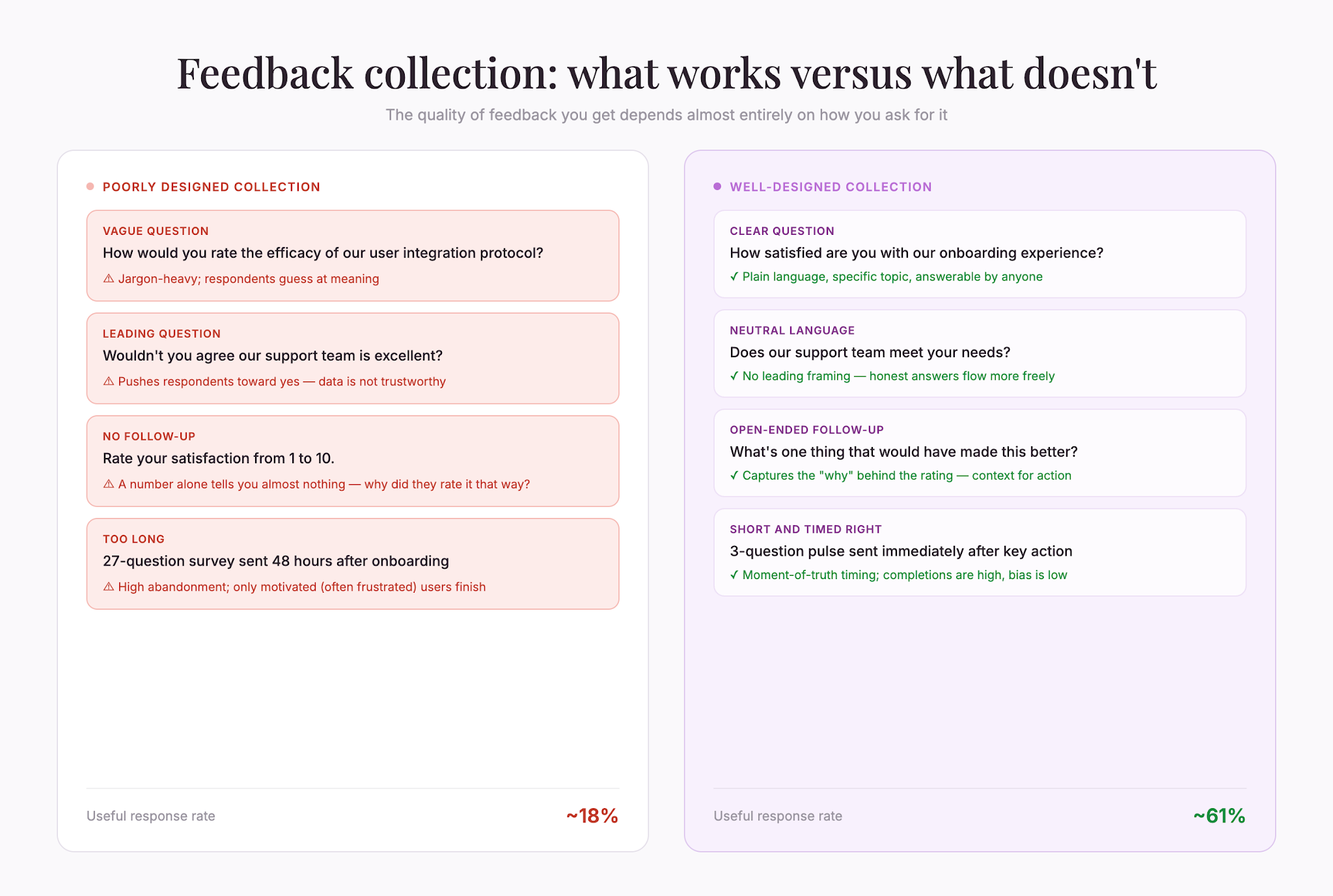
Keep questions clear and jargon-free. “How satisfied are you with our onboarding experience?” is better than “How would you rate the efficacy of our user integration protocol?” If your customers don’t understand the question, their answers won’t help you.
Ask follow-up questions, or at least leave room for open-ended comments. A customer might rate you 7 out of 10, but that number alone tells you almost nothing. Did they like the speed but hate the interface? Did they find it confusing at first but eventually figured it out? Open comments reveal the “why” behind the rating.
Make feedback collection easy. The easier it is to respond, the more people will do it, and the less biased your results become. Long surveys get abandoned. Short surveys get completed. If you’re gathering feedback through a form or survey tool, test it yourself first—does it work on mobile? Are instructions clear? Can someone finish it in under five minutes?

Tooling categories that support each loop step
You don’t need a single platform that does everything. You need each phase covered by something fit for purpose, and the pieces need to connect.
For collection: Survey tools for structured input, in-app feedback widgets for moment-of-truth reactions, support ticket systems for unsolicited complaints, community forums and review sites for public sentiment, and interview scheduling tools for deeper conversations. The mix matters—each channel surfaces a different kind of insight.
For aggregation: A customer data platform or a feedback hub that pulls signals from every channel into one place. Without aggregation, themes hide inside silos. Even a shared spreadsheet with disciplined tagging beats five disconnected systems.
For analysis: Text analytics or theme-clustering tools for open-ended responses, dashboards for quantitative trends, and tagging systems that let humans add structure. Manual review still has a role—software is good at sorting, humans are better at judgment.
For decision-making: A roadmap tool, a prioritization framework, and a regular review meeting. The tool matters less than the ritual. A weekly thirty-minute meeting where the team reviews top themes and decides what moves forward will outperform the most expensive software with no cadence behind it.
For implementation: Project management, design tools, and the build environment your team already uses. Feedback tooling shouldn’t try to replace this—it should feed into it cleanly so engineers can see which customer requests connect to which tickets.
For communication: Email platforms, in-app messaging, changelogs, customer newsletters, and community announcements. The closing step deserves the same care as the asking step.
The goal isn’t to buy more tools. It’s to make sure each phase has a clear home, and that information flows between them without manual copy-paste.
How to analyze feedback without losing the plot
Once you’ve collected feedback, the temptation is to jump straight to action. But skipping analysis leads to implementing the wrong things.
__Start by organizing what you’ve heard. __If you’ve collected survey responses, look for patterns. Do multiple customers mention the same pain point? How often? Frequency matters—one complaint about a typo is different from many complaints about a broken feature.
Separate signal from noise. One customer asking for a purple theme doesn’t mean you need to build it. But if a meaningful share of your user base asks for dark mode, that’s signal. Look for the requests or complaints that appear multiple times or affect multiple customer segments.
Segment your feedback by customer type. Feedback from your biggest customers might deserve different weight than feedback from free-tier users. Feedback from a long-time customer carries different insight than feedback from someone who tried you once and left. This doesn’t mean ignoring anyone—it means understanding the context.
__Document your findings in a way your whole team can understand. __Create a one-page summary of the top feedback themes, how many customers mentioned each one, and what it means for your business. Avoid turning this into a novel—people won’t read it. Keep it scannable.
Most importantly, be honest about what the feedback is really saying. If customers are telling you your pricing is a barrier, don’t spin that into “customers love the value proposition.” Let the feedback challenge your assumptions. That’s where the growth is.
Deciding what to act on (and what to skip)
Not every piece of feedback deserves action. If you tried to implement everything everyone asked for, you’d never ship anything.
Instead, create a simple framework for deciding what to prioritize. Many teams use something like this: impact multiplied by effort. A feature that would delight half your customers and takes two weeks to build ranks higher than a feature that would help a small fraction of customers and takes six months.
Other teams consider strategic alignment. Does this feedback align with your product vision? Or is it asking you to become something you’re not? Both answers are valid—sometimes you say “no, that’s not our direction,” and that’s okay. But be explicit about it.
Some feedback requires no product change at all. Maybe customers are confused because your documentation is unclear. Or they don’t know a feature exists because you’ve never mentioned it. In these cases, the solution is education or communication, not building.
Once you’ve decided what to prioritize, be transparent about those decisions. Tell customers what you’re going to build, what you’re not building, and why. Transparency builds trust more than saying nothing.
Finally, set a realistic timeline. “We heard you. We’re implementing this in Q3,” is better than promising something you can’t deliver. If you’re not sure when it’ll happen, say so—but don’t leave customers hanging indefinitely.
Implementing changes in a way that matters
Implementation is where a lot of companies stumble. The changes get built, but no one tells the people who asked for them. To avoid this:
Track which feedback led to which decisions. If a feature is built because customers requested it, document that. When the feature launches, you’ll want to tell those customers that they inspired it.
__Before launch, do a final check. __Does the implementation actually address the feedback? Sometimes what you build solves part of the problem but not the whole thing. If you’re only partially addressing what customers asked for, be clear about that.
When you launch the change, tell the customers who helped inspire it. This isn’t about marketing—it’s about closing the loop. Send them an email, a notification in your product, or a message on social media. “We heard you ask for dark mode, and we just shipped it. Thank you for pushing us to build it.”
Include a way for them to give feedback on the implementation. Did you get it right? Is there something else they’d change? Keep the conversation going.
Closing the feedback loop with communication
This is the step that turns a feedback loop from a process into a real conversation.
After you’ve implemented a change based on feedback, communicate about it. Tell customers what changed, why you changed it, and how you’re measuring success. For example: “We streamlined signup based on your feedback that the old process had too many steps. Time to onboard dropped from eight minutes to three minutes.”
If you decide not to implement feedback, explain that too: “We heard requests for offline mode. We’ve decided to focus on mobile compatibility first, but offline mode is on our roadmap for next year.”
Make this communication regular and easy to consume. A monthly email highlighting changes made based on customer feedback works. A section on your website showing customer-requested features that have shipped works. A message to your customer community works.
The key is consistency and honesty. When customers see that their feedback directly leads to product changes, they keep giving you feedback. When they see that you’re transparent about what you’re doing and why, they trust you more.
Over time, a closed feedback loop creates a community of invested customers. They feel like they’re part of building your product, because they are. That sense of ownership is worth more than most loyalty programs.
How to measure loop health
A customer feedback loop is itself something you should measure. If you don’t track its health, it can quietly atrophy without anyone noticing.
Here are a few practical metrics to watch:
Response rate. What share of customers you asked actually responded? A drop usually means survey fatigue, poor channel choice, or a feeling that responses don’t matter. Watch the trend, not just the absolute number.
Coverage. Are you hearing from every customer segment, or only from a few? Track responses by tier, tenure, region, and channel. Gaps tell you where you’re flying blind.
Time-to-acknowledgment. How long between a customer giving feedback and getting some kind of response—even just “we heard you, we’re looking into it”? Faster acknowledgment keeps people engaged.
Time-to-action. How long between a recurring theme being identified and a decision being made about it? This separates teams that listen from teams that just collect.
Implementation rate on flagged themes. Of the top feedback themes you identified last quarter, how many led to a change—product, process, or communication? If the answer is consistently zero, the loop is broken upstream of implementation.
Repeat-feedback rate on closed items. Once you’ve shipped a fix, do customers stop raising the issue? If they keep reporting it, the fix didn’t address the real problem.
Customer-perceived responsiveness. Ask customers directly, once or twice a year, whether they feel the company listens and acts on their input. The number itself matters less than the trend.
Treat these metrics like any other operational dashboard. Review them monthly, set targets, and assign owners. A loop you don’t measure is a loop you can’t trust.
Scaling the loop as you grow
A feedback loop that works for a fifty-person startup will buckle at five hundred customers, and definitely at fifty thousand. As you grow, the principles stay the same—collect, analyze, decide, implement, communicate—but the mechanics need to evolve.
Early stage: Founders read every piece of feedback themselves. Decisions happen in Slack threads. Closing the loop is a personal email from the CEO. This works, and it builds extraordinary loyalty, but only while volume is low.
Growth stage: Feedback volume outpaces the founder’s inbox. The risk here is that systems haven’t caught up with reality. The fix is to formalize: assign a feedback owner, pick a primary aggregation tool, set a monthly review meeting, and start writing down themes. This is also when the loudest-voice problem starts to appear, so introduce a simple weighting framework before it becomes a habit.
Scale stage: A single team can no longer process all feedback. Distribute ownership by area—product feedback goes to product, service feedback goes to support, pricing feedback goes to commercial. The risk is fragmentation: each team optimizes its own slice and the company loses the holistic view. Counter this with a quarterly cross-functional review where teams share top themes and look for patterns that span boundaries.
Mature stage: The loop is a function, not a project. There’s a customer insights team. There are documented service-level expectations for time-to-acknowledgment and time-to-action. Closed-loop communication is automated where possible and personal where it counts. The new risk is bureaucracy—the loop becomes so process-heavy that quick action is impossible. Keep one direct, low-friction channel for urgent or high-stakes feedback to skip the queue.
At every stage, the test is the same: can a customer who gave feedback six months ago see what you did with it? If yes, the loop is closing. If no, something has slipped.
Making it stick
Building a real customer feedback loop takes work, but it’s not complicated. Collect input from the right people, using the right questions. Analyze what you hear honestly. Decide what to build based on a clear framework. Implement thoughtfully. And most importantly, close the loop by telling customers what you did and why.
When you do all five steps consistently, feedback stops being a one-time survey and becomes an ongoing conversation. Your customers feel heard. Your product improves faster. And your business gets the insight it needs to stay competitive.
Start small if you need to. Pick one customer segment, one channel for feedback, and one decision cycle. Get the process working. Then, expand it. A feedback loop that actually closes—even a small one—is better than a half-baked attempt to listen to everyone at once.