HCAHPS survey: what it is and how to run one
Learn what HCAHPS measures, how CMS administers and scores the survey, and where supplemental patient experience surveys fit.
Key Takeaways
- Hospital Consumer Assessment of Healthcare Providers and Systems (HCAHPS) provides one national standard for measuring hospital patients’ care experiences. It lets hospitals and the public compare care experiences using the same measures.
- The Centers for Medicare & Medicaid Services (CMS) publicly reports HCAHPS patient-experience results. HCAHPS measures also contribute to eligible hospital scores in Medicare’s Hospital Value-Based Purchasing program.
- For results to count in the CMS program, hospitals must follow CMS eligibility, sampling, and survey-administration rules. They can use a CMS-approved vendor or, with CMS approval, collect and submit their own HCAHPS data.
- Top-box scoring counts only the most positive answer. For frequency questions, “Always” counts; “Usually” does not.
- The initial eligibility screen covers adults who stayed at least one night, had a nonpsychiatric principal diagnosis, and were alive when discharged.
Intro
Hospital Consumer Assessment of Healthcare Providers and Systems (HCAHPS) is a nationally standardized survey of patients’ hospital experiences. CMS public reports the results and uses selected HCAHPS measures in Medicare’s Hospital Value-Based Purchasing program.
A hospital cannot recreate HCAHPS in a general-purpose form tool and treat the results as CMS-reported HCAHPS data. To report HCAHPS results to CMS, it must follow CMS rules and use an approved vendor or receive CMS approval to collect and submit its own data.
Below, we explain what HCAHPS measures, how it works, and where supplemental surveys can help.
What Is the HCAHPS Survey?
HCAHPS is a standardized national survey designed to produce comparable information about patients’ experiences during inpatient hospital care. It measures reported experiences with specific aspects of care rather than relying only on a broad satisfaction rating.
The program began taking shape in 2002, when CMS and the Agency for Healthcare Research and Quality (AHRQ) started developing and testing HCAHPS. CMS moved to national implementation in 2006. Public reporting followed in 2008.
That standardization allows valid comparisons across hospitals. Internal patient-experience scores can still identify local problems, but HCAHPS results reported to CMS must use the required survey, sampling, and administration procedures.
Why HCAHPS Scores Matter
HCAHPS results are publicly reported and contribute to CMS’s Hospital Value-Based Purchasing program. They can inform hospital comparisons and internal quality-improvement priorities.
Public Reporting Makes Results Visible
CMS publishes HCAHPS results so patients and others can compare hospital experience information. Care Compare lets people compare hospitals, while HCAHPS Summary Star Rating gives them a simpler view of patient-experience performance.
Selected HCAHPS measures contribute to the Person and Community Engagement domain in Hospital Value-Based Purchasing. HCAHPS does not, however, determine every Medicare payment or hospital’s overall rating by itself.
What Questions Are on the HCAHPS Survey?
The updated HCAHPS Survey contains 32 questions: 22 substantive questions, three screener questions, and seven “About You” questions. Hospitals have used this revised version for patients discharged on or after January 1, 2025.
Current Experience Measures
The updated instrument covers 11 patient-experience areas:
- Communication with Nurses
- Communication with Doctors
- Restfulness of Hospital Environment
- Care Coordination
- Responsiveness of Hospital Staff
- Communication about Medicines
- Discharge Information
- Cleanliness of Hospital Environment
- Information about Symptoms
- Overall Hospital Rating
- Recommend the Hospital
CMS removed Care Transition from the updated survey. Quietness is now part of the Restfulness of Hospital Environment composite, although Quietness of Hospital Environment remains a standalone publicly reported measure during the January, April, and July 2026 transition periods. Beginning with the October 2026 Care Compare refresh, CMS will publicly report the 11 updated measures.
Hospitals cannot change the required HCAHPS questions or response choices. They may add supplemental questions only as CMS permits.
Top-Box Scoring Rewards the Most Positive Response
HCAHPS top-box scoring shows how often respondents choose the most positive answer for a measure. For applicable frequency questions, that means “Always” receives top-box credit.
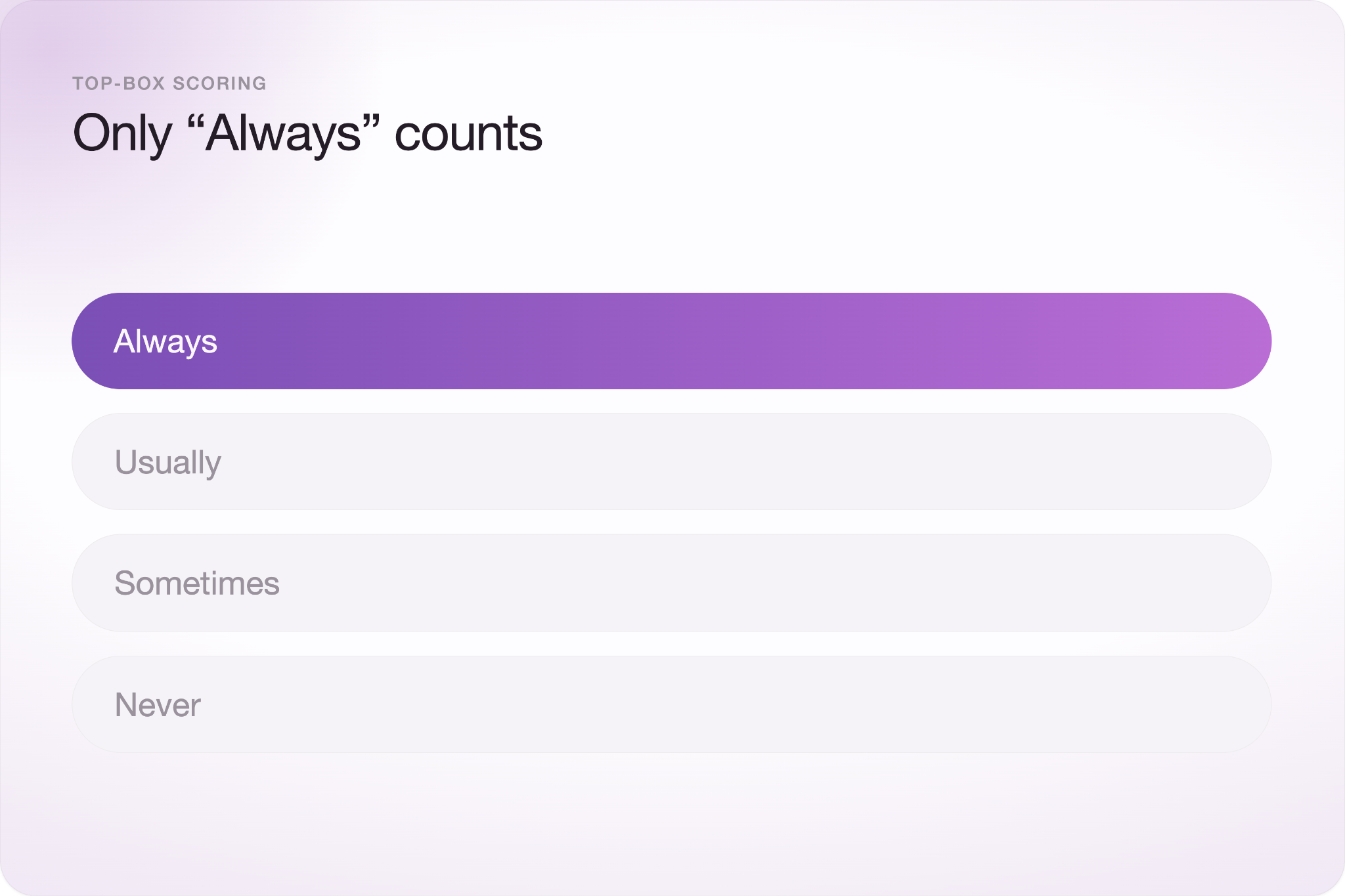
What happens to “Usually”? It does not count toward the top-box percentage, just like “Sometimes” and “Never” do not. That does not mean those answers describe equal experiences. It only means none belongs in the top-box numerator.
Not every HCAHPS question uses the same response scale.
How the HCAHPS Survey Is Administered
CMS standardizes how hospitals administer HCAHPS. For results CMS can publicly report, hospitals must follow the current HCAHPS administration requirements for sampling, contact timing, survey wording, and approved administration modes. Hospitals can use a CMS-approved HCAHPS survey vendor. To self-administer, a hospital must meet separate program requirements and receive CMS approval.
Eligibility Follows Specific Rules
Eligibility begins with the discharge record. Initially eligible patients must:
- Be 18 or older at admission
- Have an inpatient stay that includes at least one overnight stay
- Have a non-psychiatric MS-DRG/principal diagnosis at discharge
- Be alive at discharge
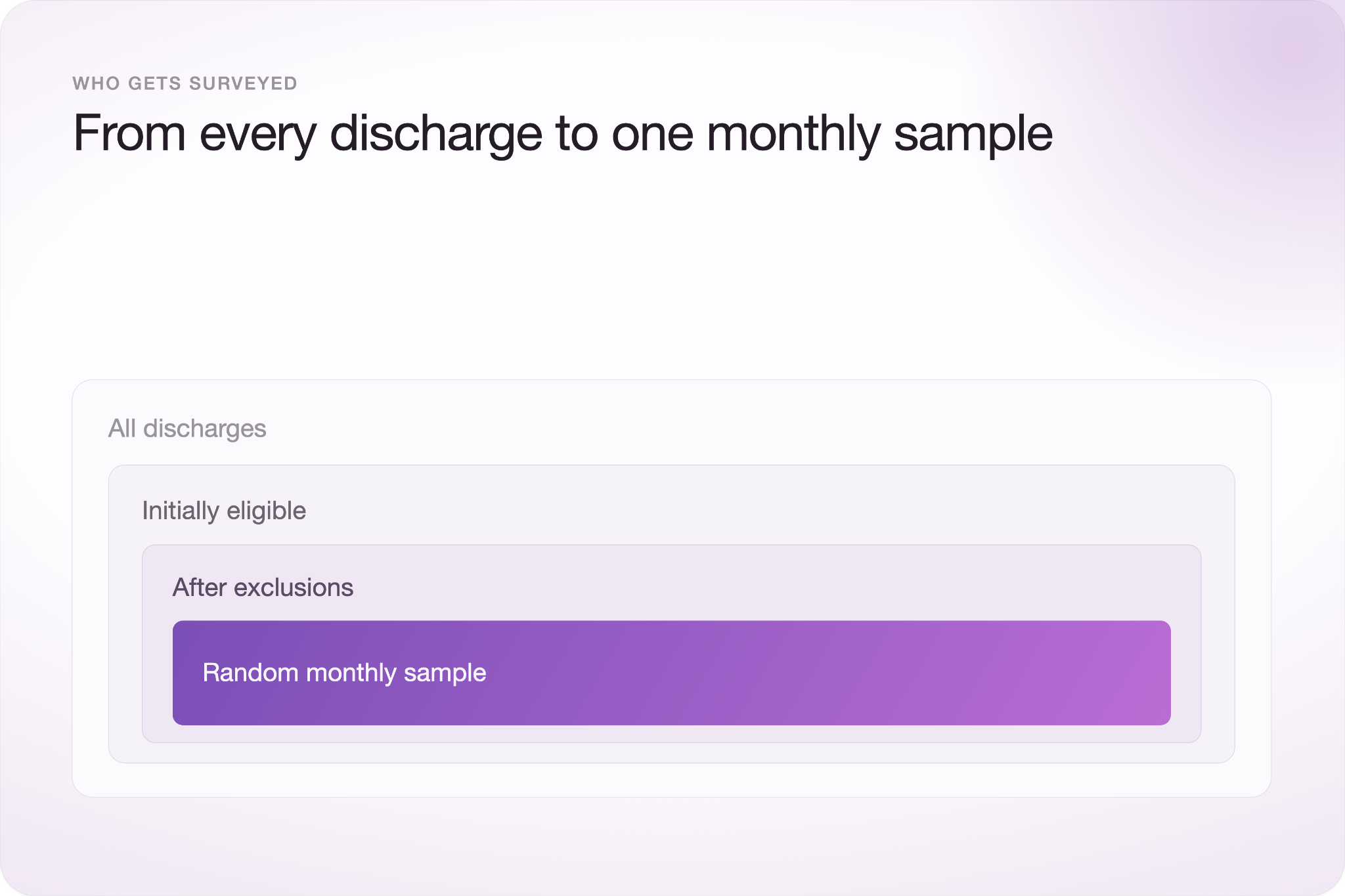
The administrator then removes protocol exclusions, including “no-publicity” patients, prisoners, patients with foreign home addresses, patients discharged to hospice or a nursing or skilled nursing facility, and patients excluded under state regulations.
Sampling and Timing Are Standardized
The approved vendor or self-administering hospital draws a random sample of eligible discharges each month, and every eligible discharge must have a chance of selection. CMS requires at least 300 completed surveys in a rolling four-quarter period. Hospitals generally calculate their monthly sample size to target 335 completes, helping them consistently meet that requirement.
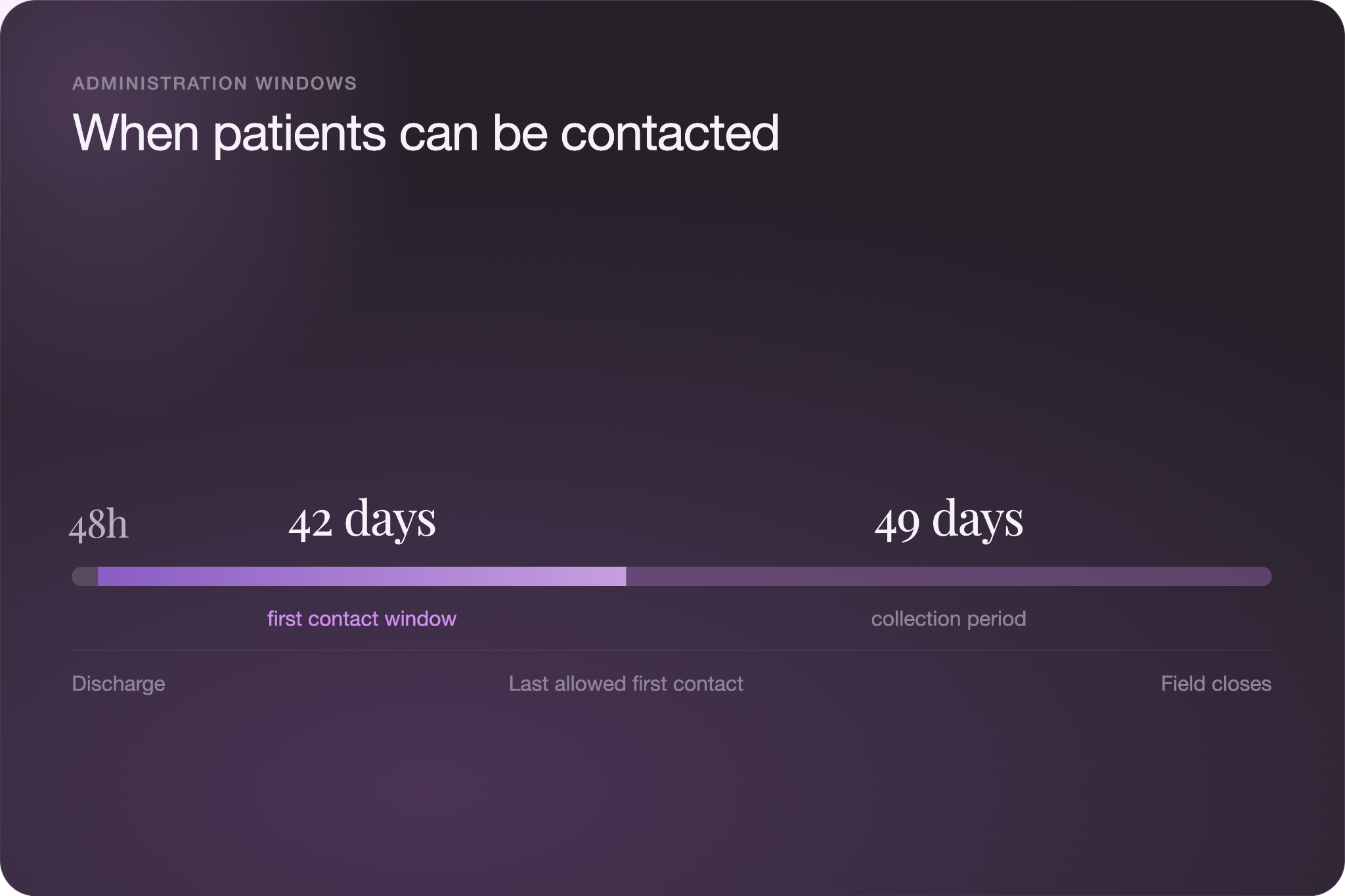
Initial contact must begin between 48 hours and 42 calendar days after discharge. Data collection ends 49 calendar days after that first contact.
CMS Currently Permits Six Survey Modes
The current approved modes are:
- Mail Only
- Phone Only
- Mail-Phone
- Web-Mail
- Web-Phone
- Web-Mail-Phone
CMS no longer approves interactive voice response (IVR).
Could a hospital rebuild HCAHPS in a general-purpose form tool? Not for official reporting.
Official HCAHPS reporting uses prescribed survey language and protocols for sampling, timing, and administration.
How to Improve HCAHPS Scores
Hospitals can aim to improve HCAHPS scores by improving the experiences behind patients’ answers—not by coaching patients or changing standardized survey wording. Quality-improvement work should focus on a specific experience area and the care process behind it.
Connect Improvement Work to the Measure
HCAHPS results become more useful when teams translate them into observable care practices. What might that look like during a normal shift?
- Use purposeful or hourly rounding to address Responsiveness of Hospital Staff and unmet patient needs.
- Use bedside shift reports appropriately to support Communication with Nurses and continuity of care.
- Explain new medications in plain language, including their purpose and possible side effects, to address Communication about Medicines.
- Reduce avoidable nighttime noise through staff routines, equipment practices, and unit-level monitoring to support Restfulness of Hospital Environment.
- Give discharge instructions patients and caregivers can understand, then use teach-back or another appropriate comprehension check to support Discharge Information.
No single tactic guarantees a higher score. Reliable care practices matter more than scripts, and staff should never ask patients to provide favorable survey answers.
Look for Patterns Behind the Score
HCAHPS improvement also requires teams to identify recurring problems. When there is enough local data, teams can examine patterns by unit, shift, or service line to guide internal improvement work. Those analyses can reveal where the patient experience consistently breaks down and which care process needs attention.
Where Supplemental Patient Experience Surveys Fit
Separate internal surveys can give hospital teams a quicker view of developing concerns between public HCAHPS updates. They do not generate HCAHPS scores or replace official HCAHPS results.
Use Supplemental Surveys for Focused Feedback
Hospitals can use unofficial surveys for focused internal learning. Common uses include:
- Gathering unit-level patient feedback.
- Running post-visit or post-discharge follow-ups.
- Investigating concerns identified in HCAHPS results.
- Asking staff about workflows, communication barriers, or recurring patient concerns.
Because teams control their timing and internal purpose, supplemental surveys can provide a faster signal on specific concerns.
Typeform can support these unofficial efforts through resources for patient feedback, follow-up surveys, staff pulse checks, and supplemental survey design.
Hospitals must not call supplemental results HCAHPS scores or present them as CMS-reported data. Official HCAHPS data must be collected by a CMS-approved vendor or an approved self-administering hospital and then reported through the CMS process. Supplemental surveys can help teams identify and investigate problems sooner.
FAQ
Is HCAHPS mandatory?
For most hospitals paid under Medicare’s Inpatient Prospective Payment System, HCAHPS reporting is required through the Hospital Inpatient Quality Reporting Program. Critical Access Hospitals can participate voluntarily.
How often is HCAHPS conducted?
Hospitals draw a random sample of eligible discharges each month and survey those patients. CMS updates publicly reported HCAHPS results quarterly using a rolling four-quarter period.
Who can see HCAHPS results?
Anyone can view publicly reported HCAHPS results on Medicare Care Compare. Results may include individual patient-experience measures and HCAHPS Star Ratings when a hospital has enough completed surveys.
What is a good HCAHPS score?
There is no single good HCAHPS score. A strong result depends on the measure, because scores vary across topics such as nurse communication, discharge information, and hospital cleanliness. Hospitals should compare each measure with current national or state benchmarks and their own results over time.