Post-event survey questions: 20+ examples
Learn the 20-real-world post-event survey questions based on what you’re trying to learn to help you build a survey people want to complete.
Key takeaways
- Timing drives quality: Send your survey within 24 hours, while impressions are still fresh, to get specific, honest feedback instead of vague pleasantries.
- Short surveys win: Questionnaires with only a few questions see far higher completion rates, so pick a handful of questions that match your goal and cut the rest.
- Match questions to goals: Decide whether you're measuring satisfaction, content value, logistics, networking, or referral potential before you write a single question.
- Act on what you learn: Segment results, spot patterns, and tell attendees what changed. Closing the loop on feedback doubles as building customer loyalty.
After an event wraps, attendees have fresh impressions: what went well, what fell flat, and what they'd want to see next time. A well-timed post-event survey captures that feedback while it's still vivid, giving you insights to refine future events and show attendees their opinions matter.
The challenge is asking the right questions without making it feel like a chore. A survey that's too long tanks your response rate. One that's vague leaves you with unusable feedback.
This guide gives you 20 real-world post-event survey questions—organized by what you're trying to learn—so you can build a survey that people actually want to complete.
Why post-event surveys matter
Events create a window of opportunity. Attendees are in the mindset of your event, speakers are fresh in memory, and logistics are top-of-mind. That's when you get honest, detailed feedback.
Post-event surveys help you:
- Spot what resonated so you know what to repeat
- Identify friction points—long lines, confusing schedules, poor audio—that hurt the experience
- Uncover unmet needs that shape future programming
- Measure ROI by connecting attendance to business outcomes
- Build a data trail showing attendees their input matters
Timing is the multiplier here. Wait a week and you'll get vague pleasantries. Ask while the closing session is still fresh and you'll get specifics: the room that ran cold, the speaker who ran long, the session people skipped lunch to attend.
Short surveys consistently see the highest completion rates—the fewer questions you ask, the more people finish—so keeping your survey focused pays off in both response rates and usable data.
Before you write: set your survey goal
Not all post-event surveys are the same. A conference needs different feedback than a product launch. A webinar needs different post-event survey questions than a networking happy hour.
Before you write a single question, decide what you need to know:
- Overall satisfaction – Did attendees feel the event was worth their time?
- Specific experience elements – How was the venue, food, speaker quality, or networking flow?
- Content or learning value – Did sessions meet expectations? What topics should return?
- Likelihood to return – Will they attend the next one?
- Referral potential – Would they recommend it to others?
- Actionable improvement areas – What's the single biggest thing you should change?
Once you know what you're measuring, choose questions that address that head-on.
That's the same discipline behind creating a market research survey: define the objective first, then work backward to the questions. If a question doesn't serve the goal you've picked, cut it, no matter how interesting the answers might be.
20 post-event survey questions, organized by goal
Overall satisfaction and likelihood to return
These questions gauge whether attendees felt the event was a success and whether they'd come back.
1. On a scale of 1-10, how likely are you to attend our next event?
This is a direct measure of intent. It's quick to answer and gives you a single number you can track over time.
2. Did the event meet your expectations?
Yes/No questions are fast to answer and reduce respondent fatigue. This tells you whether people got what they came for.
3. How would you rate your overall experience? (Excellent / Good / Fair / Poor)
This gives more nuance than yes/no but is still simple. You can compare results event-to-event and spot trends.
4. What was the single best thing about this event?
Open-ended questions let people tell you what mattered to them. Their answers surface unexpected wins you can amplify next time.
5. If you were summarizing this event for a friend, how would you describe it in one sentence?
This forces attendees to synthesize their experience into one takeaway. Answers are often more honest than traditional rating scales.
Content and programming
If your event had sessions, speakers, or educational content, these questions help you understand what landed.
6. Which session or speaker was most valuable to you?
This tells you what people found useful and identifies standout sessions for next year.
7. Was the content level appropriate for your expertise? (Too basic / Just right / Too advanced)
If your audience felt split between bored and lost, your next event needs segmented tracks. This surfaces misalignment quickly.
8. What topic would you like to see covered at our next event?
You'll get ideas you wouldn't have brainstormed alone, and attendees feel heard.
9. Did the keynote speaker meet your expectations? (Yes / No)
Yes/No questions work well for screening. You get a binary signal fast.
10. How much of the content was new to you? (Most of it / About half / Very little)
This tells you whether your event felt redundant or whether you're reaching a different audience than before.
Logistics, venue, and experience
Even great content suffers from poor logistics. These questions help you spot friction.
11. Did you experience any issues with registration, check-in, or event logistics? (Yes / No)
Binary questions are perfect for quick screening. If the answer is "Yes," follow up with a free-text question.
12. How would you rate the venue? (Excellent / Good / Fair / Poor)
Venue quality affects every part of the experience. Bad audio or uncomfortable seating poisons even a great speaker.
13. Was there enough time for networking?
Networking is often why people attend in person. This tells you whether you scheduled enough unstructured time.
14. Did the event stay on schedule? (Yes / No)
Nothing kills enthusiasm like an event that runs late. This tells you whether your timing was realistic.
15. How was the food and beverage? (Excellent / Good / Fair / Poor)
The small stuff adds up and impacts the overall experience.
Engagement and networking
For events where connection is a major draw, these questions measure whether you facilitated it.
16. Did you make a meaningful connection with someone at the event?
This simple yes/no measures the social value of your event, often the real reason people attend in person.
17. How comfortable did you feel approaching speakers or other attendees?
If people feel awkward or unwelcome, they won't network even if there's time. This tells you whether your event's culture and layout worked.
18. What would have made it easier to connect with other attendees?
An open-ended question that surfaces concrete ideas: name tags, icebreaker games, or reserved networking time. You get actionable feedback.
Likelihood to recommend
These questions measure whether attendees became informal ambassadors.
19. On a scale of 0-10, how likely are you to recommend this event to a colleague or friend?
This is the classic Net Promoter Score (NPS) question adapted for events. Scores of 9-10 are promoters; 7-8 are passives; 0-6 are detractors. Track it over time.
20. Who else from your network should we invite to our next event?
This generates leads while confirming whether the event was worth attending and sharing. Attendees who give you names are confirming your event's value.
How to design your post-event survey for better results
Asking good questions is half the battle. The other half is how you ask them.
Keep it short. Aim for five to eight questions max. One or two rating scales, one or two open-ended questions, and maybe one yes/no screening question.
Ask immediately, but not too soon. Send the survey within 24 hours while memories are fresh, but not in the venue while people are still leaving. A follow-up email the next day works better.
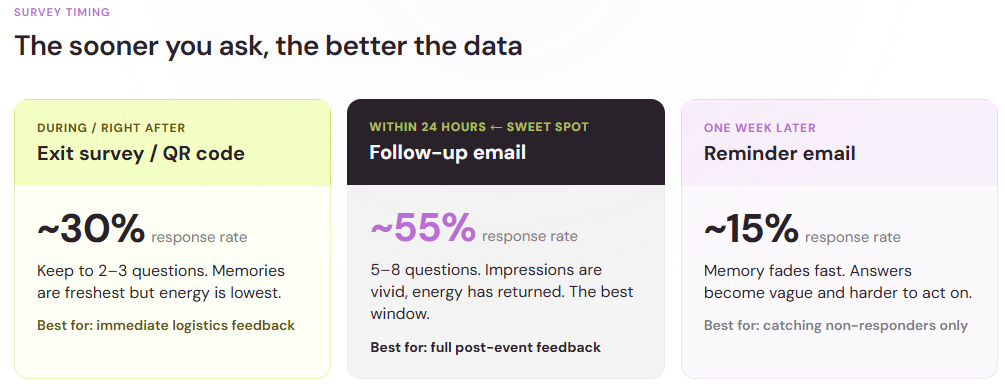
Use a mix of question types. Ratings give you quantifiable data. Yes/no questions are quick. Open-ended questions surface unexpected insights. Vary the format so respondents don't zone out. Not sure which format fits which goal? This breakdown of forms, surveys, quizzes, and polls explains when each one earns its place.

Choose your delivery channel deliberately. Where you send the survey matters as much as when you send it. Response rates vary widely by channel and audience. As a benchmark, anything above a 30% response rate is considered excellent. With 80%+ of people completing surveys on mobile devices in many markets, mobile-friendly delivery matters more than ever. For an event audience, that might mean a QR code at the exit, a push notification in your event app, or a text the next morning. Pick a channel your attendees already use, and don't make them hunt for the link.
Watch for bias. Social desirability bias—the tendency to overreport good behavior—is especially strong in event surveys where people feel obligated to be polite. Reassure respondents that honest feedback is what you want. Consider anonymity for sensitive questions.
Mind your framing. How you word a question shapes its responses. Asking "What would you change?" feels more collaborative and surfaces more useful feedback than "What was the worst part?" Use neutral phrasing for honest reactions.
Plan how you'll use the data. Before sending the survey, decide how you'll analyze it. Will you calculate average ratings? Categorize feedback? Compare this event to the last one?
Analyze and act on the feedback
Collecting feedback is only useful if you use it to improve. After the survey closes:
- Spot patterns. If 8 out of 10 people mention the venue was too cold, that's actionable.
- Separate signal from noise. One "too advanced" rating among nine "just right" is probably fine. A 50/50 split might mean you need two levels for your content.
- Close the loop. Tell attendees what you learned and what you're changing. People who see their feedback implemented are more likely to attend again.
- Track metrics over time. Your NPS score, attendance rate, and "would recommend" percentage become your event's health dashboard.
One more habit worth building: segment before you conclude. First-time attendees often rate an event differently than returning ones, and sponsors see a different event than paying guests do. If your registration data captures attendee type, split the results before you read them. A middling average often hides one delighted group and one frustrated one, and each needs a different fix.

The bottom line
Post-event surveys are most useful when they're brief, timely, and focused on what you want to improve. Pick up to eight or so questions that align with your event's goals. Mix question types to keep respondents engaged. Send them within 24 hours. And actually use what you learn to shape the next event.
When attendees see their input spark real change, it becomes a conversation about what you're building together. Treat each survey as one round in an ongoing discussion, and make every event you run a little sharper than the last.