Qualitative survey questions: 25 examples for richer answers
Get 25 ready-to-use qualitative questions across product, CX, employee, and market research surveys, plus when to use them and how to write your own.
When you ask yes-or-no questions, you get fast answers. But you often miss the story behind them. A respondent might say “no” to a product feature, but they won’t tell you why—or what they’d prefer instead. That’s where qualitative questions come in. They invite people to explain themselves, share context, and give you the nuance that transforms raw data into insight.
Qualitative questions are open-ended. They ask “why” and “how” instead of forcing people to pick from a list. The payoff is richer, more honest feedback that helps you understand not just what people think, but how they think and what drives their choices.
This guide walks you through 25 real-world qualitative questions you can use right now, plus the principles behind them, so you can write your own that actually get the answers you need.
Why qualitative questions matter
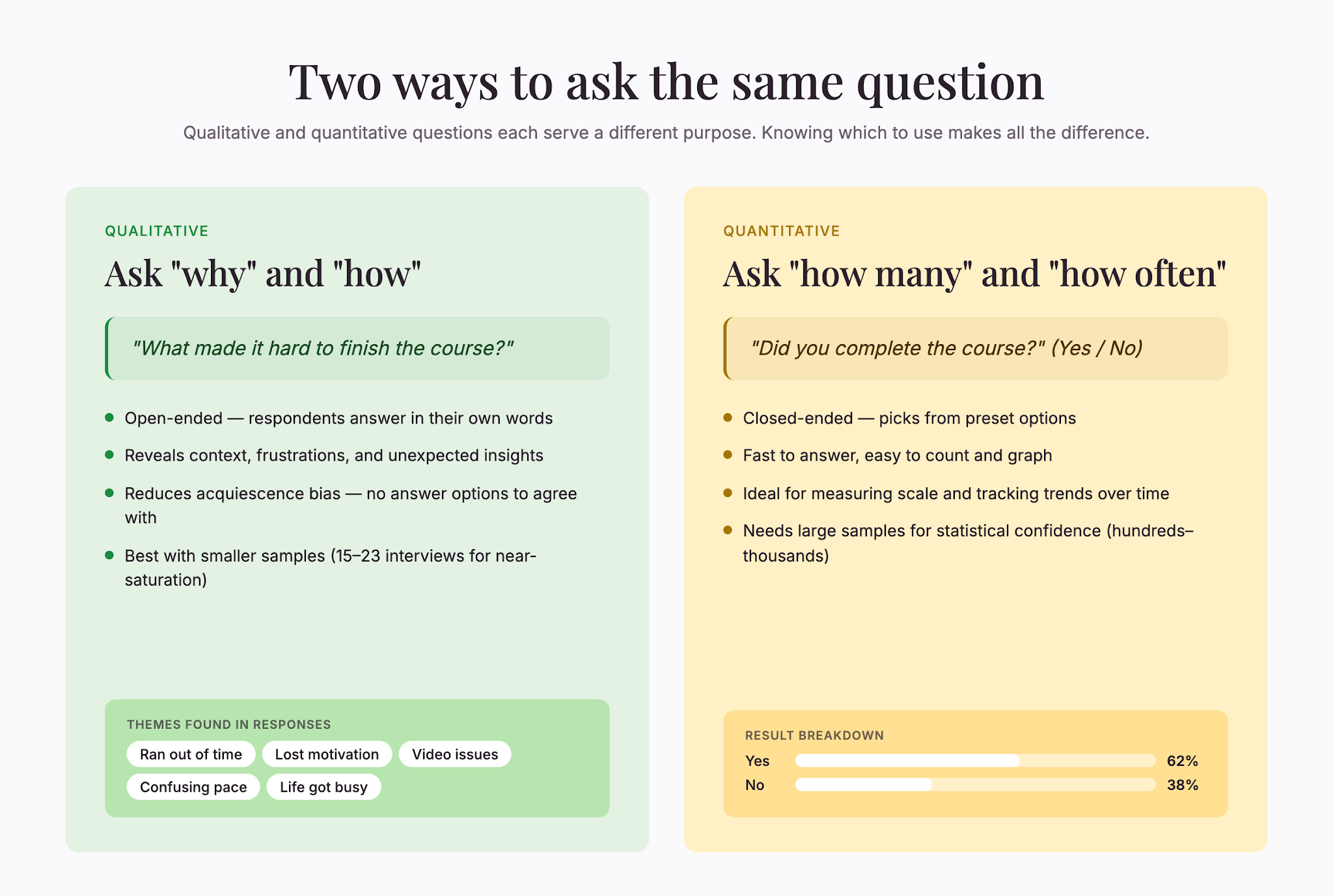
Quantitative data tells you how many people did something. Qualitative data tells you why they did it.
Say you run an e-learning platform. A quantitative question might ask: “Did you complete the course?” You get yes or no, and you can count the completions. But a qualitative follow-up—“What made it hard to finish?”—gives you actionable feedback. Maybe students ran out of time, lost interest after week two, or struggled with the video player. Each reason calls for a different fix.
Qualitative questions also reduce bias. When you let people answer in their own words, they’re less likely to be swayed by the answer options you’ve provided. They can’t accidentally agree with something just because you phrased it a certain way. This matters, because research shows that acquiescence bias—the tendency to agree with statements regardless of content—is common in surveys (Qualtrics, 2025).
The downside is volume. Open-ended answers take longer to read and analyze. You can’t instantly plug them into a spreadsheet and make a graph. But if you’re looking for depth over scale, qualitative questions are the way to go. Unlike multiple-choice surveys that prioritize efficiency, qualitative questions prioritize understanding the full context of a respondent’s perspective. This context-rich approach often reveals unexpected insights that quantitative data alone would never surface.
When to use qualitative questions
Qualitative questions work best when you’re trying to understand the “why” behind behavior, not just the “what.”
Use them when:
- You’re exploring a new topic and don’t yet know what answer options to offer
- You’re validating an idea or hypothesis and need people to explain their reasoning
- You want to uncover problems or frustrations that might not fit neatly into categories
- You’re following up on a quantitative result and need context
- You’re designing a product or service and need feedback on specific features or experiences
Avoid them when:
- You need to survey a large population quickly and analyze results in minutes
- Your respondents are fatigued or time-pressed
- You’re measuring simple yes/no preferences across teams
An intelligent approach: combine both. Pair a quick yes/no question with an open-ended follow-up. This gives you both speed and depth. Researchers commonly pair dichotomous questions—close-ended questions with exactly two answer options—with open-ended or Likert-scale questions to capture richer detail alongside fast quantitative data (Zonka Feedback, 2024).
This hybrid approach maximizes the strengths of each method: the speed and simplicity of closed questions paired with the depth and nuance of open-ended responses.
How many qualitative responses do you need?
This is a common question, and the answer depends on your research goal.
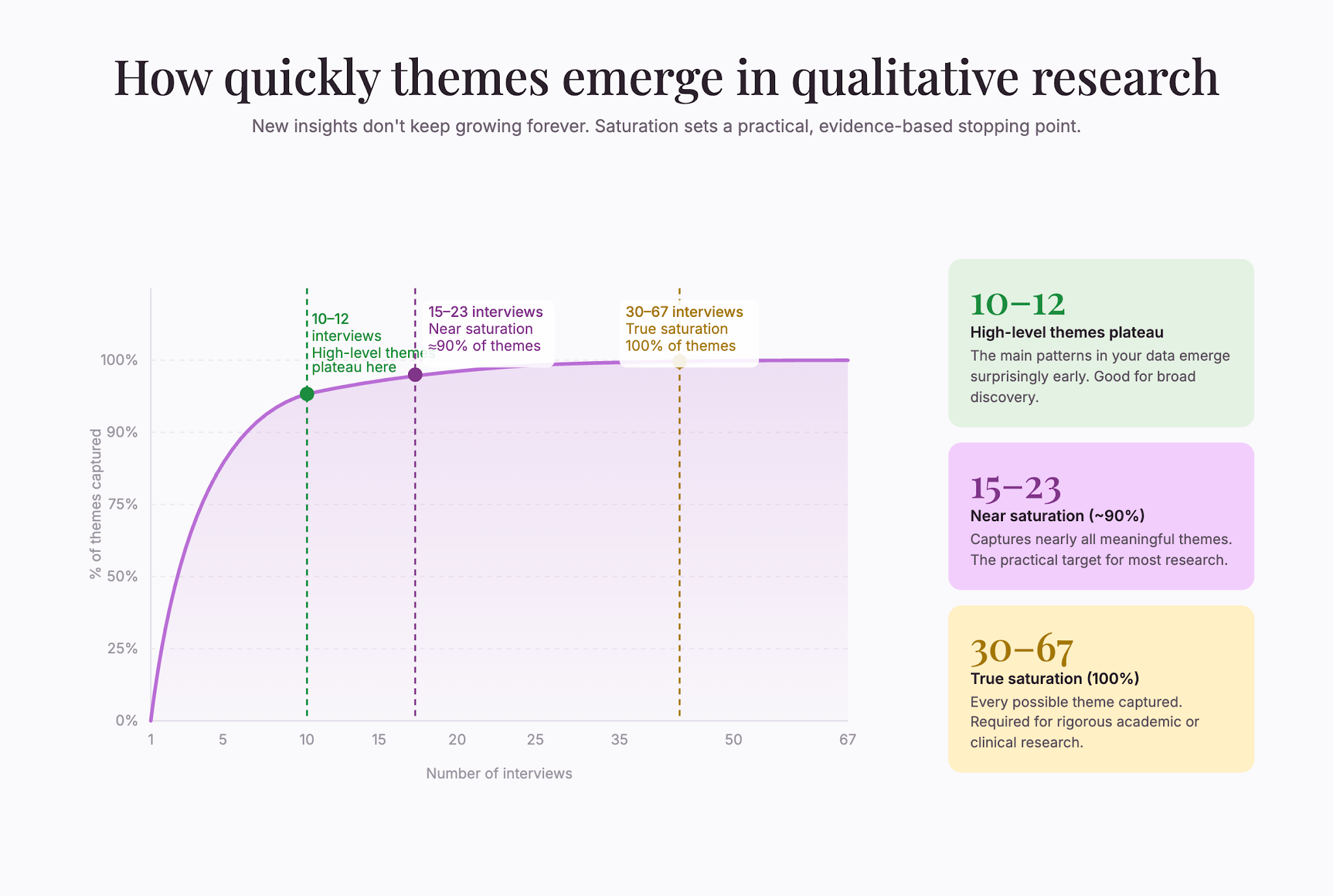
If you’re looking for broad themes and patterns, you don’t need hundreds of responses. Research shows that near saturation (capturing about 90% of meaningful themes) in qualitative research is reached at 15 to 23 interviews, while true saturation (capturing every possible theme) requires 30 to 67 interviews (Journal of Medical Internet Research, 2024). Interestingly, earlier research found that high-level themes actually plateau at just 10 to 12 interviews (Journal of Medical Internet Research, 2024).
The catch: sample size depends on study characteristics, population homogeneity, and your research objectives. If your population is very diverse, you may need more responses. If you’re studying a tight-knit group with similar backgrounds and experiences, you can stop sooner (Journal of Teaching in International Business, 2025). For instance, surveying a niche professional community may reach saturation faster than surveying the general public, where perspectives vary widely based on demographics, geography, and personal experience.
This is very different from quantitative research, where you’d need hundreds or thousands of responses to reach statistical significance. With qualitative data, a smaller, thoughtful sample often tells you everything you need to know. The quality and depth of responses matter far more than raw numbers.
25 qualitative survey questions across common scenarios
Product feedback
- What’s the biggest pain point you’ve experienced with this product?
- How would you improve this feature if you could change anything?
- What would make you recommend this product to a colleague or friend?
- What’s stopping you from using this product more often?
- Describe a moment when this product made your job easier. What happened?
Customer experience
- Walk us through your experience purchasing from us. What went smoothly, and what was frustrating?
- Why did you choose us over a competitor?
- What would make it easier to do business with us?
- Tell us about a time you felt heard by our customer support team.
- What’s one thing we could do differently that would have the biggest impact on your experience?
Employee and team feedback
- What do you enjoy most about working here?
- What skills or resources would help you perform better in your role?
- Describe a recent project where you felt motivated and engaged. What made it meaningful?
- What’s one thing management could change to improve the team’s morale?
- How do you prefer to receive feedback, and why?
Market research and ideas
- When you think about [product category], what’s the first thing that comes to mind?
- Describe your ideal solution to [problem]. What would it look like?
- What’s preventing you from [desired behavior]?
- How do you currently solve [problem] today?
- What’s a recent purchase you regretted? Why did you make that choice?
Event and experience feedback
- What was the most valuable part of this event for you?
- What topic or format would you like to see at future events?
- Who did you meet or what connection did you make that surprised or impressed you?
- What could we have done better?
- Would you attend another event like this? Why or why not?
How to write qualitative questions that get honest answers
Keep them simple and specific
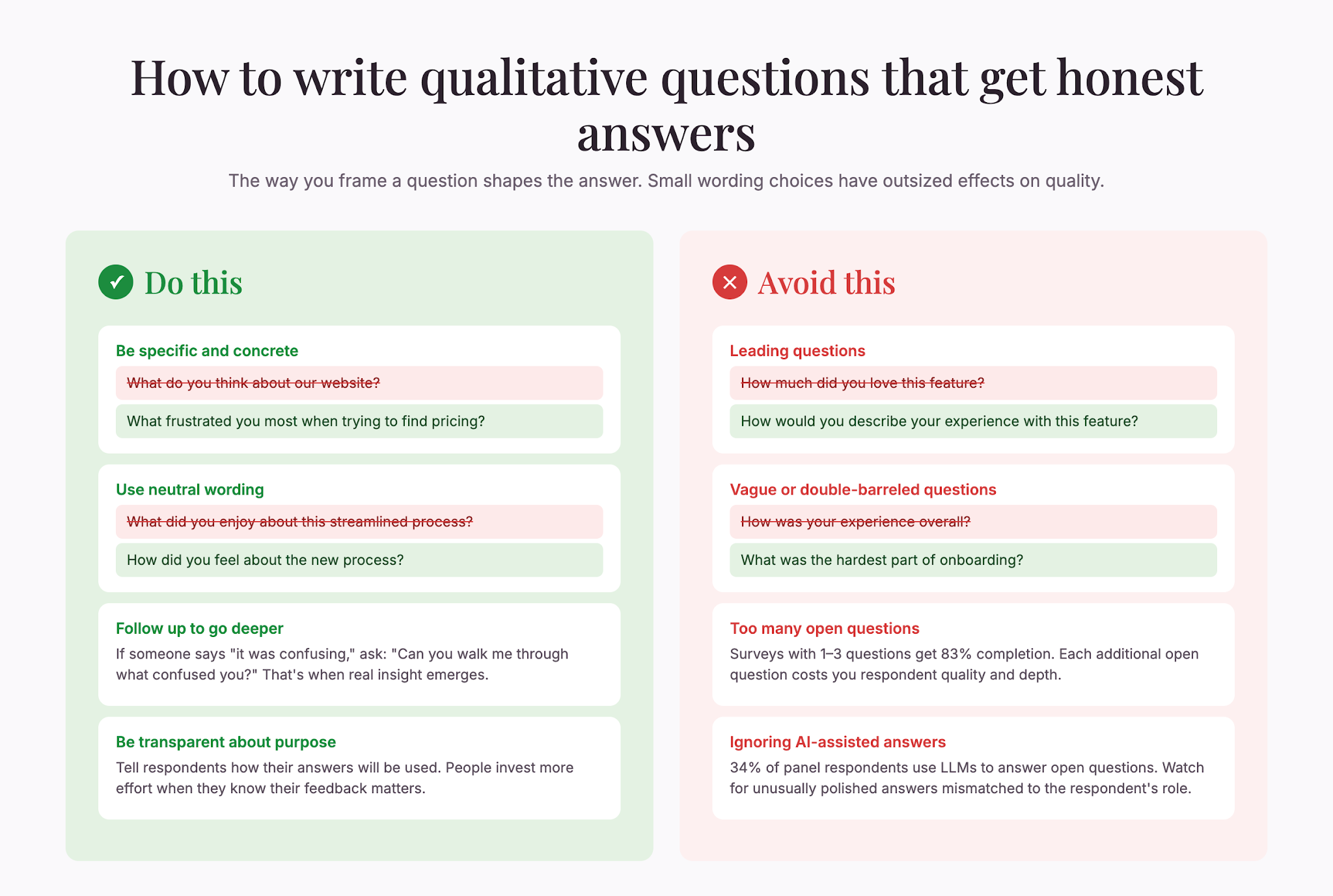
Vague questions get vague answers. Don’t ask, “How was your experience?” Ask, “What was the hardest part of onboarding?”
Bad: What do you think about our website?
Good: What frustrated you most when trying to find pricing information on our website?
Avoid leading language
Don’t telegraph the answer you want. If you ask, “How much did you love this feature?” you’re pushing people toward a positive response.
Bad: What did you enjoy about this streamlined process?
Good: How did you feel about the new process?
Use follow-up questions to dig deeper
If someone answers, “It was confusing,” ask them to say more. “Can you walk me through what confused you?” This is when the real insight emerges. Strategic follow-ups reshape surface-level answers into detailed narratives that reveal the motivations and challenges behind a respondent’s experience.
Give people space and time
Short surveys get higher completion rates. Research shows that surveys with just 1 to 3 questions are completed by 83.34% of respondents, and people give shorter, less reliable answers when fatigued (SurveySparrow, 2025). But if you do ask open-ended questions, don’t rush them. Let respondents know they can take their time and that there’s no character limit.
Be honest about how you’ll use the data
People answer more thoughtfully when they know their feedback matters. Tell them how their responses will shape your decisions. Transparency about data usage builds trust and encourages respondents to invest effort in providing detailed, authentic answers rather than generic ones.
Common pitfalls to watch for
Acquiescence bias creeps in even with open questions
Some respondents will agree with almost anything, even in an open-ended format, if they sense what you’re looking for. Watch for canned or generic responses, and follow up with specific prompts if needed.
Respondents may use AI to answer
A recent study found that 34% of online research panel respondents reported using large language models (LLMs) to help answer open-ended survey questions (Zhang, Xu, Alvero, 2025). This can homogenize responses and make feedback less authentic. If you suspect this, look for signs like unusually polished language or responses that don’t quite match the person’s role or experience.
Longer surveys breed shorter answers
When surveys run long, respondents fatigue. They stop thinking deeply and start rushing through. If you must ask multiple open-ended questions, keep the overall survey brief or break it into multiple touchpoints over time.
Analyzing qualitative responses
Once you’ve collected answers, you’ll need to make sense of them. The good news? You don’t need sophisticated statistical software. Here’s a simple approach:
- Read all responses once without judgment. Get a feel for the range of answers.
- Look for patterns. Are certain themes or complaints coming up repeatedly?
- Group responses by theme. Create categories like “onboarding confusion,” “pricing concerns,” or “feature requests.”
- Count how often each theme appears. This gives you a sense of priority.
- Pull out the most vivid quotes. These often tell the story better than summaries.
You’re done when you’ve captured the major themes. Remember: you don’t need to analyze every single word. Your goal is to understand the landscape of feedback, not to catalog every possible interpretation. This thematic analysis process, sometimes called “coding,” transforms individual responses into actionable insights organized by topic.
Make qualitative questions part of your research mix
The strongest insights come from using qualitative and quantitative questions together. Yes/no questions are fast to answer and reduce respondent fatigue and dropout, producing categorical data that is easy to quantify and graph without complex statistics software (piHappiness, 2024). They’re perfect for screening and quick assessments. But they’re one part of the picture.
Add qualitative questions to dig into the “why.” Let people explain themselves. Listen for what they care about, what frustrated them, and what would make them happier. That’s where real understanding lives.