Research operations (ResearchOps): the complete guide
Research operations helps teams recruit participants, store insights, and run user research at scale, from the core pillars to building the function.
%20The%20complete%20guide.png)
Key takeaways
- ResearchOps frees researchers from admin work to focus on insights: Recruitment, scheduling, and compliance take away hours that could go toward analysis and synthesis.
- Knowledge management helps teams reuse research: A searchable repository gives findings a home, along with the context people need to apply them.
- Governance protects both participants and the organization: Consent, data retention policies, and privacy compliance build the trust that makes people willing to share honest feedback.
- Scheduling and contact forms deserve a closer look: In our data, booking and scheduling forms had a 46.63% completion rate, while forms with a phone number question had 44.74%. Keep scheduling simple and ask only for the contact details you need.
- Start small with your biggest pain point, not everything at once: A shared research calendar or a single repository often delivers quick, visible wins that build the case for bigger investment.
Research operations, often called ResearchOps or ReOps, is the backbone that makes user research scalable, efficient, and impactful. It's the discipline that handles the systems, processes, and infrastructure researchers need to do their best work.
When research teams spend hours chasing participant recruitment, wrangling spreadsheets, or hunting down compliance documents, they can’t put that time toward uncovering insights. That's where research operations comes in.
You don’t need a dedicated research department to benefit. If you’re a marketer collecting customer feedback, a designer testing a signup flow, or a founder interviewing customers, a few repeatable processes can make your next study easier to run.
What is research operations?
Research operations refers to the people, mechanisms, and strategies that support the execution of user research across an organization. It covers everything from participant recruitment and data management to tools, governance, and knowledge sharing.
Think of ResearchOps as the scaffolding around research activities. It handles the operational side: scheduling sessions, managing incentives, maintaining repositories, ensuring ethics compliance. That way, researchers can focus on what they do best: understanding users.
For example, a customer onboarding study might need a recruitment form, a way to schedule interviews, a consent process, and somewhere to store findings. ResearchOps makes those pieces reusable, with clear ownership, so the next study doesn’t start from scratch.
Why research operations matters
As research teams grow and research becomes more democratized, meaning non-researchers start conducting studies, operational complexity increases. Without dedicated research operations, teams face bottlenecks, duplicated effort, inconsistent quality, and scattered insights.
Research operations addresses several critical pain points:
- Data silos: When findings are scattered across different platforms, shared drives, and individual notebooks, their collective value diminishes. A shared repository helps product, marketing, and customer support teams discover what others have learned.
- Manual inefficiency: Standardizing workflows and automating repetitive tasks reduce mistakes and free up capacity. Reusable screeners, scheduling messages, and report templates reduce the setup work for each study.
- Scaling barriers: Without coordination, each new initiative requires rebuilding participant lists, recreating templates, and reinventing processes. Clear processes help more people participate in research without leaving quality to chance.
The payoff: less time organizing research and more opportunity to use it. This can mean noticing an onboarding problem before launch or checking existing customer feedback before commissioning another survey.
Core pillars of research operations
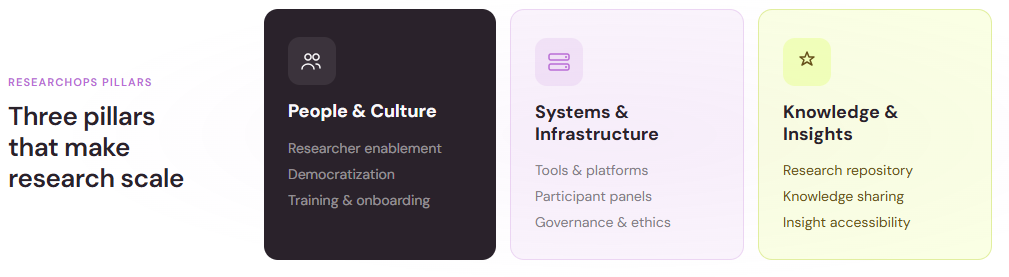
ResearchOps covers a broad range of work. These 5 areas are useful starting points for teams building a more consistent research practice. The ResearchOps Community offers a broader framework for understanding the work that supports research as it grows. That framework outlines 8 pillars: environment, scope, people, organizational context, recruitment and admin, data and knowledge management, governance, and tools and infrastructure.
Participant recruitment and management
Finding the right people to talk to is half the battle. Research operations builds and maintains participant panels, manages screeners, tracks incentives, and ensures diversity in recruitment. This is more than just administrative convenience: thoughtful participant management directly impacts research quality and speed.
Consider setting up:
- A customer research panel you can tap repeatedly, segmented by key characteristics and behaviors
- Reusable screeners and consent templates that you review and adapt for each study (start with our focus group survey template or interview consent form template)
- Payment tracking systems for incentives that streamline logistics and maintain participant satisfaction
- Participant databases segmented by demographics, behaviors, and prior research history, so you can avoid over-sampling the same individuals
Start recruitment with the behavior you need to understand. If you’re studying why new customers abandon onboarding, recruiting only long-term, active customers will leave an important gap. A screener might ask when someone signed up and which setup steps they completed. Collect demographic information only when it serves the study. Use our screener survey guide to learn how to write one.
Our branching logic lets you direct people to different questions or endings based on their answers. You can use it to ask relevant follow-up questions and give people who don’t qualify a short, clear ending. Test each path before sharing the form.
Put screening questions first, then ask qualified participants for the contact details you need. In our data, forms that included a phone number question had a 44.74% completion rate across 312 million form starts, while forms with an email question had a 50.49% completion rate. That doesn’t prove contact questions cause drop-off, but it’s worth reviewing what you’re asking for. If you’re recruiting from an existing panel, use URL parameters (formerly Hidden Fields) to pass in a participant ID so people don’t have to re-enter details you already have. Use an ID that doesn’t reveal personal information, and keep sensitive details out of the URL.
Keep the participant experience in mind, too. Explain the time commitment, activity, and incentive upfront. Track recent invitations, honor requests to stop receiving them, and look beyond your existing panel when you need perspectives it doesn’t include. A well-organized panel alone doesn’t guarantee a representative sample.
Make scheduling easy for participants. In our data, booking and scheduling forms had a 46.63% completion rate, compared with 74.83% for event feedback surveys. The forms serve different purposes, but the gap makes scheduling worth a closer look. Offer several time slots, confirm bookings right away, and send a reminder before each session.
Knowledge management
Insights are only valuable if people can find and use them. Knowledge management ensures research findings don't vanish into someone's hard drive or get buried in a shared folder where no one thinks to look.
Many organizations discover they've already conducted research on a problem they're about to study again, but only after they've invested time and money in duplication. Effective knowledge management prevents this waste. It also enables researchers to build on prior work, connecting findings from multiple studies to form a more comprehensive understanding than any single project could provide.
Key activities include:
- Building a centralized research repository, whether that's a dedicated tool, a structured database, or a well-organized wiki
- Tagging studies by topic, method, date, team, and findings so they're discoverable when researchers search for answers
- Creating short summaries that link to supporting evidence, with access appropriate to the sensitivity of the material
- Maintaining a “research radar” so teams know what's been studied recently, what's in progress, and what's planned
Give every study a consistent summary: the question, who participated, when the research happened, the main findings, limitations, and the decision it informed. Include an owner people can contact with questions.
Here’s an example of a completed research summary:
- Research question: What prevents new customers from completing onboarding?
- Participants: 8 customers who signed up within the past 60 days but hadn’t finished setup
- Date and method: March 2026; 30-minute remote interviews
- Key findings: Most participants struggled to connect their first integration. Several weren’t sure where to find help.
- Limitations: Small sample; English-speaking participants only; no enterprise customers
- Decision informed: Prioritized an in-app setup checklist for the next quarter’s roadmap
- Study owner: [Name], Product team
- Supporting evidence: [Link to interview notes and recordings, with restricted access]
That context matters when you reuse research. Feedback from first-time buyers may not apply to repeat customers, and findings about an old checkout flow may need revisiting. Before reusing research, check whether the audience, product, and circumstances still match.
Tools and infrastructure
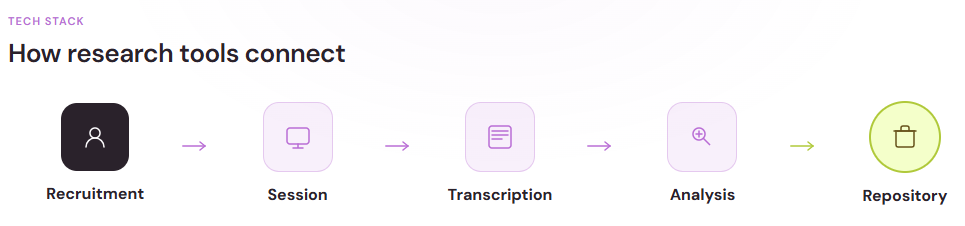
Research operations evaluates, procures, and maintains the software stack researchers rely on: everything from video conferencing platforms to survey tools, transcription services, and insight repositories.
A well-chosen tech stack should:
- Connect the steps in your workflow without unnecessary copying and pasting
- Support collaboration across time zones and teams through comment threads, shared access, and real-time visibility
- Offer security and compliance features so you can manage sensitive data confidently
- Scale as research volume grows without degrading performance or requiring constant workarounds
For a small team, the starting setup might be a survey tool, a scheduling tool, and a shared location for research summaries. Map the workflow before adding software: Where do responses go? Who reviews them? Who sends invitations? Where will findings live?
Automate predictable handoffs once those responsibilities are clear. Keep participant contact details in a restricted location, and share only the information each destination needs. Moving every response into every connected tool creates more data to manage.
Governance and ethics
Research operations ensures your team follows data protection regulations, obtains proper consent, anonymizes sensitive data, and adheres to ethical research practices.
Build these decisions into the study setup so participants understand what they’re agreeing to and your team knows how to handle their information. Work with your legal or privacy team to establish requirements appropriate to your research.
This includes:
- Clear participant information explaining what you’ll collect, how you’ll use it, and who will have access
- Consent processes that address recording, sharing quotes or clips, and future research contact where relevant
- Data retention and deletion policies that specify how long you keep research data and how to securely destroy it when its useful life ends
- Access controls for contact details, recordings, transcripts, and other sensitive material
- Ethics review processes for sensitive studies involving vulnerable populations, health information, or other protected data
Treat consent templates as a starting point: Check that they reflect the actual study and tools you’ll use. Removing a participant’s name also doesn’t necessarily make a quote anonymous. A job title, employer, or distinctive detail may still identify them. Review material before sharing it more widely.
Research democratization
Research democratization means enabling non-researchers (product managers, designers, marketers) to conduct lightweight research with proper guardrails. ResearchOps supports this by creating self-serve resources like templates, training modules, and quick-start guides.
Give people a clear route from question to study. A starter kit could include a research brief, neutral question examples, an approved recruitment process, and a report template. Add a review step so someone with research experience can check the plan before it goes live.
Scale-based questions can be useful additions to your kit. In our data, forms that included an NPS question had a 71.99% completion rate, compared with 66.49% for forms with an opinion scale and 64.48% for forms with a rating question. These figures describe whole forms, so they don’t show that question type alone drove completion. Choose a scale that fits what you want to learn, and keep the wording and answer options consistent when comparing results across studies.
Set expectations about what the findings can support. A handful of customer responses can surface questions worth exploring, but they can't establish how common a preference is across your whole audience. Studies involving sensitive topics, complex sampling, or major business decisions need experienced research support.
When democratization is done well, research scales beyond a small team of specialists. When done poorly, quality suffers, and risks pile up.
How to build a research operations function
Starting a ResearchOps practice doesn't require a big team. Many organizations start with a single ResearchOps specialist, or even a researcher wearing 2 hats. The key is starting somewhere and building momentum through early wins and visible impact.
Start with pain points
Audit your current research process. Where do things break down?
Common pain points include:
- Spending too much time on participant recruitment
- Losing track of past research findings
- Documenting studies inconsistently
- Compliance gaps or unclear data policies
- Tool sprawl: too many platforms that don't talk to each other
Prioritize the 1 or 2 areas causing the most friction and tackle those first.
Walk through a recent study with the people who ran it. Identify where work stalled, what had to be redone, and which tasks depended on one person’s knowledge. This gives you a specific problem to solve.
Build foundational systems
You don't have to solve everything all at once. Start with high-impact, low-complexity initiatives that provide immediate value and require manageable effort:
- Create a shared research calendar so teams know what's happening
- Set up a participant database or sign up for a recruitment platform
- Establish a single folder or wiki for research reports
- Draft templates for consent forms and screeners
Assign an owner to each process. A participant list needs updating, templates need reviewing, and a repository needs someone to keep its structure usable. Try the new process on a study, gather feedback, and adjust it before rolling it out more widely.
What it looks like in practice: one study, start to finish
Here’s how a small team can run the onboarding study from earlier using a process they can repeat:
- Start with a one-page brief. Define the research question, who you need to hear from, which decision the findings will inform, and who owns the study.
- Create a short screener. Ask qualifying questions first, like when someone signed up and how far they’ve progressed through setup. Use branching logic to thank people who don’t qualify and end the form.
- Collect contact details and book a time. Ask qualified participants for their email address, then use the Calendly integration to let them choose a session time within the form.
- Get consent before the session. Explain what participation involves, whether you plan to record, and how you’ll use any quotes. Give participants a chance to ask questions before they agree.
- Limit access to participant information. Send screener responses to a Google Sheet with access limited to the people managing the study. Share only the details other teammates need.
- Summarize and save the findings. Use the summary format above, add relevant tags in your research repository, and link the summary from your research calendar so it’s easy to find later.
After the study, save your brief, screener, consent form, and summary as templates. The next study will start at step 2, not step 1.
Secure buy-in
ResearchOps thrives when leadership understands its value. Frame the business case around efficiency, quality, and impact.
Quantify the impact wherever possible, using data from your own organization (time tracking studies, recruitment timelines, duplicate research incidents) to make the case concrete and compelling.
Choose a few measures that match the problem you’re solving:
- Recruitment time: How long does it take to fill a study with qualified participants?
- Completion rate: What percentage of people who start your screener or survey finish it? For context, our data showed completion rates of 66.81% for market research forms and 68.07% for customer feedback forms.
- Administrative effort: How much staff time goes into scheduling, reminders, and incentive handling?
- Research reuse: Which existing findings helped answer a new question or shape a study?
- Decision impact: What did a team change, prioritize, or decide after reviewing the research?
Compare results before and after your change. More completed studies can be useful, but tracking the decisions they inform gives you a stronger picture of their value.
Integrate with the broader organization
Research operations doesn’t exist in a vacuum. Connect with:
- Legal and compliance teams for data governance frameworks and regulatory guidance
- IT and security for tool procurement and data protection protocols
- Product and design leadership to align research roadmaps with product strategy
- Marketing and customer support to coordinate outreach and share relevant customer insights
Working across teams makes ResearchOps part of how the entire organization plans and runs research.
For smaller teams, this may be a short planning conversation with the people who own those responsibilities. Agree on who approves tools, handles participant questions, and reviews sensitive studies before an urgent request arrives.

The evolving role of research operations
AI gives teams more ways to speed up research tasks, like drafting questions, transcribing interviews, and suggesting initial themes. It also makes review processes more important. Nielsen Norman Group’s guidance on AI-assisted research highlights the need to check transcripts, summaries, and suggested themes for errors and omissions.
ResearchOps can make the review repeatable:
- Define which tools are approved and what participant data can be entered into them.
- Check generated questions for leading language before using them.
- Verify quotes and findings against the original responses or recordings.
- Look for contradictory evidence and perspectives an automated summary may have missed.
- Make a person responsible for the final interpretation.
Treat AI-generated summaries as a starting point for analysis. Keep the supporting evidence accessible so your team can understand how a conclusion was reached.
Getting started with research operations
Whether you're a researcher looking to add operational rigor to your practice or a leader building a ResearchOps function from scratch, the principles are the same: streamline the repetitive, systematize the essential, and scale what works.
Start small. Identify your biggest operational headache and build a solution. Document it. Share it. Iterate.
For your next study, choose one improvement: a reusable participant screener, a clearer consent process, or a research summary your teammates can easily find. Give it an owner and find a way to measure whether it helped. That’s a practical foundation for making research a repeatable part of how your team makes decisions.
Source: Typeform internal data from 882,461,930 form starts across approximately 2.4 million forms, September 2025 to August 2026. Completion rate is calculated by dividing submissions by form starts.