Student interest survey templates teachers actually use
Four student interest survey templates, from a 2-minute icebreaker to a 7-minute deep dive, with question examples and design tips for honest answers.

Getting to know your students takes time—time most teachers don’t have. A quick student interest survey cuts through the guesswork and tells you what your class actually cares about, what motivates them, and how they learn best. That insight helps you tailor lessons, pick better examples, and build stronger connections with every student in the room.
The best student interest surveys are short, focused, and designed so students actually want to fill them out. Here’s how to build one that works, plus templates you can start using today.
Why student interest surveys matter
You walk into class with lesson plans, curriculum standards, and maybe five minutes to understand 30 new people. A student interest survey makes that possible.
When you know your students’ interests, you can:
- Pick examples and case studies that resonate with your actual students
- Spot patterns in motivation and learning styles that inform how you explain concepts
- Identify students who might need extra support or stretch challenges
- Build trust early by showing you care about who they are
- Connect curriculum to real life in ways that make subjects feel relevant
Students benefit too. When they see that their interests shaped the class, they engage more deeply and participate more actively. Even small signals—using an example tied to a hobby a student mentioned, or framing a unit around a topic the class chose—show that their answers mattered.
The anatomy of a good student interest survey
Before you build, it’s important to understand what makes a survey land with students versus what makes them click away halfway through.
Keep it short. Short surveys with 1 to 3 questions are completed by 83.34% of respondents (SurveySparrow Survey Response Rate Benchmarks, 2025). Students have limited attention and time. A two to three-minute survey is ideal.
Use clear, conversational language. Avoid jargon and edu-speak. Ask “What do you like to read?” not “What are your preferred genres of literature?” Students answer honestly when they understand the question.
Mix question types. Yes/no questions are fast to answer and reduce respondent fatigue (piHappiness Dichotomous Questions Best Practices, 2024). Pair them with multiple-choice and open-ended questions so you get both quick data and rich detail.
Avoid leading or biased questions. Don’t nudge students toward answers you want. The framing effect causes people to avoid risk when options are positively framed but seek risk when negatively framed (Frontiers in Psychology, 2020). Neutral wording keeps responses honest.
Be aware of social desirability bias. When students sense a “right” answer, they’ll give it instead of a true one. If you ask, “Do you like reading?” many will say yes to please you. Ask “What kinds of books do you actually pick up?” and you get the truth.
Decide on anonymity up front. A name field encourages follow-up but can also chill honest answers about struggles. For surveys about obstacles or sensitive topics, let students skip the name. For interest surveys, names are usually fine. Just decide before you launch and tell students which it is.
Student interest survey template 1: Quick icebreaker (2 minutes)
Use this at the start of the school year or when you inherit a new class.
About you
- What’s one thing you’re good at? (Open-ended)
- What’s something you’d like to learn this year? (Open-ended)
That’s it. You’ll learn what students value about themselves and what they’re curious about. Just two sentences per student that give you a real window into their minds.
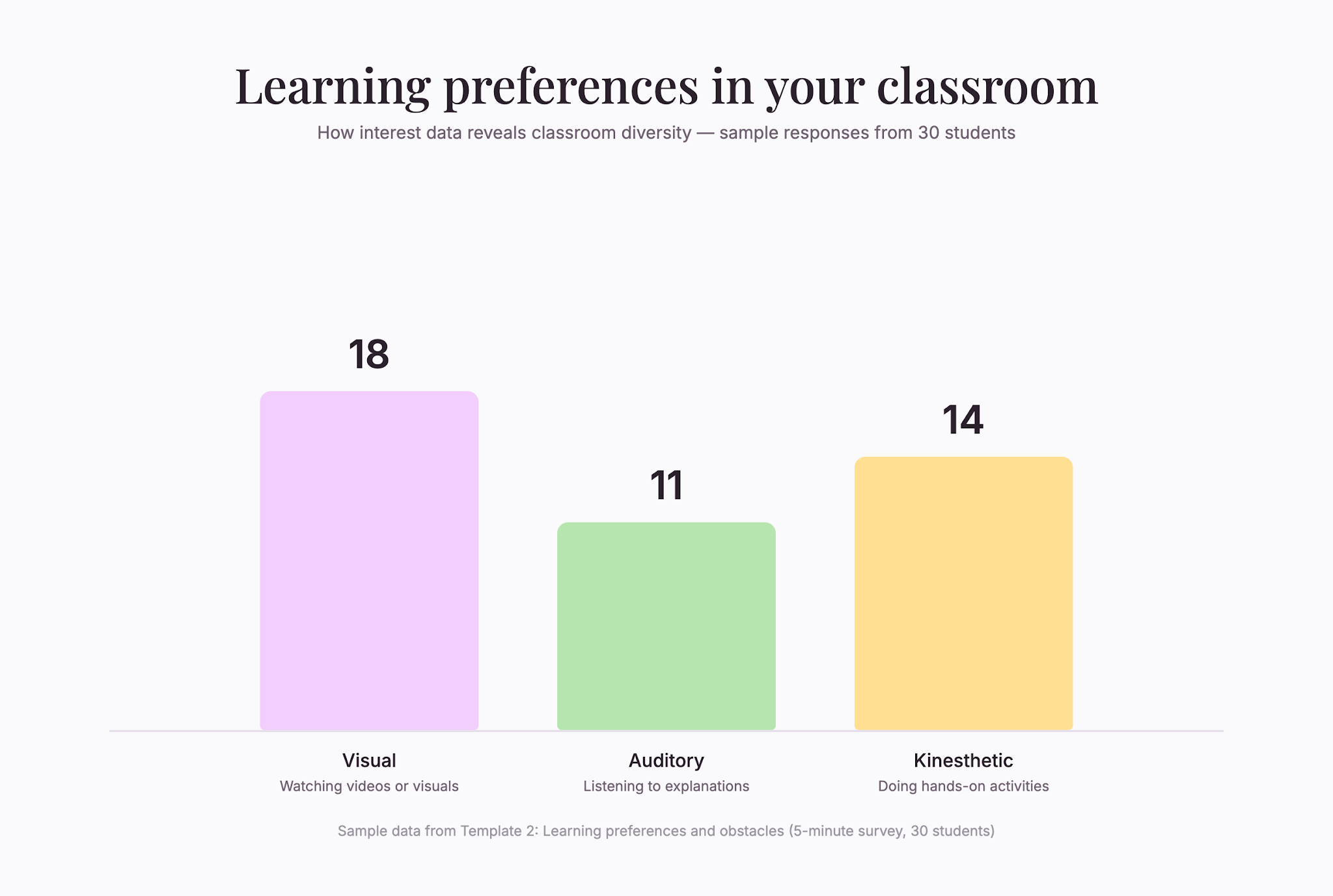
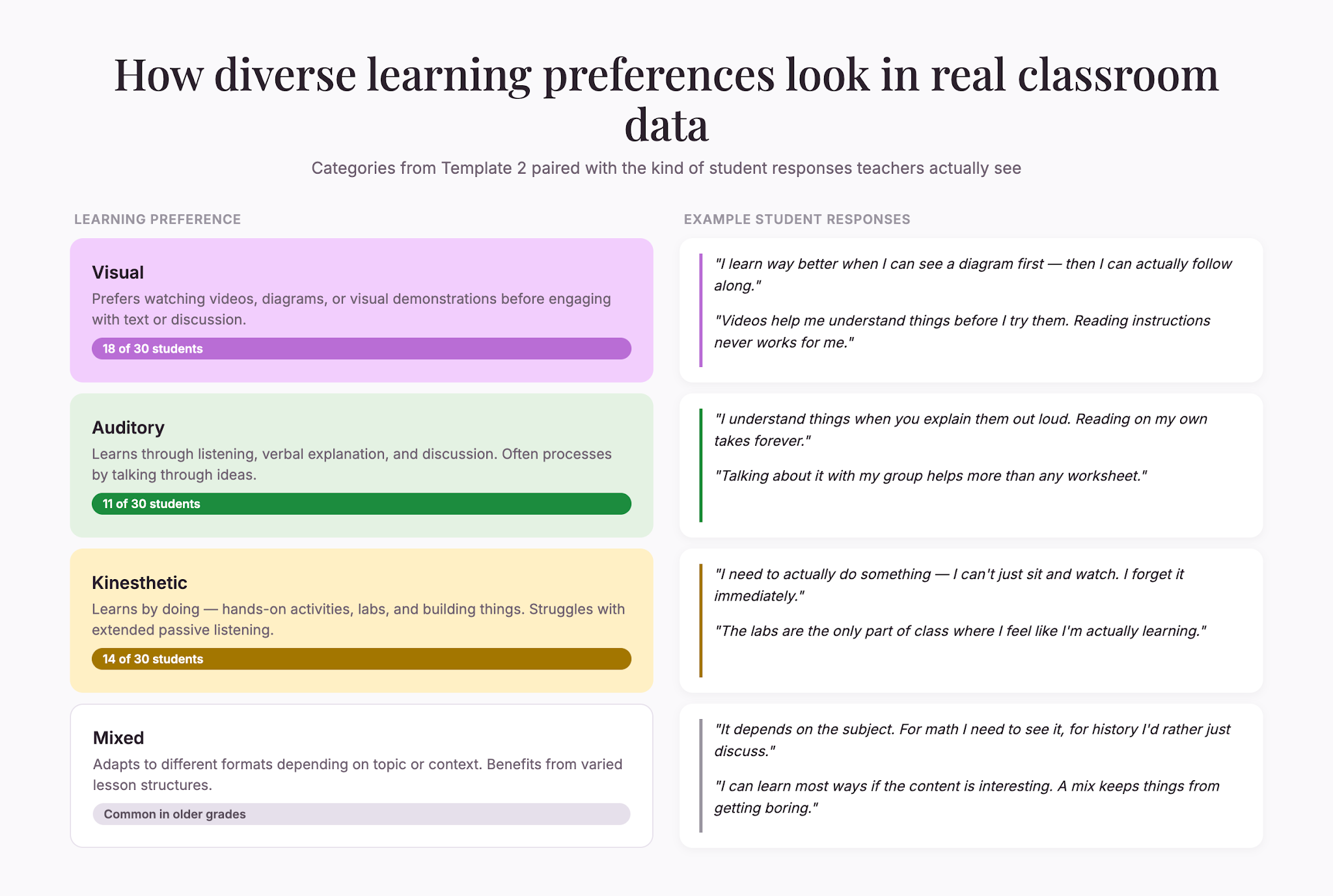
Student interest survey template 2: Learning preferences and obstacles (5 minutes)
Use this to tailor how you teach and spot where students might struggle.
How do you learn best?
- I prefer to learn by: (Select one)
- Listening to explanations
- Reading and taking notes
- Doing hands-on activities
- Watching videos or visuals
- A mix of all of these
- When you get stuck on something, what helps most? (Select all that apply)
- Asking the teacher for help
- Working with a classmate
- Looking it up myself
- A break and a fresh start
- Something else
About school and life
- What’s one subject or topic you’d actually choose to learn about? (Open-ended)
- What gets in the way of you doing your best work? (Open-ended)
Question 4 is gold. You’ll learn about sleep, stress, distractions, confusion, and family factors—the real obstacles. Once you know them, you can problem-solve together.
Student interest survey template 3: Deep dive on interests and values (7 minutes)
Use this mid-year or if you want richer data for project planning and differentiation.
Your interests
- I’m interested in: (Select all that apply)
- Sports and fitness
- Music and performing arts
- Gaming or digital media
- Nature and the outdoors
- Building or making things
- Social causes
- Business or entrepreneurship
- Science and technology
- Creative writing or storytelling
- Something else
- If you had to pick one from the list above as your top interest, what would it be? Why? (Open-ended)
- When you think about your future, what do you hope to be doing? (Open-ended)
How you work best
- Do you prefer working alone or with others? (Multiple choice: Alone / Small group / Whole class)
- What time of day do you do your best thinking? (Multiple choice: Morning / Afternoon / Evening)
What we should know
- Is there anything about how you learn or what you need that your teachers should know? (Open-ended)
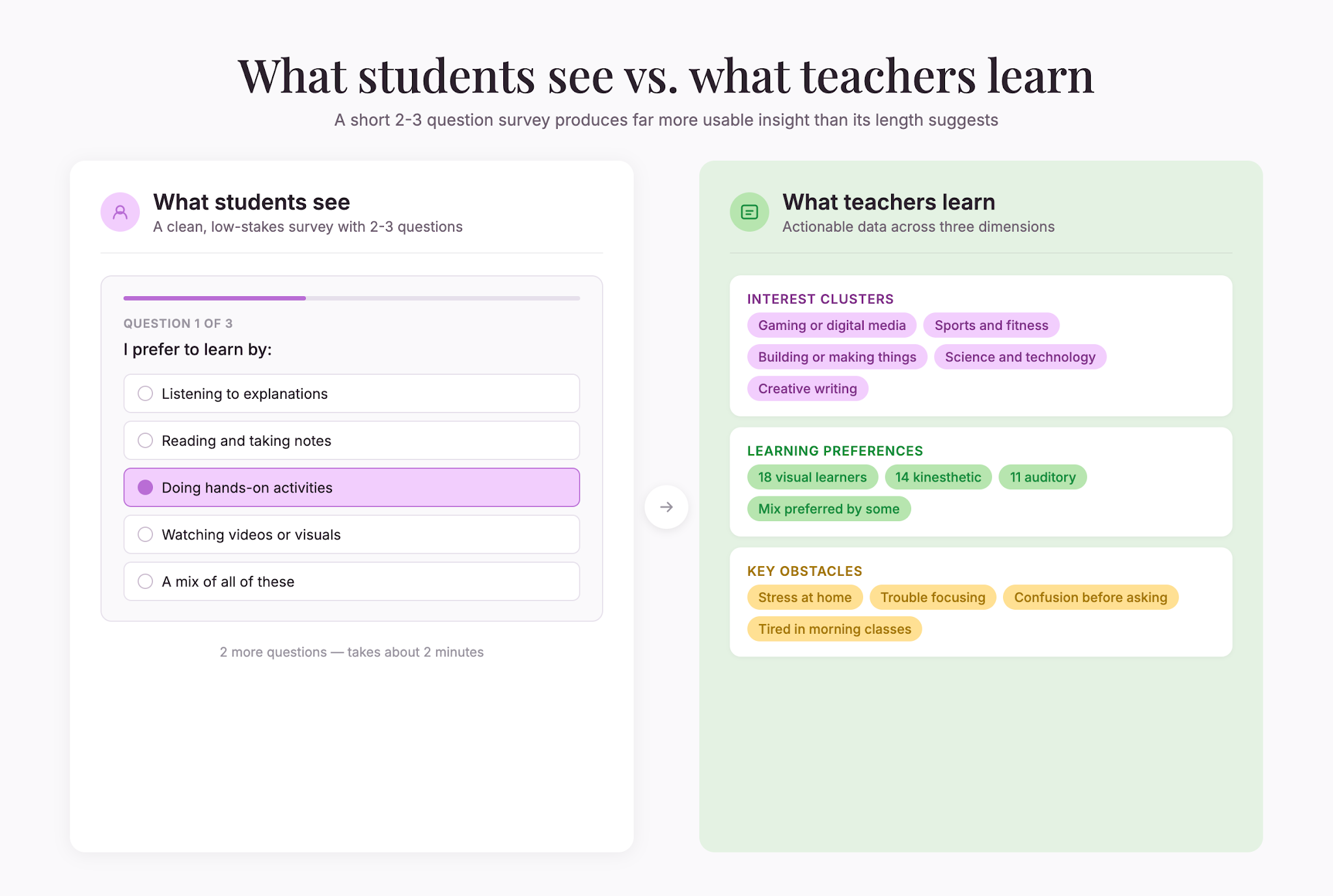
This template gives you actionable detail. You’ll see clusters of interests and preferred working styles, plus individual needs that might not show up any other way.
How to avoid common survey mistakes with students
Don’t stack open-ended questions on the same page. When you ask multiple open-ended questions on a single screen, students get fatigued. Open-ended probes on the same page as the source question raise survey break-off by 0.6 points and item nonresponse by more than 25 percentage points (Hadler, Sociological Methods & Research, 2025). Page them so each question feels fresh.
Don’t ask about sensitive topics without context. If you ask about family income, mental health, or trauma, frame it carefully and explain why. Students answer more honestly when they understand the purpose, and they have a right to know what you’ll do with the answers.
Don’t assume everyone has the same access. Some students may not have quiet space at home or reliable internet. Administer surveys in class when possible so access isn’t a barrier. If the survey is going home, give students a paper option.
Don’t forget to use the data. If you ask students about their interests and then never mention it again, they notice. Reference what you learned. That builds trust for next time.
Don’t survey on top of an existing survey. If your school just ran a climate survey or a counseling intake, students are saturated. Wait a couple of weeks—back-to-back surveys feel like surveillance, not care.
When to survey and how often
Survey students early, in the first week or two. You’re building a foundation and want time to act on what you learn.
You don’t need to repeat a full interest survey every month. Once a year or once per term is plenty. Mid-year, a quick pulse check tells you if your approach is landing.
If you teach multiple sections, use the same core survey so you can compare and adapt accordingly. Comparing data across sections often reveals which interventions are working and which aren’t—the same lesson can land differently in two periods, and the survey data will sometimes tell you why.
Making surveys engaging for students
Students know when they’re being surveyed and when it feels authentic. A survey that’s part of your real classroom culture gets better responses.
Try these approaches:
- Tie it to something real. “Help me plan our next unit. What topics from this theme interest you most?”
- Make it low-stakes. Emphasize that there are no wrong answers.
- Share results back. Show students a simple chart of what the class said. Interactive polls have high engagement: 82% of users engaged with quizzes shown via their newsfeed (BuzzSumo, 2024).
- Keep anonymity when it matters. If you ask about obstacles or sensitive topics, let students skip the name field.
- Vary the format. Alternate between written surveys, quick polls, one-on-one conversations, and observation.
- Model your own answer. A quick example—“If I were filling this out, I’d say I’m good at puzzles and want to learn to garden”—lowers the bar for honest replies.
Templates for specific subjects and grade levels
Elementary (K–5): Interest in learning
- What’s your favorite thing to do?
- What do you want to learn more about?
- Do you like working with friends on projects? (Yes/No)
Middle school (6–8): Interests, learning style, and future
- What’s something you’re really into right now?
- How do you like to learn best? (Listen / Read / Do / Watch)
- What do you think you might want to do when you’re grown up?
High school (9–12): Detailed interests, learning preferences, and real-world connections
Use Template 3 above, or adapt it. Add a question about career interests or ask how a subject connects to their goals.
Advanced or accelerated students
Add depth: “What would you change about how we study this subject?” These students often have opinions about the curriculum. Listening to them builds buy-in.
Subject-specific add-ons
For a humanities class, ask which authors, films, or current events students would want to study. For a STEM class, ask which problems they’d want to solve. The framing shifts the same interest data into something you can plan a unit around.
Turning survey data into action
You’ve collected the surveys. Now what?
Read for patterns, not perfection. You don’t need to use every single answer. Look for themes. If eight kids mention gaming, that’s a pattern worth noting.
Start with quick wins. If students say they learn best through video, add a video to your next lesson. Small changes signal that you listened.
Plan bigger shifts for the next unit. Interest data informs project choices, group composition, reading selections, and examples.
Follow up one-on-one when needed. If a student mentions an obstacle like difficulty focusing due to stress, talk privately. That’s where real support happens.
Revisit once a term. Short pulse surveys keep you connected to how students are experiencing your class.
The bottom line
A good student interest survey is simple, focused, and genuinely used. It doesn’t have to be long or fancy. Five questions, delivered at the right moment, can shift your entire approach to a class and build the kind of connection that makes students feel seen.
Start with Template 1 if you’re new to surveys or short on time. Move to Template 2 or 3 as you get comfortable. The goal isn’t perfect data. It’s real understanding that shapes how you teach.