Leading and biased survey questions: examples and fixes
Learn how you can spot biased survey questions, see real examples, and rewrite them to get more honest, useful responses.
You know that feeling when you’re asked a question but you can tell that they have already decided what they want you to say?
Key takeaways
- Biased survey questions can influence people before they even choose an answer. Leading language, assumptions, and loaded words can quietly push respondents in one direction.
- Neutral wording gives people room to answer honestly. Instead of hinting at the answer that you want, ask what people actually think.
- Watch more than just the question itself. Answer choices, question order, framing, and even the survey introduction can introduce bias.
- A little testing can go a long way. Read your questions aloud, have someone else review them, and look for assumptions before sending out your survey.
“Don’t you think this is the best restaurant in town?”
This is technically a question. However, it doesn’t really leave you feeling free to say, “Actually, no.” Surveys can do the same thing.
A few carefully chosen words can nudge respondents toward a particular answer without you even realizing it. This is where biased survey questions can ultimately become a problem. You may collect hundreds or even thousands of responses, only to learn that your data reflects the way you asked the question, and not what people actually think.
We have great news. You don’t need to be a survey methodology expert to avoid it.
Let’s take a look at what makes a survey question biased, some common examples, and simple ways to fix them.
What are biased survey questions?
These are questions that influence respondents to answer in a particular way. The bias might come from the wording, assumptions built into the question, the available answer choices, or even the order in which questions appear.
The tricky part is that biased questions will not always look so obviously biased.
Take this question: “How satisfied were you with our excellent customer service?”
A neutral version would let respondents say it was excellent, average, poor, or somewhere in between. That distinction is important because the goal of a survey isn’t to confirm what you hope is true, but to find out what’s actually true.
Strong survey questions should avoid leading language and give respondents room to answer honestly.
Leading vs. biased survey questions: is there a difference?
You will often see “leading questions” and “biased questions” used interchangeably, but there is a small distinction between the two.
A leading question is a type of biased question that encourages a particular response.
For example: “How much did you enjoy our new product?”
The wording assumes the respondent enjoyed it. A neutral alternative would be: “How would you rate your experience with our new product?”
A biased survey question is the broader category. It can include leading questions, but it can also involve loaded wording, unfair answer choices, assumptions, or framing that influences responses.
Think of it like this: leading questions are one way to create bias, but they’re not the only way.
7 biased survey question examples and how to fix them
Ready to learn how to spot the problems? Below are some of the more common examples that you may face.
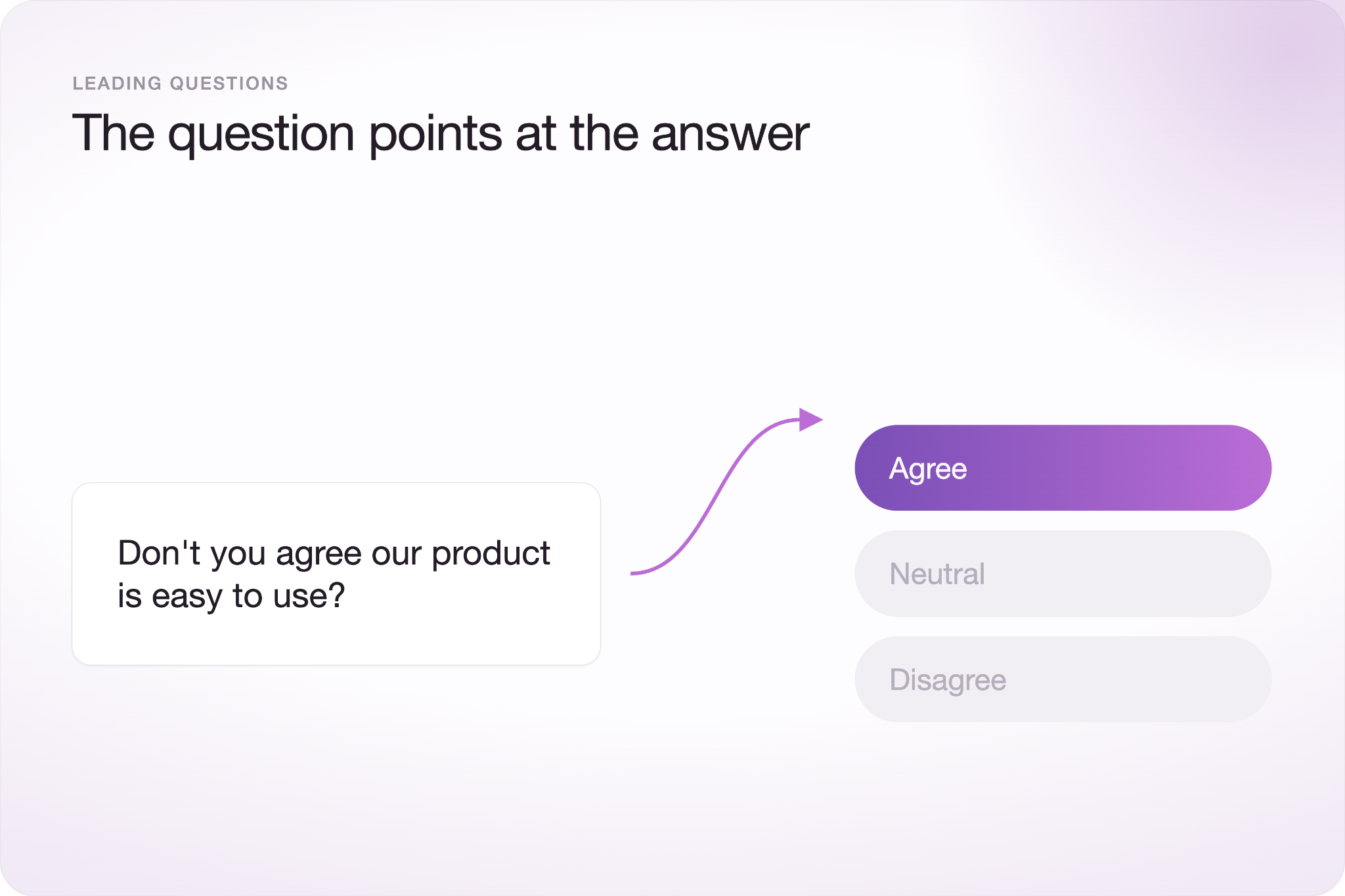
1. “Don’t you agree our product is easy to use?”
This one practically hands respondents the answer. “Don’t you agree” creates pressure to agree, while “easy to use” assumes the product is just that, easy to use.
Try this instead: “How easy or difficult is our product to use?”
This version gives respondents a balanced range of answers, including the possibility that they found it difficult.
2. “How satisfied are you with our amazing customer support?”
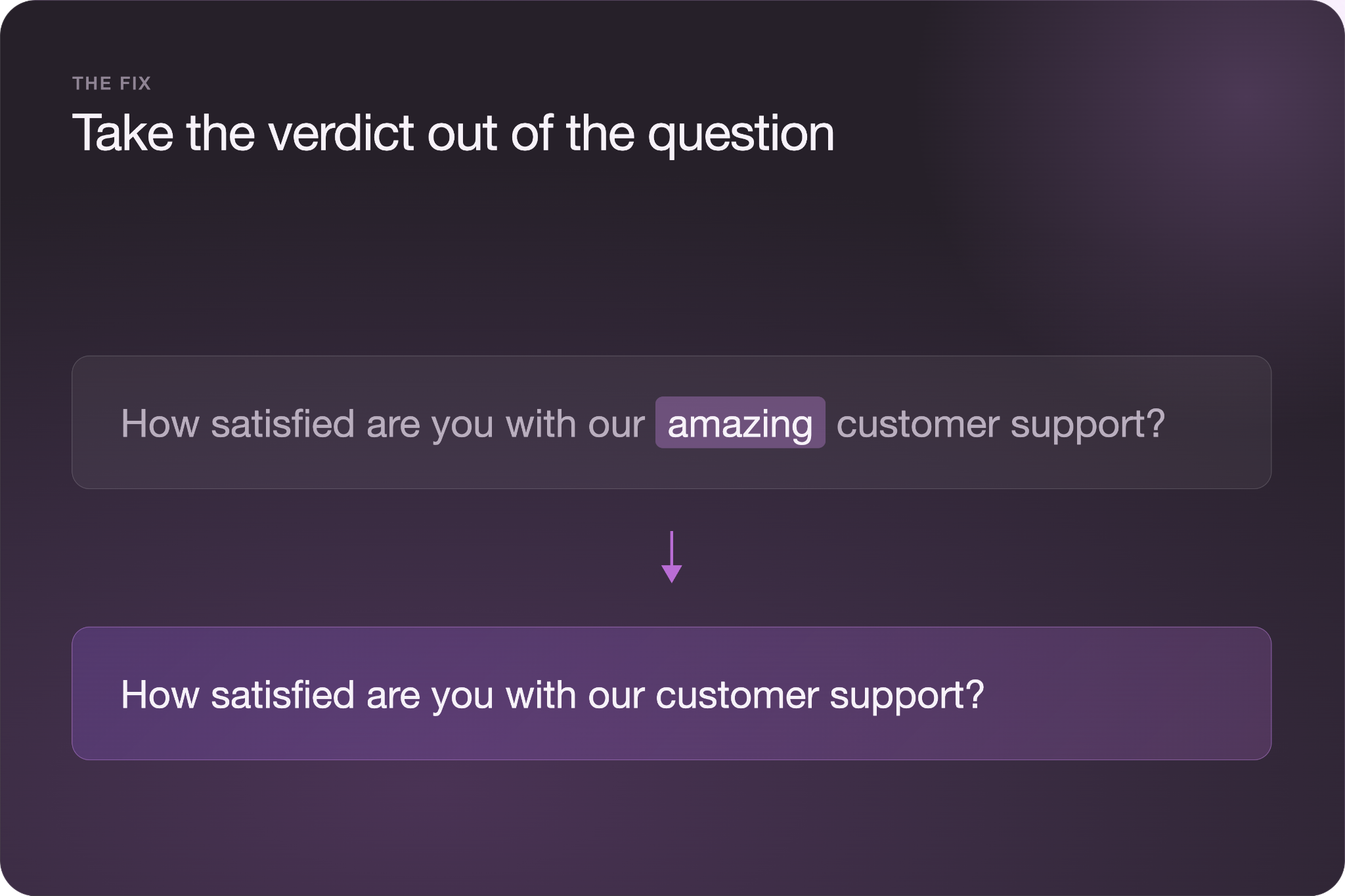
“Amazing” is doing a lot of work here.
The question is already telling respondents how they should think about the service. Even if you genuinely believe your support team is amazing, your survey shouldn’t make the judgment for them.
Try this instead: “How satisfied are you with our customer support?”
Simple? Yes. And that’s the point. We recommend avoiding superlatives and letting respondents tell you what they think rather than embedding your opinion in the question.
3. “How much did you enjoy our event?”
Maybe they enjoyed it. Maybe they hated it. Or maybe they thought it was fine but left early because the parking was horrible.
The question assumes enjoyment before giving them a chance to answer.
Try this instead: “How would you rate your overall experience at the event?” You can then offer a balanced scale from positive to negative.
4. “How helpful was our new feature?”
Again, you are assuming the feature was helpful. What if respondents never used it? What if they used it but didn’t find it useful? What if they weren’t even aware it existed?
Try this instead: “How would you rate the usefulness of our new feature?”
Even better, if usage matters: “Have you used our new feature?” If they answer yes, you can follow up with: “How useful did you find it?”
That keeps the question relevant and avoids forcing people to answer something they don’t have enough information about. Using logic to ask only relevant questions is one of our recommended ways to reduce confusion and improve survey experiences.
5. “Would you choose our affordable plan over an expensive competitor?”
There are two loaded words here: “affordable” and “expensive.” You’re essentially telling respondents which option is a good deal and which one isn’t.
Try this instead: “Which pricing option would you be most likely to choose?” Then list the options without adding judgment.
If you want to understand why, follow up with an open-ended question: “What’s the main reason you chose this option?” Now you are learning something instead of steering the respondent toward your preferred answer.
6. “How much do you agree that employees are happier since the new policy?”
This one contains an assumption: employees are happier.
But maybe they are not. Maybe the policy made no difference. Or maybe employees are actually less happy.
Try this instead: “How has the new policy affected your overall experience at work?”
You can offer options like:
- Much more positive
- Somewhat more positive
- No change
- Somewhat more negative
- Much more negative
- Not sure
Now respondents have room to tell you what actually happened.
7. “What did you like most about our new website?”
This is another sneaky one because it assumes respondents liked something.
What if they didn’t?
Try this instead: “What are your thoughts on our website?”
You can also use a rating question first: “How would you rate your experience with our new website?” Then give respondents a chance to explain their answer.
Biased questions aren’t the only thing to watch
Here’s where survey design gets interesting. Sometimes the question itself is perfectly neutral, but something around it does introduce bias.
For example, imagine you ask: “How satisfied are you with our service?”
This is pretty neutral, right?
Now imagine the previous question was: “How impressed were you by our award-winning service?” Suddenly, the second question doesn’t feel quite so neutral.
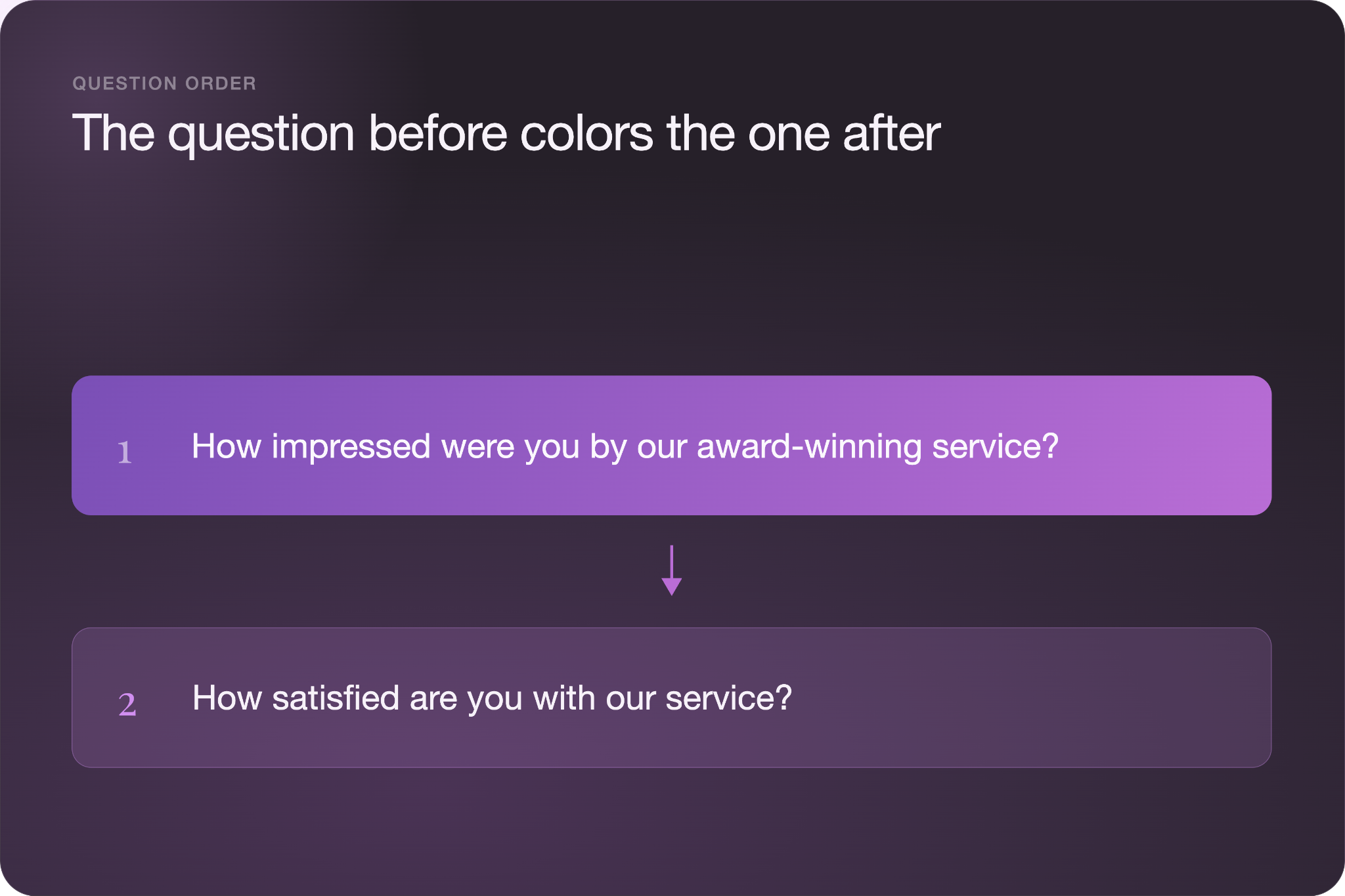
Question order can influence how people interpret what comes next. We recommend thinking about the full survey experience. This includes wording, order, answer choices, and framing, not just the individual questions.
Watch your answer choices
Bias can sneak into your response options, too.
Suppose you ask: “How would you rate our product?” And the choices are:
- Excellent
- Very good
- Good
- Okay
Why isn’t “poor” listed? If someone had a negative experience, they have nowhere to put it. A better scale could be:
- Excellent
- Good
- Fair
- Poor
- Very poor
You might also include options like “Not sure” or “Not applicable” when they make sense. Otherwise, respondents may choose an answer because it’s the closest option available.
Be careful with double-barreled questions
Not all bad survey questions are biased in the traditional sense. Some are only trying to do too much.
For example: “How satisfied are you with the quality and price of our product?”
Someone can love the quality but find that the product is overpriced. There are two opinions but only one answer. The fix is splitting it into two questions: “How satisfied are you with the quality of our product?” and “How satisfied are you with the price of our product?”
This gives you cleaner data because each question measures one thing.
How to write less biased survey questions
You don’t need to second-guess every word that you write. A few simple habits can make a big difference.
Start with your research goal. Before writing any survey questions, decide what you actually need to learn. If you know the goal, you’re less likely to write questions designed to prove a point.
Remove the judgmental language. Words like “amazing,” “terrible,” “successful,” and “easy” can influence how respondents interpret a question.
Don’t make assumptions. Give people an “I don’t know,” “Not applicable,” or similar option when appropriate.
Keep questions focused. Ask one thing at a time instead of combining numerous ideas into a single question.
Offer balanced answer choices. If you’re measuring an opinion, make sure respondents have a reasonable way to express positive, neutral, and negative views.
Test your survey before sending it. Ask a colleague or someone unfamiliar with the project to read through it. If they interpret a question differently from how you intended, your respondents probably will also.
Don’t forget the survey introduction. Even your opening message can create bias if it emphasizes how great your product, company, or idea is. Keep introductions transparent and focused on explaining the purpose of the survey rather than selling respondents on the thing that you’re asking about.
What to do if you can’t eliminate all bias
Here is the truth: you probably can’t eliminate every bit of bias from a survey. People will bring their own experiences, expectations, memories, and opinions with them. That’s normal.
Your job isn’t to create a magically perfect survey. It’s to minimize the influence you have over the answers.
So before you launch, read through every question and ask yourself: “Am I giving people space to disagree with me?”
If the answer is no, then rewrite it. Then ask: “Could someone answer this without knowing what I want them to say?”
If the answer is still no, rewrite it again. It could take a few extra minutes. But those minutes will save you from collecting a lot of data that tells you just what you wanted to hear, and little about what your audience actually thinks.
Ask questions. Don’t lead the answers.
Good surveys are not about getting the answers that you want. They are about creating enough space for people to give you the answers that you need.
That means ditching the “don’t you agree?” questions, removing loaded language, checking your answer choices, and making sure that every question gives respondents a fair chance to say what they truly think.
The result is not just a more neutral survey. It’s better data. And better data gives you something much more useful than validation. You get a clearer idea of what to do next.